Epidemiologist Donna Spiegelman sez: SUTVA is “mostly not necessary for valid causal estimation and inference most of the time”

Donna Spiegelman shares this presentation she gave at the recent American Causal Inference Conference. I like what she has to say.

Here are the two parts of the stable treatment value assumption:

1. No interference between units. As Spiegelman says, nowadays it’s not hard to model spillovers. As I say, untangling spillovers is an ill-posed inverse problem that can be solved using Bayesian inference with reasonable priors. Serious practical work has moved past the demonstrate-that-spillover-doesn’t-matter stage to the just-model-the-spillover-directly stage.

2. Deterministic potential outcomes. As Spiegelman says, in the real world, outcomes are stochastic. Jonas and I talk about this in our Russian roulette paper.

The part that I’m less sure about is Spiegelman’s claim that adjustments for pre-treatment variables usually don’t matter. I’m persuaded that they usually don’t matter in the epidemiology and biostatistics applications she’s worked on, but I think that in social science, such adjustments can be important. Especially if there are big treatment interactions and your population is a lot different from your sample.

In any case, I recommend you look through Spiegelman’s slides, as she offers a refreshing perspective compared to our usual obsessive focus on the details of causal identification:

I’m on the EPA science advisory board.

I just joined, and I’m one of 37 people on the board, a mix of people from academia, industry, and government.

If you google *EPA science advisory board*, you get sent to this page, which at first seems reasonable:

Look carefully, though, and you’ll see that the most recent meeting was in 2024!

Here’s the official description:

The SAB is a Federal Advisory Committee established by Congress to provide advice to the agency on scientific and technical matters. It is administered by the EPA Science Advisory Board Staff Office through a Designated Federal Officer. All meetings are open to the public. . . . SAB panel members serve until the work of the panel is complete. Some meetings are held virtually. Panels usually conduct 2-3 video teleconferences and one in-person meeting to discuss reports and work products before providing advice to the Administrator through the Chartered SAB.

My dad worked for the Environmental Protection Agency a long time ago–he was in Mobile Source Enforcement, which pretty much involved stopping people from manufacturing or selling leaded gasoline–and I’m inclined to serve my country when asked.

Then again, I just read this news article about Lee Zeldin, the current director of the EPA, and it’s pretty scary. The official documentation says that our role is to provide advice to the administrator. I guess then it’s up to him to decide what to do about it.

John Carlin says, “‘Identifying variables that independently predict…’ is not a well-defined research task”

John “Bayesian Data Analysis” Carlin writes:

Recent developments in the methodology of epidemiological research have emphasized the importance of achieving clarity of purpose by classifying research questions into one of three types: descriptive, predictive, and causal. . . .

I [Carlin] do not believe that studies aiming to “identify” independent predictors or “prognostic factors” are addressing well-defined research questions. Indeed, beyond the issues already raised, there is a broader question of the extent to which it is ever sensible to frame a research question as if it could be answered dichotomously, as in “is this an (independent) prognostic factor?” Prediction questions, which include prognosis, are those that involve the development of a model or algorithm to provide predictions of outcomes using available variables that are potential predictors.

This all makes sense. I kinda think that descriptive, predictive, and causal are all the same thing–or, more precisely, that “descriptive” and “causal” are special cases of “predictive,” under different conditions. But if you want to divide them into three tasks, sure, go for it. Personally, I’d rather divide statistics into the goals of exploration, estimation, and discrimination, but I think that’s because I’m thinking in a more general “data science” perspective, whereas John is focusing more on the more traditional problem of inference.

But, yes, I agree with him 100% on avoiding dichotomization, a topic that Sander Greenland, I, and others have been screaming about for a long time–indeed, John and I contributed to the anti-dichotomization theme in our book Bayesian Data Analysis, in that we focused on model building and inference within a model, rather than on the then-fashionable problem of choosing among or comparing models using Bayes factors. So, yes on that.

John continues:

Some variables may have greater predictive value than others, but this should be assessed by comparing the predictive value of the model or algorithm with and without the use of that variable, not by examining its “independent effect” in a multivariable regression model.

I’m confused on this point. I mean, sure, I agree that you shouldn’t label a regression coefficient as an “independent effect”; indeed, I always use the terms “predictors” and “outcome” rather than “independent and dependent variables.” Beyond this, I’m not quite sure what John is suggesting. Suppose you have a predictor of interest, x3, and you’ve fit the model y ~ x1 + x2 + x3 (for convenience using standard R notation). I guess John is saying, don’t just look at the coefficient for x3 in that model; also compare it to the model y ~ x1 + x2. Maybe this is a good idea–it’s not something I’ve thought about for a while. Is this the same as what used to be called “partial regression coefficients”? I remember from the statistical literature in the 1960s and 1970s that there was a lot of work on methods for understanding what happens in linear regression when you add one variable at a time. Perhaps it would be good to revisit some of those ideas, and maybe it’s a mistake that we don’t cover them in Regression and Other Stories.

I also want to plug my paper with Guido Imbens (also included as Section 21.5 in Regression and Other Stories), Why ask why? Forward causal inference and reverse causal questions. Our point there is that it can be a good idea to search for prognostic factors in observational data, not with the idea this will identify causal effects but rather as a way of understanding what’s missing from our existing models.

Finally, John writes:

More broadly, debates on whether to “adjust” or not for certain variables in a regression model can only be answered by situating the analysis within a sharply defined research question and a sharply defined rationale for specifying a regression model in the first place.

I don’t get this at all. First I don’t get why “adjust” is in scare quotes; second, ummm, yeah, it’s always good to have a sharply defined research question, but in the meantime people are always making comparisons, and so let’s do what adjusting as we can. For example, in an epidemiology study it should pretty much always be a good idea to adjust for age and smoking history. Or maybe John would say that the rationale for adjusting for age and smoking history is sharply defined, in which case maybe we’re in agreement.

To put it another way, it’s often a good idea to have a sharply defined research question–but that applies in general, not just for statistical adjustments. I think it’s also true that it’s better to have a sharply defined research question when performing a randomized clinical trial. A randomized clinical trial gives identification for the sample average treatment effect in any case–but without a sharply defined research question, it’s not clear what can be done with such an estimate.

So I’m wary of John singling out adjustment in his criticisms, as I fear his article will be taken as implying that, if you don’t try to adjust, that everything will be ok.

A study is retracted after it turns out that its authors were misrepresented as “third-party experts” even though they were actually paid by the company?

Gur Huberman points to this news article:

A Study Is Retracted, Renewing Concerns About the Weedkiller Roundup

Problems with a 25-year-old landmark paper on the safety of Roundup’s active ingredient, glyphosate, have led to calls for the E.P.A. to reassess the widely used chemical.

In 2000, a landmark study claimed to set the record straight on glyphosate, a contentious weedkiller used on hundreds of millions of acres of farmland. The paper found that the chemical, the active ingredient in Roundup, wasn’t a human health risk despite evidence of a cancer link.

Last month, the study was retracted by the scientific journal that published it a quarter century ago . . .

The 2000 paper, a scientific review conducted by three independent scientists, was for decades cited by other researchers as evidence of Roundup’s safety. It became the cornerstone of regulations that deemed the weedkiller safe.

But since then, emails uncovered as part of lawsuits against the weedkiller’s manufacturer, Monsanto, have shown that the company’s scientists played a significant role in conceiving and writing the study.

Oh, what was that significant role?

Monsanto employees praised each other for their “hard work” on the paper, which included data collection, writing and review. One Monsanto employee expressed hope that the study would become “‘the’ reference on Roundup and glyphosate safety.” . . .

In retracting the study last month, the journal, Regulatory Toxicology and Pharmacology, cited “serious ethical concerns regarding the independence and accountability of the authors.” Martin van den Berg, the journal’s editor in chief, said the paper had based its conclusions largely on unpublished studies by Monsanto. . . . There was no disclosure of a conflict of interest on the part of the authors beyond a mention in the acknowledgments that Monsanto had provided scientific support.

There seems to be some controversy about the safety of this pesticide:

Dr. Philip J. Landrigan, who is a pediatrician and epidemiologist and the director of the Program in Global Public Health at Boston College . . . recently chaired an advisory committee for a global glyphosate study that found that even low doses of glyphosate-based herbicides caused leukemia in rats. . . .

Laboratory tests first flagged potential risks posed by exposure to glyphosate as far back as the early 1980s, and soon after, studies of Midwestern farmers exposed to herbicides started to show an increase in certain cancers. A U.S.-backed effort to eradicate coca fields in Colombia by spraying glyphosate from planes onto hundreds of thousands of acres of cropland led to widespread reports of illnesses among residents.

The 2000 paper declaring glyphosate safe was published against that backdrop. . . .

Bayer has paid out more than $10 billion to settle approximately 100,000 Roundup claims . . .

And then there’s the bigger picture:

The retraction points to a wider problem of research secretly funded by industries like tobacco and lead, said David Rosner, co-director of the Center for the History and Ethics of Public Health at Columbia University. “Shading the science to favor the corporate interest,” he said, was likely “the rule rather than the exception.” Journals needed to “press scientists more forcefully to identify conflicts of interest,” he said. “Huge financial interests are at stake.”

The most disturbing thing in the linked emails was that the Monsanto people referred to the authors of that paper as “third party experts” and as “independent experts.”

But if they were paid by Monsanto, then it doesn’t seem accurate to characterize them as “third party” or “independent” experts.

The research article appeared in 2000. The emails were released in 2017 in the process of a lawsuit. The article was retracted in 2025 (although the official publication date of the retraction is February, 2026, i.e., a month after the writing of this post).

I don’t know what to think about all this. On one hand, how much can you trust research on a controversial topic that was written, funded, and reviewed by one of the parties to the controversy? They do say this in the paper, “In this effort, the authors have had the cooperation of Monsanto Company that has provided complete access to its database of studies and other documentation,” but it sounds like Monsanto provided more than data access.

I guess I could try to read the original article . . . .OK, let’s take a look:

The paper goes into details on three studies from 1988, 1991, and 1992 of oral doses in rats over 10 or 15 days. Then it looks like there was another study from 1973 on oral doses in rats for 15 days, and then three studies of skin exposure from 1983 and 1991, two on monkeys and one on humans. Then there’s a mouse study from 1992, rat studies from 1987 and 1992, a dog study from 1985, a rat study from 1979, a mouse study from 1983, a rat study from 1981, . . . ok, I’m getting tired now. There’s not really much for me to chew on here as a statistician. It does seem that belief in these results is going to boil down to your trust in the research team, and so the undisclosed conflicts of interest are a big deal.

On the other hand . . . I’ve done research funded by Novartis–they paid my colleagues and they paid me directly too. We published a paper based on that work–two of the authors were Novartis employees and two of the other authors had worked for me at the time (more precisely, they’d worked at Columbia under my supervision). That project used Novartis data, but it was a little different from the above-discussed Roundup article in that its purpose was methods rather than policy.

Also I did some consulting for Monsanto at one point, I think! I can’t remember the details, I think I was on the scientific advisory board of some company that was doing some agricultural stuff, I went to one of their meetings and then I stopped hearing from them, actually I can’t even remember if they paid me. So I’m not gonna get on my high horse and denounce industry-funded or pharma-funded research in general terms.

Two Health Economists Walk into a Bar: What bothered me in that conversation of Jay Bhattacharya and Emily Oster

Last week I was at a conference on enhancing scientific integrity (as I reported here), and one of the sessions was an interview of Jay Bhattacharya, the current director of the National Institutes of Health, and Emily Oster, a professor of economics and Brown University.

I referred to that session in a post the other day regarding the recent case of a report from the Centers for Disease Control and Prevention that was pulled by Bhattacharya, in his additional capacity as acting director of the CDC. I’ll get back to that story in a bit, but here I wanted to talk about some larger things that bothered me in the interview.

Before getting to my disagreements, let me give my positive take, which is that both the people in the interview had an air of moral seriousness.

This is important. So much of the discourse in politics and social science these days is polluted with cynicism, whether it be from history professor Niall Ferguson decrying the “wokeness” on college campuses when he’s not encouraging college students to do “oppo research” on each other, or Lawrence Summers sleazing around with a sex trafficker and then trying to enlist his rich friends to intimidate student journalists, or Cass Sunstein writing an entire book on a topic he knows nothing about, or Sunstein’s friend Adrian Vermeule promoting election denial, or Mehmet Oz and Andrew Huberman trading off their medical and scientific credentials to hawk dietary supplements, or Steven Levitt promoting dubious claims on mind-body healing and global warming denialism (presumably because they’re cool and transgressive, respectively), or Matthew Walker torturing the data, etc etc. I’m talking about researchers who see science as a path to glory, not to understanding, and politically-minded academics who will happily promote stupid ideas that push their agenda. Beyond that there are straight-up politicians who lie, cheat, and steal, and that’s bad too–but here I’m talking about that nexus between government, policy, and the human sciences.

Anyway, Bhattacharya and Oster weren’t like that. They recognize that we’re talking about serious issues here. When asked about disruptions to NIH funding, Bhattacharya emphasized the larger goal of improving public health, making the point that they want to fund a portfolio of projects to address health challenges. I have no sense of how things are run internally within NIH, so I’m not saying I agree or disagree with his particular administrative directions, but I appreciated that he kept his eye on the ball by emphasizing ultimate goals. For her part, Oster questioned Bhattacharya on a number of issues. She too gave the sense that this is a serious topic, not just a political game.

How to do better is another question! Last month Oster wrote positively about some silly dietary guidelines recently released by the FDA, and if you read her op-ed carefully she doesn’t actually seem to agree with most of those guidelines (the best thing she could say about them was that they were “not crazy”), so I take it that in writing that piece she was making a sort of persuasion calculation that the best way to be effective is to mix the criticism with a gallon of sugar. That’s not my style. So, Oster uses a different approach than I do, and I’m sure we’d have our differences in how to interpret statistical evidence. But, again, I think she’s engaging with moral seriousness.

And it’s possible to be morally serious while still having fun. Consider Nate Silver. Nate’s an entertaining writer–I try to be too!–and I’ve had my disagreements with him regarding statistics and communication, but I think he’s coming from a place of intellectual and moral seriousness that shows respect for the challenges of political analytics and the stakes involved. Indeed, sometimes when he’s disagreed with me, it’s on the implicit grounds that he’s making progress in understanding the real world, doing some analytical engineering that is outpacing the statistical theory. I still think there’s a benefit to interrogating the edge cases where our methods break down . . . anyway, my point is that I’m not just using the term “moral seriousness” to refer to things that I agree with. I’m talking about an attitude that I see in Bhattacharya, Oster, and Silver that I don’t see in, say, Niall Ferguson or Andrew Huberman.

Now, to return to our main thread, these are the parts of last week’s interview that bothered me:

1. When asked about some news reports regarding the NIH and CDC, Bhattacharya dismissed them as “fake news.” This annoyed me for two reasons. First, he offered no evidence that the reports were untrue. Second, he was appointed by a man who spews out false statements at an amazing rate, including on the topic of public health. Who are we supposed to trust here? News reports or a political appointee? Also, Bhattacharya himself has a record of being sloppy with the facts, as I happen to know because it happened to me.

Now, don’t get me wrong, I’m not saying that Bhattacharya was lying or misinformed regarding recent NIH and CDC policies. It could well be that the news items were erroneous or misleading–and, if so, I can see how Bhattacharya would be legitimately annoyed. And he should feel free to express his annoyance! But just dismissing the reports as “fake news” . . . that’s not a serious response.

As I wrote above, I appreciate that Bhattacharya treats the nation’s public health spending with the seriousness it deserves. As a statistician, I think information needs to be treated with respect as well. Which means he should be addressing serious news reports and, for that matter, respecting the institution of journalism. Which he wasn’t doing here.

2. When the topic of vaccines came up, Bhattacharya came out strongly in favor of vaccination, and he expressed the view that it is better for vaccination to be voluntary rather than mandatory. This could be. I guess it depends on the context. For almost all my life, childhood vaccines were mandatory, just about everybody got vaccinated, and just about nobody complained about it. So mandatory vaccination can work just fine–we have decades of experience on this one. The bad news is that in the past few years, vaccination has become politicized and anti-vax attitudes have become embedded in right-wing politics. So it could be that Bhattacharya is right and the mandates will have to go, we’ll just have to accept more sick and dead kids and adults, just the price to pay for this aspect of political dysfunction. I don’t know, but it could be, so I’m not going to criticize Bhattacharya for his hot take on this issue.

What bothered me was . . . if you are going to go with a voluntary vaccination strategy, I think you’d want a strong strategy of encouraging people to choose vaccination for themselves and their kids. So I think his response would’ve been stronger if he’d also said something about how to vigorously promote vaccine usage. That’s part of public health policy too. Also, Bhattacharya doesn’t have a great track record on this issue: just a few years ago he was part of an anti-vax organization. See here for the ugly story. OK, fine, everybody makes mistakes and has lapses in judgment. But then at least he should address that, in the past, he’s been part of the problem. To just say that you want vaccines to be optional but without addressing that history, that’s not right.

3. The un-publishing of that CDC report. Bhattacharya said he stopped the CDC from publishing the report because it was using an approach called a test-negative design, which he thinks is a bad statistical method. When he said this, Oster jumped in and said that she too thought it was a bad method. It was only a brief exchange and there was no time for either of them to give a reference or to explain why they think the method is bad. In the meantime, it seems that the report has been leaked; see here. One of the authors of the report said, “I’m strongly opposed to this kind of censorship . . . It should be out in the world at large for the scientific community to judge it for what it is.”

I think the best next step would be for the CDC to release the report officially, along with a critical response from a statistician explaining how the method is flawed. Bhattacharya said it was common knowledge that the method was terrible; on the other hand, it seems that this “test-negative design” is a standard approach for studying the effect of vaccines in the population after they have been released; see also here. So at the very least it would be a valuable educational opportunity to see this article that was on the verge of publication, and to understand its purported problems. Publishing the report along with a companion article discussing its problems, that could make sense. Canceling the report without explaining why (and, no, just saying you don’t like this method isn’t enough of an explanation) . . . that’s not serious science. Scientific integrity is not being advanced by this sort of behavior.

I was also upset that Oster just jumped into the discussion to say that she, too, hates the test-negative design. Neither Bhattacharya nor Oster are statisticians. They’re health economists. It’s fine for a health economist to have an opinion on a statistical method, but, to be so sure about it, that doesn’t seem right to me. To the extent that Bhattacharya and Oster have legitimate concerns about the statistical method, they can work with a statistician to express these concerns openly and scientifically.

I’m not saying that statisticians or epidemiologists are always right or that other professionals should defer to them. Statisticians can be wrong, really wrong, and the errors can be compounded by a presumption that they know what they’re doing. So question these reports all you want. But then is the time to bring in an expert of your own, not to wing it.

Above I talked about moral seriousness regarding outcomes. There’s also moral seriousness regarding methods, and neither of the two people in that interview were displaying it. Also important is moral seriousness about communication, which has not been displayed by Bhattacharya, who has yet to come to grips with the fact that he was on the board of an anti-vax organization.

P.S. Dorothy Bishop provides a detailed discussion of this event.

Update on that un-published CDC report on covid vaccines

The other day I criticized the Centers for Disease Control and Prevention for canceling the publication of a report on vaccine effectiveness. Apparently this move to unpublish was unusual; from a news report, “‘I’ve never seen a case where an article in the [Morbidity and Mortality Weekly Report] that got to that stage was not published,’ said Dr. Michael Iademarco, who led the center that included the publication’s operations from 2014 to 2022.”

But then today I was at a conference where Jay Bhattacharya, the acting director of the CDC, was asked about this unpublished report, and he said it was because it was using a really bad statistical method. It was only a brief exchange and there was no time for him to give a reference or to explain why he thinks the method is bad. I still haven’t myself seen a copy of the report so it’s hard for me to judge.

I think the best next step would be for the CDC to release the report in question, along with a critical response from a statistician explaining how the method is flawed. Bhattacharya said it was common knowledge that the method was terrible, so at the very least it would be a valuable educational opportunity to see this article that was on the verge of publication, and to understand its fatal problems. As a citizen, as well as in my role as statistician, I find it frustrating to hear about this dispute and not be able to see the controversial document and an explanation for why it’s not to be trusted.

It may be that the CDC is in the process of doing this. There could be a statistician right now writing that document explaining the problems with the almost-published paper.

Or maybe they sent it back to the original researchers to redo using a better analysis.

It’s kinda scary if the CDC was routinely using a terrible statistical method. Or maybe there’s more to the story. I just don’t know, which is why I’d like to see the study and also to see the criticism.

If that CDC report had just included some fake citations and some crazy dietary advice, the boss would surely have approved it for publication.

From a news article, “C.D.C. Cancels Publication of Study Showing Benefits of Covid Vaccines”:

The acting head of the Centers for Disease Control and Prevention has canceled the publication of a study that found that the Covid vaccine sharply cut the odds of hospitalizations and emergency visits last winter, a Health Department spokesman said. . . .

The study, conducted by C.D.C. scientists, calculated the effectiveness of Covid shots by looking at the vaccination status of people who had sought care at hospitals and emergency rooms. It found that vaccination cut the likelihood of emergency visits due to Covid by 50 percent and of hospitalizations by 55 percent, according to a summary of the study viewed by The New York Times.

It was scheduled to be published on March 19 in The Morbidity and Mortality Weekly Report, the C.D.C.’s flagship journal. News of its cancellation was reported earlier by The Washington Post.

Some former C.D.C. officials said it was unusual for the head of the agency to cancel a scientific publication that had already been cleared by the agency’s staff scientists and had been scheduled for publication.

So what happened?

Andrew Nixon, a spokesman for the Department of Health and Human Services . . . said that assessment “identified concerns regarding the methodological approach to estimating vaccine effectiveness, and the manuscript was not accepted for publication.”

But:

“I’ve never seen a case where an article in the M.M.W.R. that got to that stage was not published,” said Dr. Michael Iademarco, who led the center that included the publication’s operations from 2014 to 2022.

And:

The approach employed in this research has been used for years by scientists at the C.D.C. and elsewhere to gauge the real-world performance of flu and Covid vaccines, said Dr. Fiona Havers, a vaccine expert who resigned from the agency in June.

No link to the report itself. Maybe the authors should anonymously email it to [email protected] and then it can appear in the next file dump.

It must be horrible to be working for CDC right now. They were literally shot at by an anti-vax terrorist, and now the in-house anti-vaxxers are suppressing their reports. Meanwhile the government is releasing health-related reports with fake citations and is releasing dietary guidelines which are so bad that even a supporter of these guidelines can do no better than describing them as “not crazy.”

So, that’s the way it’s going. The report with fake citations is released. The “not crazy” (actually, crazy) advice is promoted. The CDC report is suppressed. I guess it doesn’t meet the government’s high standards. Maybe if they’d thrown in some fake citations and some nutty health advice, it would’ve been approved for publication. That’s how you get “gold standard science,” right?

P.S. More here. I hope that future updates are coming.

Did Taylor Swift kill a bunch of people?

In a post entitled “FARCE: FARS Album Release Coincidence Examination,” Gaurav Sood writes:

Replication and extended analysis of Patel, Worsham, Liu & Jena (2026), “Smartphones, Online Music Streaming, and Traffic Fatalities,” NBER Working Paper 34866.

Key Findings

1. The Statistical Effect Is Real

Traffic fatalities are elevated on major album release days:

Estimator Effect (Tier 1) SE t-stat
Local (±10 day)* +23.0 deaths 5.1 4.5
Donut-global +16.2 deaths 5.1 3.2
Forecast +22.8 deaths 4.9 4.6

. . .

2. But The Causal Story Doesn’t Hold Up

No dose-response relationship:

Album Streams Effect
Tortured Poets (2024) 313M -2 deaths
Her Loss (2022) 97M +63 deaths
Midnights (2022) 185M +5 deaths

. . .

Out-of-sample replication fails (2023-2024):

The paper analyzed 2017-2022 releases. We tested 7 major 2023-2024 albums as a true out-of-sample test:

Album Streams Effect
Tortured Poets 313M -2.1
UTOPIA 128M +10.5
For All The Dogs 109M -12.8
Cowboy Carter 76M -0.4
Hit Me Hard and Soft 73M +7.0
SOS 68M +9.4
One Thing at a Time 52M -1.5

Average effect: +1.4 deaths (vs. +22.8 for original sample). The biggest streaming day in Spotify history (Tortured Poets, 313M) shows a negative effect. The pattern found in 2017-2022 does not replicate forward.

Single outlier dominates: Her Loss accounts for 34% of the total Tier 1 effect.

3. Methodology Concerns

The ±10 day estimator uses post-treatment days as controls. The paper compares release-day fatalities to the average of the surrounding ±10 days—but this includes days after the release. Standard event studies use only pre-treatment periods. If the effect persists beyond day 0, the control mean is biased upward.

What The Paper Claims

Patel et al. (2026) find:

  • 139.1 deaths on release days vs 120.9 on control days (+18.2 deaths, +15%)
  • 123.3M streams on release days vs 86.1M control (+43%)
  • Proposed mechanism: smartphone distraction from streaming while driving

What We Did

Analysis Description
Extended data FARS 2007-2024 (vs. 2017-2022)
Forecast estimator Train model on non-release days, predict counterfactual
Dose-response Test if more streams → more deaths
Extended sample Added 2023-2024 albums (27 total vs. original 10)
Placebo tests Pre-trends, year permutation, window sensitivity

Results Summary

Finding Result Interpretation
In-sample effect +22.8 deaths/release Statistically significant (2017-2022)
Out-of-sample +1.4 deaths/release Effect vanishes in 2023-2024
Dose-response r = -0.18 Wrong sign for causal story
Her Loss outlier 34% of total effect Results driven by one album
Tier 2 ratio 0.80 (expected 0.50) Effect doesn’t scale with streams
More details at the link.


And Matt Thachet writes in with further thoughts:

I was wondering if you saw this paper. I first saw it written up in the New York Times, but it generated a fair number of articles in other outlets, too. The main claim is that the 10 biggest album releases (by Spotify streams) were associated with a 15% increase in fatal car crashes in the US.

I see the logic: higher streaming activity indicates more distracted driving, which causes more car crashes, but something feels flimsy to me. For one thing, it’s not clear to me that streaming music would actually be that distracting. If I wanted to listen to a new album I would put it on and then drive. There’s not much more to it, but maybe I’m underestimating the amount of other smartphone use that comes from this, like posting my reaction on social media.

The other part that sounds challenging is controlling for the day,.Most albums are released on Fridays which will have higher car crashes than other weekdays, but they control for this by comparing the 10 day periods before and after release date, which will include the same day of the week before and after the release date.

They include this list of albums and 5 of them were released within 10 days of another album in the list, which presumably makes the 10 day before and after control trickier. The other thing I wondered about, but they don’t seem to mention is whether the albums in the bottom half of the list have half the fatalities associated with the ones at the top, having half the streams. The average number of traffic fatalities per day is about 100, so maybe this would be too hard to tell.

image.png

Anyway I’m curious if you have time to hear your reaction to it. Like I said, the causal mechanism makes sense to me, but 15% is a huge increase and it just seems like controlling for day, season, holidays, etc. would make this almost impossible to be sure about.

I don’t have the energy to look into this myself.  Gaurav and Matt seem to have the right general approach, which is to look at the effect in the context of specific cases and to study variation.  In contrast, the common approach to quantitative research in published social science is to find some statistically significant relationship and hold onto it for dear life.

Or maybe I’m just saying this because I don’t want to believe that musicians are killing people.  I have a soft spot for pop stars, as compared to the culture heroes of today.

“Making Your Research Free May Cost You”

Stephanie Lee writes:

Stephanie Rolin, a mental-health services researcher, found out last month that a journal had accepted her latest paper for publication. But there was an asterisk. Community Mental Health Journal was requiring her to fork over about $4,400 — a fee that she hadn’t budgeted for, and one she says she cannot afford. . . .

Most studies appear in paywalled journals, and critics have long contended that those paywalls enrich publishers while gatekeeping taxpayers from the research they fund. The NIH has been pushing for more openness in the ecosystem into which it pours nearly $48 billion annually, and its biggest move yet took effect on July 1. Under a policy that was approved by the Biden administration to take effect at the end of 2025, and moved up six months by the Trump administration, all agency-funded research must now be made freely and immediately available. The previous policy had allowed papers to stay paywalled for up to a year.

But since July 1, some publishers have only given researchers one way to comply with the NIH’s mandate: paying fees that were previously optional. In a year when federal funding has been exceptionally unreliable, scientists say they are stressed about spending thousands of grant dollars on unexpected and questionable open-access charges.

Things don’t have to be this way, open-science experts say: These fees are imposed entirely by publishers. The most prominent examples are Springer Nature and Elsevier, for-profit enterprises that generate billions in revenue. . . .

When Rolin submitted to Community Mental Health Journal earlier this year, she expected the process to go as it had when she’d published in its pages before. At the time, Springer Nature — which sets policies for the 3,000-plus journals under its umbrella — gave NIH-funded authors a “hybrid” of two choices. They could pay an open-access fee to make their study available right away. Or, for free, they could put their paper behind the journal’s paywall while preparing a second copy that was identical save for formatting changes and copy edits. Within 12 months of journal publication, this author’s version would become openly available on a federal database called PubMed Central, in line with a 2008-era NIH requirement. . . .

In late July, Community Mental Health Journal hit Rolin with a $4,390 bill for article-processing charges. Springer Nature’s website now explains that publishing behind a paywall is “not a viable option” for authors like her because it “conflicts with immediate public access policies, such as NIH’s policy.” . . .

Rolin said she’d been aware that the NIH policy was forthcoming, but was surprised by Springer Nature’s hard-line interpretation. Similarly, Elsevier’s terms and conditions for putting studies on PubMed Central list options that involve either author-paid fees or delayed embargoes that wouldn’t comply with the NIH’s mandate. A page describing how NIH-funded authors can “comply with NIH’s public access requirements” has been deleted. . . .

Not every publisher is responding in kind. The JAMA journals, published by the American Medical Association, say that immediately after publication, authors can post their accepted manuscript in a repository of their choice. . . .

But Springer Nature and Elsevier aren’t the only ones reacting to the NIH’s mandate this way. Melanie J. Scott, an associate professor of surgery at the University of Pittsburgh, had a paper accepted in August by the Journal of Leukocyte Biology, which is published by the Society for Leukocyte Biology and Oxford University Press. . . .

In the meantime, researchers will have to figure out how to foot the bill. . . .

Now I’m wondering exactly what is the government policy. I’d think it would be fine to post the paper on a preprint server such as Arxiv, then it doesn’t matter what’s happening with the journals, right?

The funny thing is, this happened to me just the other day, with this article, I think it was, which is indeed published at a Springer journal. Fortunately for me, this research was not NIH-funded so I did not need to pay, nor did I need to withdraw my submission from the journal. I can’t remember how much they wanted to charge me because I was never going to pay. Maybe $2K? And Theory and Society is not a major journal! I like Theory and Society–I’ve published two papers there in the past year–; I’m just saying that it’s wack to ask someone to pay $2K to publish there.

P.S. It’s good to see a government policy that was pushed by both the Biden and Trump administrations so we can talk about it without getting into a political tangle.

How to report a N=12 study?

Someone who goes by the handle Concerned Cow writes:

I am writing anonymously to ask whether you might be willing to look at a series of major statistical issues in a recently published Nature paper, “CD8⁺ T cell stemness precedes post-intervention control of HIV viremia,” that appears to contain a textbook unit-of-analysis error.

The central analyses of the manuscript treat epitope-specific T cell measurements as independent biological replicates, even though multiple responses come from the same individual (e.g., 23–26 “responses” from only 7 participants). This pseudo-replication inflates the effective sample size and makes non-significant participant-level differences appear highly significant.

When the data are aggregated properly at the participant level, the reported p-values collapse (for example, p = 0.007 becomes approximately p = 0.14–0.39 in Figure 2c, and removal of a single outlier even further eliminates all claimed effects). This pseudoreplication is evident in several panels (Fig. 1d, 2h, 2i, 4c-f). Moreover, a substantial selection bias in Figure 2h-j further compounds the problem.

The above picture reveals both the pseudoreplication, but also a significant imbalance in epitope-specific responses per participant (e.g., 23–26 responses from 7 individuals, with one individual contributing 5 responses), which substantially inflates the apparent sample size and drives the reported significance. When aggregated properly at the participant level, the differences disappear.

Here is a concise one-page technical summary
outlining the statistical issues and why the reported analyses cannot support the paper’s conclusions (which is also attached).

I don’t know nuthin bout CD8⁺ T cell stemness, but there was something about the name “Concerned Cow” that appealed to me. I have the unreasonable feeling that anyone who uses the handle of Concerned Cow will be a good person.

On the other hand, I have no good reason for that feeling, and, in any case, good people make scientific mistakes all the time–I know I do!–so we shouldn’t jump to any conclusions here.

At this point I could just give up, as I’m not planning to educate myself on the topic of HIV viremia, but the above issue seems purely statistical so I’ll take a look. I have some sympathy for people who see problems with published papers. I guess the Cow should also post these concerns on Pubpeer.

I guess the main concern here is that of generalizing from only 12 people. In a medical study you can learn a lot from just one person, so it’s not like a low sample size is disqualifying.

So maybe the most helpful way to consider this sort of study is not to compare it to a hypothetical study of 1200 people (in which you should be likely to get statistical significance even with an unquestionably legitimate analysis) but to a study of one or two people.

What do you get out of N=12 that you wouldn’t get out of N=1 or 2? Mostly, what you get is some sense of variability. The 12 people in your study will be different in various ways–different bodies, different ages, different stages of the disease, etc. If all 12 people show the some responses, that’s telling you something. To the extent these responses vary, that’s telling you something too.

Can N=12 give you reliable information on population average behavior? Let’s do a quick calculation. Suppose you’re comparing two groups with 6 people each. If the standard deviation of your outcome variable within each group is sigma, then the sd of the difference between the two group means is sqrt(sigma^2/6 + sigma^2/6) = sigma/sqrt(3) = 0.58*sigma. So, if you want your comparison to have a signal-to-noise ratio of 2 (so that you’d have approximately 50% chance of attaining conventional statistical significance in a clean experiment), your underlying mean effect size would have to be at least 1.16*sigma. That would be a huge effect. Not that it can’t happen, just that it will only happen if:
(a) The underlying effect really is large.
(b) The outcome varies very little within each group, or, if it does vary, this variation is explained by pre-treatment predictors included in your model.
(c) The outcome is stable within each person and is measured precisely. Just about any amount of uncontrolled measurement error or variation over time will make it hard for you to get that signal-to-noise ratio down.
(d) The treatment or exposure is measured well. Misclassification or noise in the treatment variable will destroy any chance of keeping that high signal-to-noise ratio.

From the perspective, one of the key roles of an N=12 study is to identify the sources of variation and error in your experiment, so you can figure out how to control these. Or, where that can’t be done, how you can adjust for them.

To paraphrase the famous saying:
God grant me the serenity to adjust for the things which cannot be controlled; The courage to control the things which can be controlled; And the wisdom to know the difference.

Now, to get to the study at hand, the key statistical point is that, unless you’re pretty sure you’ve satisfied conditions (a), (b), (c), and (d) above, you shouldn’t be looking for statistical significance in your data anyway, for three reasons:
1. With so much variability, the fact that an observed difference not reach statistical significance should not be taken that the underlying effect is zero, or even that it is small.
2. Any differences that are statistically significant in the data are likely to be huge overestimates–that’s the well-known problem of type M errors in noisy studies.
3. If you’re under pressure to find statistical significance, there’s a motivation to cheat. That’s the Amstrong principle. I’m not trying to say or imply or insinuate that the authors of this particular paper were “cheating,” just that, by reporting significance levels in this small study, they’re (inadvertently) asking for trouble.

And, indeed, these issues arise here. In addition to reporting some statistically significant comparisons (the ones addressed by Cow above), the paper also reports some lack of associations based on non-statistical-significance.

What should the researchers have done?

Most of the paper under discussion is about the technical details of the experiment and the associated biological processes. There’s also lots of data, including at the individual patient level. I won’t try to evaluate any of this! My guess would be that the value of the paper is in all these data and that these results could be useful in designing future studies. I wouldn’t do that based on statistical significance, that’s all.

You may notice that I never got around to evaluating the particular issues raised by Concerned Cow. That’s because I wouldn’t expect to see statistical significance in this small-sample, high-variance setting, absent some selection on forking paths. On one hand, this means that I would not be surprised if the Cow’s concerns are legitimate; on the other hand, in some sense it doesn’t matter so much anyway, because even if the standard errors aren’t invalidated by clustering in the data, I’d still be concerned.

It’s possible that the authors of the published article will see this post. If they do, my recommendation to them is to think more about how to control and adjust for variation, and to not use statistical significance thresholds to classify your results.

My talk at Stanford later this month: “What to do when your estimate is 1 standard error away from 0?”

Tuesday 28 Apr 2026, 4pm in CoDa E160:

What to do when your estimate is 1 standard error away from 0?

Andrew Gelman, Department of Statistics and Department of Political Science, Columbia University

We provide a new answer to this simple yet very important question. Thinking clearly about this problem leads us to bring in many ideas in statistical analysis and computing, including causal identification, meta-analysis, Mister P, expectation propagation, decision analysis, experimental design, and the fundamental unity of Bayesian and frequentist statistics. We demonstrate our approach in examples from many applications, including medicine, social science, business, sports, and public policy.

This work is joint with Witold Więcek and Erik van Zwet.

In addition to all the above, I’ll probably drift into some related general topics such as the role of experimentation in science and engineering and the limitations of thinking about policy analysis in terms of causal inference.

Shameless plug alert: Win prizes by forecasting real healthcare data to help UK’s health service save lives

This post is by Lizzie, on behalf of my colleague Will Pearse in the UK about a cool forecasting competition. It’s different in some ways than the cherry competition, but the same in other ways, predict blooms, predict beds… Only predict! (Only connect!)

Every four hours of delay in admitting patients from an emergency department adds up to roughly 25 potentially avoidable deaths per month (Howlett et al. 2026). We’re running a contest where you can forecast those risks 1–10 days ahead so UK hospitals can take action.

The data in the contest are all real healthcare data. The data come from the Bristol NHS system, with 220 variables ranging from daily counts to 15-minute feeds (e.g., bed occupancy, ambulance waiting times). You build a model in R or Python, submit by June 5, and forecasts are judged by mean squared error over short- and medium-term horizons.

The winning model(s) will be implemented in Bristol’s live system to flag emerging system pressure and so this is, literally, a chance for you to save lives with your stats know-how.

If you like this sort of thing (…and of course you do, you’re reading this blog…) then please sign up for the SPHERE-PPL mailing list. We (SPHERE-PPL) are organising a series of forecasting challenges just like this one, and we can tell you more about them.

Press release: https://www.imperial.ac.uk/news/articles/natural-sciences/life-sciences/2026/researchers-launch-forecasting-challenge-to-help-predict-severe-patient-harm-in-nhs-hospitals/

GitHub repo to enter: https://github.com/SPHERE-PPL/NHS-EAD-forecast

Frank Harrell on why and how to do Bayes for clinical trials and the recent FDA draft guidelines

Witold, Erik, and I just published a paper in JAMA commenting on the recent FDA draft guidelines for the use of Bayesian methods in clinical trials. Earlier today I posted links and my reactions to two other comments on these draft guidelines published by JAMA at the same time: Embracing Bayesian Methods in Clinical Trials: FDA’s Long-Awaited Draft Guidance, by Jack Lee, Frank Harrell, Lisa LaVange, and David Spiegelhalter, and Reflections on FDA Draft Guidance on Bayesian Methods in Trials—Protecting Scientific Integrity and Evidentiary Standards, by Scott Evans, Thomas Fleming, Holly Janes, and Lori Dodd.

I pointed all the above authors to my post, and Frank Harrell shared some reactions:

I [Frank] agree completely with what you write in your blog about the guidance document and about our perspective. I also agree with your disagreements with our other cc’d hbiocolleagues except on one point: Bayesian and frequentist inference diverge when you have sequential data looks. Here is an example where the divergence is severe: https://hbiostat.org/bayes/design

I will be writing more about Tom, Scott, Holly, and Lisa’s perspective in the coming couple of weeks. Some of the perspective is written in a way that implies that FDA clinical and biostatistical reviewers are not very savvy about priors and prior data. Having worked as an FDA employee for 8 of the past 10 years I can unequivocally say that there are only a few areas where the reviewers have the wool pulled over their eyes, and these relate to being overly accepting of traditional methods used in statistical analysis plans, for example:

• allowing a sponsor to use a standard t-test on % change from baseline on a 4-point Likert pain scale
• allowing sponsors to use linear mixed effects models with no model diagnostics, e.g., not caring that an assumed compound symmetric correlation structure is correct (getting the covariance structure wrong will distort alpha)
• allowing sponsors to use change from baseline in a parallel group design (especially when the scale has floor or ceiling effects)
• not complaining when sponsors dichotomize a perfectly legitimate continuous or ordinal variable
• not asking sponsors to verify accuracy of p-value calculations for nonlinear models or models containing random effects.

I can’t comment one way or another on the real world of the FDA, but that’s a good point he has about sequential design. I gave a whole talk about this issue a couple years ago. It’s a fascinating topic that I think needs to be better understood.

Frank adds:

This example is instructive as it studies the Bayesian operating characteristics of a least-inefficient group sequential design. The findings in a nutshell are that group sequential boundaries are so conservative that when you stop with a given conclusion you can be fairly certain of its correctness, but you stop way, way too late.

Why and how to do Bayes for clinical trials: Our comments on the recent FDA draft guidance, and reactions to two comments by others

The Journal of the American Medical Association recently contacted me to ask for a comment on a recent Draft Guidance for Industry from the U.S. Food and Drug Administration on the use of Bayesian methodology in clinical trials of drug and biological products.

I’ve recently been doing a lot of work with Erik van Zwet and Witold Więcek–we meet every week and we’re writing a bunch of papers related to statistical inference and decision making, especially for clinical trials (our two completed papers are Meta-analysis with a single study and A statistical case for qualified scientific optimism) so I invited them to join in writing this. Erik is a biostatistician who works with clinical researchers all the time, and Witold’s involved in policy analysis, also he posted on the FDA draft guidance back when it appeared in January.

What with all the bad things going down at the U.S. Department of Health and Human Services, I was ready to get riled up–also there was this problematic document from HHS back in 2015–but actually this new Draft Guidance for Industry was just fine, very serious and professional. I guess the clowns at HHS were too busy doing pushups or whatever to interfere with this one.

So, Witold, Erik, and I wrote this short article for JAMA. The review process was smooth. The journal was on a tight schedule so we submitted our first version right away, while simultaneously sending it to several colleagues who made various useful suggestions, which we implemented for our revision. Our first version was too technical for JAMA–maybe we’ll put it into another article–so we were able to cut to the required length.

I’m happy with our final version, and here it is:
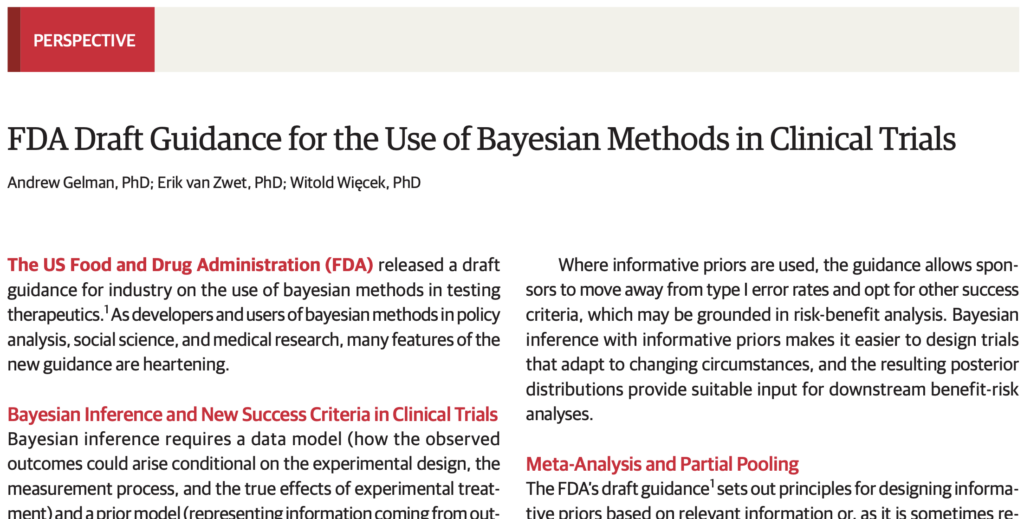
Some of our key points:

The prior is sometimes described as a subjective belief, but the FDA guidance frames it as pre-study information, which we think is a good framing. The formal and transparent incorporation of prior knowledge into the design and analysis of trials is the main advantage of the Bayesian approach. The use of prior information, even if not in a formal Bayesian framework, is not new in the context of clinical trials. For example, it is used during the planning stage of a trial using traditional frequentist methods to determine the sample size. . . .

The guidance still insists on type I error control when Bayesian methods are used, but only when the prior is noninformative. We see the logic to this: Bayesian analysis with noninformative priors is functionally similar to a traditional frequentist analysis, and in these cases there is no compelling reason to break with the current paradigm. In contrast, when substantial prior information is available, the required assumption for defining type I error of no treatment effect may already be inconsistent with that prior information to some extent, invalidating the type I error rate as a meaningful design metric. . . .

We suggest two simple rules for Bayesian analysis of clinical trials: (1) the prior should be clearly stated and (2) readers and reviewers should be able to assess the prior’s influence on the result. . . . The guidance is right to stress the importance of justifying the prior. However, we also remind readers that it is just as critical to have a prespecified and valid data model. Both the prior and the data model should be scrutinized when the data arrive, and it may be necessary to revise either. We also applaud the recommendation that computations be evaluated using simulation studies: in the Bayesian framework, these would be posterior predictive checks, in silico replicated datasets simulated from the fitted model that are then compared with the observed data, with systematic discrepancies indicating problems with the model. . . .

Although often criticized as subjective, Bayesian approaches, when implemented transparently, can improve on informal principles of clinical judgment that often inform the current FDA model.

Two other discussions

Along with our article, JAMA ran two other comments on the FDA guidance:

– Embracing Bayesian Methods in Clinical Trials: FDA’s Long-Awaited Draft Guidance, by
Jack Lee, Frank Harrell, Lisa LaVange, and David Spiegelhalter.

– Reflections on FDA Draft Guidance on Bayesian Methods in Trials—Protecting Scientific Integrity and Evidentiary Standards, by Scott Evans, Thomas Fleming, Holly Janes, and Lori Dodd.

Both groups of authors have lots of experience on the statistical analysis of clinical trials, and both articles are thoughtful. I recommend reading them both.

Comments on the pro-Bayesian discussion by Lee et al.

Lee at al. share our general perspective, and their comment is usefully complementary to ours. We focus on priors, hierarchical modeling, and meta-analysis, while they go into more detail on the way that Bayesian methods connect to classical methods and existing regulatory approaches.

I only have three nits to pick on their article. First, they refer to “skeptical, optimistic, or noninformative prior distributions.” I’d like to clarify that there are too sorts of “skeptical prior.” One version of a skeptical prior is centered at a negative value, i.e., you assume the prior model in which the effect is more likely to be negative than positive, so that to get a positive estimated effect you need strong positive information from the new trial. The other version is centered at zero, which corresponds to a world in which most effects are small (as in the priors on the signal-to-noise ratio discussed here). By default with clinical trials we recommend that second sort of skeptical prior.

Second, Lee et al. write, “By contrast [to classical p-values and confidence intervals], Bayes tackles the real question of interest head-on and provides a direct answer to the question ‘Does the new drug or biologic work?’ by computing the probability of treatment benefit.” I get what they’re saying, but I don’t like the binary framing of whether something works or not. Effects will vary by person, across situations, and over time; there’s not really a stable effect or average effect, and even if we’re summarizing by an average, the question is not whether this average is different from zero or even whether it’s positive, but how large it is. Sure, you can take your Bayesian inference distribution and summarize it by the posterior probability that the average treatment effect is positive, but that’s just one thing to look at, and I think it’s a mistake to identify this as “the real question of interest.”

Third, for reasons I’ve discussed many times, I’m not happy with their use of the term, “prior belief”–unless they’re also willing to refer to other aspects of statistical models as “belief.”

But these are all just minor issues of emphasis. In practice I expect that Lee et al. are recommending the same sorts of Bayesian methods for design and analysis of clinical trials as we are.

Comments on the Bayes-wary discussion by Evans et al.

The article by Evans et al. expresses much more skeptical about the use of Bayesian methods for clinical trials. As noted above, I find their article to be thoughtful and it is worth reading. But they do say some things I disagree with.

The good news is that I think that some of their concerns can be directly addressed, and I hope that after reading my comments they will revise their view somewhat.

You might say that Evans et al. have a strong prior against Bayesian methods, and in this comment I’m sharing information that should shift their prior a bit. As a Bayesian, I can hardly complain that they have strong priors, and it’s my duty to provide arguments that they will view as convincing evidence.

Evans et al. conveniently provide a list of key points:
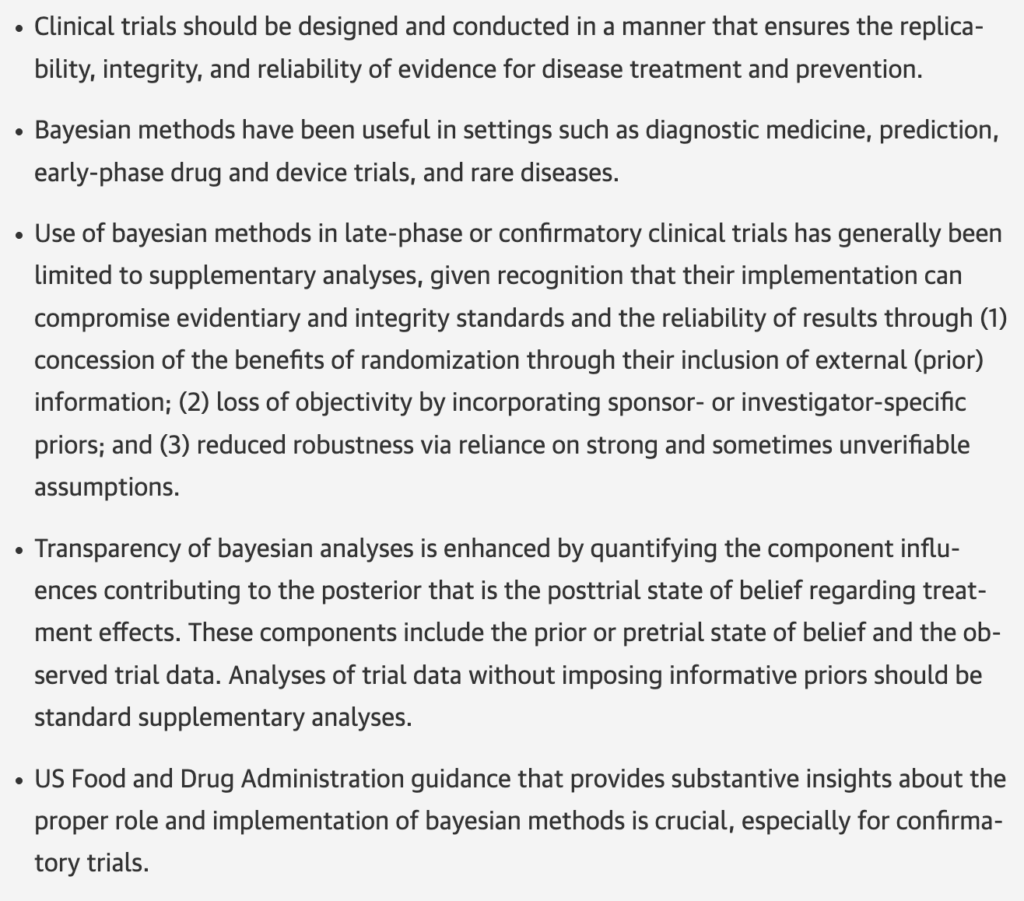
I’ll go through their five points in turn.

Item 1: I agree 100%. “Replicability, integrity, and reliability of evidence for disease treatment and prevention.”

Item 2: Again, I agree completely in this list of settings where Bayesian methods have been useful.

Item 4: Again, I agree! Transparency about all aspects of design, data collection, and modeling is absolutely necessary. This is the case for non-Bayesian method and for Bayesian approaches as well. I also agree that Bayesian inferences based on informative priors should be accompanied by results with noninformative priors or non-Bayesian estimates. It’s important to see the effect of the prior.

Item 5: Again, complete agreement. FDA guidance is crucial.

So it all comes down to item 3.

Item 3: They write that Bayesian methods “can compromise evidentiary and integrity standards.” I agree: any statistical method can be used inappropriately, and we should be aware of failure modes, especially in a high-stakes situation such as clinical trials. They list three concerns: “concession of the benefits of randomization,” “loss of objectivity by incorporating sponsor- or investigator-specific priors,” and “reduced robustness via reliance on strong and sometimes unverifiable assumptions.” I think they’re just wrong on the first of these items. We discuss the issue more fully in Bayesian Data Analysis (see chapter 8 of the third edition), but, just quickly, Bayesian analysis of clinical trials makes strong use of the benefits of randomization, as this is what allows you to set up a likelihood function corresponding to an unbiased estimate. I don’t see any concession of the benefits of randomization, in design or analysis. For their second item, yeah, if you put in a bad prior you can get a bad posterior, and that’s one reason we emphasize transparency in any statistical analysis. See the last paragraph of our article above. Finally, yes, I agree that Bayesian inference has additional assumptions beyond a classical analysis. I don’t think this “compromises evidentiary standards,” though! The prior is based on evidence too.

Let me put it another way. Sometimes you’ll have a nice clean trial, no problems with recruitment, dropout, or missing data, precise and well-targeted measurements, and a large enough sample size to get precise inference for endpoints of interest. You can do a Bayesian analysis if you want, but it won’t make much difference, and the classical confidence interval should be just fine. In other settings, your data are noisy, there are various sources of bias, you’re interested in small subgroups, and classical inferences aren’t enough. You’re in the position of making decisions based on incomplete information. And here the Bayesian approach can be helpful. Yes, additional assumptions are required–I’d like to frame that as, “additional information can be added to the analysis”–; that’s the price you pay for adjusting for bias and noise.

All this explains why I agree with Evans et al. that it’s good to compare any Bayesian inference to the (potentially biased and noisy) classical estimate, and it’s important to be transparent about all assumptions–including the past data and theory used to construct the prior. Data models can be constructed badly (for example, adjusting for age or smoking using binary indicator variables, or using curves that don’t fit the data, or not accounting for hierarchical structure), and priors can be constructed badly too (for example, by centering your prior from a noisy past estimate). Transparency doesn’t eliminate these problems but it should help us notice and correct them when they happen.

Summary

General caution by skeptics of Bayesian methods is valid and should be applied more generally, to all of our statistical models.

A useful analogy is to regression adjustment for experiments and observational studies. If your experiment is clean and your noise level is low, you might be able to get away with a simple treatment vs. control comparison with no adjustment. But in real-world studies there are a lot of reasons to adjust for pre-treatment predictors–it can help even in the simplest experimental settings. That said, it’s good to compare adjusted to unadjusted results and to understand your adjustment procedures as they get more complicated.

The reason for Bayesian methods in clinical trials is that classical methods are often not enough. It’s good to see these new FDA guidelines, and I think JAMA got some good discussions that should help move the ball forward.

P.S. There’s this funny thing . . . the JAMA style required us all to write “bayesian” as lower case. I told them this was nonstandard but they insisted on it. Weird, huh?

P.P.S. More here from Frank Harrell.

Claimed “100% sensitivity and specificity in differentiating autistic individuals from typically developing controls using retinal photographs” . . . yeah, right.

An international correspondent who would like to remain anonymous writes:

I just read your blog post on autism junk science. I am a researcher focusing on autism. The post reminded me of two studies published, not in MDPI journals, but in JAMA series, claiming extraordinarily high diagnostic accuracy for autism.

The first study reports 100% sensitivity and specificity in differentiating autistic individuals from typically developing controls using retinal photographs and deep learning algorithms. As background information, the current gold standard diagnostic tool (ADOS) requires approximately two hours with a certified assessor, and even then, diagnosis remains challenging due to autism’s heterogeneity. A widely used screening tool for autism, social responsiveness scale, showed a sensitivity of ~0.85 and specificity of ~0.75. If the retinal photo were a valid diagnostic method, it would be ground-breaking and change every aspects of diagnosis of autism. However, a claim of 100% diagnosis accuracy from anyone (including a super-intelligent AI) would seem unrealistic to me, as the “diagnosis criteria” per se are still under debate. Also, the perfect alignment results appear spurious, as it is likely that there were some cases of misclassification of autism. A perfect alignment would require replication of human errors on these cases. Such perfect prediction, to me, may indicate complete case segregation on some hidden factors, like camera differences between the two groups, differences in background brightness, etc. In this study, autistic participants were recruited from a single center during a specific period, while controls were retrospectively selected from multiple centers. Though, more specific information on this “hidden factor” was not available and could only be speculative.

The second study, by the same research group, claims near-perfect diagnostic accuracy (area under curve > 0.99) using video recordings of a specific task combined with deep learning algorithms. While they reported standardized conditions for task performance and recording, the exceptional metrics remain concerning from a statistical perspective.

It is kind of annoying that when doing literature review on this topic, we generally have no good reason to omit these studies. However, inclusion of these studies appears to suggest that the issue has been solved, which is definitely not the case. I would appreciate your thoughts on should we think of or deal with such perfect metrics that passed peer review in respected journals.

I agree that these sorts of claims are hard to believe. Given that autism is a spectrum, how could you even hope to get 100% accuracy in diagnosis? Also, there’s this weird disconnect: in the abstract they claim perfect diagnosis on 958 participants, but then the discussion says, “The findings of this study suggest that retinal photographs may serve as a viable candidate for an objective method to screen for ASD.” If they can get perfect classification, this is big news, no? Not just “may suggest . . . a viable candidate . . .”

That said, the data from the study are available from the authors [ok, just kind of available; see this comment], so you could take a look yourself. The paper is from 2023 and it’s been cited a few times, for example here, where they say, “Recent studies, such as Kim et al. [60], propose that retinal photographs could serve as an objective screening tool for autism and may assist in assessing symptom severity.” It’s that disconnect again: it’s a citable study but I guess nobody, even the authors, really believes the 100% claim. Could be a good project for a machine learning student to look into.

Also, it’s kinda funny that “this study included 1890 eyes of 958 participants.” I guess their sample included a few pirates?

Another reason to hate on prediction markets

Louis Mittel points us to this news article with headline:

Gamblers trying to win a bet on Polymarket are vowing to kill me if I don’t rewrite an Iran missile story

Bettors are using death threats to try to get The Times of Israel’s military correspondent to change his report on a missile impact in central Israel. This is his alarming account.

Mittel writes:

A lot of recent coverage of problematic aspects of prediction markets: the ethics of betting on war and death, ambiguous contracts (“was Khamenei out by March 1?”), insider trading, etc.

One of the weirder issues not covered is how prediction marketss turn ordinary people into de facto umpires, but without the security or pay MLB gives its umpires.

A previously routine call at the National Weather Service can now swing hundreds of thousands of dollars and piss off hundreds of gamblers. Or as in the article: missile strike or interception might hinge on a reporter updating a story or not.

These people never signed up to be umpires. They aren’t paid by Kalshi or Polymarket and never agreed to the role.

Here’s the news story:

Tuesday, I [journalist Emanuel Fabian] received an unusual email, in Hebrew, from someone named Aviv.

“Regarding your Times of Israel report that described today’s launch as an ‘impact’ — Beit Shemesh Municipality and MDA (Magen David Adom) later corrected their reports to clarify that what fell was an interceptor fragment, not a full missile,” he claimed.

“I’d appreciate it if you could update your article, as in its current form it does not reflect reality. Alternatively, if you have information that it was indeed a full missile that was not intercepted, I would be glad to be corrected.”

I told Aviv that, from what I know from the Israeli military, the impact outside Beit Shemesh was indeed a missile warhead and not just fragments. . . .

A day later, on Wednesday, I received another email, also in Hebrew, regarding the impact just outside Beit Shemesh, from someone identifying themselves as Daniel.

“Sorry for reaching out without a prior introduction, but I assume we will get to know each other well,” he wrote, in a somewhat threatening manner.

“I have an urgent request regarding the accuracy of your report on the missile attack on March 10. I would really appreciate a response if possible. There is an inaccurate report from you about the missile attack on March 10, and it’s causing a chain of errors,” Daniel’s email continued. . . .

By Thursday morning, Daniel had sent me another email. . . . “I ask again, if you could handle this as soon as possible, it would help us a lot. It’s really important, if possible, still this morning,” Daniel demanded. . . .

As far as I now understand, the emails I received were intended to confirm whether or not a missile had hit Israel on March 10 in order to resolve a prediction on Polymarket. . . .

Polymarket is one of the largest prediction markets in the world, where users can wager their money on the likelihood of future events, using cryptocurrency, debit or credit cards, and bank transfers. However, there are accusations that the site has been plagued by manipulation and insider trading.

The event that these people had bet on was “Iran strikes Israel on…?” More than 14 million dollars had been wagered on March 10.

The rules of the bet state: “This market will resolve to ‘Yes’ if Iran initiates a drone, missile, or air strike on Israel’s soil on the listed date in Israel Time (GMT+2). Otherwise, this market will resolve to ‘No’.”

However, there is a clause: “Missiles or drones that are intercepted… will not be sufficient for a ‘Yes’ resolution, regardless of whether they land on Israeli territory or cause damage.”

My minor report on a missile striking an open area was now in the middle of a betting war, with those who had bet “No” on an Iranian strike on Israel on March 10 demanding I change my article to ensure they would win big. . . .

This is already pretty creepy (kind of like this related story) but it gets worse:

More emails arrived in my [Fabian’s] inbox.

“When will you update the article?” one was titled. The email had no text content, only an image — a screenshot of my initial interaction with Daniel.

Except it did not show my actual response to Daniel, but a fabricated message that I had not written.

“Hi Daniel, Thank you for noticing, I checked with the IDF Spokesperson and it was indeed intercepted. I sent it now for editing, it will be fixed shortly,” I supposedly wrote. (To be clear, I wrote no such thing.) . . .

By this point, it was clear to me why these people were asking about the missile impact, and I took to X and told the gamblers to get a better hobby.

This did not stop them.

Shortly after midnight between Saturday and Sunday, I started to receive threatening messages in Hebrew on WhatsApp from someone called Haim. . . . “Despite the fact that you received countless inquiries — you insist on leaving it that way.”

“If you do not correct this by 01:00 Israel time today, March 15, you are bringing upon yourself damage you have never imagined you would suffer,” he threatened, in a very lengthy message. . . .

On Sunday morning, he messaged me again. . . . Hours later, more messages . . . I then received a WhatsApp message from another number, someone posing as a lawyer called Vered. I ignored the message. Then they called me, though the person on the other end sounded awfully like a young man, and not a middle-aged female lawyer.

Hey, that reminds me of this story!

Fabian continues:

I hung up and contacted the police. . . . Contacted by The Times of Israel later on Monday, Polymarket denounced the threats against me.

“Polymarket condemns the harassment and threats directed at Emanuel Fabian, or anyone else for that matter. This behavior violates our terms of service and has no place on our platform or anywhere else,” a spokesperson for the betting company said in a statement to ToI.

“Prediction markets depend on the integrity of independent reporting. Attempts to pressure journalists to alter their reporting undermine that integrity and undermine the markets themselves,” the spokesperson said.

He concludes:

The attempt by these gamblers to pressure me to change my reporting so that they would win their bet did not and will not succeed. But I do worry that other journalists may not be as ethical if they are promised some of the winnings.

An Israeli military reservist and a civilian were indicted last month for using classified information to place bets ahead of Israel’s war with Iran in June 2025. Similarly, journalists could easily exploit their knowledge for insider trading on the platform.

OK, I have a few thoughts on this:

1. Most obviously, I have a natural revulsion to people trying to make money by betting on war. Yeah, yeah, I know you can bet on oil futures or whatever, there can be legitimate reasons to hedge your financial risks, etc.–we discussed some of that here–but betting on people being killed as if it’s a sporting event? I say, leave that sort of thing to the ancient Romans.

2. I don’t know that the above story actually happened. I don’t have any reason to believe it didn’t happen, and I guess the Times of Israel is considered a legitimate news source; I’m just saying it’s something that was pointed to me on the internet, and sometimes these “outrage of the week” stories are fake, or at least exaggerated.

3. The bit about these guys threatening the reporter . . . I can picture it happening. From the reporter’s standpoint, this is a scary threat. But these guys could’ve been egging each other on, thinking how cool they are. On social media there are lots of pranks and celebration of violence, and I can see how a group of young guys would want to get into the action, work themselves into a fury, and have an adventure.

When I was in high school, kids would do things like spray paint “KKK” on the wall. They wanted to live on the edge. Nowadays the edgelords are in control (perhaps to the concern of some former edgelords).

I guess the question is: what would have happened if you’d dropped instant news and instant gambling into the world of 50 years ago, back when gambling was something to be embarrassed about, and back when impersonating people on the phone was something that high school kids would do for fun, not associated with death threats?

I guess that, had instant news and instant gambling technology been inserted into the world of 1976, it would’ve been highly regulated. Also money was less liquid so it would’ve been harder to lose it so fast.

Even back in 1976, there was Vegas, there were gambling addicts, there were high rollers, there were people who dissipated their income into lottery tickets or lost big in the neighborhood poker game . . . but it was a smaller corner of the economy, a sort of “red-light district” within the larger society. I’m guessing that, had modern gambling technology suddenly been introduced fifty years ago, that it would’ve been restricted to that red-light district.

Just for example, Pete Rose threw away much of his life in plain old analog gambling, and he ended up involved with dangerous mobsters. The point is, these mobsters mostly stayed in the red-light district. What’s happening now is scary because they’re out on the loose.

And, yeah, prediction markets are cool and can provide social value, I agree with that. They may even be the wave of the future. But something can be cool and also dangerous.

P.S. Further thoughts here from columnist Matt Levine.

And Palko points to this post from Steve Herman, “Betting and Prediction Market Alliances Erode Journalistic Integrity.” In the bio, it says that Herman “began his career in Las Vegas, reporting on the casino industry and organized crime.” So very relevant to our topic here.

Survey Statistics: sampling to assess data quality

In 2010, Bethany Hedt-Gauthier (one of my heroes) let me tag along in her project with the Malawi Ministry of Health. At the time, 270,000 patients were treated at 377 HIV antiretroviral clinics. Patient treatment cards were (and often remain, Taylor & Kazembe 2025) paper-based.

Image of Bethany Hedt-Gauthier

Quarterly, these treatment cards were compared to the clinic register to catch errors. At the time, they did a full census in every clinic. In Hedt-Gauthier et al. (2012) we proposed taking a sample of records in each clinic, and using a decision rule (Lot Quality Assurance Sampling, LQAS) to decide if the clinic would receive a full census of treatment cards.

We joined in 19 clinic visits to try this out alongside the status quo censuses. The censuses took 28.5 hours total and corrected some data errors, the sampling-based decision rule took less than half the time and caught more than half the errors.

Consider one clinic. Let:

  • p = true agreement rate between treatment cards and clinic register
  • n = number of sampled treatment cards, we sampled 76
  • D = number of those with disagreement ~ Binomial(n, 1-p)

Our decision rule was: if D >= 3 then do a full census of treatment cards.

  • P(do a full census | p = 0.99) = around 4%
  • P(don’t do a full census | p = 0.89) = less than 1%

There is a tradeoff between reviewing hours (cost) and data corrected (benefit). LQAS navigates this with the probabilities above, sometimes called “Type I” and “Type II” errors in hypothesis testing. But Hedt-Gauthier et al. (2012) didn’t refer to hypothesis testing. Their focus was on measuring the costs and benefits of the decision.

In Abandon Statistical Significance (quoted on this blog) the authors wrote about statistical significance thresholds:

such thresholds implicitly express a particular tradeoff between Type I and Type II error, but in reality this tradeoff should depend on the costs, benefits, and probabilities of all outcomes

The polar bear has his own paper-based system (notes about survey statistics). He aspires to do a census of them. He also aspires to do a census of the Appalachian Trail, he’s done the red-marked miles.

From junk science (largely non-political) to junk medical treatments (mostly associated with the far-right): A financial connection

Paul Krugman writes:

Last week the Food and Drug Administration refused to review Moderna’s new mRNA-based flu vaccine. They didn’t reject it based on evidence; they wouldn’t even look at it, in line with RFK Jr.’s evidence-free, dogmatic assertion that mRNA technology, which gave us Covid vaccines, is useless and harmful.

The motivations behind the crusade against clean energy and the crusade against vaccines are also similar. The conspiracy-theorizing hostility to science and expertise in general that underpins both movements also predisposes people to become right-wing extremists, which means that their movements are now in power. The headline on a 2023 article in The Guardian captured this perfectly: “‘Everything you’ve been told is a lie’: Inside the wellness-to-fascism pipeline.”

In both cases it’s crucial to follow the money.

It may seem strange to think of the wellness industry as a corrupt and corrupting force comparable to the fossil-fuel sector. But wellness is big business. McKinsey estimates that U.S. spending on wellness is running at around $500 billion a year, while spending on nutritional supplements alone was close to $70 billion last year.

And sellers of nutritional supplements, unlike companies selling pharmaceuticals, are effectively allowed to make false, outlandish claims about what their products do. . . .

I [Krugman] wrote about this almost five years ago. The relationship between quack medicine and right-wing extremism has a long history. As the historian Rick Perlstein has documented, extremists have been marketing medical snake oil, and snake oil purveyors have been financially supporting extremism, since the days when misinformation had to be disseminated through paper newsletters. This mutually beneficial relationship continued through the eras of talk radio, cable TV, and now podcasts.

It’s interesting that Krugman says that “the relationship between quack medicine and right-wing extremism has a long history.” My impression is that, before very recently, there was no correlation between political ideology and belief in quack medicine. That doesn’t mean that Krugman’s statement is false, however. There could well also be a longstanding relationship between quack medicine and left-wing views, even if not a longstanding financial relationship of the form discussed by Krugman.

In any case, Krugman’s remarks reminded me of something I’ve been wondering about: Is there a through line from B.S. numbers in junk science to B.S. numbers coming from the government? My feeling was that the past couple of decades have seen a disturbing toleration of junk science coming from credentialed or quasi-credentialed academic sources: things like the claim that attractive parents are 36% more likely to have girl babies, or that women are three times more likely to wear red or pink clothing during certain times of the month, or that scientific citations are worth $100,000 each, or that grandmasters burn 6000 calories during a chess game. Or, for that matter, the support in the elite media for the idea that UFOs are space aliens.

None of the items in the above paragraph are particularly political, and media promotion of bullshit arguments is nothing new; I still have a vivid memory from my childhood in the 1970s of the Bermuda triangle, Noah’s ark, ancient astronauts, and other wacky-but-mainstream ideas. It’s a little different, now, though, in that the old junk science was done by outsiders, whereas the new junk science is both performed and promoted by prominent academics, as I discussed in my post, Junk Science Then and Now.

One thing that came up in the comments to the above post that the entire academic sector is much bigger than it used to be. Meanwhile, book publishing is smaller. Back in the 1970s you could get rich selling a few million copies of Chariots of the Gods or whatever. Nowadays books don’t sell so well, but you can make a fine living as a professor at a university with possibility of lots more money from paid speaking engagements. So this creates the incentive and the opportunity for junk-science entrepreneurs within elite academia.

I followed that up with a post, Junk science becomes more professionalized. Meanwhile, conspiracy theories are being more associated with the center-right and right, politically. How does all this fit together? I’m not sure.

And I’m still not sure. But one thing I hadn’t considered in that post are the direct financial incentives for quack medical treatments. This is only a small part of junk science, but arguably it’s one of the most consequential parts. Shooting down vaccines is a lot more serious than stupid attention-grabbing crap about citations or chess players or whatever.

Even there, though . . . yeah, maybe there’s a connection. If you’re willing to take the word of some Stanford authority telling you lies about chess playing and calories, is this really so far from taking the word of some other Stanford professor who’s trying to sell you supplements, or trying to talk you out of taking a vaccine? All of these things represent a mystical, anti-scientific attitude, where it be vaccine scaremongering or beliefs of magical energy expenditure, and that opens the door to whatever supplements or potions they’re promoting. After all, if you can really burn days’ worth of calories in a chess game, or heal faster just using your mind, then, sure, various quack remedies are just as plausible.

So I do think there’s something there. And Krugman’s point about the finances is interesting.

Is there an alternative universe in which it’s left-wing media, rather than right-wing media, that are supported by the quack-remedies industry, in which case we’d see a different ideological lineup? Maybe president Harris would’ve appointed RFKJ to head the nation’s health policy, etc.?

This sounds kinda farfetched, but maybe not. There’s not a lot of leftwing media now, and whatever is there is not partisan in the mode of Fox News, Alex Jones, etc., but a few decades ago every city had an alternative weekly, and almost all of them were on the left. I think they made a lot of their money with advertising from music venues and the sex trade. I don’t recall seeing a lot of ads for dietary supplements but maybe it could’ve gone that way? Indeed, perhaps if supplements had sustained the alt-weeklies, we’d still have a robust left-wing media in this country?

On the other hand, there is a logic to the music and sex ads going in the alt-weeklies and dietary supplements and gold (now crypto, I guess) being advertised on conservative outlets. Music and sex are hobbies of the young, whereas it’s the old people with the ailments (to require the supplements) and the free cash (that they could spend on gold). Now there’s lots of talk about right-wing influencers among the young, but it’s my impression that the right-wing ecosystem sustained itself over the decades through its audience of oldsters.

So lots to chew on here.

The 80% power lie

This came up in class today and I wanted to repost it:

To get NIH funding, you need to demonstrate (that is, convincingly claim) that your study has 80% power.

I hate the term “power” as it’s all tied into the idea of the goal of a study that results in statistical significance. But let’s set that aside for now, and just do the math, which is that with a normal distribution, if you want an 80% probability of your 95% interval excluding zero, then the true effect size has to be at least 2.8 standard errors from zero.

All right, then. Suppose we really were running studies with 80% power (by which I mean 80% power conditional on the true effect; that is, suppose that the true signal-to-noise ratio is 2.8, so that there is an 80% probability that any given study reaches statistical significance). In that case, the expected z-score is 2.8, and 95% of the time we’d see z-scores between 0.8 and 4.8.

Let’s open up the R:

> 2*pnorm(-0.8)
[1] 0.42
> 2*pnorm(-4.8)
[1] 1.6e-06

So we should expect to routinely see p-values ranging from 0.42 to . . . ummmm, 0.0000016. And those would be clean, pre-registered p-values, no funny business, no researcher degrees of freedom, no forking paths.

Let’s explore further . . . the 75th percentile of the normal distribution is 0.67, so if we’re really running studies with 80% power, then one-quarter of the time we’d see z-scores above 2.8 + 0.67 = 3.47.

> 2*pnorm(-3.47)
[1] 0.00052

Dayum. We’d expect to see clean, un-hacked p-values less than 0.0005, at least a quarter of the time, if we were running studies with minimum 80% power, as we routinely claim we’re doing, if we ever want any of that sweet, sweet NIH funding.

And, yes, that’s 0.0005, not 0.005. There’s a bunch of zeroes there.

And, no, this ain’t happening. We don’t have 80% power. Heck, we’re lucky if we have 6% power.

Remember that wonderful passage from the Nosek, Spies, and Motyl “50 shades of gray” paper:

We conducted a direct replication while we prepared the manuscript. We ran 1,300 participants, giving us .995 power to detect an effect of the original effect size at alpha = .05.

Followed by:

The effect vanished (p = .59).

None of this should be a surprise

When I say, “None of this should be a surprise,” I don’t just mean that, in response to the replication crisis and the work of Ioannidis, Button et al., etc., we should realize that statistically-based science is not what it’s claimed to be. And I don’t just mean that, given the real world of type M errors and the statistical significance filter, that we should expect claims of statistical power (which are based on optimistic interpretations of a biased literatures) will be wildly inflated. Issues of failed replications, type M errors, etc., are huge, and they contribute to the conditions that allow the erroneous power estimates.

But what I’m saying right here is that, even knowing nothing about any replication crisis, without any real-world experience or cynicism or sociology or documentation or whatever you want to call it . . . it just comes down to the math. With 80% power, we’d expect to see tons and tons of p-values like 0.0005, 0.0001, 0.00005, etc. This would just be happening all the time. But it doesn’t.

I should’ve realized this the first time I was asked to demonstrate 80% power for a grant proposal. And certainly I should’ve realized this when writing the section on sample size and power analysis in my book with Jennifer, over ten years ago, well before I’d thought about all the problems in statistical practice of which we are now so painfully aware. All the math in that section is correct—but the implications of the math reveal the absurdity of the assumptions.

P.S. In response to a couple of comments on the earlier post: Yes, the power is conditioned on the assumed effect size. But the point of the power calculation for the NIH grant is to say that the power really is at least 80%, at least much of the time. The assumptions are supposed to be reasonable. Given that we’re not routinely seeing tons and tons of p-values like 0.0005, 0.0001, 0.00005, etc., this suggests that the assumptions are not so reasonable. See here for further discussion of this point.

P.P.S. The funny thing is, when you design a study it seems like it should be so damn easy to get 80% power. It goes something like this: Assume a small effect size, say 0.1 standard deviations; then to get 2.8 standard errors from zero you just need 0.1 = 2.8/sqrt(N), thus N = (2.8/0.1)^2 = 784. Voila! OK, 784 seems like a lot of people, so let’s assume a effect size of 0.2 standard deviations, then we just need N = 196, that’s not so bad. NIH, here we come!

What went wrong? Here’s what’s happening: (a) effects are typically much smaller than people want to believe, (b) effect size estimates from the literature are massively biased, (c) systematic error is a thing, (d) so is variation across experimental conditions. Put it all together, and even that N = 784 study is not going to do the job—and even if you do turn up a statistically significant difference in your particular experimental conditions, there’s no particular reason to expect it will generalize. So, designing a study with 80% power is not so easy after all.

P.P.P.S. To clarify one more thing: I do not think the goal of an experiment should be to get “statistical significance” or any other sense of certainty. The paradigm of routine discovery is over, and it can’t be recovered with N = 784 or even N = 7840.

The Atlantic Monthly, March, 1947

I picked this off the bookshelf the other day–I have no idea when or where I bought it–and read through it. The Orwell article I’d read before; of the rest, the most readable by far were the book reviews. Among other things was a review of some books about General Franco of Spain. Perhaps unsurprisingly, the reviewer took Franco’s side. Coincidentally I happened to read a review the other day of a new book on the topic in the TLS.

But the highlight of the Atlantic issue was this poem:

How about that fourth verse, huh? “Cosmopolitan cringe,” indeed.

Also this ad from the National Dairy Products Corporation:

This would fit right in with the current government and its apologists in academia and the news media. Just give him some whole milk!