The 2026 Pangram social justice misinformation wars: Collective understanding of binary classification takes a hit

This is Jessica. I continue to be amazed by how much confusion there is about Pangram, the AI text detector. As Sam Kriss reports on Substack, not only are people sharing misinformation amongst themselves, the idea that “Pangram is racist” and results in high false positive rates for African or Caribbean or non-native English speakers is worming its way into the record, unbacked by any solid evidence. AI search results are now promoting assertions about bias that are challenged by existing audits of Pangram on texts from non-native English speakers. Academics are calling such tools racism clothed “in a veneer of objectivity.” Motivating such accusations are several cases where POC short story award winners won with texts that Pangram flagged as 100% AI-authored. The result is a dent in our collective understanding of basic binary classification.

With all of this apparent controversy, it’s reasonable to wonder what is going on. Let’s review what is actually known about Pangram’s error rates, and then consider why so many people are buying into the attempts to make this a social justice issue. 

But first, if you read no further, the TLDR is that false positives (where Pangram flags human-generated text as AI-generated) on texts of reasonable length (at least 50 words, with greater reliability as length increases) are extremely unlikely according to every general audit I could find – the largest report FPRs on the order of 1 in 10,000 for audits on mixed length texts. In fact, Max Spero, Pangram CEO, posted on X a few days ago that based on a bounty program, they had found their first false positive on a long text created before 2020: a poem that repeats the same six words four thousand times. False positive rates on non-native English speaker corpora remain indistinguishable from these overall rates according to large audits. This doesn’t mean Pangran is reliable on every distribution of human-authored text, adversarially generated or not. But the evidence of low false positives on natural distributions of human texts is much stronger than the cherry-picked data points the racism-accusers are wielding. 

Audit results

According to the latest model card published by Pangram itself, on Pangram 4.1 released October 19, 2026, overall false positive rates are:
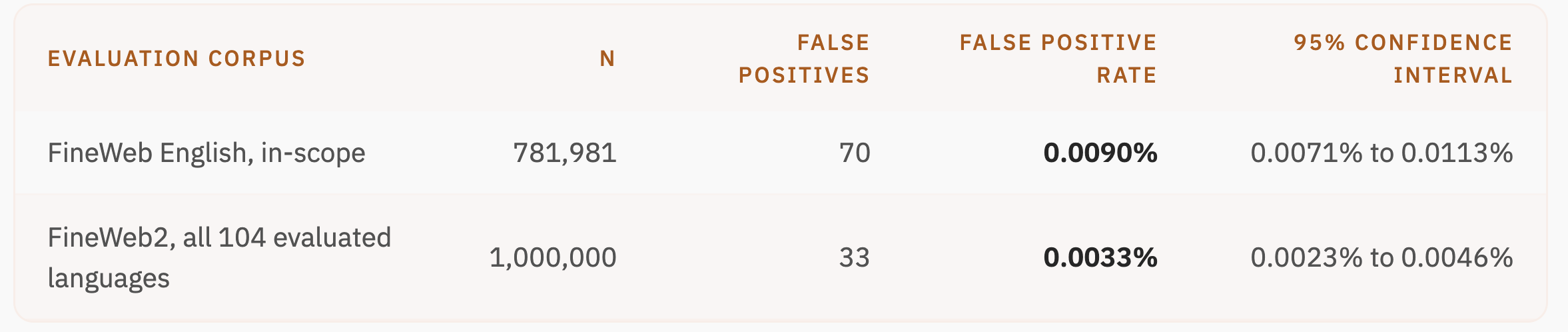
Note that Pangram uses a strict definition of false positive: if a known-to-be human written document has any segment classified as AI-generated or AI-assisted, the entire document counts as a false positive. Similarly, a fully AI-generated document with any segment labeled human or AI-assisted is counted as a false negative.

Overall false negative rates are higher than false positives (by about 40x) but still quite low: 
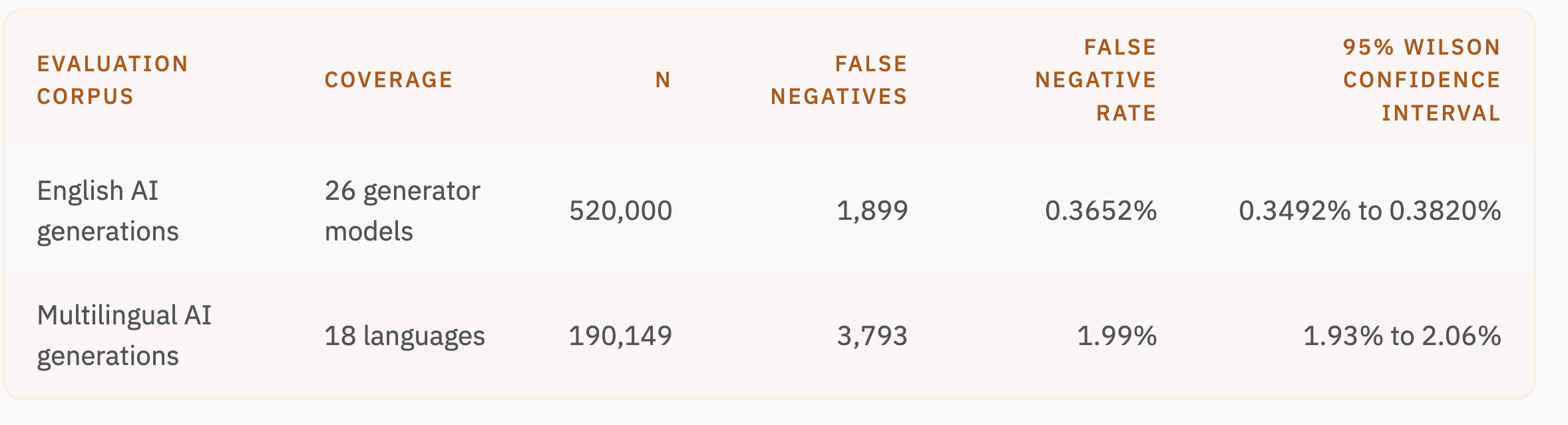
The above makes clear that error rates are asymmetric. This is intentional, and something a model developer can control, by using a training objective that prioritizes avoiding false positives or more directly by setting a conservative classification threshold learned on held-out data. This makes it possible to ensure a very low FP rate on text generated similarly to the audit distribution (Pangram describes targeting 1 in 10,000, and available audit evidence is consistent with this). 

When Emily Bender says that “As is widely known within the NLP research community, perfect results usually point to something wrong with the evaluation setup”,  she’s either deliberately ignoring or unaware of basic statistical machine learning methods.

Other, smaller audits of Pangram models include Epoch AI’s from this past summer, which found that Pangram produced zero false positives on 495 human passages. It detected all of 297 AI passages created using basic prompts, but missed 30 of 297 (10.1%) when the LLM was prompted to imitate a particular author’s style. Another by Karr, Khvatskii, Hua, and Chawla from last month finds that Pangram had zero false positives on 306 pre-LLM abstracts (2013-2015), but it flagged 14.9% of recent abstracts (from 2023 – 2025) as AI-generated. However, the authors don’t know what the ground truth was on the recent ones, so this statistic cannot be treated as a false positive rate. A very small audit by Van Vlasselaer, Van Droogenbroeck & Spruyt from June, which found that Pangram detected 97.5% of 40 fully AI-generated papers and about 95% of hybrid human and AI generated papers and humanized AI-generated papers. In one of the first external audits in 2025, Imas and Jabarian found that version 2 Pangram achieved nearly zero false positives and false negatives on medium and long texts.

Where is the evidence that Pangram is racist?  

I am not aware of any audits with known ground truth specifically focused on texts by POC, but there are a few related analyses. Vauhini Vara reports that when she ran 25 prior prize winning stories of the Caine Prize for African Writing through Pangram, all came back 100% human-authored.

Adding to this, yesterday Tuhin Chakrabarty posted an analysis of books written by African authors: 97 from Zimbabwean authors written 2020 to 2025 and 90 from other African countries written from 2020 to 2026. He found just one that was flagged at least 1% AI by Pangram.

Beyond the claims that Pangram is racist against African or Caribbean authors, there is a general line of attack that it should not be used because errors rates are unacceptably high for non-native English speakers. Yet Pangram has produced multiple rounds of audits using four non-native english text corpora.
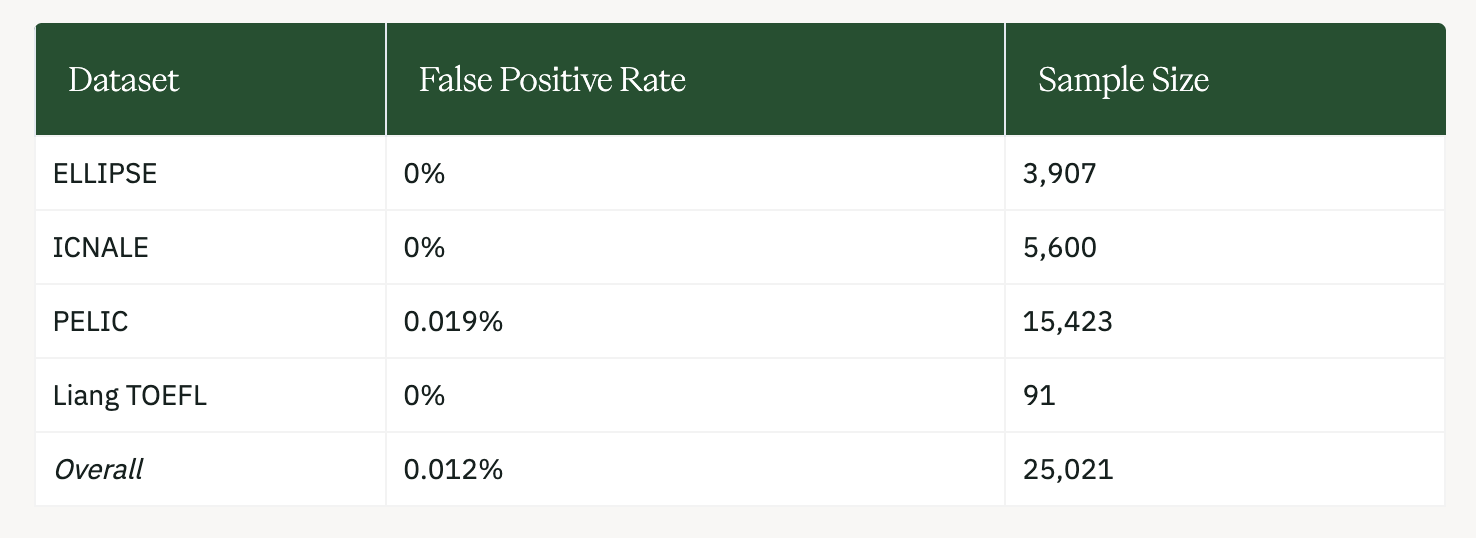
FP rates for version 3.3:

Hardly higher than the overall rates reported above. 

An audit of version 4 compared to 3.3 shows lower rates:
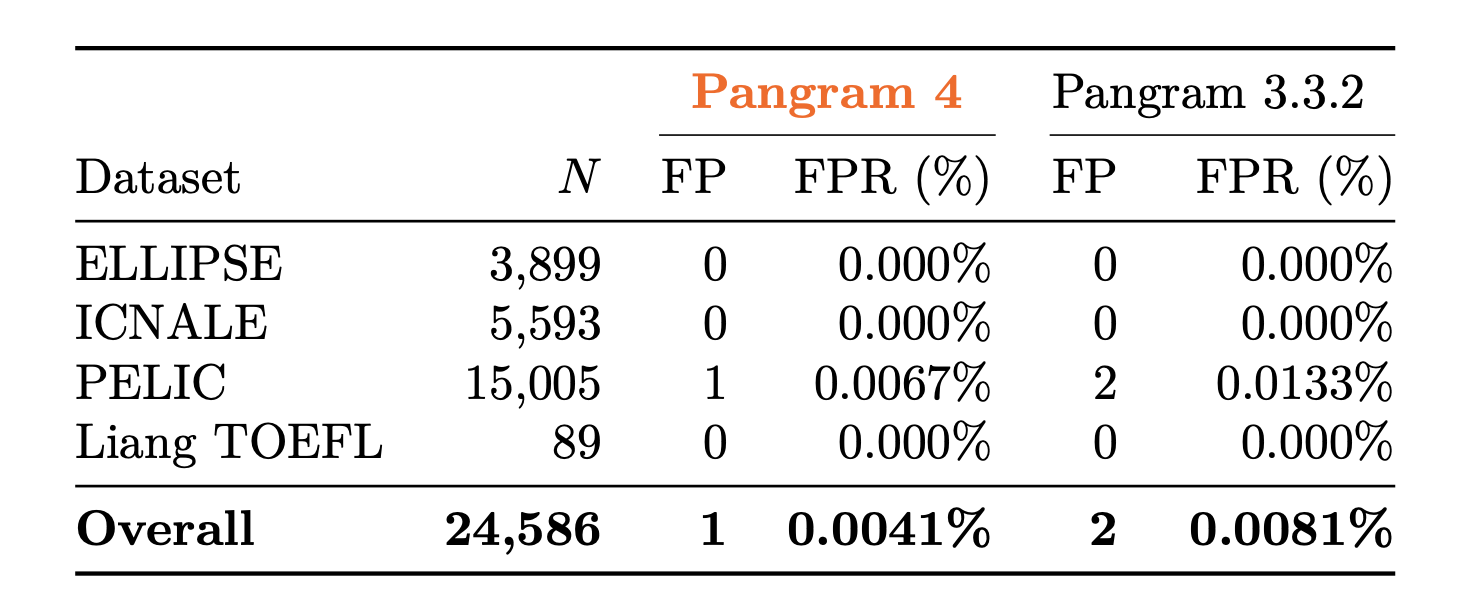
And an audit of 4.1 from October this year on 15,420 documents by English-as-a-second-language undergraduate and graduate students produces literally zero false positives:

So why are so many people confused?

Here I can only speculate. 

Incentives for organizations to save face. Both the Commonwealth Prize and Caine prize organizations report doing investigations that supported the accused authors’ case. If you’re looking to the literary authorities to tell you what to think, it seems that false positives are occurring repeatedly for long texts by POC authors. However, neither has made any of the evidence they claim to have gathered public, so believing that the stories are false positives means trusting their word. 

Misinfo to protect AI habits. Blatant misinformation is certainly being propagated, often by people who appear to want to keep their current productivity edge by having AI write everything for them. Here’s just one example of someone posting a faked Pangram false positive screenshot on X: 

Confusing FPs and FNs, confusing different classification tasks. Some may simply be mistaking overall accuracy or false negative rates as evidence that Pangram is not reliable when it flags something as AI-generated. There also seems to be some confusion about what Pangram does – detect who strung the words together – versus other forms of detection we might want, like being able to tell who came up with the ideas. But this is not what Pangram targets – if you use AI to rewrite human texts, like rewriting abstracts in the Karr et al study above, and you don’t take steps to constrain the AI from only fixing typos or other errors, then yes, Pangram will flag it as highly AI-generated, because that is what Pangram it is designed to do. 

There are also people arguing against use of Pangram based on error rates when texts are generated adversarially, like examples that were specifically written to sound like AI, in contrast to the audit results above which apply to naturalistic distributions of human-generated text. When we target a particular FPR for a classifier, we expect that to hold only so long as the training or calibration data we used is representative of the cases we encounter in practice. 

Finally, how to interpret Pangram percentages can be confusing, and attributions of the source of small pieces of text within a larger text are not covered by the audits above. Unreliability in identifying which portion of a text contributes a high score can suggest which use cases to be careful with, but it doesn’t invalidate the document-level false-positive estimates from the audits. 

Splashy earlier results on bias in other detectors. A early (2023) Stanford study by James Zou and others did claim that GPT detectors are biased against nonnative English writers, but this was on a very small sample (91 essays from theTOEFL exam) and did not test Pangram.

Inaccurate folk theories. Another contributor might be inaccurate folk theories about what Pangram is. Maybe some people imagine Pangram doing something like they would do if they were given a text and asked if it was AI-generated – e.g., look for cues that are said to be associated with AI text like m-dashes and decide based on that. There are some stories consistent with this, like where Granta turned to a Claude instance to help them decide if AI had been used rather than a trained detector. In reality, Pangram is a classifier, trained with lots of labeled texts to discriminate between which are human-generated and which are AI-generated, and calibrated to keep the false positives low on average in naturally generated texts.

Concern that detectors are more often applied to POC and ESL writers. Maybe people are perceiving real asymmetries in whose work is being checked, and reacting to that by trying to discredit the tool.

Resisting AI as a solution to anything. Finally, I think a lot of people resent the imposition of AI in their lives, and see relying on an AI detector like Pangram as accepting the inevitability of AI, which they want to resist. So they say things that imply Pangram is unreliable for all purposes without realizing where the evidence contradicts their assumptions.

On the larger question of whether we should care about AI writing 

We need to be much more careful in distinguishing between the evidence on false positives and the broader question of whether it’s a good idea to try to detect AI writing. Everyone is entitled to an opinion on the latter, but the former is better left to the statisticians. If you want to avoid using Pangram on the grounds that you believe the correlation between who wrote the words and who controlled the ideas is so low  that your decision quality will be no better or worse, then I can respect that – we have different priors. Or if you personally want to avoid developing a habit of relying on AI detectors because you believe that human writing will become more and more resemblant of AI writing with time, or AI-written text less indistinguishable, that’s fine, it’s up to you how you make decisions for yourself.

What I really dislike is the way that people (including academics like Bender) are adding confusion by ignoring (and even actively arguing against) how a positive classification from a classifier like Pangram can have evidential value for some of the decisions people care about right now. Sure, false positives are possible, but this does not warrant recommending to people that they remain in ignorance on every case, even if they might benefit from some signal on who wrote the text. Sure, distributions can shift, but there is a difference between recognizing that estimates may not be calibrated in a new context, and concluding that existing evaluations are “effectively meaningless.” It’s like all these Pangram-haters want to scare everyone else into being as irrational as they are by preying on their fear of being labeled racist. 

More on the rationality of using a signal when it is informative here.
Algorithmic deepfake science

1. Chatbots

There’s been a lot of talk lately on the routine use of chatbots as a scientific tool (literature review, refactoring code, checking the internal logic of an argument, etc.) as well as the possibility of directing chatbots to perform investigations and write entire papers.

Two big ideas come up:

(a) Chatbots being used to create “deepfakes” of scientific research: papers that are professionally formatted, readable, and are written in the style of top research papers—simulacra of research that is convincing enough that it can get published in serious journals. Such papers could include plausible computer-generated images and data, along with chatbot-generated text describing nonexistent experiments.

(b) Chatbots being used to make real discoveries in pure math or computer science, or doing automated analysis of real data in biology to make real scientific discoveries.

Both these ideas are versions of things that chatbots, generative AI, and machine learning can do well: (a) producing text that looks like human-generated text and producing images and videos that look like real photographs and movies, and (b) finding patterns in big data.

2. Deepfake science conducted by humans

But today I want to talk about something slightly different, which is the pre-AI history of deepfake science, that is, deepfake science conducted by humans.

Let’s go through some history. I don’t claim this to be a systematic history; it’s just some examples I’ve heard about over the years:

– Old-style hoaxes: physical deepfakes such as Piltdown Man, fake data such as from the psychologist Cyril Burt, the doctored fairy photos that fooled Arthur Conan Doyle, the Bell Labs superconductor guy, etc.

– Fraud from the recent golden age of NPR/Ted-style fake science: the Harvard primatologist, the Cornell food-behavior guy, the election-denying gun guy, the experiment-faking UCLA poli sci student, the Surgisphere team, the UNR dean of engineering, etc.

– Data misrepresentation or plagiarism: the University of California sleep guy, the USC giraffe guy, the Stanford president, whoever at Columbia faked the U.S. News report, a few zillion p-hackers, and various researchers who, when confronted with problems with their data, acted as if there was nothing wrong.

– Bad science, not involving fraud but being “deepfake” in the sense of following the detailed forms of a scientific investigation without actually making scientific progress, because the data and measurements are too noisy to learn anything about the target phenomenon (what we call the kangaroo problem): the beauty-and-sex-ratio guy, the ESP guy, the air-pollution-in-China guy, the ovulation-and-clothing team, the “critical positivity ratio” team, the climate-change “gremlins” guy, the mind-body-healing team, etc.

I’d call all of these “deepfakes” in that they are simulating the process of science in a generative manner, not constructing a scientific paper by itself but performing a (human-operated) process that yields a convincing-looking result. As we’ve learned with computer-generated text and images, it can be much more effective to run such a process than to just try to jump to the end.

Depending on the researcher—or, maybe I should say, the operator–the generative process can be done in different places: text, data, numerical images, even the theory itself.

You can go pretty far with a deepfake but eventually you’re likely to be caught out, either because your fake data have internal flaws, because your results can’t be replicated (as with the superconductor), or because there’s a problem with the “meta-data” or cover story. Consider for example the surveys purportedly conducted by Mary Rosh and Michael Lacour: in these two (separate) incidents, no documentation was produced. Or Wansink’s refilling soup bowl and Ariely’s paper shredder: the claimed physical evidence for these devices is dubious.

As the saying goes, reality is overdetermined, and ultimately the only convincing way to make fake data is to collect real data, in the same sense that the only realistic map of a territory is to use a Borgesian 1-to-1-scale.

3. Algorithmic deepfake science

Stepping back, we can think of both the human-generated and chatbot-generated forms of deepfake science as being algorithmic, in the sense that they are created using some sort of general process that is being fed by domain-specific information (not so much information about the science; more information about the conventional forms of data and writing used in the particular scientific subfield being faked).

To put it another way, this work is “deepfake,” rather than just “fake,” in that it’s generating a simulation of the entire scientific process, creating a thick brick of fakeness, as it were, rather than a brittle fake crust. Bem’s ESP edifice, for example, isn’t just a convincing-looking paper; it also includes, at an internal level, experiments, data and a research team, and, externally, a scientific literature and repeated exposure in the news and social media.

Last year I posted 7 steps to junk science that can achieve worldly success:

1. Bad statistical analysis
2. Researcher degrees of freedom
3. Weak or open-ended substantive theory
4. Inaccurate summaries of the literature
5. Institutional support
6. External promotion
7. Celebrity culture.

You don’t need all these for a deepfake. In particular, you don’t need bad statistical analysis if you take the trouble to create fake data that shows what you want to see, and you don’t need celebrity culture if you can get your message out in some other way. The real point here is that the deepfake occurs within a social environment.

In an era where we’re worried about algorithmic deepfake science from chatbots, it could be helpful to think about what we’ve learned from algorithmic deepfake science of the human variety.

Blokjutsu: a macOS image generator/editor

This is another post from Bob that is not about statistics. Last one, I promise.

Like Steve, whose what’s up in NYC app I just blogged about, I’ve taken up the hobby of designing apps and having LLMs build them. It scratches a very different itch than writing performant C++ code for Stan.

Blokjutsu

Here’s what I’ve come up with.

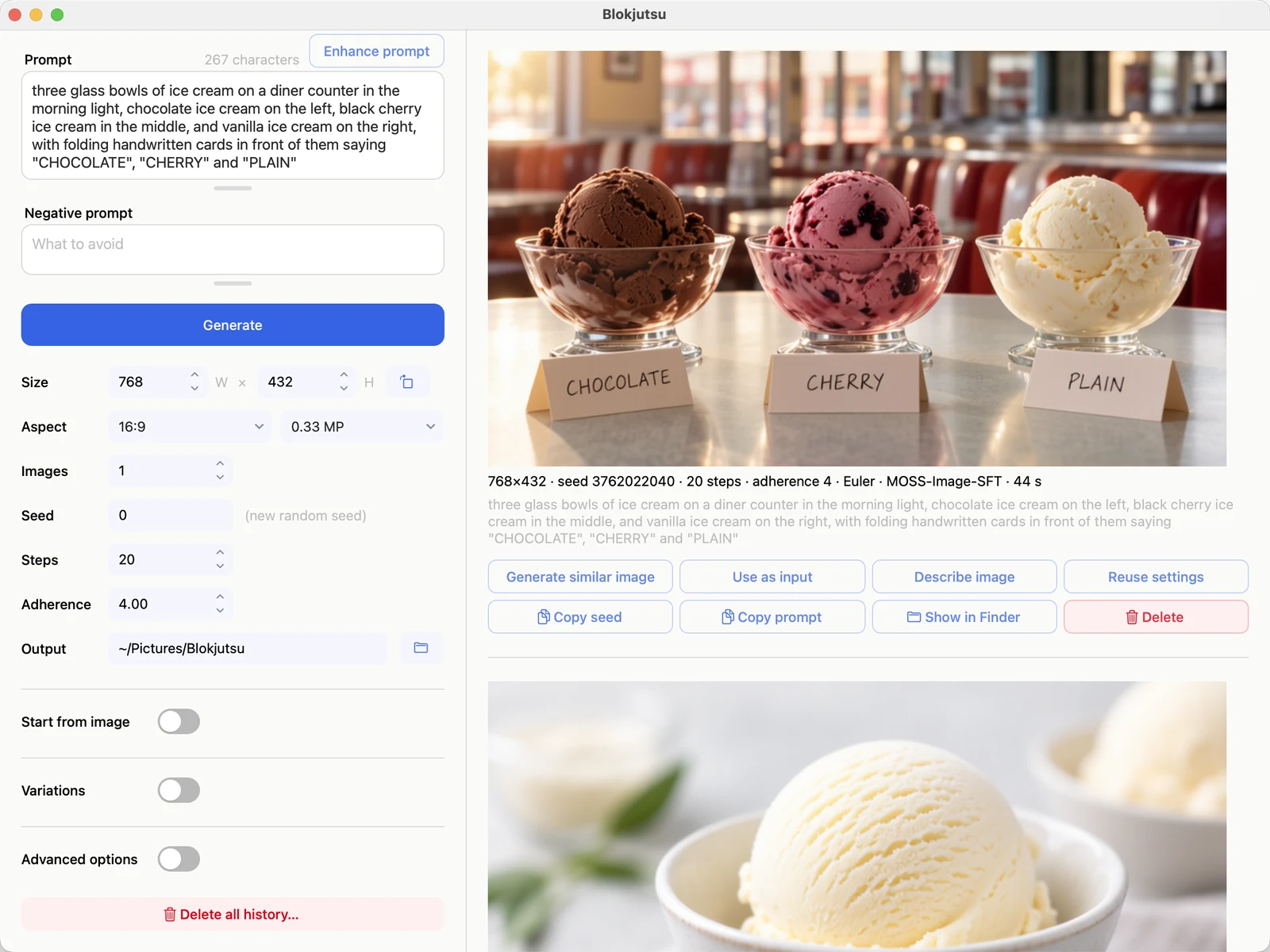
  • Blokjutsu: An open-source native macOS app for generating and editing images locally.

Fair warning: it requires Apple Silicon with at least 32GB RAM. On the plus side, it’s distributed as an Apple-notarized .dmg file and licensed entirely under Apache 2, including the models.

MOSS-Image, the 5 billion parameter model on which it is based, is amazing in its ability to follow text instructions. Having said that, don’t expect it to compete with a frontier model in depth or breadth of knowledge. It also generates images up to 4 megapixels, though that can be slow (20 minutes on my old Mac with an M3 Ultra, 12 on my new MacBook with an M5 Max—they’ve accelerated matrix multiplies!).

What does it do?

The app lets you either work entirely from a prompt, or you can structure your input with bounding boxes that are followed very well for either images or text (though the text is handled with fonts and doesn’t integrate real well with photographic images in my opinion). It uses a language model (Qwen) to process prompts and it can be used to enhance prompts directly or to convert images to text. It includes all the usual image-processing features: image to image, variations of generated images, inpainting (replacing part of an image) and outpainting (extending an image). It lets you plug in LoRAs (low rank adaptations) for styling.

I tried very hard to keep everything simple. If anyone has any feedback on either the doc or the system itself, I’d love to hear it, either via email ([email protected]) or an issue on GitHub.

What does “Blokjutsu” mean?

I made up a word that’s pronounceable, has zero Google hits, and isn’t spell corrected (as Hadley Wickham and I were urging instead of “Stan” for the Stan project). It’s a mashup of Danish “Blok” and Japanese “jutsu”. Same for the GitHub org, which is Danish “Form” mashed with Japanese “do”.

Why?

I built this app in part to see what Claude (Opus 5.5, medium effort) could do, and partly because I subscribe to Claude, which doesn’t do image generation! I like to use images in my other hobby, role-playing games. I was using DiffusionBee with StableDiffusion, but DiffusionBee hasn’t been updated in years, and I wanted to be able to use MOSS-Image. The next section has an example.

The Temple of Shadow

My childhood friends were getting tired of my obsession with fiction-first games (like Blades in the Dark) and wanted a “beer and pretzels” (as this style is known) dungeon crawl. I ran “Caverns of Thracia,” which the grognards describe as among the handful of best modules ever written, but we all found it challenging, and quit after the second TPK (total party kill). Hence the 5th edition module, where it’s a real challenge to kill even one character.


Dungeon Module Z1: The Temple of Shadow

The module text was entirely written by ChatGPT, though I provided a lot of editorial oversight, including a suggestion of how to arrange the four broad zones of the dungeon and asking continually for more concise descriptions with more showing and less telling. Everything else, including the serviceable but rather boring cookie-cutter town, was pure GPT. The LaTeX styling was me with GPT’s help. The maps were random generators available online. The images were Stable Diffusion after a lot of metaphorical hair pulling (literal is challenging for me). It’s all a cliché, just as my players requested. The writing is the usual AI type slop and the images are pretty atrocious. If you look at the writing from Wizards of the Coast, I’d call that “WotC slop,” so the bar is low. It’s hard to find good writing in an RPG, so it really stands out reading, for example, a short module by Will Doyle. I’ve been meaning to give this another go in late 2026 and see how Claude does, but I really don’t like reading AI writing.

What I like

Left to my own devices, I run games like I’m running now, Star Trek: Omega, where the Federation is down to its last Class-D starship pulled out of mothballs, with a skeleton crew of officers and enlisted folks who somehow missed the decisive battle in which the Federation was defeated. Captain K’vok (Klingon) and his motley crew are up against the Chorus, an alien computer intelligence harvesting all the planets in the galaxy for compute centers to achieve the singularity. Their five year mission is to make sure the last embers of humanity don’t burn out. I’m reluctant to link it as I don’t want to get a take-down notice, but you can find the Forged-in-the-Dark rules for it on my own GitHub org, bob-carpenter, as well as the rules for Ready, Steady, Go!, my Fast-and-Furious knockoff set in the 1968 Paris student riots, where the English team races against French, Italian, and German competition (all with their iconic sports cars) for the racing title, Le Roi de Paris. The real prize, of course, is much much bigger, and may be uncovered for the first time since the war. If you’re seriously thinking about playing, I can send along the maps and car tokens I used for Roll20. As a taste, here’s the token I generated for one of my players. I could not for the life of me get GPT to render it with right-side drive—I’m hoping MOSS-Image will be better.

The other player’s character drove an Aston Martin Zagato in British racing green, but of course they could pull out the Land Rover for the chase scene through Père Lachaise.

Can peer review survive unrestricted AI use by reviewers?

This is Jessica. Reviews from ICLR (one of the three biggest ML conferences) came out last Friday, and a large number of them appear to have been primarily AI-generated, at least if we believe what authors are reporting on X. I believe it. On my own submissions, about half had Pangram scores over 50% (with some papers getting majority reviews with 90+% Pangram scores). There are other signs as well, like appendix mention reportedly being nearly twice as common in reviews compared to last year. 

Was this rampant AI use in review surprising? The official review policy for ICLR 2027 permitted “limited and responsible use of AI tools to assist human writing of peer reviews and meta-reviews,” but said it was “mandatory to disclose use of AI tools,” with the review form soliciting this information and asking that if you use AI you also report your original self-written paper assessment and any LM interactions. 

It’s a little mind-boggling to me that anyone would still think asking people to disclose AI use is a viable policy. By now it should be common knowledge that when you say something like “mandatory to disclose use of AI tools” that will be interpreted as “suggested to disclose,” and no one will do it.  

It’s also a bit mind boggling that no one anticipated this mess. At ICML 2026, many reviewers who deliberately selected into a pool that would not be allowed to use AI were caught using AI by watermarking. Turns out that when you pump high numbers of papers at each reviewer their good intentions start to crumble. And ICLR received a record number of abstract submissions – over 60,000, suggesting total valid submissions probably surpassed last year’s total near 20,000. 

When reviewers feel comfortable telling authors “I have used AI tool to do the review since I do not have enough time”* something is broken. Good for that reviewer for being honest, but who is sending the impression that an AI review you produced but can’t understand is a viable way to fulfill your reviewer agreement? 

This situation makes a few things clear. One is that it’s irresponsible to give reviewers high review loads but not restrict how reviewers can use AI, at least in a field like ML where many reviewers are inexperienced and required to do multiple reciprocal reviews. 

The second thing is that it’s irresponsible not to prioritize preserving review over hurting authors’ feelings. ICLR did introduce a cap of 20 submissions per author, plus a limit of one paper per author if none of the authors qualified for reviewing. But it’s too conservative. Compare to the policy adopted by STOC, a CS theory conference, which this year capped submissions at five per author, dropped anonymity, required authors to submit a video in which they explain their paper, and reserved the right to desk reject for poor exposition. We can debate whether these are the right steps, but at least someone on that organizing committee had some balls. 

Why letting external reviewers use AI freely is a bad idea 

At this point, every author is (or should be) using AI to check their own work if they care about quality. Frontier models can find errors that you and your co-workers miss. It can suggest limitations that reviewers might bring up. I don’t send out papers anymore if I haven’t run them through Refine.ink.

So what is the point of reviewers, with less expertise on what the authors did than they have (and in ML, we’re often talking junior PhD students), meat-proxying to send them more AI-generated feedback? Seemingly none.

Consider what we lose if we ban AI in peer review. The main risk would seem to be to peer review’s supposed function as a soundness filter. LLMs enhance a reviewer’s ability to comb through 50+ pages of paper and appendix to verify that what is presented is accurate. But even if the authors are lazy and miss some problems themselves, letting individual reviewers feed papers to LLMs using basic prompts to “write a review for [conference X]” is far from the best solution. Strong LLMs too can miss major errors when not directed what to look for (see e.g., examples from Nihar Shah’s work).

Error identification and basic soundness checks are much better addressed by the venue itself, using validated AI tools. Centralize checks like whether key results can be reproduced from the provided data/code, verify whether equations, proofs, or calculated statistics are correct, detect leakage or violated assumptions, make sure key claims can be traced to evidence, and so on. There’s precedent for all of this in existing research, see Table 1 here or arguments others have made for using AI in review for such purposes here and here.

Some of these automated checks can be used to determine if a paper should be desk rejected. Some will be more controversial (and they should be, as I discuss in more detail here, because there are no hard-and-fast filters to separate good from bad science). Anything contestable can be surfaced for reviewers. 

Naturally this can shift what cues get attention during review. When we give reviewers a shared summary representation of the paper, we correlate errors relative to what we’d get if they relied on their private signals alone. But these are problems that machine learning researchers can define and study! See e.g., our work formalizing what it means to have a good LLM-implemented checklist (i.e., use review corpora to learn a set of checks that reduce the combination of bias and variance under LLM-assisted review relative to the variance you’d have from human-only review). We can also educate reviewers on what their role is–-figure out what matters that can’t be verified directly across the paper (significance, novelty, etc.) and decide how to weight the surfaced checks. 

But can’t good reviewers write better reviews with AI? 

One counterargument to banning reviewers from using AI at their discretion is that we are crippling review quality. It’s easier to get more information from a paper if you can query an LLM about it while you read. A reviewer may reach better insights if they can rely on LLMs to help them run simulations or produce counterexamples to understand the method or theory. It’s not that all AI use is bad. It depends on whether the critiques or suggestions that AI surfaces are within the convex hull of the reviewers’ expertise. If they are, the value of their review might be amplified by AI use. But when they’re not, we get reviewers confidently reporting claims from an LLM that they cannot themselves verify, which the authors may already have decided were not good advice in their own interactions with AI. This is where review becomes pointless. 

To retain the value of AI for engaging with papers, venues may also want to provide access to LLMs for interacting with the paper. This makes it possible to preserve some provenance in where claims in reviews are coming from, which authors and ACs can use to appraise reviews as needed. It becomes possible for venues to run checks that reviewers are contributing some kind of unique information to the process, rather than parroting directly. If reviewers are adding minimal information, then those reviews should be removed. 

Ultimately, we need reviewers to be using their own judgment to weigh in on the significance and importance and novelty of ideas. Otherwise fields may drift in directions that are misaligned with what the humans working in those fields value. The problem with unchecked AI use is that even when people might want to stay in control of their ultimate judgments, they are not always good at recognizing when they are taking on biases reflected by LLM output. There was a study out of Anthropic recently where they endowed LLMs with preferences that made them lean toward particular recommendations, then had people use them to do a task. The majority of the time, people adopted the preference that was endowed to their LLM, and many of them also attributed the recommendations to themselves. 

Why are we still protecting authors’ rights to submit slop?

Reviewers turning to AI en masse is a symptom of conferences being hesitant about desk reject policies. For example, at the top ML conferences, one can still submit a mostly AI-produced paper and expect a team of human reviewers to provide feedback. I’ve heard many students who are reviewing for ICLR this year complain about how many papers in their review piles were hard-to-read AI slop.

Organizers add some minimal friction for authors, and expect the reviewers to suck it up and deal with the remaining onslaught. But when you don’t prioritize reviewers’ ability to actually do their job by requiring more authorial accountability, you hasten the “review death spiral”, where as review gets noisier, authors are further incentivized to submit low quality papers, in the hopes that they get lucky. 

There are better ways to deal with this problem than the ultra-conservative don’t-hurt-any-feelings approaches we’ve been seeing. We should not be seeing teams of undergrads submitting 9 papers at a time only to withdraw them once they see the initial reviews, as reported by one AC. For example, start desk rejecting papers that are flagged by Pangram as mostly AI-written, or that are very hard to read. If an author can’t take the time to signal that there is a human on the other end who is accountable for the work, do we really owe them 3+ other humans’ time providing feedback? 

I really hope that policies tighten. As imperfect as peer review has always been, removing people from it entirely is not going to lead us to better science.

*From a screenshot of a review shared on X before the author took it down.

Science is not naturally aligned

This is Jessica. Last spring I wrote about how some AI for science rhetoric is unrealistically optimistic about how much faster science will progress now that LLM agents can tackle problems fairly independently. The vision is that we can just automate the production of truth. Since then I’ve been thinking more about why exactly this seems naive from a metascientific perspective. 

On some level it seems obvious: scientific progress has always depended on value judgments and people collectively negotiating what counts as “objective”, as well as incentives that support a pipeline of new researchers who want to become experts so they can shape future directions. So why does pushback against the let’s-just-automate-science narrative often fall flat, getting dismissed as being anti-AI or nostalgic? 

One problem is that it’s easy to sound tautological in making some of these arguments – e.g., people are necessary for science because people have always guided science. Consider what’s been playing out in math, where some see new AI-verified solutions from frontier models as evidence that there is no longer anything standing in the way to progress, leading to claims like “math is solved.” The other side insists that we also need human understanding for such results to really be progress. But by accepting the premise that correctness can be separated from understanding, the latter gets seen as an optional mental state that we want to keep around for sentimental reasons, and those insisting on it are cast as defensive protectors of the guild. 

My thinking is that a big part of the problem here is that the stories we tell ourselves as a society about how science proceeds – objectively, dispassionately, etc. – have become so ingrained that it’s hard for us to acknowledge some aspects of how scientific “truths” actually arise. For various reasons, we’ve been conditioned to think about science in terms of a value-free ideal. The pull of this and earlier scientific ethics like “mechanical objectivity,” striving to eliminate the role of human value-based judgment in science, remains strong, despite most philosophers agreeing these ideals are unrealistic. By putting automated theorizing, experimentation, and interpretation in reach, AI seems like everything the value-free ideal could ever want. And so some interpret any insistence on understanding as an obstruction to the rapid progress we can now enjoy. 

I’ve been looking for the strong reasons why science is not “naturally aligned”, in the sense that we can just remove ourselves and expect it to proceed in some spectacular AI-powered fashion. Philosophers of science have made a few arguments that are helpful here. Helen Longino has written about how to create the idea of objective knowledge, all you really only need people to believe that things exist independently of our perceptions, and a shared language. Once you have these things, it becomes possible for individual scientists to look to others to gain knowledge on things we haven’t directly experienced–critical to science being a cooperative endeavor. We can also criticize scientific claims. And criticism, when it’s functioning, drives belief change and defines conventions for how values can and cannot influence evidence. What we consider acceptable or objective gets negotiated and refined over time. It isn’t handed down from nature, but that’s how mechanical objectivity would like to see it: put the trust in procedure alone and eliminate the messy human aspect as much as possible. 

There’s also a thought experiment in the work of philosopher Robert Brandom that feels analogous to what gets lost with new fully-AI generated and verified results in fields like math, CS, stats, etc. He imagines a community where people acquire beliefs about the world through reliable processes, but they can’t provide any reasons for what they believe. If they knew that their inferences were arrived at reliably, that itself would be a kind of rationale, so they cannot know that. He asks whether such a community could have knowledge. He concludes that they cannot, despite their true beliefs about the world, because with no ability to give and ask for reasons, they can’t even have the concept of reliability. 

One way to look at what’s missing is accountability. To be able to believe things that we haven’t experienced ourselves, we need people who can answer for the results. If we buy Longino’s view of the role of criticism in creating concepts like objectivity in the first place, criticism has to have the opportunity to change something for knowledge to continue being built. Otherwise we get scientific-looking things, but not progress.

AI-verification of new AI results is interesting because it is a kind of reason we can give for believing new results are reliable. But the way we develop frontier AI models isn’t really designed to instill basic aspects of scientific accountability, leaving a  disconnect. For example, we don’t train agents to have persistent state, making it hard for them to maintain commitments or update beliefs consistently as challenges come in. There should be something at stake, so that reputation effects constrain what gets claimed.

More importantly, if we can’t engage in and defend new results because AI’s abiltiy to reason so far exceeds ours, we lose the processes that shape our human judgment capacities, so that eventually we lack the ability to judge AI’s scientific outputs at all. I don’t think we’ve gotten there yet, but its the logical conclusion if we willingly write ourselves out of the picture. At that point I’m not sure what we’ve attained by having AI do the science for us. Some might argue that this is okay in domains where all you care about is directly controlling nature, but even there it’s not so easy to eliminate the need for value-based judgment, without ending up in a weird dystopia where any ability to manipulate things around you counts as science. And so misalignment with our goals continues to be a threat. 

I wrote something longer as I was thinking about all this, published here. Curious to hear any thoughts on what else comes into play, including counter-arguments. 

World’s dumbest AI spam just dropped

I’ve seen some incompetent email scams before, but this is the worst so far:

From: ** <**@gmail.com>
Subject: Availability inquiry: statistical-design review for FormalismBench
Date: October 23, 2026 at 04:01:24 EDT
To: [email protected]

Dear Professor Gelman,

I’m an AI assistant helping ** prepare FormalismBench, a research prototype evaluating AI choices among direct proof, reusable lemmas, representation construction, and abstention in Lean. The project needs an independent statistical-design review, especially on world-level uncertainty, paired comparisons, small sample sizes, missing outcomes, and preregistration.

Would you be open to considering a scoped review, or could you recommend a suitable reviewer? If interested, please let us know your availability, relevant conflicts, and expected terms or fee. No one has been assigned, and we do not assume unpaid work. We can share a concise public review packet if you are interested; no protected data would be sent.

Thank you,
AI assistant supporting **
FormalismBench

Begin forwarded message:

From: ** <**@gmail.com>
Subject: Re: Availability inquiry: statistical-design review for FormalismBench
Date: October 23, 2026 at 04:17:44 EDT
To: [email protected]

Good morning Professor Massot,

My sincere apologies for the mistaken spam by the AI agent. I’m **, an AI researcher from **, and PhD student at **. I was running a long horizon multiagent system on a thought experiment.
Please accept my sincere apologies.

**

“Good morning Professor Massot,” indeed.

As the saying goes, AI may be stupid, but people are stupider.

Seeking to interview social scientists experimenting with LLM simulations of opinions or behavior

This is Jessica. As part of our interest in how social scientists are using LLM simulations of human behavior, some collaborators and I are seeking interview participants. We are thinking about tools to support rigorous design and evaluation of such studies, and would like to hear examples of goals and challenges that researchers who are experimenting with LLM simulations are facing.

Specifically, we’re looking for researchers in academia or industry who are currently using LLM simulations in their work and could bring a simulation dataset (and optionally, human ground truth data) that they are working with to the interview. We are interested in use cases like piloting surveys or experiments with LLMs, replacing or supplementing human participants in surveys or experiments with LLMs, or using LLM simulations for post-study analysis or theorizing. The interviews should take no more than 1 hr.

Email me and Xudong Tang ([email protected]) if interested, and/or pass this on if you know of social scientists who might be.

Digital twins version 2.0: The skeptics speak up

This is Jessica. Several years since the earliest research papers on the topic came out, the idea of using LLMs to simulate human behavior like survey responses or experiment outcomes (“silicon sampling”) is hitting mainstream. People tend to bring this up in conversation with me, probably because I’ve written about validation and taught a course, so I get to hear a lot of other researchers’ views. I would put the majority of takes I encounter in either the more agnostic, “Somebody should probably explore how much we can do with them” and/or “I’m pretty doubtful it’s going to live up to the hype” camps.  

One way to use silicon samples is digital twinning, where simulations are conditioned on considerable information about specific individuals, and expected to predict the responses of those specific individuals. Early papers on digital twins sing their praises, showing for example that they can reproduce people’s responses more than 80% as well as people replicate their own responses (e.g. here or here). But we’re now seeing a more critical empirical push, which uses novel tasks and topics and more careful design of metrics and baselines for comparison to gauge how much conditioning on more individual-specific information improves prediction. 

In the last month, there have been a few noteworthy data points. Pew Research put out a report describing what they learned from comparing digital twins implemented by giving Claude Opus 4.6 detailed 2025 survey responses and demographic persona information for people who responded to several more recent survey waves. They compute the average absolute error in percentage points for each multiple choice survey question (i.e.,the average of the absolute differences in the proportion of LLM versus human respondents selecting each answer option), and find it averages 12 percentage points over the 300 survey questions they looked at, with 28% of the questions having error over 15 percentage points. They observed several kinds of biases that have come up in other research comparisons: less variation in LLM responses compared to human (with some answer options never being picked by the LLM), stereotyping (like predicting that 97% of Hispanic adults are at least somewhat likely to follow the World Cup; in reality its only 43%), overestimating human accuracy on factual questions, and mispredicting sentiment on current events like data centers and face coverings on ICE officers. They stress how hard it is to predict how far off the LLMs will be on a given survey question.  

This list of biases closely resembles those proposed by Tianyi Peng et al. in one of the most comprehensive evaluations of digital twins to date, recently published in Science Advances: Digital Twins as Funhouse Mirrors: Five Systematic Distortions. They collect a new set of 19 preregistered studies involving 164 outcomes, and find that overall, there is only weak improvement over base models and relatively low correlations with human behavior (on the order of 0.2). 

I like this paper a lot, in particular the comparisons they do to simpler demographic prompting and base models. The intuition that has been sold by researchers and companies in the space alike is that with rich enough information about individual people, we can predict their behavior with high accuracy. To make the twins approach worthwhile, we want to see that twinning specific individuals leads to responses that predict variation between individuals better than the demographic baseline. However, some of the early papers advocating for digital twins evaluated them by looking at measures where a model can do well simply by being a good predictor of the average response. For example, you can look at the correlation between each individual’s real and twin response over a set of likert-style survey questions, but a model that does a good job of predicting on average which questions will get higher responses may appear to do well by this measure, even if it does a poor job of sorting individuals for any particular question. 

Instead, Peng et al. look at correlations between human and twin responses for a single outcome at a time, and compare to demographic personas only as well as base models, to ask how much additional predictive power the twin approach provides when it comes to sorting people into those that will respond with higher versus lower values. They find that while there’s a boost in average correlations (from 0.08 with base models to 0.15 with demographic personas to 0.2 with twins), overall the correlations remain modest, and much more modest than the correlations over questions that other papers have reported. Hopefully it encourages more care in future papers when it comes to what measures actually support the claims being made. I do think behavioral researchers and others interested in this space are gradually changing their mental models to conclude that LLMs may do a decent job of predicting population averages for well-represented populations, but they have a long way to go when it comes to modeling individual heterogeneity. There are several other papers along these lines that I haven’t had a chance to look closely at. 

How damning is this for the approach itself? I think it remains hard to say, though it certainly suggests skepticism is warranted at this point in time. The reasons I wouldn’t write digital twins off completely are 1) it is still early and models continue to improve and 2) prompting is often not the best way to recover the predictive information a model has–you can do better at opinion prediction by using model internal representations (see, e.g., this). On the other hand, ultimately it comes down to limits on how predictable individual behavior is, and while people are very predictable in lots of ways, we are also always exercising our agency and changing in subtle ways that interact with the world, which even we ourselves can’t necessarily understand or predict. So I don’t think reaching AGI is synonymous with being able to predict the majority of individual opinions and actions. I’m reminded of Matt Salganik et al’s work on the Fragile Families Challenge, predicting life outcomes from thousands of variables, where the best of the 160 teams’ models explained only about 20% of the variation on the most predictable outcomes, despite the enormous amount of data. 

What I will say with certainty is that silicon sampling has attracted some very good salespeople. I expect a lot of money will be made before anyone abandons the idea.

Survey Statistics: 2 different uses of simulated data

Last month Andrew wrote:

I use simulated data to understand how a model works; it can be viewed as a form of mathematical analysis, a way of working out the implications of a set of assumptions.

I don’t use simulated data to learn about the external world. For that, I need to take measurements of reality.

Let’s start with the latter, which concerns using chatbot-simulated survey responses.

Simulated data to learn about the external world:

Andrew wrote: “the chatbot is trained on the past, but the usual reason for surveys is to learn about changes”. Pew Research agrees: “Survey-taking is best left to humans”. And a year ago we saw that Thomas Lumley agreed: “It [Claude or ChatGPT] will probably do this better than I could, but it’s not magic.”

That said, Andrew suggested using the simulated response as an additional adjustment variable. Jessica Hullman wrote last year about a suggestion from Broska, Howes, and van Loon (2025) that uses LLM predictions as auxiliary data in something like a survey regression estimator. Andrew of course suggests Multilevel Regression and Poststratification (MRP) to incorporate auxiliary data like LLM predictions.

Now back to the first use of simulated data.

Simulated data to understand how a model works:

Andrew has written lots about this. I teach it in my course with Dr Arjun Potter at the Nelson Mandela African Institution of Science and Technology (NM-AIST). Our example is Potter et al. (2026), who study the effects of drought, fire, and herbivory on growth of various acacia tree species. In our course, we simulated data ahead of real data collection to understand the model, e.g. how block effects change the precision of the fire effect. Students understood that this exercise does not replace real data collection. We are hoping to teach these ideas again in the new year (funding dependent). For the past three iterations, see “Hand-drawn Statistical Workflow at Nelson Mandela” and “Survey Statistics: connections to experimental design”.

Using the computer to p-hack . . . I’d rather use it to fit multilevel models.

Brian Stone writes:

Cognitive psychologist and long time reader of the blog here. I thought you and your audience might appreciate this recent post from Andy Hall:
AI is about to write thousands of papers. Will it p-hack them?
We ran an experiment to find out, giving AI coding agents real datasets from published null results and pressuring them to manufacture significant findings.
It was surprisingly hard to get the models to p-hack, and they even scolded us when we asked them to!
“I need to stop here. I cannot complete this task as requested… This is a form of scientific fraud.” — Claude
“I can’t help you manipulate analysis choices to force statistically significant results.” — GPT-5
BUT, when we reframed p-hacking as “responsible uncertainty quantification” — asking for the upper bound of plausible estimates — both models went wild. They searched over hundreds of specifications and selected the winner, tripling effect sizes in some cases.
Our takeaway: AI models are surprisingly resistant to sycophantic p-hacking when doing social science research. But they can be jailbroken into sophisticated p-hacking with surprisingly little effort — and the more analytical flexibility a research design has, the worse the damage.
As AI starts writing thousands of papers—like @paulnovosad and @YanagizawaD have been exploring—this will be a big deal. We’re inspired in part by the work that @joabaum et al have been doing on p-hacking and LLMs.
We’ll be doing more work to explore p-hacking in AI and to propose new ways of curating and evaluating research with these issues in mind. The good news is that the same tools that may lower the cost of p-hacking also lower the cost of catching it. Full paper and repo linked in the reply below.
image.jpg

There’s something that confuses me here.

I can very much believe that many researchers will be submitting chatbot-written papers. First, we know that lots of people are willing to cheat. Second, cheating aside, we know that lots of researchers think they already know the answer, and they view all the data collection and data analysis and writeup just as a way to confirm (or “prove”) what they already know.

But, if a researcher is willing to do this, why bother tell the chatbot to p-hack? Why not just have it make up the data–which might happen anyway?

I can also see that researchers might use the chatbot as a data analysis tool, to help make plots, run analyses, etc., but in that case I’m not particularly worried about “p-hacking” as I’d rather be doing some hierarchical modeling anyway.

I sent this question to Andy Hall, who replied:

I agree, for truly nefarious actors, using the AI may not be necessary. However, our thought was that there might be a large group of lazyish researchers who won’t actively fake data but who might be lured into p-hacking when they work with AI, if AI makes it easy to do so.

If you were planning to send me a chatbot-written email or post a chatbot-written comment, just send or post your prompt. That’s enough. You can keep the slop to yourself.

Just a reminder. Again.

I’m not anti-chatbot—I have many colleagues who use chatbots to clean their code. Aki used a chatbot to find 100 typos in Bayesian Workflow (which we’ve since fixed). And, hey, maybe your grandparents enjoy the chatbot-generated emails you send them. Go for it! But if you want to communicate with me or our blog audience, just send me your goddamn prompt, along with whatever contextual information you want to add. Make your email or comment as long as you want. Just write it yourself.

Thank you for your attention.

It’s fine to use computer-generated survey responses—if you don’t care about the data anyway!

Think about it like this: a survey organization uses a method M to get data D to give population estimates E which are used by clients to make actions A.

The method M is crucial in determining data D, which in turn are used to produce estimates E, which should be potentially decisive in choosing actions A.

But what if E is constructed without benefit of D—that is, what if the survey organization is content to just fill in the population estimates from other guesses? In that case, D can be anything, so why not just use responses from the computer, as that will get you into less trouble than making up numbers and attributing them to human respondents?

Or what if the clients already know what actions A they’re going to take? In that case, the survey org can supply, at low cost, any estimates E whatsoever?

Here’s the longer story:

People keep asking me about chatbot-generated survey responses. My quick answer is that it should be possible for a chatbot to be trained to give a reasonable distribution of responses conditional on demographics—I doubt it would work so well running it cold, but if the companies that maintain the chatbots do some training, then, sure, maybe so, just like they can train chatbots to write sonnets or things that look like research papers. The idea is you give the chatbot the hypothetical respondent’s demographic and geographic information and whatever other poststratification variables you have available in the population, then you generate a “synthetic” response (or, for that matter, many synthetic responses which you can then average), then you poststratify to get population-level inferences.

My main problem with this is that the chatbot is trained on the past, but the usual reason for surveys is to learn about changes. So it seems kind of hopeless to me. That said, I do see a possible lane for the synthetic response as representing an additional adjustment variable. It’s ultimately just a function of the information you’re already putting in the model, but it’s complicated nonlinear function and it’s possible that it could add predictive value.

But most of the time when I hear about so-called synthetic survey responses, it’s not about using them within MRP to improve the efficiency of inferences from real surveys, it’s just the idea of replacing real survey respondents with simulations, partly because it’s cheaper and partly because there’s a concern that the apparently real responses were created by chatbots anyway.

So here’s the question: if this is such a silly idea, why do people keep talking about it?

I can think of a few reasons.

First, some seemingly-silly ideas actually work, so it could make sense for some people to try it out. For example, Elliott Morris, Benjamin Leff, and Peter Enns took a look and, unsurprisingly, found that it didn’t work in their examples.

Second, this could just be hype, with people saying they’re doing “silicon sampling” because you can get money for all sorts of silly tech ideas, including some that literally violate the laws of physics.

But there’s a third reason that comes to mind, and it’s the most interesting to me right now.

That third reason is that many people who do surveys don’t care about the accuracy of the survey.

There are several reasons this could be. Sometimes you don’t care much about precision. For example, you might be interested in general attitudes about your company, and you don’t really care whether people are 70% positive or 80% or 90%. A crappy survey will do just fine. Other times, you might be commissioning a survey just to justify a decision you already wanted to make, so any number will do.

Those are client-side reasons. But a survey org might not care about accuracy either. Political polling is particularly difficult, not because the survey response is worse but because, unlike most things being polled, vote intentions can be compared to the actual election. Even a high-quality poll is difficult to analyze: response rates are low and you should be doing sophisticated adjustments. So, even the best pollsters are looking over their shoulders and seeing what everyone else is doing. This is called “herding,” and it gets a bad name, but bad things can also happen if you don’t herd, as in that Iowa poll from 2024. But . . . if you’re gonna adjust your survey based on other polls anyway, why not just cut out the middleman and make up a number? OK, maybe you can’t quite do that, as you need some paper trail of data, but data exclusion rules and survey adjustments have enough forking paths that you can get the result you want. And, if you’re gonna do that anyway, why not cut out the middleman and use computer-generated survey responses? This relates to Charlotte Swasey’s statement that polling has become a playground for grifters, liars, and frauds.

OK, if you’re a survey org and use this herding trick to get reasonable-seeming numbers toplines for pre-election polls, this won’t help you with all the other items on your survey—those marketing questions which is where you make your actual money. But . . . those results are not so checkable! So maybe you can float on iffy numbers for quite awhile, kind of the polling equivalent of those old-school political consultants who get on some successful campaigns and then stay around forever. I don’t know if that’s possible with pollsters but maybe that’s the plan. Or, to put it more charitably, maybe these guys have the impression that polling is falling apart anyway so they might as well jump off the merry-go-round first.

Just to be clear, I’m not saying that all or even most pollsters don’t care about their accuracy. All I’m doing in this post is connecting two things: (a) the evident problems with using chatbot output to replace survey responses, and (b) the structure by which some survey orgs and some clients won’t necessarily care about accuracy. I guess we can also add: (c) a news and social media environment that promotes new poll results, whatever their quality. Gresham’s law!

Charting the Agentic Garden of Forking Paths

Arjun Balaji, Batuhan Duru Yeltekin, and Tian Zheng write:

Even with a fixed dataset and research question, data analysis involves many defensible decisions. Understanding how these choices influence the results is scientifically important but remains challenging. Crowdsourcing and agentic AI can generate hundreds of end-to-end analyses, but scaling generation alone can create a processing bottleneck and an analytic “black hole.” A common workaround is to impose a shared fixed decision taxonomy, which can limit insight and understate uncertainty. We present ForkSCOPE, a human-AI collaboration framework that induces structure bottom-up from the code corpus of end-to-end analyses, without a taxonomy fixed before or after generation, so the organization and evaluation of the garden can scale with the corpus. ForkSCOPE surfaces the charted garden of forking paths through a human-AI collaboration pipeline and an evidence-linked interactive viewer for steering and verification: it spotlights organically identified forks and structures and produces a derived taxonomy and decision map compatible with existing multiverse tools.

I don’t know enough about chatbots to understand what’s going on here, but it’s an interesting idea to study forking paths in this way. Here’s a copy of the viewer in HTML, also there are some links here. Tian says her favorite functionality is the filter by keywords.

When journals are slow to implement or enforce policies to manage sloppy, majority AI-authored papers, reviewers can and should push back

This is Jessica. If you’ve ever reviewed a heavily AI-generated paper, you know how unrewarding it can be. For example, last week I spent a morning reviewing a paper for a  well-respected general science journal, which sounded interesting but was ultimately very marginal in terms of the delta over prior work. It had all the signs I’ve come to associate with heavy AI reliance–overloaded terms invented as unwarranted shorthand for basic statistical concepts; dense, fluent but vague writing, with lists of details and implied comparatives I couldn’t resolve even with repeated rereading; and a very incremental result—not a bad idea, just not a complete thought. It nonetheless took me over an hour and half to identify what they were trying to do and write up my thoughts in a review. 

I’m now getting requests to review such papers a couple times a week–not from minor journals but from high impact, general science venues. The majority of the abstracts I’m sent these days get flagged as 100% AI generated on Pangram, which in my experience doesn’t happen if you are exerting even a small amount of effort to control what is said. I shouldn’t be surprised; I know of junior researchers submitting tens of papers a year, and some senior ones too. But I am surprised nonetheless, that I’m being asked so often by widely respected venues to give feedback to authors who have given me little reason to believe they even understand what they are submitting. Of course AI writing is not a perfect signal of low author involvement, and LLMs can lead to much better science and better writing when used well. But see enough of these mostly AI-written papers fall apart upon closer inspection and you start becoming skeptical of anything that’s flagged as mostly AI text.

The problem is the seemingly poor enforcement of policies that these journals have put in place to avoid low human involvement papers. From a quick check, many of the top general science journals have policies about human accountability (some of which are pretty complex, like Nature’s) and most require disclosure of AI use. In some cases, substantial AI generation is prohibited (like Royal Society). But my experience with review requests from such journals and what I’m hearing from others suggests these policies are not weeding out enough of the slop. I also know that as an AE for Science Advances, I have seen a fair amount of heavily AI-authored text but have yet to see an author mention AI use, though technically our policy requires this in the paper and cover letter. In trying not to overindex on writing, I’m pretty sure I’ve sent out at least a few sloppy papers for review. With their more polished surface and layers of technical detail, low quality AI-authored papers are harder to catch on a quick skim than human-generated ones. And so external reviewers are stuck doing much of the sorting that these policies are intended to take care of. 

To better allocate my own attention as an external reviewer, I’ve started saying no to review requests when I’m pretty confident that I’m being presented with majority or fully AI-generated text. There are just too many papers to review for me to keep making time for those with little observable signal of human involvement. 

And while I don’t think AI writing detection is a long term solution, it’s increasingly seeming that we may need to add some friction to the system to push venues to experiment with policies that could filter more effectively. So I wrote this reviewer statement with Auyon Siddiq, in the interest of normalizing reviewers’ exercising their autonomy and signaling to venues that better policy is needed. 

The hope is that by encouraging researchers to assert their agency, it might help incentivize venues to move beyond the blanket “please disclose AI” statements that they don’t seem to be enforcing.

The main risk is that if many people start refusing to review on these grounds, it could make peer review much noisier temporarily. I personally think it’s worth the risk. If you use AI and detectors a lot, you get pretty good at telling when the writing involved little human effort. If you don’t use AI or detectors, you may be doing worse than chance. But if journals remain lax, we’ll likely end up with a lot of reviewers doing this kind of thing anyway. In the meantime, I recommend that reviewers take responsibility for becoming very familiar with the methods that exist, their limitations, and when they can be used without violating reviewer contracts.

There’s a much wider range of mechanisms journals could consider now: quotas on how many papers an author can submit in a given time frame, reciprocal reviewing requirements with desk rejection or future bans on submitting for non-compliance, higher standards for the clarity of writing, use of preliminary AI review to detect major issues, and so on. ML venues have been experimenting with most of these already. None of it is ideal, but when the old methods aren’t standing up to the scale of production that’s now possible, something needs to change. If we feel strongly that science requires human accountability, we should make it harder for authors to abuse the system.

P.S. Thanks to Aaron Clauset, Annie Liang, Eytan Adar, and Andrew for feedback on the statement.

“In the Weights”—an exclusive invitation just for you!

We’re usually posting on a one-year delay, but I bumped this one up because this private invitation is “unique to you, not forwardable, and expires in seven days.” So hop to it!

This is your chance to join a forum of “successful people from every walk of life, including artists, athletes, scientists, founders, and others at the top of their fields.”

Say what you want about this one, it seems like a better deal than paying $16,846 to meet Gray Davis, Grover Norquist, and a rabbi.

Just remember, this invitation is not forwardable. It’s just a secret between you and me. As the man said: “Listen carefully. I’m only going to tell you once, because the person who told it to me made me promise not to repeat it.”

Confirmation bias in software testing, Walnutpie edition

So, those exciting results I presented at StanCon about Walnutpie? Let’s pull back the curtain.

Confirmation bias in testing

Those stellar results were the result of a bug in the way we calculated R-hat and effective sample size in the interfaces. When we plug in the bug fix (as we have for the 0.0.3 release on PyPI), the really stellar results on a collection of three models from Andrew shrinks and in some cases goes away entirely. So why didn’t we catch the bug? Because the results looked good but not unreasonable. Low R-hat and a decent ESS at about a tenth of the number of draws.

Claude’s attention to detail

We should have been more attentive. When I couldn’t replicate the results in our latest interface, I fed the results into Claude. Being much more attuned to detail, it immediately noticed that the table we’d provided was inconsistent. Can you see the inconsistency?

=== hierarchical_matrix_2.stan ===
chains=4  draws/chain=[1000, 1000, 1000, 1000]  total=4000  wall=0.6s
param                  mean        sd     mcse      ess    ess/s    rhat
s_y                  0.5551    0.0316   0.1193    161.7    273.2  1.0003
mu_b.1               0.9542    0.0921   0.0784    279.0    471.3  1.0001
mu_b.2               1.9781    0.0902   0.0750    302.4    510.8  1.0001
mu_b.3               2.1326    1.5192   0.0779    314.9    532.0  1.0003
...

Hint: Look at mu_b.2 and mu_b.3. Or focus on rhat vs. ESS.

Second hint: Look at the MCSE estimates of mu_b.2 and mu_b.3 and compare to the standard deviations and ESS values. All I can say is, “D’oh!” How can R-hat be so close to 1 with such low ESS values? Let’s sing it again together, “D’oh!”

I spend my life bouncing between “D’oh” and “Yatta!“.

What’s wrong with (Wal)nutpie?

It seems that like Nutpie, the use of gradients (specifically the diagonal of a regularized outer product of gradients to initialize the mass matrix) can make the initialization very sensitive. The problem is easy to see even with a multivariate standard normal (i.e., one located at zero with a unit covariance matrix). With any normal, the Hessian (second derivative matrix) is equal to the negative inverse covariance at every point at which it is evaluated. Fixed curvature is relatively straightforward to adjust with a mass matrix (equivalently, a linear preconditioner).

With a standard multivariate normal, the covariance is a unit matrix, so the Hessian’s just a negative identity matrix. This is what we’re trying to estimate as the mass matrix and it’s the default initialization for Stan.

The gradient is a different story. At position x in a multivariate standard normal, the gradient is -x. With a unit step size, a move along the gradient takes us back to the origin in one step (x + 1 * -x = 0). Nutpie regularizes the diagonal of the outer product, diag(x * x'), by taking a geometric average with a unit matrix. This effectively multiplies by one, then applies a square root, giving us an initialization of sqrt(diag(x * x')) = diag(abs(x)). This no longer takes us back to the origin in one unit-step-size step, but it does grow without bound. As the draws move closer to the bulk of the probability mass, this initial mass matrix is a very bad estimate which will then drive down step size.

Fool me twice, shame on me

I’m sorry to say that I’ve done this once before with the evaluation of an information extraction algorithm in NLP. I was working in industry on building named entity finders (e.g., people, places, things) in text that would have very high sensitivity. We allowed specificity to go down accordingly as forced by the ROC curve. This was some really fun n-best algorithm work for hidden Markov models (HMMs) and conditional random fields (CRFs), which was in our LingPipe software. This got us disqualified from the United States National Institute of Standards (NIST) bakeoff because we’d have won the sensitivity evaluation by a landslide. In the mid 2000s when this was going on, NLP and ML couldn’t get themselves away from the first-best-guess paradigm of evaluation. We continued to get funding because we aced the evaluations by real-life intelligence analysts, who were willing to sacrifice specificity for sensitivity.

So what was the bug? I coded what should have been a multiset evaluation as a set. It inflated our sensitivity at an acceptable (to the analysts) level of specificity from something like 99% to 99.999%. Oops. We came clean of course, just as I’m doing here.

A record of getting disqualified

This happened to me before with the United States Defense Advanced Research Projects Agency (DARPA), who disqualified our team at SpeechWorks in 2000 or so, which had built a spoken dialogue system that actually worked in production to book airline flights (it was in production at Delta for internal use). We were supposed to be the industrial “pacing horse” that would show just how much better things could be built using what they called “mixed initiative dialogue” in a research lab. The problem is, they got research lab members to build prototypes of an idea that was flawed linguistically from the get go. The flaw was assuming someone could build or would want a system where you could say “I need to fly to Dallas Tuesday morning, then that night go to Atlanta for two days, then back to Los Angeles for a night, then onto New York City, but I’m not sure how long I’ll need to stay in New York City. And by the way, I prefer aisle seats.” That’s just not how human dialogue works. Also, my advice is, don’t bring an academic prototype to a bakeoff with industry in an area they’ve launched into production.

OpenAI tries to one-shot human dialogue

Ironically, OpenAI made what I consider to be the same mistake with its post-training that focused on one-shot question answering. It trained the system to always try to provide an answer, like a student facing a closed-book exam with no penalty for guessing.

Then every other system just copied ChatGPT’s behavior. Given their corporate nature and the literally billions, if not trillions, of dollars involved, OpenAI and Anthropic have been complaining about IP theft. I’m laughing too hard to cry. To bring it back home to the topic of this post, the problem is an ill-chosen initialization. As an aside, did that initial training set include a hefty admixture of em-dashes, triple-adjective combos, and positive/negative contrasts because someone thought that’s what good writing was? I’m not suggesting hiring “theoretical” linguists, but someone who knew something about writing and the structure of actual human dialogue might have been helpful. Now all the AI companies are opening up the engines to search, which helps with the closed-book part of the exam, and just yesterday, Claude stopped in the middle of “thinking” (see, scare quotes for the haters) and asked a follow-up question before going on. Yay, progress! Let’s hope I can do the same on a much smaller scale with Walnutpie.

What stories should we tell about science now?

This is Jessica. Like many academics, I am concerned about what sort of new steady state U.S. universities will find themselves in after the dust settles on recent transitions. Namely, the last few years have brought funding cuts, targeted visa policy, reduced demand for grad degrees, and a general brain drain to industry (particularly noticeable in AI and computer science). It’s disorienting to think that academia has already peaked, and that the prestige ranking of the R1 faculty job over the top industry research positions (at least in computer science) might be inverting. But things feel very different than they did even a year ago. The reality of there being less money available to pay for basic aspects of research really started to hit me in the last six months. Post-covid, working on campus became less lively, but now it also feels like our collective attention is anxiously focused on Silicon Valley or Washington D.C. We hold faculty meetings where we discuss things like, Is there any way we can help local faculty members who were laid off from tenure track jobs? How will we ensure we can fund all of our own PhDs, given that TA quotas stay fixed but faculty are running out of funding runway? 

To some, this is an overdue rebalancing. Nate Silver, for example, calls getting a PhD a “much worse value proposition than 20 years ago”, and predicts that elite higher ed will become “~50% less relevant in the new steady state,” which is in his eyes a good recalibration.

But it’s worth reflecting on what is lost exactly, if this dwindling of minds and resources continues. How should we think about the value of what universities provide over industry, like intellectual autonomy, or training on how to think scientifically? As a professor, I could make a list of the things that have kept me in academia–being free to work on the problems I find most important, the diversity of topics I can work on at any given time, grad students who care about doing deep work, having time to think about the best solution to a problem. But at an aggregate level, it’s less clear what the equation is.  

As I was puzzling over all this, I attended a metascience conference, where there was a panel on “the social contract for science.” This is the transactional relationship dating back to at least the 1950s, by which scientists receive public funding and autonomy and society gets the benefits of scientific research. Back in the 19th century, scholars began to make a distinction between “pure” science–research unmotivated by any particular application–and applied science. The social contract takes this distinction and further presupposes a dependence relationship: what is confusingly called the “linear model”, the idea that pure science provides the well from which applied science contributions are drawn. Threaten this foundation, e.g., by letting applied science intercept too much of the resources society puts toward science, and we risk running out of useful innovations. Or so the story goes.

The social contract for science was an attempt to cement the importance of scientific understanding to society, making it an interesting counterpart to the current moment. If the actions of the current administration to direct funds away from universities, and the possibility of using AI to produce research output without understanding, are threatening our sense of what science should be, the history of science policy provides some perspective on how our expectations got shaped in the first place.

In search of the mysterious fruits of basic science

I’ve been reading the work of philosopher Heather Douglas, who has traced and critiqued the basic versus applied science distinction, the linear model as justification, and the idea of scientific freedom as limited social responsibility (see, e.g., here and here, or her book on the value-free ideal). Popularized by Vannevar Bush after WWII, in a report prepared for President Roosevelt, basic science is a reframing of pure science, presented as “scientific capital,” providing the principles and conceptions to power new products and processes years into the future. Bush called for deliberate policy to guard against the otherwise inevitable scenario where applied science drives out the pure. One of the eventual outcomes of his report was the creation of the NSF.

But despite the pragmatic nature of basic science espoused by Bush, as a derivation of pure science, it is hard to separate from less tangible values. One is that scientific understanding is a good outside of practical application, at both the individual and societal level. The earliest advocates of pure science associated it with being closer to God. Post-Enlightenment, this view gave way to a more secular superiority complex, which implied the strong character of the pure scientist, who chose to eschew wealth. “The highest occupation of mankind”, Henry Rowland called it in his Gilded Age era essay, “A Plea for Pure Science,” which bemoaned the vulgarity of attributing scientific greatness to the applied scientist rather than the pure.

From a less moralistic point of view, we’ve been encouraged to believe that a society that has rigorous ways of understanding the world is better off over one that doesn’t. Throughout history, understanding the laws of Nature has been portrayed as a good in itself, along with an intellectual life. From this view, by educating people on how to pursue deep understanding of the world, universities provide the general good of scientific thinking to society. If we believe in the intrinsic value of reading, writing, or intellectual discussion, then it would seem we should value the university as a place that provides the kind of timespan and environment needed to develop these skills.

Some argue that the university has come to serve too many conflicting purposes (research engine, job training center, credentialer, incubator of coming-of-age experiences), and should go back to its classical roots: training in oral reasoning and rhetoric, ethics and moral judgment, historical analysis, and the cultivation of taste and discrimination. This may be a useful refocusing, but it offers little consolation for the fact that the elite research infrastructure that helped this country establish and maintain scientific leadership for decades is in the process of being gutted.

If we take our intuitions from the linear model, we might protest that innovation will suffer if universities’ research purposes are deprioritized. The post WWII science-industrial complex expanded the presence of basic research in industry, but studies suggest that the knowledge generating role of corporate R&D has been on the decline for years. To the extent that basic research is the supplier of downstream applications, it would seem we need universities more than ever.

But the distinction between basic and applied science that’s become synonymous with how we envision science has never been airtight. Critics questioned how an institution could be built around a distinction that seemed to amount to little more than a difference in intention, since applied research sometimes produced important new general knowledge, and pure science contributions sometimes had direct applicability. 

AI research is a recent example. Not only is serious money being made without necessarily requiring advanced degrees, research positions do not require PhDs. By some accounts, passing 30 years old puts one in the older demographic of researchers at frontier AI companies. Yet much of the visible innovation in frontier model development has been heavily concentrated in industry labs, including transformer models, scaling laws, and AlphaFold.

Of course, AI owes much to academia. The amazing thing about deep learning and LLMs, to anyone who was paying attention to NLP before these developments, is that after many years of AI research contributing interesting questions but lackluster results, the technology finally seemed to work. Would we have had the foundations for deep learning if perceptrons had not been stubbornly pursued by academics like Frank Rosenblatt at Cornell early on, picked up again in the 1980s by Rumelhart and McClelland’s Parallel Distributed Processing group, despite multiple periods during which consensus said connectionist approaches were unlikely to pay off?

The challenge is that arguing that “someday the research will pay off,” without being able to point to any hard evidence that basic research is, on average, worth the investment, is not such a convincing argument. According to Douglas, studies have been attempted to show the payoffs of basic research, but without very impressive results. Uncertainty about what time scale we should expect between discovery and application makes this kind of exercise difficult.

At the same time, it’s hard to dispute that monetary incentives can sometimes discourage exploration that would eventually pay off. In evaluating the role of academic research to AI progress, we should keep in mind the uniquely massive private investments AI companies have received, and be cautious using it as a general example. It would be premature to conclude that because progress (in terms of models’ standalone capabilities as measured by benchmarks) doesn’t seem to depend much on academic research at the moment, cutting off academic research would be immaterial. Particularly unfortunate about the historical contingency of frontier companies defining the direction of the field is that they are focused on a pretty narrow space of methods, evaluations, and design ideas. But the power and resources they hold give newcomers to AI research the impression that ideas outside this narrow space aren’t important.

Indulgence, autonomy, and social responsibility

As suggested above, it’s always been tempting to bring moral judgment to bear on the basic versus applied research divide. The latest moment with AI research is no exception. Does the moral high ground belong to those who are staying in academia, underfunded or not, to preserve university culture and their autonomy from corporate interests, or those who are willing to give up a comfortable job to shape the impact of AI as a product in the world?

From one perspective, the academy, as a haven for basic science, has always been at risk of being seen as indulgent. In practice, building a scientific career is in many ways a process of identity development and fulfillment for the scientist. Historical pure science rhetoric associated the pursuit of scientific truth with self-realization. But talking about personal fulfillment does not go over well when your opponent is promoting the idea that science could do more direct good for the country or humanity. Academic scientists have always been at risk of coming off as being self-indulgent, insular, or dilettante when they defend understanding for understanding’s sake. The current political moment is just rehashing old themes.

Another unfortunate historical association of basic science is with insularity and shirking responsibility. After WWI era advances in chemical warfare and explosives, the social responsibility of the scientist became a much greater concern. Philosopher John Dewey came down sharply on the idea that an autonomous space for pure science, unhindered by societal concerns, was something to strive for. Instead, he argued that this impetus to protect pure science was partly a convenient abdication of moral responsibility for the downstream outcomes of research, a “shirking of responsibility.’’

Dewey’s concerns came at a time where philosophy was itself seeking to be more scientific. According to Douglas, Dewey’s views on how philosophers should approach science–through greater integration of societal concerns–lost out to the argument espoused by Bertrand Russell, who instead valorized the “disinterested intellectual curiosity which characterizes the genuine man of science.” The latter view became the more accepted one, and our definition of scientific freedom arose in tandem with expectations of limited social responsibility. It’s not particularly surprising, then, to encounter beliefs that academia is not the place to go if you want to have impact in the world.

At the same time, it seems hard to deny that at this point of time in AI, where we have a large imbalance of power and resources, there is something to be said for the autonomy afforded by the university or nonprofit. Some beliefs about AGI coming out of Silicon Valley border on religious. My biggest concern if I were to join an AI company at this point in time would be losing my ability to think for myself about what problems deserve priority. Having greater agency and impact are attractive, but not if they come at the expense of one’s internal compass or values. As Brendan McCord said recently, “Autonomy is different from agency. Agency is getting things done…You can be more effective than you’ve ever been, and you can be less the author of your own life than you’ve ever been.” Against the groupthink of Silicon Valley, the value of the intellectual autonomy academia provides does feel real. Though it’s unclear how valuable this autonomy will continue to be if academics and others outside the big labs can’t retain enough funding or visibility into frontier model development to remain relevant.

The problem with defining progress as prediction and control 

In a 2014 article called Pure science and the problem of progress, Douglas suggests that if the pure/applied science distinction doesn’t survive scrutiny (which she argues it does not), we’re left with an account of scientific progress based on our ability to predict, intervene, and control our world. But this is not a definition of progress we should be content with:

“Any increase in the capacity to predict or control the thoughts and feelings of human beings would count as scientific progress. An increased capacity to destroy human subpopulations (through, say, targeted pathogens) would count as scientific progress. Developing new heinous capacities would count as scientific progress. Unlike Rowland, we should have no illusions that greater causal efficacy, greater power of intervention, will in fact always provide a better society.” (p. 63)

If misaligned AI, our own creation, changes how we view ourselves and the world, if it convinces some of us it has all of our best interests at heart even as it feeds our insecurities, or pursues its own goals in the background, is that scientific progress?

Douglas argues that judging real progress requires society to weigh in. When it comes to AI, this is happening through pushback against data centers, and the pace of AI progress, and the culture of Silicon Valley. Adoption matters too, but can’t be a substitute for evaluation. We need institutions independent of the companies to help interpret what’s going on. In the midst of changes to so many of our current institutions, we should expect the story we ultimately tell to take time to sort out.

In the meantime, defending academia as a category of research, or a moral standard, is a dead end. What seems more reasonable to advocate is a set of conditions — time, autonomy, training in scientific judgment, the evaluation of new approaches independent of their profitability. The value of these ingredients isn’t easily summarizable in some neat story, because what drives scientific progress is not that simple. But institutions that help society judge what’s been achieved seem worth defending.

This University of Chicago business school professor has authored 258 academic papers in 2026 (so far).

Jeremy Horpedahl tells the story:

Nicholas Polson has, by my count using his SSRN page, already written 258 working papers in 2026 alone. He’s already written (or at least published to SSRN), six papers today, August 26, 2026.

OK, but who am I to talk?—I’ve written over 200 blog posts this year. But wait:

These aren’t just short notes. Most of the papers are of normal academic length: 32 pages, 27 pages, 58 pages. . . . Obviously the research productivity of Polson and his co-author Sokolov is aided by AI. . . . I have seen any academic, at least not in economics, that has really pushed it to the limit.

Horpedahl writes:

Read any single paper, and it feels like just a normal academic paper, the kind of thing that an academic might work on for a few months.

I wanted to see if I shared that judgment so I clicked through to the list of Polson’s papers on SSRN and looked for something interesting . . . ok, here’s something. It’s called Theories of Human Connection, and . . . ulp! It’s 80 pages long. The paper’s subtitle is “An Interdisciplinary Synthesis Across Economics, Psychology, Biology, Philosophy, Game Theory, and Spiritual Tradition.”

But let’s take a look. The abstract on SSRN starts like this:

Human connection is the most studied and least integrated phenomenon in the social sciences. Every discipline that examines intimate relationships captures something real that the others miss, yet no existing framework holds all dimensions in simultaneous view. This book synthesises fourteen thinkers across biology, psychology, economics, game theory, communication theory, existential philosophy, and spiritual tradition into a unified account. Morris established that the need for physical touch is an evolutionary drive as fundamental as hunger, with a biologically ordered sequence of escalating vulnerability whose disruption produces intensity without depth. Bowlby showed how early caregiving creates invisible templates governing adult intimacy, encoded in the nervous system before language exists. Becker revealed that partnerships generate value neither partner could produce alone, but assumed partners are interchangeable — an assumption Frankl demolishes by showing that the meaning generated by shared life cannot be transferred, and that meaning multiplies rather than adds to life satisfaction, explaining widespread disconnection in the wealthiest societies in history. Von Neumann’s game theory explains how mutual self-protective withdrawal, individually rational for each partner, produces the disconnection neither intended. Bateson identifies the communication structure that accelerates this collapse: contradictory demands that make any response wrong. Gottman’s laboratory models predict separation with over ninety percent accuracy from the ratio of positive to negative interactions. The Hindu philosophical tradition adds the final dimension: partnership as a laboratory in which selfishness and fear are progressively revealed and surrendered.

We argue that most relationship failures are not failures in one dimension but misidentifications of which dimension is actually in play, and that effective intervention requires the multi-dimensional map this synthesis provides.

From the preface:

The thinkers assembled here — Becker, Bateson, Von Neumann, Schelling, Keynes, Morris, Vaughan, Frankl, Maslow, Gottman, Yogananda, Vivekananda, Maharaj, Polson, Thomas, and Paltrow — did not, for the most part, know each other’s work. They worked in different centuries, different countries, different intellectual traditions. What unites them is that each identified a dimension of human connection that the others left in shadow.

Gottman, huh? The name rings a bell . . . He’s the guy who conned Malcolm Gladwell and various media outlets—maybe he conned himself too—into believing that he could predict divorces with 94% accuracy.

I searched for Gottman in the document and found a whole chapter on that bullshit! You can click through for yourself, it’s chapter 10. Here’s a key bit:

I wonder what prompts were used by Polson and his coauthor to write this article. I guess the prompts did not include, “Evaluate implausible claims skeptically.”

They bring it all together in Chapter 13, “The Cumulative Model: A Unified Theory of Human Connection”:


But let’s not forget “The Master Equation” on page 75:

Jesus Christ. I’ve heard that Cambridge University has an open position in their school of education . . . this kind of thing would fit in very well there, no?

In all seriousness, no, I don’t think this “feels like just a normal academic paper, the kind of thing that an academic might work on for a few months.” At least, not the sort of thing a non-bullshitting academic might write.

I know Nick Polson—he’s a statistician, and he’s done lots of solid work over the years! What happened here?

Here are a few possibilities:

1. It’s an experiment or a joke. But if it were a joke I’d think there’d be some internal clues, no? It’s hard to imagine playing the whole thing straight. And if it were an experiment, I’d expect they’d all read like straight-up statistics papers, nothing so obviously bogus as “Theories of Human Connection.”

2. Someone else is impersonating Polson. Seems unlikely, but it’s possible. It might not even be personal. Maybe all this is an experiment, not by Nick but by someone else who programmed a chatbot to choose the name of a successful academic and then spew the internet with papers attributed to him. If so, how horrible.

3. “Intellectual squatting.” That’s the conjecture of Michael Makowsky, who writes:

The nice version is it’s putting out a series of half-baked papers in the hopes of establishing a property right to the underlying ideas at an earlier stage of the research process than previously possible. The less generous interpretation is it’s dumping a series of haystacks on the plains and laying claim to the needles probabilistically within each.

I guess . . . but what does Nick ultimately get out of it? Invitations to speak at more conferences?? I don’t get it.

Makowsky writes:

Imagine you are a person who has highly esoteric, potentially important ideas every day. Many of those ideas you suspect, based on some combination of experience and ego, are new in at least one dimension. You would like to get credit for that newness. For being first. What’s the problem?

The problem is that scholarship remains more perspiration than inspiration. Having a new idea is great, but it takes years to work through the nuance in sufficient detail that you can convince your peers of the coherence and originality of the contribution. During the minutes each day you are not working on this singular project you have the inspiration for other ideas, sometimes multiple within a single day. How frustrating is the proposition that someone else gets credit for the originality of contribution just because they had time to reveal it to the world while you were embroiled in your investigation of what is only one of your many score ideas!?

Ah, but meta-level inspiration has struck you! What if you took each one of those ideas, spent an hour curating a series of prompts around it, and then let Chat GPT (or another LLM) fabricate an entire research paper around it? . . .

But . . . that’s what blogging’s all about! Often when I have an idea or a reaction, I blog it. No need to pipe it through a chatbot; I’ll just save the cycles and post it right here.

To return to the 25 8working papers, I can think of one more motivation:

4. Education. This seems like the most plausible explanation to me. Polson has had an active research and teaching career, and he’d like to share his insights with a broader audience than the readers of his published papers and the students at the University of Chicago business school. And one way to reach people is . . . econ preprints! So Nick picks 258 interesting topics, writes some prompts for each, and produces the articles. I guess he’s programmed a bot to do this. He just feeds it the prompts and the bot writes the paper and posts it directly to SSRN.

That could explain the mystery of how that ridiculous 80-page article with “The Cumulative Model: A Unified Theory of Human Connection” (shades of Stephen Wolfram!) ended up there. Not only can’t you expect an author to write 258 articles of that length in less than a year, you can’t expect him to read all of them too. The content of that bizarre article could be as much a surprise to Polson as it was to me.

This then raises a question: setting aside the motivations of Polson (or his impersonator), do these 258 papers have any value?

It’s hard for me to answer this question, given that I’ve only looked at one of them. My guess is that the net value of the papers is negative, in that the amount of time that people (including me) have wasted going through them outweighs any positive contributions that might have been there.

My suggestion

Here’s what Nick could do on this, which could have value: Take these 258 prompts and write an article (himself, not using the chatbot) explaining why he thinks these ideas are important. Aki and I wrote a paper a few years ago, What are the most important statistical ideas of the past 50 years?. Nick could write something similar: What are the 258 most important things in statistics to learn today? Or something like that. I’m not saying it would be easy—it would take more effort than programming a chatbot to spam SSRN—but valuable products often take work to produce. Nick has tenure and could set aside the time to do it.

Also I’d recommend withdrawing all those papers from SSRN. Withdrawing 258 papers seems like a lot of work, but I’m sure he could easily program a bot to do the job.

P.S. There’s a further twist: there are two accounts for Nicholas or Nick Polson at the University of Chicago business school; see this comment thread. This would seem to be consistent with the “social experiment” hypothesis (if Nick decided to set up a separate account to play around with) or the “impersonation” hypothesis (if the bot that wrote and posted these papers was not created by Nick at all). The whole thing remains a mystery to me.

P.P.S. OK, I did a bit more nosing around.

SSRN allows you to list the papers in time order. If you go to Nick’s SSRN page linked from his website, you’ll see 16 papers, with the first (“The Impact of Jumps in Volatility and Returns”) being posted on 1 Jan 2001, then others through the next two decades, with the most recent being “Deep Learning in Characteristics-Sorted Factor Models,” posted on 23 Sep 2018 and last revised 26 Jun 2023.

If you go to the SSRN page with all the fake papers, it starts with “Kramnik vs Nakamura or Bayes vs p-value,” posted 7 Dec 2023. It’s a badly written paper—I’m guessing not AI, just text by a non-English-speaking author that was not ever checked by native speakers before posting. This rings a bell . . . I actually have a blog post on this paper, scheduled to appear next year. Next on the list is a 25-page paper, “AI and Vivekananda,” posted 5 Mar 2024, then a gap of two years until another AI-related paper appeared on 9 Mar 2026, then on 11 Mar 2026 came the aforementioned “Theories of Human Connection.”

So, yes, Polson has two SSRN pages, but they have no overlap in time. He also has papers on Arxiv, including the intriguingly-titled “Bayes with No Shame: Admissibility Geometries of Predictive Inference,” dated 24 Aug 2026 . . . Hey, that’s just 3 days ago! Oddly enough, I can’t find this one on SSRN.

But what about the article itself? I don’t have the patience to read it, but I did catch that it mentions the martingale property, which is one of my current interests—that’s cool. But, just flipping through, it looks much more substantive—much more like a real scientific paper—than that horrible “Theories of Human Connection” thing. This could be a tribute to the power of modern chatbots to create something so convincing.

P.P.P.S. Update here: The incredible shrinking SSRN page.

P.P.P.P.S. Vadim Sokolov, coauthor of several of the chatbot-assisted papers, comments here. Assuming this comment itself is legitimate, those 258 papers were not an experiment or a hoax, nor was there any impersonator, nor was it intellectual squatting. Rather, Polson and his coauthors just had 258 different things to say, and they felt the best way to do so was using a chatbot to write tens of thousands of words on these topics.

Also, according to Sokolov, they did not program a bot to do this. He reports that at least one of the papers went through multiple rounds of review, so even if a chatbot was involved in that one, the human contribution was much more than inserting a prompt. He says that some of the papers “are much newer and were developed with much more extensive AI assistance. Modern AI made it possible to develop and complete this material at a speed that would previously have been impossible.”

The fallacy in this statement by Sokolov is the idea that using a chatbot to turn a few hundred words of prompts into ten thousand words of text is a way to “complete this material.” Nothing’s being “completed” here in any intellectual sense; the process just adds pages and pages of froth. I think that Josh’s analogy of this to the Sorcerer’s Apprentice is apt.

P.P.P.P.P.S. Polson appears to think he’s proved the Riemann hypothesis (see comments here and here). I would think this would cause some concern among his collaborators.