
I picked this off the bookshelf the other day–I have no idea when or where I bought it–and read through it. The Orwell article I’d read before; of the rest, the most readable by far were the book reviews. Among other things was a review of some books about General Franco of Spain. Perhaps unsurprisingly, the reviewer took Franco’s side. Coincidentally I happened to read a review the other day of a new book on the topic in the TLS.
But the highlight of the Atlantic issue was this poem:

How about that fourth verse, huh? “Cosmopolitan cringe,” indeed.
Also this ad from the National Dairy Products Corporation:
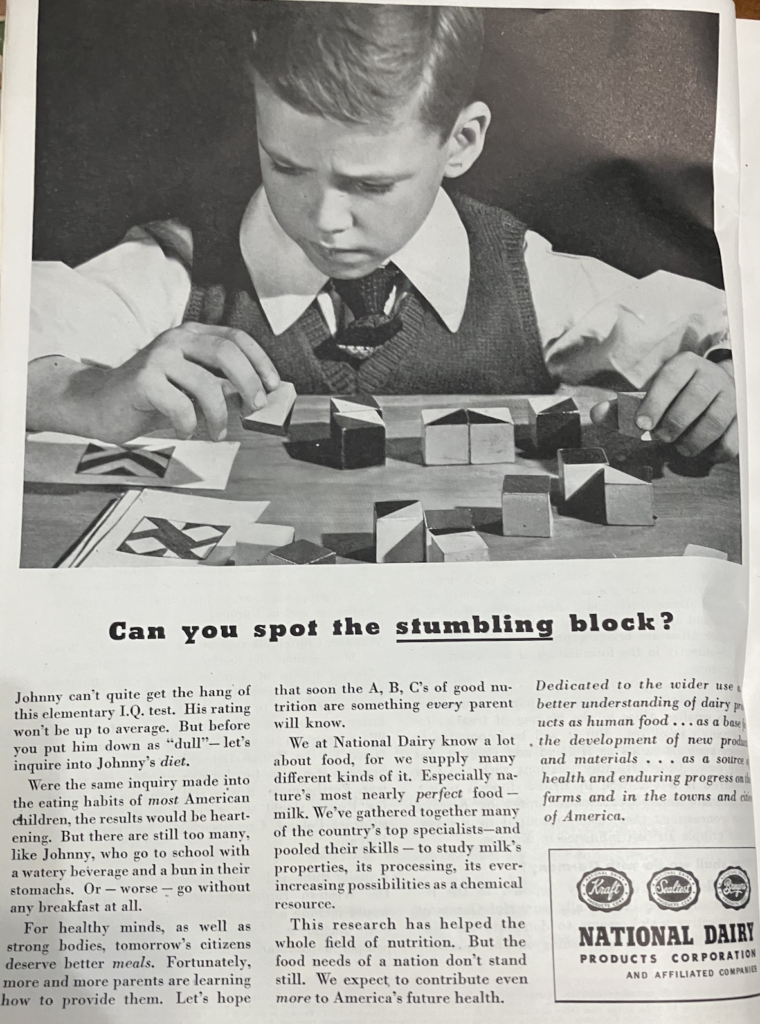
This would fit right in with the current government and its apologists in academia and the news media. Just give him some whole milk!
His archives are apparently available here: https://scua.library.umass.edu/gibson-w-walker/
including some pronouncements on doublespeak for teachers. I suppose he liked some of Orwell’s strictures and not others…
And it’s grossly misrepresenting the elementaryness of that Block Design subtest, at least the item poor Johnny is working on here. Not elementary at all for his age. Not a fair way to sell more milk, I’d say.
Up to a certain point in time, I always received good grades at school
But I still turned out a fool
Even a moment of clarity couldn’t save me
Dropping out of high school only postponed what was to happen inevitably
And now with some passed exams, and even a research masters degree
I can count to three
I know my ABC
I know a bit about history
I know some things regarding geography
I know some biology
But, I still don’t see
I still haven’t found the key
I find #4 especially shocking given that it’s post-WWII.
Numbers 1 and 3 are very anti-feminist if you think about what they’re saying. The woman are being criticized for producing books instead of children.
I suspect that due to language drift, the phrase “cosmopolitan cringe” was conveying then something like “pathetic attempts at social climbing from having been at many places”.
Maybe. In any case it’s an illustration that although virulent anti-Semitism was out, causal anti-Semitism was still very much around.
Stalin used the term “rootless cosmopolitans” (or rather the Russian equivalent), initially to refer to educated urbanites who he felt were insufficiently nationalistic but eventually he came to use mostly as code for Jewish intellectuals. This was the late 1940s, right around the time Gibson wrote this poem, so there’s surely no coincidence here.
Just four years earlier the only Jewish member of the exclusive Maryland Club had died, and H.L. Mencken wrote that the club had decided not to admit any more Jews because “There is no other Jew in Baltimore who seems suitable.”
In essence, I think this is just Gibson echoing an all-too-widespread view of the time, that Jews, however educated they may be, can never be accepted by polite society and are pitiable in their efforts to be accepted. I say “I think” because hey, I’m no expert on this stuff… but honestly I don’t see another interpretation.
Seth:
Considering everything, the mild anti-Jewish prejudice in stanza #4 above isn’t much compared to the sorts of open racism that were acceptable back in 1947. So it’s not like I’m saying that this stanza was morally worse than the others. I was just surprised to see them putting this into circulation in 1947; I naively had thought that naked anti-Jewish racism was out of fashion at that time.
Also I was kinda shocked that he used the word “hate” rather than just displaying a soft Ivy League-style condescension.
Andrew: Ah, I’m not surprised myself, as I’ve had a bit of an interest in the history of anti-Semitism and when the Holocaust became “The Holocaust”. I think people have a compressed idea of the timeline. It was much more gradual and longer term than a quick rejection of prejudice after 1945. The past is another country.
holy snap I just found out about FGM, this is horrible. i feel awful.