Didn’t you love this classic when you were a kid? I know I did, even though now the only part I remember was the bit about them supporting themselves by taking change out of the fountain. I liked a couple others of her books too–they were all at the local public library, along with Freaky Friday, Mrs. Frisby and the Rats of NIMH, A Dog on Barkham Street and The Bully of Barkham Street (those were cool because they told the same story from two different perspectives), The Wolves of Willoughby Chase, the dog- and bear-oriented novels of Walter Morey (I just looked him up on Wikipedia and, hey, he looks a lot like Richard Nixon!), and lots lots more. I guess I could sit here and type out a hundred or so, not even getting to the endless series books like Dr. Doolittle or Beverly Cleary or the little kid books by Dr. Seuss etc.
Anyway, there are some other mixed-up files in the news today featuring some of our recurring characters so I thought I’d share some bits with you:
Noan Chomsky was buddies with . . . Steve Bannon! Oh well, I guess they both share a passion for linguistics and have unusual foreign policy views.
Daniel Kahneman got to meet Woody and Soon-Yi at the corner of 71st and Fifth Avenue. I was trying to figure out what restaurant that was, but I don’t see anything on the map . . . I guess it was Epstein’s apartment?
Also there’s this hilarious exchange:
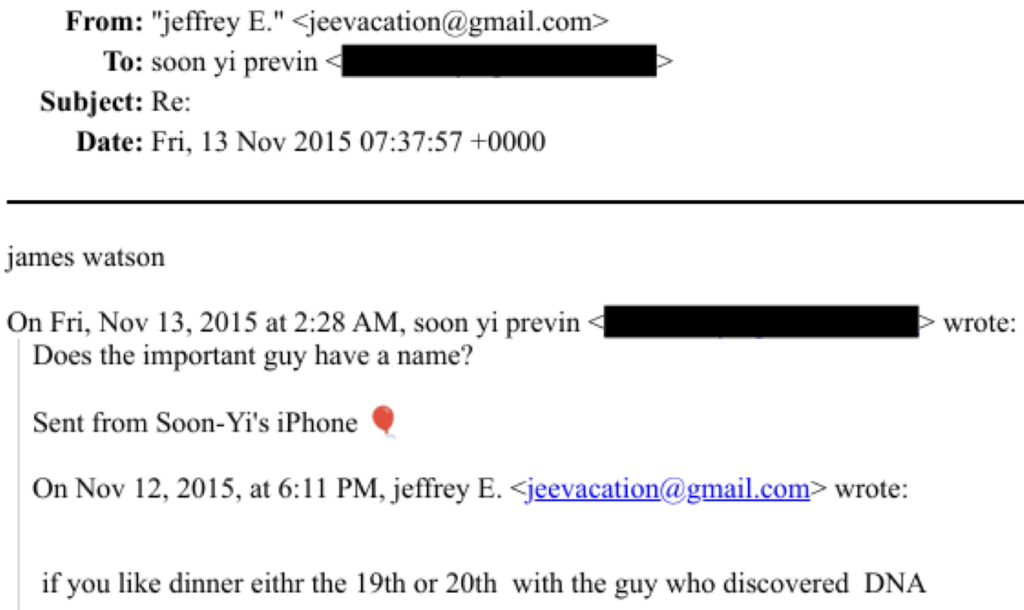
According to Wikipedia, “DNA was first isolated by the Swiss physician Friedrich Miescher who, in 1869, discovered a microscopic substance in the pus of discarded surgical bandages,” but, yeah, whatever, we know what Epstein meant. It’s just a funny exchange. I think that when Soon-Yi asked the name, Epstein should’ve responded, “Who the hell do you think I’m talking about? The ghost of Francis Crick??”
Dan Ariely asked for the name and email of “the redhead that was here with you? She seemed very smart and I would love to be able to meet her again at some point.” I wonder how that worked out? It makes sense that a professor of psychology would like to meet a person who is very smart. I don’t quite get the “redhead” thing, but I guess if you have a conversation with a very smart person and never find out her name, you might still remember the color of her hair.
Lawrence Summers asked for Epstein’s input on financial “schemes.” I’d think that Larry would be rich enough to not need any schemes, but if you’re billing $14,158.88 for a single flight, I guess you need all the money you can get. Also he asked the disgraced financier for advice on Asian opera, something about “option value”–maybe that’s how economists talk? I didn’t know that Epstein was an expert on opera but, hey, I guess he was a cultured guy.
Disgraced primatologist Mark Hauser sent Epstein the pdf of a paper that he (Hauser) characterizes as “the most important theoretical piece I have written. but i leave the judgment to you.” It’s kind of charming that he thinks that Epstein, of the notoriously short attention span, would read an entire scientific article. I’m actually curious what that article is. The email is from 2009 and it says the paper is called Mind the Gap and was in press at Nature. But when I search online, all I can find is a paper from that year called The possibility of impossible cultures, which is chock full of insightful bits like, “Nature provides a bewildering and seemingly unbounded variety of animal forms, from the microscopic (such as insects) to the macroscopic (such as dinosaurs), and from the pointy and spherical (blowfish) to the smooth and cylindrical (snakes).” Pointy and spherical, huh? Also this: “The proposal that our humaniqueness, and these four properties in particular, finds almost no parallels in any other animal suggests that there were fundamental changes in genomic and neurobiological function during a relatively recent period of human evolutionary history.” OK, maybe Epstein would like this blather. But I shouldn’t laugh–this paper has been cited 106 times! Most of my papers haven’t been cited that often.
Also this:
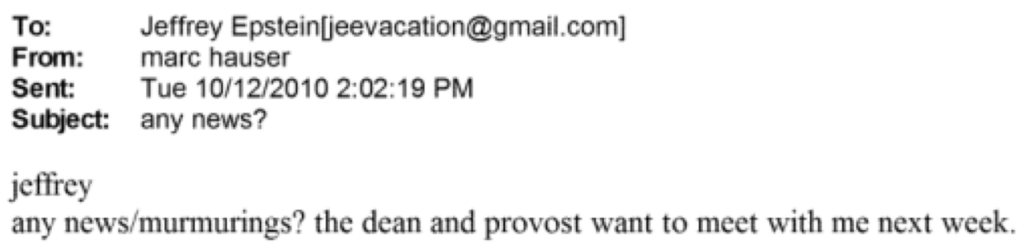
I wonder what was up? Maybe Hauser was about to get a special endowed chair!
Finally, Don Rubin thought that he and Epstein “had some mutual interests concerning the complications of doing experiments with humans,” including “noncompliance with the assigned treatment, which we briefly discussed at dinner” and “the placebo effect, which can be gigantic, for example in ‘viagra’ type studies.” It’s funny: when I was reading this email I was thinking this was one more example of Epstein conning people into thinking he was actually interested in what they had to say–can you imagine the notoriously short-attention-spanned financier being able to focus on statistical problems of noncompliance??–but then when he got to “gigantic” and “viagra,” I started to think that maybe there were some mutual interests here. Also I learned that the Medical Faculty of the University of Uppsala in Sweden gives out honorary degrees like candy. The email also discusses something called “the Emotional Brain female viagra issue” and some dude named Adriaan Tuiten, who I googled and it took me to this paper. It seems that Emotional Brain was a Dutch company was worth $42.50 per share back in 2016—here’s their ad that appeared in Nature, and here’s their creepily-titled 2012 paper, “Toward Personalized Sexual Medicine (Part 1): Integrating the ‘Dual Control Model’ into Differential Drug Treatments for Hypoactive Sexual Desire Disorder and Female Sexual Arousal Disorder.” Ummmm, ok, I could see how Epstein would be interested in this. I can’t find the company anywhere now, though, so I guess it’s not worth $42.50 per share any more. Or maybe they got bought out by some big drug company and the principals are all filthy rich, I dunno.
So many gigantic names, so much viagra, yet all lacking the humaniqueness to stand up to Epstein.
Describing it as Noam Chomsky was “buddies” with Steve Bannon seems a bit of a rhetorical exaggeration. Chomsky does seem to have wanted to chat, but I don’t think that’s too nefarious. I don’t know what was on his mind, but I think Chomsky’s on the side of being willing to argue with people of opposing views and explaining why he is correct, rather than the shun-all-contact-with-“Nazis” side.
Seth:
Say what you want about Steve Bannon, he’s certainly not on the “shun-all-contact-with-Nazis” side!
Tying into the post from yesterday, shouldn’t we be more willing to just toss these people overboard? What is anyone really salvaging by keeping Chomsky around?
By all accounts he was a pretty mean person in linguistics (search this blog), and to me this sort of thing torches whatever leftist credentials he has. The other gimmick he did was responding to e-mails, but like, so do my parents! He seems well below replacement level, when I consider him in aggregate.
Dinosaur: Your goal of tossing Chomsky overboard is rather macabre when, as the saying goes, he currently has one foot in the grave and another on a banana peel. But while nobody is irreplaceable, I rather think there was far more to his body of work over the decades than those eager to talk of his “replacement level”. The sort of purity testing that you appear to want seems pretty scary to me.
+1. Do his revolutionizing of linguistics and his decades of activism and history writing count for nothing?
He has many detractors but the fact that so many people are reacting to him (positively or negatively) still speaks to his influence.
Well, for one thing, you sure as hell know someone has made his mark when he has divided an academic discipline into “Pro-Him” and “Anti-Him” camps.
Bannon isn’t the worst person Chomsky has met. In his own words, he has met “major war criminals.”
He still criticizes them as such, and he did the same to Bannon in 2019, after those emails (“an impresario of an ultranationalist movement”.)
Do you not have any friends whose politics you vehemently disagree with? Sad if so.
Another analogy: a CIA interrogator said he would rather spend time with Saddam Hussein than George W. Bush.
https://www.bbc.com/news/world-us-canada-38497767
More Epstein…
On Summers, it sounds like he is struggling with whether to keep going on a relationship. He doesn’t like the Asian opera, but is willing to continue for potential positives in the future.
The MAGA crowd was wrong about a lot of stuff but they sure seem to have been right about the, um, far-reaching elite pedophile conspiracy … sigh.
Yet they still frame it as a criminal democratic enterprise with Hillary et al at the helm that is being undone by the moral clarity & power of this administration.
Can you name any of the elite people involved in this pedo conspiracy?
There are worse ways to free up budget for new hires at universities than firing anyone who initiated contact with Epstein after 2008. That might not be strictly legal but neither was making the former prince Andrew move out of his palace. It’s always such charming characters too!
I saw a news report on Dan Ariely, and the first thing I thought was, “I bet this blog has an interesting commentary on this,” and I was right!
Not sure if you caught this one from Hauser (https://www.justice.gov/epstein/files/DataSet%209/EFTA00779091.pdf). He withdrew from a “Morality Conference” because he did not want to taint it due to his issues. How noble.
My takeaway from briefly looking through some of the documents is that I continue to be struck by the “club” atmosphere of these rich and famous (or would-bes). The allure of money, influence, and sex permeates so many of these interactions. As someone not inside this club, it matches the simplistic characterization of the lives of the rich and famous. They are not like us and really feel superior to us. Conscience does not seem to be part of their world. Politics, business, academia: they all seem to be caught up in this. Most of the documents seem to show something close to groveling for Epstein’s attention. I do wonder how it got that way – was it his money, his personality, or did he weave a set of connections that created an aura around himself?
Dale:
Yes, I did see that! I’m embarrassed to say that I spent an hour or so going through those emails. The Hauser item you cite came from a long series in which he was feeling sorry for himself. For what it’s worth, it does seem that he was withdrawing from that conference so as to spare them the bad publicity.
Regarding your question of how this happened, I’ve tried out a few theories.
Here I wrote that “celebrities are a kind of club. I’ve noticed this with science celebrities, that with rare exceptions they tend to defend each other . . . I’ve always attributed this to a feeling of affinity: once you become a celebrity, you feel empathy to other celebrities. But now I’m thinking that a lot of this is selection: one way to become a celebrity is to play the celebrity endorsement game. . . . Similarly with Epstein: I’m sure there were lots of businessmen who had the opportunity to hang with Jeff but didn’t want to, lots of Harvard-affiliated people who avoided the guy, etc.–but they’re not the ones in the files.” So, some selection bias: you don’t hear about all the academics, businessmen, and politicians who avoided Epstein.
Here I listed some hypotheses of how some legitimately brilliant and successful people were so receptive to Epstein’s charms:
(a) They thought Epstein might send some money their way.
(b) They were in the habit of asking sucking up to rich people for money so they were just sucking up to Epstein out of habit.
(c) They thought they might get some sex with underage women out of the deal.
(d) They liked to hang out with Epstein because he thought Epstein was cool.
(e) They genuinely enjoyed hanging out with Epstein.
I have a horrible feeling that for a lot of these people it was a mixture of all 5 of these things! I guess another option is that they enjoyed free Caribbean vacations and didn’t look too carefully at the other people at the resort.
In the cases in the above post, I think (a) was most of it. Epstein was known to throw money around. But it’s not just that. I get the impression that Epstein was able to get these otherwise smart people to believe that he was actually listening to them when they yammered on about their research.
The other thing is that sucking up to rich and powerful people is a legitimate skill. It’s natural for us to laugh at these scientists, businessmen, and politicians who were Epstein toadies and think of them as pitiful, but . . . it can be hard to get rich guys to part with their money. Obsequious flattery and abandonment of your dignity can be the price you pay to get in the room.
Consider Lawrence Summers, for example. When he was president of Harvard, sucking up to rich people was pretty much his job, so it’s not such a surprise that he kept doing it after his term was up.
Add Lisa Randall to the list. Harvard Crimson just put out an article. You’ll be amused to know they used a photo of her on stage with Marc Hauser
Wow–the best part of that story was that Epstein said that Randall “is not a great physicist” but an “attractor.” That’s just mean.
As I wrote a couple years ago, I really dodged a bullet by not signing a contract with that literary agent who was in the midst of all this.
“supporting themselves by taking change out of the fountain”
This is exactly the only part I remember!
Hey, I’m glad that at least one person read that paragraph of my post.
I know Andrew Gelman isn’t a huge fan of Malcolm Gladwell, but it seems to me these two could collaborate on a follow-piece to Gladwell’s famous article “Six Degrees of Lois Weisberg”. Epstein strikes me as a malign mirror-image version of the kind, friendly woman at the heart of Gladwell’s piece. Both were brilliant at connecting people. The list above of six reasons to hang out with Epstein misses out an important one: the desire of celebrities to meet celebrities in other fields, fields that normally have little contact with each other. You’re a famous movie director and you’d like to meet the co-discoverer of DNA? Your pal Jeffrey will help. “Woody, meet Jim Watson.” You’re a left-wing icon and you want to meet an icon of the far right? Jeffrey will help. “Noam, let me introduce Steve Bannon.” You’re a celebrity in any field and you have a weird, snobbish desire to meet a royal? Jeffrey says to you, “Let me introduce my friend Prince Andrew …”
If in addition, you have a taste for sex with underage girls, Jeffrey can facilitate encounters with one or more of them. A bonus!
Roland:
I’ve never met Gladwell, but he sent me an email once suggesting we get together for coffee sometime. I said sure but then he didn’t get back to me. I guess he’s a very busy man.
Hi,
I knew Malcolm Gladwell years ago, when we were both undergraduates in residence at Trinity College, University of Toronto (a strange place, but that’s a different story). I certainly couldn’t have guessed at his future fame. He stood out from people in his year – I was three years ahead – only in being unusually polite and soft-spoken. He was very likeable back then; I have no idea if he’s that now. I liked his early journalism. For instance, his contrarian article, written in the late 1990s or early 2000s when most journalists were going on at tedious length about the glories of the Internet, in which he argued that for business, the TRULY important innovation was bar codes. Wrong but thought-provoking. The Lois Weisberg piece was good too. Sadly, in recent years he seems to be drawn to trendy pseudo-science. This is what happens to decent Canadians who move to the US – in the Basket of Deplorables, the country that proudly flies the Scars and Spites, they eventually lose their moral fibre and become decadent :-)
I know the proper reaction to yet more Epstein stuff is to make fun of him and the people around him, but I have a somewhat sober thought. My hunch is that those who become very rich or very successful in their careers — and are men — are also likely to parlay that into affairs or more ephemeral sex. They can, right? So Epstein, who wanted to place himself in the middle of those networks, expedited these guys on all fronts. He connected people who wouldn’t have connected otherwise, provided resources (money for academics, academic glitter for billionaires) where they were wanted, and along the way also hooked up high achieving men with women who thought, or were induced to think, this could lead to something for them.
The popular view of Epstein is as an evil corrupter, but maybe he was just an all-purpose facilitator.
Yeah the idea that there was actual economic value in his role is pretty scary.
Like sure, if it’s just Les Wexner’s insane immoral personal values that drives him to give Epstein so much money — sure, that seems solvable.
But if this is some sort of large scale, underlying economic value here — that would suggest there is strong pressure to create some new Epstein characters!
It does seem like an archetypal dealer niche that has probably existed for as long as there have been imperial elites. The massive profits will draw clever young men with loose morals unless you are willing to go Duterte on them.
I’m curious what critical theorists have to say about the history of the phenomenon. I also wonder if there exist alternative equilibria, ones where you don’t need to execute everyone with a college degree but still make pimping out Eastern European teens uncool. Evangelical Christianity or some form of Islam might do the trick, but I don’t think I’m willing to trade music, dance and human rights for it.
Peter:
I think that’s an accurate description of Epstein as a middleman who, like middlemen in general, made money by facilitating connections.
Just one thing, following up on your point that the women “thought, or were induced to think, this could lead to something for them”:
I think this is true of lots of the men, too! They thought this could lead to something for them, but that “something” often never came, it was always just over the horizon.
Just to go through the people mentioned in the above post:
– Noam Chomsky. What did Noam get out of his Epstein connection? He got to go to some lame-ass Caribbean vacation spot with his wife, but I’m guessing they have enough money that they could’ve just taken a normal vacation just like everybody else. And he got to be pen pals with Jeffrey Epstein and Steve Bannon . . . seems more of a minus than a plus to me.
– Steve Bannon. Did Jeff ever give him money? I don’t know. If not, all he got from the vaunted Epstein connection was the ability to hang out with Noam Chomsky, which again sounds like something that most of us would pay to avoid!
– Daniel Kahneman. OK, he got to meet Woody Allen. That could be fun. I don’t know how witty Woody was in person, but if he was in top form, I could imagine that lunch with Woody could be a once-in-a-lifetime experience. Beyond that, he published books using Epstein’s favorite literary agent. But there are lots of agents out there–no way that a Nobel prizewinning psychologist would’ve needed any special favors in that domain. And there’s no evidence that he, or or that matter, Noam or Steve, was getting any nookie out of this.
– Soon-Yi Previn. I don’t know what her day is like, but I imagine that meeting celebrities is a big part of it, and she didn’t need Jeff’s help in that regard. And I can’t imagine she got much out of talking with James Watson, seeing as it seems that she’d never heard of the guy.
– Dan Ariely. Again, the book agent. But, again, Ariely was a good writer with the superpower of not being constrained by the truth. I’m pretty sure his books would’ve been picked up in any case. There was that redhead, but . . . Ariely teaches at a respected university! He hardly needed some middle-aged financier to set him up with people who seemed very smart.
– Lawrence Summers. OK, Epstein actually gave him $ and dating advice. I don’t know that the dating advice was very good, but, hey, money is money. Summers got something from the deal. On the other hand, Summers had learned at Harvard how to flatter rich people out of their money, so I don’t know if the marginal benefit of asking a sex trafficker was so great.
– Marc Hauser. In one of his emails, he asks Epstein to intervene at Harvard to get him off the hook for research misconduct. It didn’t work. So the one time Epstein could theoretically have helped somebody on this list, it didn’t really happen. Props to Jeff for not burning his Harvard credibility on a scientific fraud. Dershowitz and Summers were better investments–they were much more connected than blowhard Hauser.
– Donald Rubin. This is the saddest one for me. I assume Don’s main motivation was the hope of $–in one of his emails he goes on about this female-viagra-related business opportunity, trying to get Jeff to invest in it or maybe just trying to curry favor for Epstein by giving him a hot tip, in the vague hope of getting something back in the future–but to do this he was humiliating himself by lecturing the bored financier on potential outcome theory.
What I’m getting at was that Epstein seems like a bit of a con man in his social relations as well as in his businesses. He gave some money to a few people (Summers, those MIT media lab people, and some shadowy figure called Martin Nowak) and sex to some others (I won’t speculate on that one, other than to say that Alan Dershowitz and Andrew Mountbatten were definitely not involved, as both of them firmly denied it) and that was enough to get all those other people to surround him like moths around a flame, hoping that they’d get lucky too.
It could be that, for Epstein, having all these bigshots fawning over him (“Great meeting yesterday — really enjoyed it”) was an end in itself. Maybe he enjoyed stringing them along.
No, he was an evil corrupter. Ghislaine Maxwell targeted 14 year old girls with little parental and financial support and groomed them to accept more and more sexualised behaviour from Jeffrey Epstein – starting with massage and ending in sex.
To refer to these relationships as if they were transactional relationships between adults minimises the evil these very young women encountered and the horrors they experienced.
See https://www.theguardian.com/us-news/2021/dec/29/ghislaine-maxwell-jeffrey-epstein-accusers-stories
Yes, good point.
Agreed, Epstein pushed the envelope on child sex, and that’s pretty unambiguously evil. Nevertheless, the move from openly extractive sex with young adults, as documented in especially creepy fashion in one of the new Larry Summers-Epstein exchanges (the “yellow peril” one), to extractive sex with teenagers is mostly one of degree, no?
Kahneman link seems like the same link as the Noam link.
Link fixed; thanks.
Response from Dan Ariely about his connections: https://www.dukechronicle.com/article/my-connection-with-jeffrey-epstein-20260202
TLDR: his “I am not friends with a human trafficker” T-shirt has people asking a lot of questions already answered by my shirt” lol
Anon:
Yeah, here’s the best part:
Funny that he identified the woman by her hair color and not as “a microbiologist” or whatever–if Ariely remembered her from an intellectual conversation and she was Epstein’s colleague, it would make sense to identify her by what she worked on, no?
A seemingly unrelated news came out that Duke will close Dan Ariely’s center.
https://www.dukechronicle.com/article/duke-university-professor-dan-ariely-center-for-advanced-hindsigh-closes-epstein-files-strategic-realignment-20260206
Wow–I wonder where all the paper shredders will go.
This was interesting too: “He also said that he only met Epstein four times. The files show at least seven instances of Ariely being in small gatherings with Epstein.”
I guess you can be in a small gathering with someone without actually meeting him.
Why is the title of Tuiten’s peer-reviewed paper considered “creepy” by you?
James:
It’s not that the title is creepy in itself. What’s creepy is that research on “Hypoactive Sexual Desire Disorder and Female Sexual Arousal Disorder” was being funded by a sex trafficker of underage girls. “Female sexual arousal disorder,” indeed. It looks to me that Epstein and his many well-placed friends had a lot of male sexual arousal disorder. Which is what it is–people have disorders–but maybe they’re not the best ones to pontificate about the sexual arousal disorders of women.
Also the greed. You have these sexual harassers trying to make money off of female sexual arousal disorder. Just disgusting.
You seem to think that Epstein’s money was involved. It wasn’t. Tuiten and his company never received a penny from Epstein. Their funding came from the Dutch government and their patents.
James:
Why do you think that I think Epstein’s money was involved? After reading the emails, my impression was that Rubin was trying to get Epstein to invest in the project, not that Epstein actually invested in it.