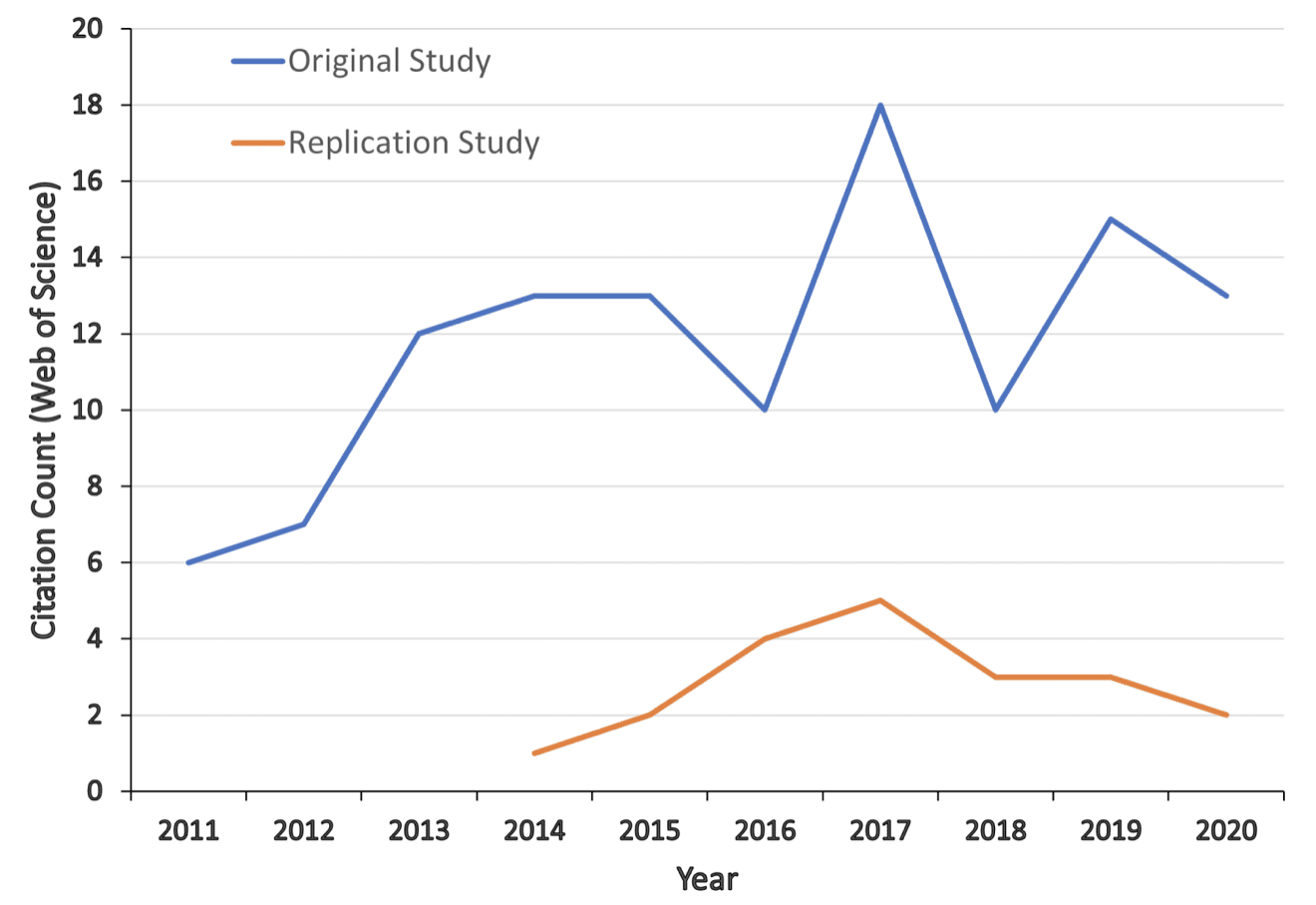
I was talking with someone the other day about some disputed claim in science, something that nobody, including the researchers who published the original claim, ever seem to have replicated. This particular example did not involve Brian Wansink or Dan Ariely, nor did it involve the lucky golf ball study that was promoted by the Association for Psychological Science long after it had been debunked (not that a debunking should’ve been necessary, given how ridiculous the study was in the first place); indeed it had nothing to do with psychology at all, but it had a similar flavor in that the lack of any attempt to replicate gave my correspondent a sense of distrust: whether it’s fraud or forking paths or Clarke’s law or whatever else, there he had a feeling that something fishy was going on. To put it another way, yeah, honesty and transparency are not enough, and it’s possible for good people to do bad science if they’re following rules that don’t make sense, but in this case it seemed that there was some dishonesty and non-transparency in the system.
Here’s my question.
For the same reason these problems were clear to my correspondent, they should be clear to others. So how does this stay afloat?
I don’t know, but here’s a theory. It helps to have some core of fraud or bad faith—some researchers on the inside who feel like they already know the answer and are willing to do what it takes to squeeze that answer out of the data. But then you need some group surrounding them who are motivated to keep the ball in the air, out of some mix of confusion, wishful thinking, misinterpretation evidence, and political or scientific ideology.
I think this perspective of mine is slightly different from our usual model of scientific error and scientific progress.
Under the usual model, researchers come up with ideas and design experiments to test them, and researchers gather data from which they learn new things, motivating new theories and new experiments. Again under this usual model, sometimes (often!) there is error: bad theories are tested and sometimes apparently confirmed, mistaken inferences are drawn from data, and then eventually bad ideas are rejected or modified in order to line up with reality, as represented by followup studies, direct and indirect replications, new theories, etc. This is the self-correcting nature of science.
One thing I’ve emphasized in the past is that “science” is self-correcting only because individual scientists do the work of checking past theories and empirical claims, revising theories, and in general correcting the record. It’s similar to how the checks and balances of our government rely on actual government officials doing the checking and balancing. The system is made up of people; nothing is automatic.
But my point in this post is slightly different. Here I’m not talking so much about how errors get investigated and fixed, but rather how they get propagated. And what I want to say is that I think this happens pretty deliberately.
I don’t mean this in a sinister way, necessarily, the idea that crafty researchers are using their networking powers to insert bad work into the literature—even though, yes, I think this happens all the time—but rather in more general terms, that it takes a lot of active effort to keep these bad ideas in embodied cognition, evolutionary psychology, subliminal effects, etc., continuing in the scientific literature. In the same way that the Loch Ness monster, UFOs as space aliens, and various political conspiracy theories require constant refreshing to stay in the news. Yes, people hold all sorts of silly beliefs—a third of Americans say they believe in ghosts!—but passive belief is not enough. Well-connected people need to be actively promoting them, or they drift to the back of the collective consciousness.
In summary: I think that for bad science to persist and continue, you need (1) a core of ethically or methodologically compromised people who are willing to fabricate data or create misleading evidence, and (2) a larger group of people who, for whatever reasons, are willing to set aside natural skepticism to promote these ideas.
This also gives some insight as to why it can be so hard to correct the record (as demonstrated by that graph at the top of this post). These bad ideas are not just mistakes that unfortunately propagated through the literature; they are mistakes or frauds or mistakes that are so bad they’re as good as frauds that are then pushed into the literature and maintained there through the efforts of locally-powerful elites, as when Freakonomics promoted that innumerate beauty-and-sex-ratio study and that climate-change denier.
Recall this story from psychologist Greg Francis recounting his difficulty pushing back against that horrible “lucky golf ball” paper:
In 2012, I submitted a commentary to Psychological Sciences on the Damish et al. (2010) paper when I realized the results seemed “too good to be true”. The editor rejected the commentary based on the feedback from “a very disitnguished professor of experimental design and statistical methods” who wrote (among other things), “I would not be at all surprised if there is publication bias involved. If I had run a study on superstition and the results were null, I would not likely submit it for publication.”
I had not noticed at the time, but I later realized that the means reported in Experiment 4 of the Damish et al. paper fail a GRIM test. The measure of performance is the number of correctly identified words, so the sum of scores across participants of each condition must be an integer value. Damish et al. do not report their sample sizes for each of two conditions, just the total sample size (n1+n2=29). The reported mean for participants with the lucky charm (M1=45.84) and the mean for participants without their lucky charm (M2=30.56) cannot simultaneously be produced by any combination of n1 and n2 sample sizes that together add up to a total sample size of 29. For example, if n1=14, then the sum of ratings would be n1*M1=641.76, which presumably rounds up to 642 (it has to be an integer because it is a count of correctly identified words). But 642/14=45.857, which does not match the reported 45.84. Rounding down does not help either because 641/14=45.785, which does not match the reported mean. There is no way to get M1=45.84 from n1=14 participants. For other combinations of n1 and n2, you can get one of the means to make sense, but never both simultaneously.
So, yeah, work on this silly topic gets pushed into journals, and dissent gets slapped back. This sort of behavior is consistent with a Lakatosian view of scientific research programmes, so in some way all of us who think about the sociology of science are aware of it. But I think it’s easy for us to slip into a naive view that bad ideas are just mistakes that stay afloat for awhile until they are eventually refuted via failed replications. Actually a lot of effort is put into propping up the status quo, efforts that include attacks delivered by the editorial boards of scientific journals; the repeated use of PNAS, Ted, NPR, etc. to promote bad work; suppression of dissent (as happened to Greg Francis as described just above); and promotion of misinformation by major academic institutions. After many years, Harvard finally stopped promoting that fraudulent Jesus’s wife manuscript, but as far as I know they never retracted their ridiculous claim that the replication rate in psychology “is statistically indistinguishable from 100%.”
Again, for each of these things, there’s the ethically or methodologically corrupt core and then the larger group of influencers who promote things when they should know better, presumably out of some feeling that the bad work is directionally correct and so deserves to be protected against criticism.
Quote from the blog post: “In summary: I think that for bad science to persist and continue, you need (1) a core of ethically or methodologically compromised people who are willing to fabricate data or create misleading evidence, and (2) a larger group of people who, for whatever reasons, are willing to set aside natural skepticism to promote these ideas.”
I hope I am understanding things correclty here, but I think it might be useful to add the following. Perhaps (2) also includes or involves people who are not necessarily “willing” to set aside natural skepticism to promote these ideas, but are “not (yet) capable”. The latter might involve PhD students who simply and truly do not know better and/or might even be there because they don’t ask too many difficult questions.
Some quotes in this light that might be relevant here can possibly be found in Smaldino & McElreath’s (2016) paper titled “The natural selection of bad science” and Levelt et al. (2012)’s investigative report concerning a certain fraud case. If I’m not mistaken, Smaldino & McElreath (2016) write the following about the existance and promotion of bad or sub-optimal methodologies, the gist of which is perhaps also relevant concerning the existance and promotion of erroneous or fraudulent findings and claims:
“In the same way, common methodologies in scientific communities can change over time not only because established researchers are strategically changing their methods, but also because certain researchers are more successful in transmitting their methods to younger generations.” (p. 4)
And this following quote is from Levelt et al. (2012) concerning their findings:
“Another clear sign is that when interviewed, several co-authors who did perform the analyses themselves, and were not all from Stapel’s ‘school’, defended the serious and less serious violations of proper scientific method with the words: that is what I have learned in practice; everyone in my research environment does the same, and so does everyone we talk to at international conferences.” (p. 48)
Perhaps there could be something changed here in light of the above if it makes sense. So, one could possibly add a (3) to your suggestions, or add something to your (2) which is what I did in the following:
“In summary: I think that for bad science to persist and continue, you need (1) a core of ethically or methodologically compromised people who are willing to fabricate data or create misleading evidence, and (2) a larger group of people who, for whatever reasons, are willing to set aside natural skepticism to promote these ideas and/or are unable to even be skeptical or critical enough to possibly notice problematic issues.”
I think that when one understands a good story, that the source or sources fade away leaving one with mainly the story, which gets integrated into one’s memory and thinking. To cite a reference in a paper, one may have to remember or (more likely) dig up a citation, but one is looking for a citation to support what one “knows” and that’s a different thing.
I think the examples of bad science initiated by “nobodies” (those without Ivy-type credentials or those not teaching at prestigious institutions) that gain traction and are hard to displace – are few. The “corrupt core” you refer to needs (mostly) to be people respected either by their past experience, credentials, or connections. The “core” in such cases might be just one individual (e.g., a Nobel Prize winner). They may be corrupt, though I suspect that more often they are convinced that they are right and just look for, or sometimes manufacture, “evidence” to support their belief. The academic hierarchy then protects their work from attack. This is not inconsistent with your story, but I would put the emphasis more on the power structures in academia than on the ideas themselves.
What I find most interesting in this post is your analogy to the “checks and balances” in government. I now view these are more reliant on trust than I used to think. Perhaps this is also true in research. There is a trust that scientists with good credentials won’t abuse the process just as their used to be a trust that Congress or the Courts would prevent a runaway Executive Branch. I think this trust of government checks and balances is pretty much destroyed. The academic trust in pedigrees as a check on bad science is proving harder to dislodge. The unfortunate thing in both cases is that when trust disappears it leaves a vacuum. Some might say that is good – we should not trust such things and can now move on to true verification of ideas and actions. But when “truth” is hard to establish, I think it just leaves a vacuum.
Andrew wrote:
“I think that for bad science to persist and continue, you need (1) a core of ethically or methodologically compromised people who are willing to fabricate data or create misleading evidence, and (2) a larger group of people who, for whatever reasons, are willing to set aside natural skepticism to promote these ideas.”
This perfectly fits what I have found poking around the Manycoauthors site. Once it dawned on me that Francesca Gino was never going to get data that supported a legitimate p<.001 result from her silly interventions – despite having reported that number over a hundred times – many things began to reveal themselves. Most significantly, in papers where Gino collected the data on one or more studies, but others did all the data handling on other studies in the same paper, how the heck can so many coauthors go through the process of publication without noticing that Gino's primary effect p values are always far lower than theirs?
There are all sorts of ways to give these coauthors the benefit of the doubt, but seriously, should we? Maybe they felt the results went in the right direction, as Andrew speculates. And there is much to support that on Manycoauthors, where many of the narratives on the website written by Gino's coauthors attest to how the effect found by Gino was confirmed in other studies that did not involve Gino, as if that somehow absolves the coauthor of not noticing problems. We could also give them the benefit of the doubt on the p values. If you are a quarterback but not Tom Brady, should others expect you to go out and produce Brady's numbers every day? So maybe the coauthors thought that they were working with a p value superstar and so were never going to produce numbers like that.
More likely it was just a "see no evil" situation.
The interesting thing is how much the idea generalizes to power structures and “human knowledge” in general.
Groups actively propagandize for or against ideas massively throughout society. When looked at unveiled, huge amounts of “common knowledge” or “cultural history” or what’s in textbooks for undergrads or whatever are just faked up bullshit motivated often by rich and powerful or people indirectly manipulated by rich and powerful.
Some bizarre examples include the CIA funding various cultural organizations which in turn funded various trends in art which enabled Abstract Expressionism to become a cultural powerhouse https://www.bbc.com/culture/article/20161004-was-modern-art-a-weapon-of-the-cia
But also tropes about subliminal messaging and advertising from the mid 20th century were certainly aided and abetted by MKULTRA, more recently we have the plastic recycling industry which was a cultural propaganda op invented in the 90s by the fossil fuel and plastics industry https://www.theguardian.com/us-news/2024/feb/15/recycling-plastics-producers-report we’ve got the opioid epidemic which was created by propaganda fed to doctors by Perdue pharma, we’ve got the current AI boom which is set to collapse as an economic op to funnel money into the hands of certain investors, there was “Havana Syndrome” which was clearly an op of some kind. Theres Elon Musk out in the open saying how hes actively manufacturing a lie machine (Grok) and connecting it to his personal propaganda platform (X). And there was the Telegram channel where billionaires puppeted Eric Adams, Columbia University, and the NYPD over the Gaza protests.
The amazing thing is that stuff comes out about how powerful interests actively manipulate public perception through a combination of spending money, recruiting useful idiots, buying up the public mouthpieces (media companies etc) doing backroom deals with government and business partners, etc and it all gets memory holed or ignored or brushed under the carpet while people busily go to school for the latest hype to learn to be a middle-hype-manager and make a good salary lying to the public.
Science isn’t different. Its a good gig to be a Harvard professor, to go around the country to talk about power posing or sleep science or the psychology of truthiness and signing documents at the top or the bottom or whatever, to promote stuff about climate change that fossil fuel billionaires like and indirectly create shadow companies to fund and get big speaking fees, and have Russia indirectly pay for your lifestyle. To be an economist working for a think tank and actively fight against modern monetary theory because powerful people in the banking industry dont want the public to know how manipulated the economy is. Etc etc
So yes, bullshit gets perpetuated and often by an active manipulation process.
Maybe there’s a CIA of Science (COS) who attempt to destabalize countries by introducing psychological constructs or by promoting social science research concerning certain topics which these countries might not even ever heard of.
Or the CIA of Science (COS) could promote large-scale international collaborative efforts which might show that participants in country A are way more happy than participants in country B, which could lead to envy in people from country B, who knows.
Or the CIA of Science (COS) could propose and promote large-scale research which all move through their data collection system, you know because that’s just efficient and saves money.
Or the CIA of Science (COS) could try and make sure their puppets are put in positions to influence matters, for instance by making them become part of designing and reviewing and financing research in some sort of format where they might influence matters even before any research is even performed.
Or the CIA of Science (COS) might receive lots of money to develop certain things, or propose certain things, or work with other similar organizations like DARPA or the FBI or who knows what or who.
Perhaps I might be a bit more skeptical here now in 2025 than Popper might have been when he wrote the following in his 1971 paper titled “The moral responsibility of the scientist”:
“I am confident that in fact most scientists, at least most creative scientists, value independent and critical thinking very highly. Most of them hate the very idea of a society manipulated by the technologists and by mass-communication.” (p. 283)
“To be an economist working for a think tank and actively fight against modern monetary theory because powerful people in the banking industry dont want the public to know how manipulated the economy is. Etc etc”
Jesus. Of all the economic theories you could have chosen as an example, you choose a laughable crank theory like MMT? Really?
MMT is literally what you get by simply drawing a box around say M2 money and drawing the arrows that flow into and out of the box, its the very first step an undergraduate systems engineering student would use to analyze the flow of money. That you call it “laughably crank” is indicative of exactly how broken Economics is as a “science”.
The lessons people take from that knowledge could vary in quality but the description of where money comes from and how its created and destroyed are basically trivial and unarguable.
Just to make it clear what I’m saying heres the things that increase and decrease M2:
Money creation:
Govt purchasing services and goods
Govt paying interest and principal on bonds
Banks making loans
Printing currency
Money destruction:
Taxes
Citizens buying Govt Bonds
Repayment of bank loan principal
Collecting and destroying currency
Thats the essence of MMT and its essentially trivial (I may have left out an item or two I’m on a dog walk)
Yes, the CIA was active in civil society in ways that people today would find hard to believe. For example, in the early 1960s when the CIA had operatives in the National Student Association. I remember hanging out with a guy who turned out to be one of them.
Science by its very nature has to rely on a structure of hierarchical credentialing and trust. How to frame questions, what methodologies to use, what prior results to rely on, and how scarce resources should be allocated across individuals and organizations — these things can’t be invented from scratch in each situation. Norms and expectations develop and have persistence. There are large advantages, psychic as well as financial, from being situated on the higher end of those hierarchies. (My experience, FWIW, is that, for a lot of academics, their compensation for getting less pay than corresponding private sector professionals is esteem. Academia selects for this.) This creates the incentive to fudge, of course, but it also creates second-order incentives to attach yourself to those whose credentials reflect positively on yours. There can be a directly clientelist character to this attachment when it takes the form of an exchange, which I brought up in a recent piece on “modern” clientelism: https://doi.org/10.1007/s11186-024-09582-3.
Quote from above: “This creates the incentive to fudge, of course, but it also creates second-order incentives to attach yourself to those whose credentials reflect positively on yours”
This reminded me of the following from the Levelt et al. (2012) investigation report concerning the fraud case of Stapel:
“In a formal sense, the people affected are hampered in their careers, such as when extending temporary contracts and applying for grants. To have had Mr Stapel as PhD supervisor once worked in a student’s favour; but the opposite is now true.” (p. 34)
I don’t know exactly what clientelism entails or involves, and I can’t access your paper, but since you mention it here I now wonder whether you could apply a clientelist view to several issues or processes in science, and whether that might be a specific focus that might be interesting to write a paper about.
I think I have heard about certain “tactical” citing of certain people in a field, or “honorary authorship” in which people are added as co-authors without having done much to contribute and warrent the adding, or about the “cult-like” features or academia, or about how academia “resembles a drug gang” or “pyramid scheme”, which can perhaps all be seen in light of clientelism (?).
Possible new paper idea: “Clientelism in the academic frame”?
Sorry about the paywall; I can’t afford the open access fee. Here’s the passage:
Participants in academic life tend to regard their enterprises as meritocratic, and to a large extent they have to be right. Surely the advancement of knowledge along a broad if uneven front is inconceivable without the general allocation of academic prestige according to merit. Yet merit is difficult to ascertain in the heat of intellectual battle, and there are other worthy criteria besides being smart. Moreover, academic systems, like others, are adaptable and can sustain a measure of non-meritocracy in their status hierarchies without being rendered entirely perverse.
On this basis, the patron-client relationship has become a familiar sight in academia. Consider the interaction between senior professors on the one hand and junior professors or graduate students on the other. The well-established and well-connected academics have much to offer to their lesser colleagues and students: they can supply ready-made research programs and access to prestigious professional associations and journals, not to mention sage advice. They can write stirring letters of recommendation and invite those beneath them to share coauthorship. They can be invaluable in securing grants. And what do they want in return? Loyalty, in its academic form. This means siding with the senior professor in intellectual conflict or simply assisting in the execution of their research program. Perhaps the purest distillation of this relationship can be found in the laboratory sciences, where junior researchers often devote years to advancing the agenda of senior academics in the expectation that they will be rewarded in due course with the opportunity to assume senior positions themselves, but similar mechanisms operate in other domains, especially in the supervision of dissertations. Over time, a strategically astute senor professor can assemble a veritable academic army, ultimately a resource that can decide the fate of their ideas. Intellectual leaders without followers are generally soon forgotten, no matter how brilliant; movements with ample foot soldiers carry the day or at least give other movements the agonistic opportunity to shine. At retirement the festschrift is often the final mustering of the troops, the opportunity to size up the impact one has made. In short, the senior professor receives a flow of academic loyalty that enhances their status and expands the benefits they can transmit to their acolytes.
It should be noted that academic clientelism often presents itself as mentorship, and rightfully so. Academic patrons normally serve as mentors to their apprentices, and their success in carrying out this function plays a role in their assessment by deans and others. What distinguishes clientelism is that it is contingent mentorship: the services of the mentor are offered in the expectation that their recipient will provide academically meaningful support and are scaled back or even withheld otherwise. (Contingency, like mentorship, occurs in gradations.) Of course, personalism typically plays a key role in this process, and the student or junior professor normally experiences their outflow of loyalty as an expression of their gratitude for the opportunities extended to them and their appreciation for the importance of the senior professor’s research program. The exchange aspect introduces a psychological bias to this evaluation (explicable as an avoidance of cognitive dissonance), but it does not in general imply dishonesty. In practice, the clientelist assemblage of waves of academic cohorts into cohesive intellectual movements is productive, so long as it doesn’t displace at an institutional level other, more disinterested procedures for allocating research and teaching funds, employment, publication opportunities and other desiderata.
Thank you for the reply and text! That was perhaps a mini version of the possible paper titled “Clientelism in the academic frame”.
The sentence “Over time, a strategically astute senor professor can assemble a veritable academic army, ultimately a resource that can decide the fate of their ideas.” reminded me of that quote from Meehl which goes something like:
“Perhaps the easiest way to convince yourself is by scanning the literature of soft psychology over the last 30 years and noticing what happens to theories. Most of them suffer the fate that General MacArthur ascribed to old generals—They never die, they just slowly fade away.”
In light of clientelism, and your sentence concerning assembling a veritable academic army, perhaps we should add something about the role of the old general’s subordinates (lieutenant general? major general?) in this Meehl quote as well…
“Science by its very nature has to rely on a structure of hierarchical credentialing and trust.”
I disagree with this fundamental assumption in the strongest terms. It seems to me like this is an argument more from experience of what has been rather than necessity imposed by “its very nature”.
It’s the nature of science of course that some people have more knowledge about a topic than others. But that doesn’t necessitate that those people be in charge of “what prior results to rely on, and how scarce resources should be allocated”. Furthermore, the community doesn’t necessarily have perfect information about who actually has the highest quality information. For example person X could be billed as the “foremost expert in power posing” but person AG could easily be “the expert in why the entire study of power posing is unrecoverably flawed”.
The reality we know is that there are 8B people in the world, and they exist in a web of interconnected knowledge. Some people study power posing, some people study statistical methodology, some people study endocrinology, other people study neuroanatomy, others study neurophysiology, others study test-taking… whatever. Fields that assume XYZ in their basic assumptions and then study PDQ on that basis can be completely overturned by another field showing that XYZ assumption is false at its core for example. Then it doesn’t matter how much of an expert on PDQ you are.
In addition, the most important question when it comes to how scarce resource should be allocated is what the community “values” and this has nothing directly to do with scientific knowledge. It may well be true that for example person X is the foremost expert on navel lint formation, and therefore would be the proper person to decide which of the many navel lint proposals should be funded, but the total amount to be dedicated to navel lint should still be decided by community consensus. This is therefore, not a hierarchical relationship. The expert works in conjunction with community decision makers to inform the decision makers about the fruitfulness of various forms of navel lint research, but ultimately the community decides its resource allocations. While we could have hierarchical community decision making, it’s entirely possible also to have completely distributed decision making. For example, each person in society could be given “research bucks” and then they could “go fund me” various research proposals at the individual level. there’s absolutely nothing that by “its very nature” rules such things out. In fact, I think the nature of hierarchical decision making is always to vastly distort the allocation of resources towards those issues preferred by the elite at the top of the hierarchy and away from those issues that are actually important to the creators of the resources that are being allocated.
Your argument for hierarchy, on its face also would seem to apply against a distributed approach for economics as well (market based, or consensus or whatever) but I think we all understand that Stalin style centralized control was a disaster. And I don’t think you intend to argue for that either.
Note also that it would seem to be the case that your argument goes through for say software development as well. There are certainly degrees of expertise in various areas of software development and within the topics for which software is developed. One methodology might well be to have, say, Microsoft, Google, and a few tens of others decide based on their accumulated expertise and status to be the only ones allocating resources to development of software. But very very clearly that has failed and distributed open development succeeds because the many competing interests in society must necessarily find better representation within anarchic structures where if a sufficient set of people care enough about altering how something works, they can literally just fork the thing and develop the technology themselves. Similarly, within science if enough people care about the question of bacterial colonies within navel lint then they can “fork” the research into navel lint production into a new related field or even take it into a completely different direction, perhaps eventually looking at colonies of bacteria in mammalian fur or whatever.
Science done right is NOT a hierarchy, and the fact that it is largely hierarchical today is I believe core to why it is floundering in many fields. Examples of the importance of the anarchic version includes Katalin Kariko and her persistent insistence on pursuing mRNA vaccines while the hierarchy at her university did its best to squash her research. The research by Marshall and Warren on Helicobacter pylori is another good example. There are many others.
Andrew and the previous comments focus on why scientists accept bad science. This leaves out a huge and important constituency: the scientist-adjacent people who fund research and play an indirect role in who gets promoted etc. Think university administrators, NSF program directors, foundation officers.
In my experience, a story they love can have serious legs, even though the academics discard it. Here is an example. An earlier literature showed that in developing countries, more-educated women tended to have fewer children. This led to the claim that education for women promotes lower fertility. A later generation of research showed what should have been obvious: more-educated women differ in lots of ways, and their lower fertility reflects other aspects of their background. More-educated women tend to have wealthier parents, for example. Educating more women might be a good thing but it would not reduce fertility on its own.
The original story was really convenient and has stuck. I doubt many people in the field take it seriously, but the revised account has little appeal to grant officers etc who always want research to produce the silver bullet.
Alfred:
Good point. Another example is the former dean of engineering at the University of Nevada at Reno who published amazingly, astoundingly terrible papers, much worse than almost anything else you’ve ever seen. Before going to UNR, this guy had had a position at NSF, and I seem to recall that he’d received a lot of NSF funding over the years. I guess they just wanted to believe that he was doing good work, so they kept throwing money at him. And nowadays things are even worse, in that the government is throwing resources into whatever fake science is being promoted by RFKJ or whatever.
Citations?
Speaking of belief in ghosts, there are no atheists in Congress.
E:
Interesting! According to wikipedia, “Atheists are between 4% and 7% of American adults. Agnostics make up between 4 and 5% of the adult population. . . . The percentage of Americans without religious affiliation, often labeled as ‘Nones,’ is between 22 and 31%.”
Wikipedia also has pages on the religious affiliations of congressmembers. In the House of Representatives, 0.7% are Unitarians, 4.4% are “Unknown/refused to state” and 0.9% are listed as “Unaffiliated.” In the Senate, 4% are “Unknown or refused to specify” and that’s it. So, no matter how you slice it, atheists are underrepresented.
It’s possible that some of the congressmembers who publicly declare religious identifications might identify themselves as atheists in a confidential survey; I don’t know.
Also, in the list of denominations, Mormons are listed in the Christian category, which might be controversial in some quarters.
The wikipedia page points to this news article from a few years ago, “‘I prefer non-religious’: why so few US politicians come out as atheists.”
“In summary: I think that for bad science to persist and continue, you need (1) a core of ethically or methodologically compromised people who are willing to fabricate data or create misleading evidence, and (2) a larger group of people who, for whatever reasons, are willing to set aside natural skepticism to promote these ideas.”
I think this post gives too much weight to the idea that bad science is largely a product of bad actors. Bad in the sense that their mistakes go beyond what are normal human errors. In particular I doubt people have much “natural skepticism” towards ideas they find congenial. And of course once people incorporate something into their view of the world they are reluctant to abandon it (confirmation bias).
For a personal example I was ready to accept the study claiming there aren’t really hot streaks in sports because for some reason I found the idea appealing . And I was reluctant to credit the later studies to the contrary. Even now I have the idea in my contested box and not my disproven box. With a fall back position of okay maybe there is a hot hand effect but it is so small that it is practically insignificant. And this is for an idea which is largely independent of the rest of my overall world view. And not one that as far as I remember that I was ever a public advocate of in any significant way.
So I don’t find it surprising that people are very reluctant to listen to people disputing a study that they find very consistent with their overall world view and that they have publicly supported in their academic role. Much easier to find reasons to dismiss the criticism. Thereby getting even more locked into their position.
James:
Sure, but I think you’re talking about what I call group 2: “a larger group of people who, for whatever reasons, are willing to set aside natural skepticism to promote these ideas.” I guess you’re just saying that skepticism isn’t always so natural for people.
But think that in many or most cases, group 1 is important too. Yes, some bad ideas are created and perpetuated entirely in good faith, but in many fields I think the core of fabricators, liars, misrepresenters, etc., play an important role in creating the supposed facts for the believers to hang on to. Motivation for cheating can be financial or social; the point is that there is some nontrivial percentage of people who have no problem with cheating, who can justify it to themselves or think that everybody does it or that the end justifies the means or whatever. Consider someone like that disgraced Harvard primatologist, Marc Hauser. He might be a great guy to have a beer with or whatever, but he seems to have been willing to cheat. Then others such as Noam Chomsky happily believed what he said, but it helped that Hauser was willing to do the dirty work to produce data to support the story.
Reminded me of this ad:
“In a verifiably fabricated survey, 9 out of 10 dentists said they would buy [product]. Can the 10th one be convinced too?”
I couldn’t find a YouTube link, so you will have to be content with instagram.
https://www.instagram.com/reel/DPnbiWdgKhA/
For experiment 4, if you have N1=19 and N2=9 then the decimal places make sense. And N1+N2=28 < 29, so, presumably, there was an unreported missing value.