Harvard’s not behaving as badly as the University of California or the election-deniers in the U.S. Congress, but they’re behaving badly nonetheless.
We had a long discussion a few years ago about “misrepresentation,” the deliberate refusal to correct an untruth. I don’t like it when politicians do it, and I don’t like it when Harvard does it either.
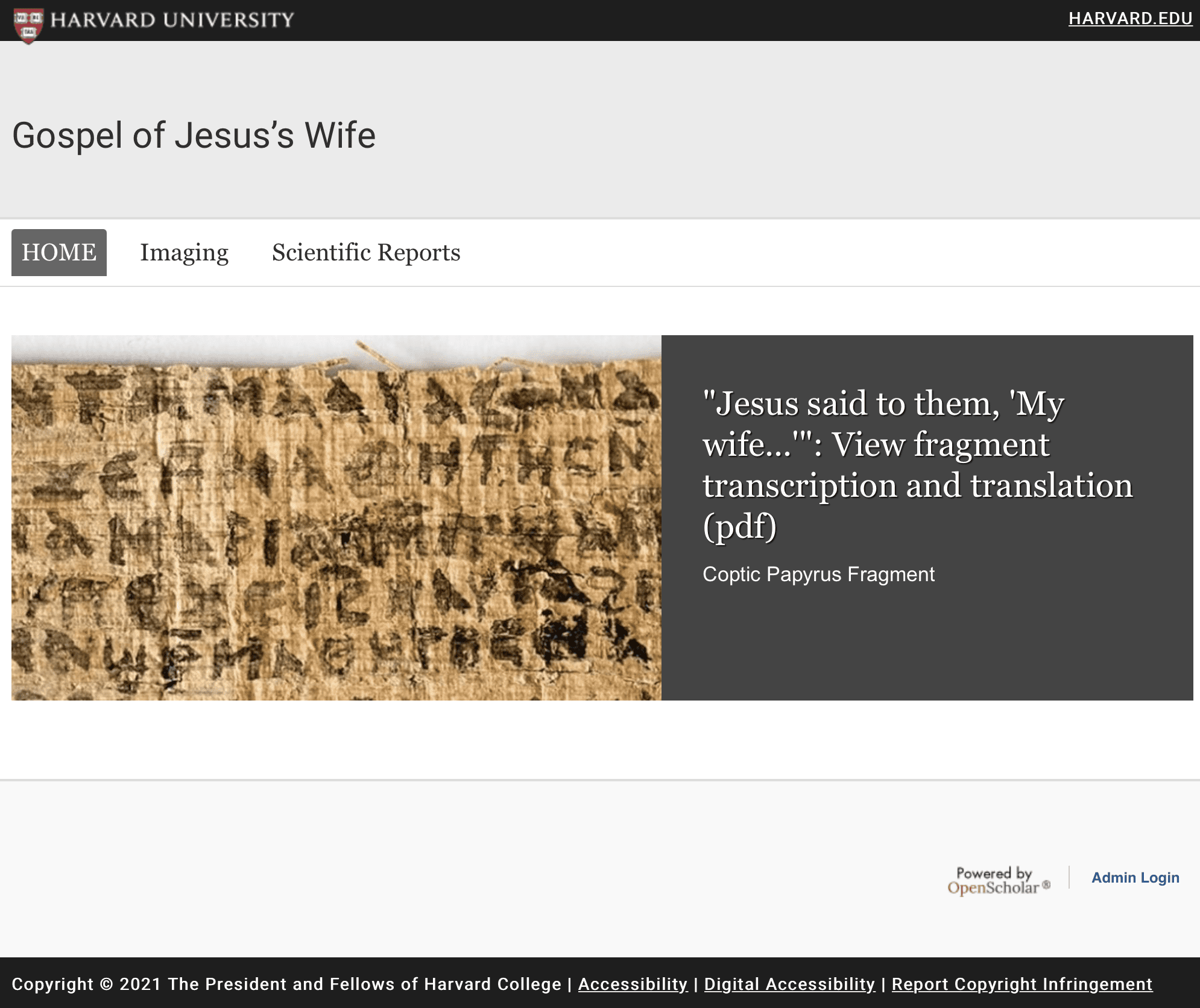
Here’s the background. The above image is at Harvard University’s website.
But, no, it’s not a “Coptic Papyrus Fragment.” That’s a lie. Or, I guess, several years ago we could call that statement a mistake, but given that it’s been known to be false for several years, I think it’s fair to call it a lie at this point. Saying something you know to be false is lying, right, even if several years ago you believed it?
To say it again, no, there’s no Coptic papyrus fragment; it’s actually a notorious forgery, caught by scholar Leo Depuydt back in 2012 shortly after it came out and discussed in detail by reporter Ariel Sabar in a book published last year. I think there’s exactly zero chance that the Harvard Divinity School has not heard of Sabar’s book. There is no dispute that the document is a modern forgery.
Here’s Harvard’s policy on Academic Integrity and Academic Dishonesty:
Members of the Harvard College community commit themselves to producing academic work of integrity – that is, work that adheres to the scholarly and intellectual standards of accurate attribution of sources, appropriate collection and use of data, and transparent acknowledgement of the contribution of others to our ideas, discoveries, interpretations, and conclusions. Cheating on exams or problem sets, plagiarizing or misrepresenting the ideas or language of someone else as one’s own, falsifying data, or any other instance of academic dishonesty violates the standards of our community, as well as the standards of the wider world of learning and affairs.
It’s a paradox! The above image is on Harvard’s official webpage, and the statement about it being a Coptic papyrus fragment is a blatant lie . . . so this violates Harvard’s Academic Integrity and Academic Dishonesty policy . . . so it violates the standards of our community . . . but it is part of the community whose standards it violates. I guess the resolution here is that any institution, Harvard included, has a distribution of integrity. At the high end there are heroes who uncover fraud, speak truth to power at great personal risk, etc.; then there’s the vast majority of work that is solid, open, honest scholarship that advances human understanding and scholar; then moving over to the dark side we have the tenured plagiarists at the law school; and finally you have the out-and-out fakes like those monkey experiments from the psychology department, the Surgisphere thing from the medical school, and the above disgrace from the divinity school.
So I guess it would be more accurate to say, not that cheating, plagiarizing, misrepresentation, etc., “violate the standards of our community,” but rather that they lower the average integrity level of the community. No matter how you slice it, it’s bad.
It could be worse
As noted above, I don’t think this is as bad as what the University of California is doing with the sleep guy or what Trump etc. are doing with the election lies.
The University of California is worse because they’re not just passively letting a lie stand. They were directly contacted regarding the research misconduct in Why We Sleep author and they just out-and-out refused to do anything about it.
The election stuff is more consequential because, yeah, they were trying to nullify the will of the majority of the voters.
Yet another problem is lies and uncorrected errors in journalism. As with lying or b.s.-ing politicians, lying and b.s.-ing journalists have been a problem forever—there’s no bright line distinguishing journalism from propaganda—but, to the extent that we rely on journalism as a check on private and public power, and I think we do, lies and uncorrected errors in the news media are a big problem, whether they come from left, right, or center.
To return to the Harvard story: Sure, passively allowing a lie to stay on your website is a much more minor problem than actively resisting correction or attacking people who won’t go along with the fraud. So, yes, there are degrees of behaving badly here. And the so-called Gospel of Jesus’s Wife is no big deal; we’re not talking about people trying to overturn an election, spread false news stories, or even misrepresent science. Still, it bothers me. It bothers me that nobody at Harvard has fixed this, and it bothers me that nobody at Harvard seems to care. They were happy to get the positive publicity when the “Jesus’s wife” story first came out, but then when the story turned negative they just looked away and acted like it never happened, even to the extent of not correcting or apologizing for this website. What I’d really like Harvard to do is to keep this page up forever but with a big note acknowledging they’d been scammed. Unfortunately, I think the best we can hope for is that they quietly take it down (“404 not found”). Keeping it up as is, though, that’s the worst.
Harvard’s violating its own policy on Academic Integrity and Academic Dishonesty. But, hey, it got them good publicity. NPR (and again)! That’s what it’s all about, right?
Not sure the topic here is so much dishonesty as “anything can be obfuscated.”
Having read through all this stuff, I have no doubt it is a forgery. But the author of the original, credulous paper, Dr. Karen King, has pushed back here:
https://dash.harvard.edu/bitstream/handle/1/12423693/Response%20to%20Leo%20Depuydt%20for%20webpage%20and%20DASH.pdf?sequence=1&isAllowed=y
King’s response ends with this:
“In conclusion, Depuydt’s essay does not offer any substantial evidence or persuasive
argument, let alone unequivocal surety, that the GJW fragment is a modern fabrication (forgery).”
If you search the Harvard website for the “Gospel of Jesus’ Wife” you get three pages of hits, all sanctioned or written by King as near as I can tell. The critical works are not there, but they conveniently don’t belong to Harvard.
Harvard is guilty of letting King present a wholly one-sided argument on their website. The rest of the blame goes to King, IMO.
Matt:
I agree that it’s on King for being defensive and slow to admit error. The article you link to comes from 2014, when the defenders of the Jesus’s wife story still had some vague hope that something could be salvaged from the document. But lots has happened since 2014, and especially since Sabar’s book has come out it’s even more clear that the document is a modern forgery. Meanwhile, the Harvard page falsely characterizes it as a “Coptic Papyrus Fragment.” Or, hmmm, it seems that the document may physically written on an ancient papyrus fragment that was stolen from a German museum. But I don’t think that’s what they meant by “Coptic Papyrus Fragment.”
Harvard is a complex institution with many moving parts, and what “Harvard” should do here is not so clear. University faculty have a lot of freedom: freedom to express unpopular views, freedom to make mistakes, and so forth. Do they have the freedom to lie, the freedom to promote claims that are known to be false? That’s not so clear. Harvard does have an Academic Integrity and Academic Dishonesty policy, after all.
But, sure, I agree that the simplest way for this to be cleaned up would be for King to call up the people at Harvard’s IT department and ask them to add a bold-face addendum to the webpage saying that she’d been conned and that the document is a modern forgery.
Is this Andrew’s “April Fool Joke”? Surely, after all the publicity following Sabar’s book, everyone at Harvard must be aware that the papyrus fragment is a complete phony, created by the former head of a Stasi museum who went on to make sex videos. The next thing you know, there will be people at Harvard who claim Covid does not exist and is curable with horse dewormer.
Paul:
Official Harvard policy is that the replication rate is “statistically indistinguishable from 100%.” So I think that makes them infallible . . . Hey, that’s another Jesus connection!
P.S. It’s October, not April.
October? April? Given the age of the universe, the difference is miniscule. Or, as we used to say back in my undergraduate sliderule days of the 1950s, “within engineering accuracy.”
So should we forgive them, even when they know what they do?
You realize its a broad spectrum antiviral too right?
“Originally identified as an inhibitor of interaction between the human immunodeficiency virus-1 (HIV-1) integrase protein (IN) and the importin (IMP) α/β1 heterodimer responsible for IN nuclear import (Wagstaff et al., 2011), Ivermectin has since been confirmed to inhibit IN nuclear import and HIV-1 replication (Wagstaff et al., 2012). Other actions of ivermectin have been reported (Mastrangelo et al., 2012), but ivermectin has been shown to inhibit nuclear import of host (eg. (Kosyna et al., 2015; van der Watt et al., 2016)) and viral proteins, including simian virus SV40 large tumour antigen (T-ag) and dengue virus (DENV) non-structural protein 5 (Wagstaff et al., 2012, Wagstaff et al., 2011). Importantly, it has been demonstrated to limit infection by RNA viruses such as DENV 1-4 (Tay et al., 2013), West Nile Virus (Yang et al., 2020), Venezuelan equine encephalitis virus (VEEV) (Lundberg et al., 2013) and influenza (Gotz et al., 2016), with this broad spectrum activity believed to be due to the reliance by many different RNA viruses on IMPα/β1 during infection (Caly et al., 2012; Jans et al., 2019). Ivermectin has similarly been shown to be effective against the DNA virus pseudorabies virus (PRV) both in vitro and in vivo, with ivermectin treatment shown to increase survival in PRV-infected mice” https://www.ncbi.nlm.nih.gov/pmc/articles/PMC7129059/
Calling it a “horse dewormer” is signalling you get your science from journalists.
Well it is a horse dewormer. It’s an anti-parasitic largely used in veterinary medicine.
You’ve copied and pasted a chunk of text from a paper that reports inhibition of SARS Covid-2 in vitro, but lots of different compounds inhibit Covid viral replication in vitro and any particular compound can be shown to have all sorts of effects in various biological assays as in the excerpt you copied. The scientific evidence so far certainly isn’t conclusive about any benefit of ivermectin in Covid treatment though the clinical trials have been seemingly limited. The Oxford Uni Principle trial might give some better indications of possible benefit (or not) but so far molnupiravir is looking like a much better bet aa are dexamethasone and other corticosteroids.
I had heard of the anti-parasite drug used by humans way before the start of the pandemic. Ivermectin also comes as a veterinary product and as lotion to cure head lice and rosacea. Probably avid travelers are more familiar with Ivermectin since parasites are easy to get while traveling abroad.
You could just as well call it a human dewormer. Many medicines are used for both humans and animals, and Ivermectin has been an important drug for human use for 40 years. It’s on the WHO’s list of essential medicines. To quote from a 2011 paper,
“Ivermectin… has had an immeasurably beneficial impact in improving the lives and welfare of billions of people throughout the world. Originally introduced as a veterinary drug… It was quickly discovered to be ideal in combating two of the world’s most devastating and disfiguring diseases which have plagued the world’s poor throughout the tropics for centuries.”
https://www.ncbi.nlm.nih.gov/pmc/articles/PMC3043740/
When officials and the media characterize Ivermectin as a “horse dewormer,” they are using misleading terminology to imply that it has only had veterinary use before now and is unsuited for humans. We can debate how effective it is against Covid, but please, let’s leave the propagandizing out of it.
Well unfortunately some people that have been “self-medicating” with Ivermectin have been using the veterinary preparations (aka horse dewormer) and landing up in hospital – that’s probably where the association has come from! Human formulations are approved (in the US) under quite specific conditions (as topical treatments and pills for some parasitic infections). Bottom line is that there’s no evidence that ivermectin is efficacious against Covid19 infection and it will take some properly designed clinical trials (as in the Oxford Principle trial) to decide the issue.
I am disturbed by this increasingly common trend of replacing “I find this evidence to be weak” with “there is *no* evidence.” It’s simply untrue that there is *no* evidence that Ivermectin is effective against Covid. It’s arguable how strong or how reliable that evidence is, but it’s not like we have no reason at all to suspect that Ivermectin might possibly be useful against Covid.
This is definitely at least partly a legacy of the NHST baloney that’s so widespread. It’s so incredibly common for people to do some study, get no statistical significance in some test, and then claim “there is no evidence that X”.
Sorry but there isn’t any evidence that ivermectin is effective against Covid.
Data from the Oxford University Principle trial isn’t available yet (clinical trial including ivermectin efficacy) – the largest properly conducted trial with data so far (Together trial at McMaster Canada) found no efficacy. Other than that there has been a mish-mash of largely sub-standard (or downright suspect) studies or observational data.
For example does the recent study from Lebanon in which independent analysis reveals blocks of 11 patient data repeatedly copied and pasted constitute “evidence”? How far are you willing to lower your standards of evidence? A very recent analyses of all of the published data indicates that in two meta analyses apparent efficacy was dominated by two studies with very apparent flaws (one of which is now withdrawn). One of the meta-analyses has been withdrawn (retracted) as a result. And so on. Some of this is described in a very recent commentary in Nature Medicine https://doi.org/10.1038/s41591-021-01535-y
In the meantime people are becoming sick from taking veterinary preparations of ivermectin and in Peru the scale of ivermectin poisoning was considerable until the health authorities withdrew their recommendation for using it.
Yes there is (really quite limited) reason to suspect that ivermectin might be useful against Covid (in vitro anti-viral activity), but so far no real world evidence that it is. Possibly the Oxford Principle trial might give some evidence which would be great!
(PS tried to post this 5 days ago but couldn’t get round reCaptcha probs)
The block of text is essentially a list of all the supposed antiviral activity from well before covid, which is the rationale for trying it. So calling it a “dewormer” doesn’t make any sense. It is a broad spectrum antiviral.
Ivermectin i-s old hat. The up-and-coming new drug seems to be Nitazoxanide Nick Brown,s blog.
Ivermectin is something of a miracle drug for humans in its own field. Idiots seem to think it helps with Covid-19 So far, there is no evidence that it does.
Horses and sheep are quite a bit different from humans. Something formulated for a 1 tonne horse might not be good for a 60–80kg human. BTW have you ever seen a hypodermic designedfor use on a cow?
A fat clydesdale might weigh 1000 kg but most horses are more like 600 kg (500kg for a race horse)
Papyrus is a material, and Coptic is a language. Literally speaking, this is indeed a Coptic papyrus fragment–just not an ancient one.
I’m hardly an expert on ancient manuscripts, but I do know that scholars in the field routinely make this sort of distinction. What Harvard is guilty of is failing to mention relevant information, rather than directly lying.
Kevin:
Sure, but do you really think that by “Coptic papyrus fragment,” they mean Coptic words written on a piece of papyrus? I mean, suppose I buy a piece of papyrus, rip it in half (so now I just have a “fragment”), find some Coptic on the internet, and scrawl it on the papyrus, and donate it to Harvard. Does that make it a “Coptic papyrus fragment”? I feel like the term “Coptic papyrus fragment” implies that this is a fragment from a larger Coptic document, which it’s not.
To step back, I think that presenting that document with a straight face without stating that it’s a forgery seems clearly to be a violation of the requirement of “accurate attribution of sources.”
Yes, I actually do think that’s what they mean. Again, I’m far from an expert, but I’ve read enough scholarship in the field to get a sense of how the real experts talk. They like to be precise and not mix up separate questions. What language a manuscript is in, what material it’s written on, and when it’s written are certainly all separate questions. Especially when there’s a question about the dating, the most concise phrasing will be to speak of a “Coptic papyrus fragment” before asking whether it’s genuinely ancient.
You are certainly correct, though, that to a general audience there will be a strong implication of genuine ancientness. And Harvard should know that. I’m making a bit of a nitpick here, but I feel like it’s worth making because “lie” is such an extremely strong word.
It can only be an authentic Coptic papyrus fragment if you FIRST write Coptic on it and THEN tear it :)
Damn! I didn’t think of that.
I am an ancient historian, and that page strikes me as deeply professionally irresponsible. It might have been acceptable in 2012, but by 2016 even Professor King had acknowledged that the weight of evidence was for a recent forgery. People on this blog have talked before about how refusing to acknowledge contradictory evidence, or implying things which are not true, is more common than the lie direct.
When I first wrote about this topic in early January,
https://srheblog.com/2021/01/15/bayes-keynes-king-and-fritz-fake-news-and-academics-with-fixed-ideas/
I made a snarky comment that in general, unlike machines, academics are decidedly non-Bayesian because they tend not to learn from new data. Apparently, this applies to institutions as well.
As another example of behaving badly, consider this article on the CDC website:
“New CDC Study: Vaccination Offers Higher Protection than Previous COVID-19 Infection”
https://www.cdc.gov/media/releases/2021/s0806-vaccination-protection.html
From that headline, you would think that those who have been vaccinated (but have never had Covid) have better immunity than those who have recovered from Covid (but have never been vaccinated). After all, it says right there that vaccination offers higher protection. And in fact this is how the media, government officials, corporate policy makers, university administrations, etc. have interpreted it. It’s the reason why vaccination mandates don’t have an exclusion for those who have previously recovered from Covid.
Yet if one reads the body of the article carefully, the study in question does not support the headline. BOTH groups of subjects in the study were people who had previously been infected and recovered from Covid. The study merely indicates that vaccination can provide ADDITIONAL short-term protection above and beyond the immunity acquired by recovering from Covid. It does NOT compare those who have been vaccinated (only) to those who have recovered from Covid (only).
Given that there are various studies showing that previous infection (alone) provides as good or better protection than vaccination (alone), and better in the case of the Delta variant, this article seems to be a deliberate attempt to mislead the public.
Kevin:
Good catch. The press release other than the title looks fine, but the title is misleading. And the title is the most important part of the press release! Whether deliberate or not, they should fix it and clarify the point.
Speaking of Harvard, I’m listening to Steve Pinker’s podcast with Razib Khan and he mentions that in his latest book he deliberately didn’t specify which “experts in cognition” among his friends/colleagues made what Pinker deems foreseeable errors regarding COVID. I recall that “Rational Choice in an Uncertain World” contained a number of failures to understand Bayesian probability, which were revealed in “House of Cards” to be drawn from Robyn Dawes’ own colleagues in psychology.
Wonks:
Pinker’s publisher contacted me a couple weeks ago offering to send me a copy of this new book. I gave my address but the book hasn’t arrived yet. So no comments yet.
But I can make a guess about the foreseeable errors. Pinker is at Harvard and so was one of the authors of those notorious Surgisphere paper. That author must have made a foreseeable error sometime between when the Surgisphere guy contacted him on the phone and when he submitted the paper to the Lancet. Also one of those Nudge guys is at Harvard and he wrote a notorious column about Covid last year. So that’s two people right there.
I’ve read Pinker’s book: he’s referring to Sunstein and Gigerenzer.
I don’t find the rate exorbitant. 200 hours (granted, he said more than, but just being quick and dirty…and it’s also “more than” 150k) is 25 days of work, at 8 hour days (granted, he might have worked 10s, but keeping it simple). So that’s $6,000/day.
I do day rate strategy consulting (head down, butt up work, not opining as some sooper-Ivy) and get a rate less than half of that. But it’s for more sustained work.
I remember in the late 90s, the day rate for expert witnessing that the profs all threw out was $3000/day. Using the CPI calculator for 30 years (DEC95 to DEC25), I get $3,000 then converted into $6,300 now. So…it really just looks like standard expert witness pay.
I would note that it didn’t seem like those profs could not really “get” expert witness gigs as much as they wanted. It was mostly some plum that was rare and they heard about. Certainly not if you factor across all of them at R1 unis, not just the BSDs.
And they were selling prestige, not just analysis, obviously. So they were buying his name (and his resume, and probably even the association with current gig).
And there’s some pressure to make the story come out to benefit your client. It’s not some omniscient, objective analysis.
I do think it’s interesting that he was doing 25 days of side gig work within a year. Obviously he was not all in on the main gig. And he also liked getting the 150K. It mattered to him.
FWIW, I have hired academics (profs or students or postdocs), at what was a very nice part time rate, for specialized R&D or brainstorming workshops. But we paid half the expert witness rate and we required them to do actual work. I was pretty clear with the profs that this was not a “look important” thing (in this science field, they are all basically research administrators, rarely get hands dirty doing things). Some of them were OK with it…some of them just said use my student or postdoc. Overall, the interactions were quite positive for them and us. But mostly because I knew how their minds worked and made brutally clear that this was not an expert witness gig.
P.s. I don’t know the specifics of this painkiller bruhaha. Didn’t even know it was “a thing”. Am not a pregnant woman, don’t use painkillers, and stopped getting the paper years ago.
Crap…that was meant for a different open window. My bad. FML