This is quite possibly the stupidest thing in the Epstein files.
Lord knows there’s lots of competition from the likes of Soon-Yi “Woody” Allen, Larry “Lawrence” Summers, Nathan “Clippy” Myhrvold, and Columbia’s own Richard “Axel” Foley, but I think this one takes the cake.
In honor of another Epstein associate (see here), I’ll frame it as a “Linda problem”:
Vilayanur is 74 years old, outspoken, and very bright. She majored in neuroscience. As an adult, he was deeply concerned with issues of motor control in stroke victims.
Which is more probable?
1. Vilayanur is a psychology professor who believes in extra sensory perception (ESP)
2. Vilayanur is a psychology professor who believes in ESP and tried to get 3 million bucks from a sex trafficker to fund his lab.
Here’s the story and here’s the evidence:
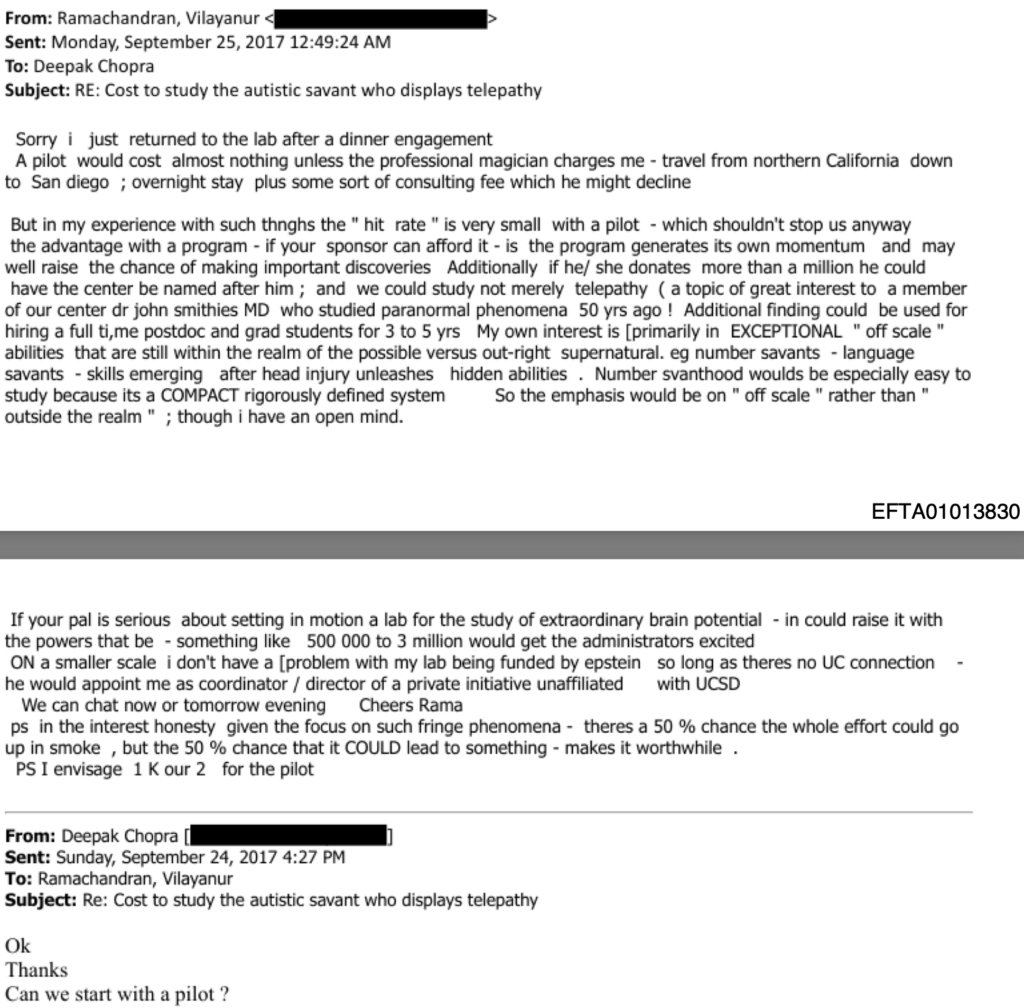
OK, a dog-bites-man story: over-the-hill professor on the Ted talk cycle seeks return to former glory through the funds of a shady operator.
The interesting part to me is when Ramachandran writes:
In the interest honesty given the focus on such fringe phenomena – theres a 50% chance the whole effort could go up in smoke, but the 50% chance that it COULD lead to something – makes it worthwhile.
I get it that some old guy could think that autistic people have ESP: this kind of mystical thinking was big back in the 1970s when Vilayanur was young, and I think a lot of Boomers have a soft spot for the paranormal. So, sure, why not study the topic–it does no harm.
But to think there’s a “50% chance” that it could lead to something . . . jeez, what an idiot. There’s a big difference between the sane view that doing speculative research on the high-risk, high-reward principle that even if there’s only a 1% chance it comes to something, it could still be worth a shot; and the absolutely insane view that your supernatural study has a 50% chance of being real.
Look, he had tenure, and in any case people have the right to be idiots and not get fired, as long as they do their job well. Ramachandran might well have been an excellent teacher. Or, hey, maybe he was insincere, lying to Epstein in an attempt to scam $3 million from the sex-trafficking financier. But until I hear otherwise, I’ll take Ramachandran’s words at face value and just conclude that he couldn’t think straight about science, I guess in a comparably innumerate way as that physicist who thought that scientific citations were worth $100,000 each. There are a lot of innumerate people out there, and some of them up with tenured academic positions.
It happens. We accept that there are corrupt cops; we also have to accept that there are stupid professors. Some corrupt cops reach heights of political power; similarly, some stupid professors become Ted-talk stars. That’s how it goes.
There’s also the issue, which we’ve discussed before, of which sorts of pseudoscientific beliefs are socially acceptable and which are not. We can laugh or scream at Dr. Oz for promoting astrology (“People that fall under the Aries sign are known for being resourceful, assertive, and headstrong. An Aries can tend to ‘ram or dive in to things head first.’ When an Aries feels blocked, this pent-up energy may appear in the form of migraines, sinus issues, or even jaw tension.”) or out-and-out magic (“You may think magic is make believe but this little bean has scientists saying they’ve found the magic weight loss cure for every body type–it’s green coffee extract.”), but if they believe in the burning bush or the virgin birth or whatever, that’s kind of a different category. Maybe the supernatural stylings of Ramachandran and Oz could be put in the “religion” column and then it would all be cool. I guess the problem is when they try to bring science into the mix rather than just existing on pure belief.
Dr. Oz is currently running the Centers for Medicare & Medicaid Services. That’s a U.S. government agency! I hope he’s not funneling our tax dollars to hucksters promoting “the No. 1 miracle in a bottle to burn your fat,” etc.
Isn’t the biggest embarrassment in the Ramachandran story the fact that Deepak Chopra was a “UCSD family medicine and public health clinical professor”? Ramachandran seems to have been shading his request to appeal to Chopra’s paranormal desires, but he clearly expresses his own preference for what he calls “off scale” but not paranormal abilities; it’s this “off scale” he thought he had half a chance with. Chopra’s professorship reveals deeper problems, as it extends into the academic and administrative system of UCSD. It’s as absurd as putting a quack in charge of some significant branch of the US health care system.
Is it possible that the “effort” and the “it” Ramachandran is referring to when he said “theres a 50% chance the whole effort could go up in smoke, but the 50% chance that it COULD lead to something” is the effort to set up a lab to study “extraordinary brain potential”, not the effort to actually find evidence of ESP/telepathy?
Sort of embarrassing to realize that I was totally unaware of this blog’s history regarding Ramachandran. But, is this “he/she” a typo or is the “he/she” full of meaning–or merely referring back to the famed “Linda Problem”?:
“Vilayanur is 74 years old, outspoken, and very bright. She majored in neuroscience. As an adult, he, was deeply concerned with issues of motor control in stroke victims.”
“Linda is 31 years old, single, outspoken, and very bright. She majored in philosophy. As a student, she was deeply concerned with issues of discrimination and social justice and participated in anti-nuclear demonstrations….”
Is the shift from “she” to “he” in the above a mere typo, or is there some deep significance available only to the cognoscenti?
I am on the autism spectrum (whatever that means and implies) and a scorpio (whatever that means and implies). Can someone please tell me what special and amazing gift(s) I possess, as I am having a pretty tough time with this whole life thing.
I reason maybe becoming aware of any possible special and amazing gift(s) might be useful in some way, shape, or form, hence my question.
Thanks in advance!
A friend of mine, passionate Tarot reader, who owned a Labrador (lovely dog, BTW), once told me that if you hold a pendulum above an animal, it will spontaneously swing one sense or another, depending on the animals’ sex. I proposed that we test this (note: as a tennis player, I have no problems locking my wrist). One minute passed, yet the pendulum didn’t swing – but an explanation was offered immediately: “It’s because you don’t believe in it!”.
And why is it that no one ever was a poor peasant with tuberculosis in a previous life?
Damn tennis players, ruining everything!
“And why is it that no one ever was a poor peasant with tuberculosis in a previous life?”
They would know how much this whole life (on earth?) thing can suck, and will not agree to do it again of course!
Yet if you had been an Abyssinian princess in a previous life, why would you bother being reincarnated as a Canadian sociology professor?
Punishment for bad deeds in the previous life.
“Yet if you had been an Abyssinian princess in a previous life, why would you bother being reincarnated as a Canadian sociology professor?”
In that case, they would (still?) believe that reincarnation is there because one can, or even has to, “learn” things, hence the Canadian sociology professor of course!
Side note: I have sometimes pondered the option of reincarniation, or the possibilty that one is here to “learn” things. I sometimes compare this to going to school here on earth in the normal way, like on earth you go to school to “learn” things and in a similar way one is born on earth to “learn” things.
I then think about how it doesn’t make sense to me to “learn” or “experience” things on earth by being born here that seemingly have little to do with being a being that is somehow able to reincarnate. For instance, why would I have to deal with emotions and bodily sensations and things like that, that seem useful to me when I would be in my “spiritual being” -form when I die, or inbetween my reincarnations.
I then also think about going to school on earth in the normal way, and that it’s at least pretty clear what one should learn or focus on and what the exam is. If I think about coming to earth, being born, and possibly “learning” stuff that way, it’s difficult for me to then things about what it is I should “learn” and what the “exam” is. That’s kind of annoying for me.
I then also think that I dropped out of high school, got my state exam studying alone by myself, and compared my university diploma to expensive toilet paper in a correspondence with a bunch of teachers and professors of the university I went to as a final attempt to underline points I had been trying to make up to that point. Should being born on earth be some way to “learn” things and be sort of like going to school in the normal way, it is perhaps not really surprising that I am having a difficult time here agreeing with, and participating in, it all.
Aaa:
It’s annoying aspect of life that we become experts on things that then become irrelevant to us. You finally figure out dating and then you meet the right person, get married, and never date again. You become an efficient changer of diapers and learn how to get the baby to sleep, and then your kids grow up and it’s not a skill you need anymore. You become an expert in some computing language or lab technique which eventually becomes obsolete. You learn all the routes in an area and then you move. You build up skills at the job and then it’s time to retire. You figure out how to live your best live, and then . . . well, you know what happens next.
Mr. Gelman:
Yep, and my brain is asking what’s the point of it all then. This may be more relevant of a question for people like myself not really enjoying such things in the first place, or even being or becoming experts.
I recently described my feelings about life as feeling like I have a job that I feel I didn’t sign up for, don’t want to do, and don’t even know what it exactly is. I try and solve this whole thing by thinking about IF there was a job I have, which one would it be, and then I could try and act in accordance with that job. I have been trying to do that, but I don’t feel it has brought me much pleasure or clarity. I just want to do my job, and get out of here.
I have had this exact experience, though presumably with less tennis ability.
Ramachandran was quite influential (RadioLab loved him), but my primary exposure to his ideas was unimpressive. He argued that men who wanted amputation of their healthy limbs had some kind of reverse phantom limb lesion. (They have a paraphilic desire, usually accompanied by preferential attraction to amputees.)
Also, Epstein wasn’t a sex trafficker. (And “sex trafficking” doesn’t mean what it used to.)
https://www.mtracey.net/p/sex-trafficking-laws-are-out-of-control
Also wasn’t a pedophile.
https://www.thefp.com/p/separating-fact-from-moral-panic
Michael:
From wikipedia:
And:
That sounds like a description of a pedophile and sex trafficker.
“theres a 50% chance the whole effort could go up in smoke, but the 50% chance that it COULD lead to something”
I’ve seen this before, I view it as the idiot’s version of Bayesian reasoning. You have no clue… so your “prior” is things are 50-50, it either works or it doesn’t, and then you stop thinking (if you ever started…), realise those odds sound good enough to make a selling point and send out the email.
It’s necessary to read the fine print, or in this case the not-so-fine print. The odds that it COULD lead to something are different from the odds that it WILL lead to something. The former is 50%, the latter is…well, what’s our prior that ESP is real? If for half of us it is zero and for the other half of us it is nonzero but exceedingly small, then Ramachandran has accurately stated the situation!
If you’re going to solicit funding for studying the ridiculous, target the innumerate.