Someone who would prefer to remain anonymous writes:
Before anything else and like many of the people who write to you, as an early career academic in the area of economics, I feel constrained in the criticisms that I can make publicly. So I have to kindly request that, if you do publish any of what follows, that identifying information about myself be not made public.
My correspondent continues:
The recent disclosed leaks at Uber revealed some, well, distressing behaviour by some of my peers. As the Guardian recently wrote (https://www.theguardian.com/news/2022/jul/12/uber-paid-academics-six-figure-sums-for-research-to-feed-to-the-media), several noted economists collaborated with Uber when writing some academic papers. In short, Uber shared data with a selected group of economists, paid them and had Uber economists collaborating with the authors.
The act of collaboration is not, in itself, necessarily a bad thing, as the potential access to proprietary data allows research to be done that otherwise would not be possible. But the way things were done raises several issues, many of which you have commented on before. I’d like to focus on one in particular: how do we deal with studies done with closed data shared by interested parties?
In the leaked emails, Uber staffers wrote that, concerning one economist who wanted to do a separate unpaid study using Uber’s shared data: “We see low risk here because we can work with Landier on framing the study and we also decide what data we share with him.” I.e., the issue here isn’t just of replication, already a serious concern, but the risk that a company may omit data so as to influence academics doing a study, so as to frame things in the best light possible. It is distressing to read that executives wanted to work on report’s message to “to ensure it’s not presented in a potentially negative light”.
Perhaps I’m being a bit too naive about all this, in that the obvious question when seeing a study like this is to ask why would Uber be ready to collaborate unless they are going to get what they wanted? Indeed, I recall being a little bit sceptical about Hall and Krueger’s initial NBER paper when I read it. But the excerpts produced by The Guardian are so much worse than I’d have feared, even if we don’t know the exact extent that Uber acted as these excerpts describe, it’s hard not to fear the worst. Where does that leave us with these studies? Should we dismiss them altogether or can we salvage some their analyses?
There is one small bright spot in all of this. Because I am not a Labour economist, I only ever read Hall and Krueger’s initial NBER paper, so missed Berg and Johnston’s later critique (https://journals.sagepub.com/doi/full/10.1177/0019793918798593?journalCode=ilra), where the issue of inadequate data was already being raised, among others even stronger criticisms. So even before the emails, there were some people tackling these issues head on. And, to the credit of ILR Review, the journal that published Hall and Krueger’s paper, the critique was published by themselves, unlike what happens so often.
Anyway, that’s all. I guess I’m shocked at how much worse things seem to be, at how willing Uber was to manipulate and try to use well regarded academic’s reputations to, it seems, launder their own reputation…
Some googling revealed this exchange between financial journalist Felix Salmon and economists Michael Strain and Justin Wolfers:


This followup wins the thread:

Lots to chew on here, so let me go through some issues one at a time:
1. Conflicts of interest
It’s easy to get all “moralistic” about this. It’s also easy to get all “It’s easy to get all ‘moralistic’ about this” about this.
So let’s be clear: the conflict of interest here is real; indeed, it’s hard to get much more “conflict of interest” than “Company pays you $100,000 to write a paper, then you write a paper favorable to that company.” At the same time, there’s nothing necessarily morally wrong about having a conflict of interest. It is what it is. Every year I fill out my conflict of interest form with Columbia. “Conflict of interest” is a description, not a pejorative.
With regard to the Hall and Krueger paper, the dispute was no whether there was a conflict of interest but rather (a) whether the conflict was sufficiently disclosed, and (b) how this conflict should affect the trust that policymakers would hold in its conclusions.
I don’t have a strong feeling about the disclosure issue—Salmon holds that the statement, “Jonathan Hall was an employee and shareholder of Uber Technologies before, during, and after the writing of this paper. Krueger acknowledges working as a consultant for Uber in December 2014 and January 2015 when the initial draft of this paper was written,” is not “an adequate disclosure that Uber paid $100,000 for Krueger to write this paper.” I dunno. I’ve written lots of acknowledgments and I don’t recall ever mentioning the dollar value. It seems to me pretty clear that if you have one author who worked at the company and another author who was paid by the company, the conflict is there, whether it’s $1000 or $100,000.
Regarding trust: yeah, with this level of conflict, you’d want to see some data analyses by an outside team, like with that Google chip-layout paper.
News reports should be more clear on this. A headline, “Ride-hailing apps have created jobs for Paris’s poorer youth, but a regulatory clampdown looms,” should be replaced by something like “Uber-paid study reports that ride-hailing apps have created jobs for Paris’s poorer youth, but a regulatory clampdown looms.” Just add “Uber-paid study” to the beginning of every headline!
2. Morality
I don’t get this reaction:
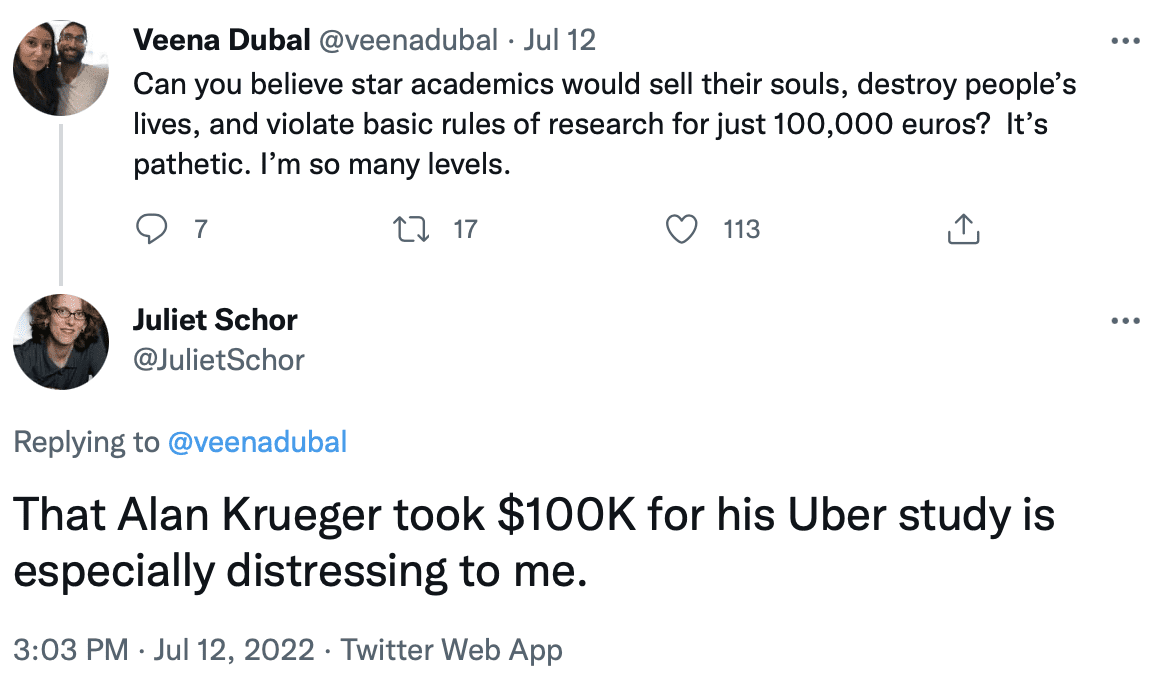
I mean, sure, I don’t like Uber either. Some people think a company like Uber is cool, some people think it’s creepy. Views differ. But “sell their souls . . . destroy their lives . . . especially distressing”? That seems a bit strong. Consider: back in 2015, economists absolutely loved Uber, which is no surprise given that economists loved to talk about the problems with the market for taxicabs, the famous medallion system, etc. Economists hated taxi regulation about as much as they hated rent control and other blatant restrictions on free enterprise. Economists on the center-left, economists on the center-right, they all hated those regulations, so it’s no surprise that they loved Uber. The company was an economist’s dream, along with being super convenient for users.
3. Interesting data
I get Wolfers’s point that Krueger would find the Uber data interesting. I would have too! Indeed, had Uber offered me $100,000, or even $50,000, I probably would’ve worked for them too. I can’t be sure—they never approached me, and it’s possible that I would’ve said no—, but, if I had said no, it wouldn’t have been because their data were not sufficiently interesting. The point Wolfers seems to be missing here is that God is in every leaf of every tree. Yes, Uber data are interesting, but lots of other data are interesting too. Ford’s data are interesting, GM’s data are interesting, Bureau of Labor Statistics data are interesting. Lots of interesting data out there, and often people will choose what to look at based on who is paying them. I think one missing piece in the public discussions of this case is how much economists looooved Uber back then: it was a symbol of all that was good about the free market! So they found these data to be particularly interesting.
4. What can you get for $100,000?
A funny thing about the discussion is how little an amount of money $100,000 seems to be to commenters, and that includes people on both sides of the issue! Wolfers thinks that $100,000 is so small that it is “extremely unlikely” that Krueger would write a paper for that paltry sum. From the other direction, Dubal thinks it’s “pathetic” that he would “violate basic rules of research for just 100,000.”
I only met Krueger once, so I can’t speak to his motivations, but I will say that being the second author on a paper can sometimes be pretty easy, and $100,000 is real money! For example, suppose Krueger’s consulting rate was $2000/hour. He should be able to do the work required to be second author on a paper in less than 50 hours. The disclosure in that article says he was working as a consultant during the 2-month period when the initial draft of the paper was written. Spending 50 hours on a project during a 2-month period, that’s plausible. So I can’t really see why Wolfers thinks this is “extremely unlikely.”
There is an alternative story, though, consistent with what Wolfers hypothesizes, which is that Krueger would’ve coauthored the paper anyway but took the $100,000 because it was offered to him, and who wouldn’t take free money? I’m willing to believe that story, actually. This also works as a motivation of Uber: they offered free money to Krueger for something he would’ve done anyway, just to give him an excuse to clear his schedule to do the work. So, he didn’t coauthor a paper for $100,000; he coauthored a paper for free and then accepted the $ to motivate himself to do it. Meanwhile, from Uber’s perspective, the money is well spent, in the same way that the National Science Foundation is motivated to pay me to free up my time to do research that’s they think will be valuable to society.
Regarding Dubal’s comment: I don’t see what “basic rules of research” were being violated? Not sharing your data? If working with private data is violating a basic rule of research, fine, but then scientists are doing that for free every day. If you set your time machine back to 2015, and you consider Krueger as an economist who thinks that Uber is cool, then getting paid by them and working with their data, that’s even cooler, right? I imagine that for an economist in 2015, working with Uber is as cool as working with a pro sports team would be for a statistician. Getting paid makes it even cooler: then you’re an insider! Sure, Krueger was a big-name academic, he’d served at the highest levels of government, and according to Wolfers he was doing well enough that $100,000 meant nothing to him. Still, working with Uber, as an economist I’ll bet he thought that would be something special. Again, Uber in 2015 had a different aura than Uber today.
5. “Laundering” and the role of academia and the news media in a world that’s mostly run by business and government
What exactly was it about the Hall and Krueger paper that bothered people so much? I don’t think it was simply that these guys were working for Uber or that, given that Uber was paying them, they’d write a report with a pro-Uber spin. I think what is really bugging the critics is the sense that academia—in this case, then NBER (National Bureau of Economic Research), an influential club or organization of academic economists—was being used to launder this money.
If Hall and Krueger were to publish a book, The Case for Uber, published by Uber Press, arguing that Uber is great, then it’s hard to see the problem. These guys chose to take the job and they did it. But when published as an NBER preprint, and one of the authors is a respected academic, it seems different—even with the disclosure statement.
Again, it’s a problem with the news media too, to the extent that they reported this study in the way they’d report straight-up academic research, without the “Uber-funded study claims . . .” preamble to every headline and sentence describing the published findings.
This all kinda makes me think of another well-known economist, John Kenneth Galbraith, who wrote about “countervailing power.” Galbraith was talking about economic and political power, but something similar arises in the world of ideas. Government and business are the 800-pound gorillas, and we often like to think of academia and advocacy organizations as representing countervailing power. When industry or government inserts propaganda into academic channels, this is bothersome in the same way that “astroturf” lobbying seems wrong. It’s bad for its own sake—fooling people and potentially affecting policy through disinformation—and also bad in that it degrades the credibility of un-conflicted scientific research or genuine grassroots organizing.
In saying this, I recognize that there’s no pure stance in science just as there’s no such thing as pure grassroots politics: Scientists have prior beliefs and political attitudes, and they also have to be paid from somewhere, and the same goes for grassroots organizers. Those mimeograph machines don’t run themselves. So there’s a continuous range here. But getting $100,000 for two months of work to coauthor a paper, that’s near the extreme end of the range.
What I’m getting at here is that, while there is indignation aimed at Krueger here, I think what’s really going on is indignation at perceived manipulation of the system. One way to see this is that nobody seems particularly angry at the Uber executives or even at Hall, the first author of that paper. If it’s bad science, you should be mad at the people who promoted it and the person who did the work, no? I think there’s this attitude that the full-time Uber employees were just doing their jobs, whereas Krueger, who was just a consultant, was supposed to have had a higher loyalty to academia.
6. Politics
There’s one other thing I wanted to get to, which was Wolfers’s attitude that Krueger needed to be defended. (Again, nobody seemed to feel the need to defend Hall for his role in the project.)
One part of the defense was the silly claim that he wouldn’t have done it for the money, but I think underlying there were two implicit defenses:
First, conflict of interest sounds like a bad thing, Krueger was a good person, and therefore he couldn’t’ve had a conflict of interest. I don’t think this argument makes sense—I see conflict of interest not as an aspect of character but as an aspect of the situation. When I write about Columbia University or any organization that is paying me or my family, I have a conflict of interest. I can still try to be objective, but even if I have pure objectivity, the conflict of interest is still there. It’s inherent in the interaction, not in me.
Second, Krueger is a political liberal so therefore he couldn’t have issued a report unduly favorable to Uber, because liberals are skeptical of corporations. I don’t think this argument works either, first because, as noted above, back in 2015 economists of a wide range of political stripes considered Uber to be awesome, and second because Krueger, while political, was not known as a hack. He works with Uber, they tell him good things about the company, he coauthors a positive report.
I always wondered if something similar was going on when the economist James Heckman hypes early childhood intervention programs. Heckman is a political conservative, and one would expect him to be skeptical of utopian social spending programs. So when he and his collaborators found (or, to be precise, thought they found) strong evidence of huge effects of these programs, it was natural for him to think that his new stance was correct—after all, he came to it despite his political convictions.
But it doesn’t work that way. Yes, you can be biased to come out with a result that confirms your preconceptions. But when you come out with a result that rocks your world, that could be a mistake too.
7. Who to credit or blame
I agree with my correspondent, who focused the blame (or, depending on your perspective, the credit) for this episode on Uber management. The online discussion seemed to be all about the economist who consulted for Uber and was the second author of the paper, but really it seems that we should think of Uber, the organization, as the leader of this endeavor.
Full disclosure: I’ve been paid real money by lots of organizations that have done bad things, including pharmaceutical companies, tech companies, and the U.S. Department of Defense.
P.S. Interesting comment here from economist Peter Dorman.
P.P.S. More here.
All of the issues regarding authors’ integrity, size of payment, and potential bias are red herrings to me. I don’t have enough real information to judge these and I suspect they can be debated forever. What does bother me about this story is the fact that NBER “published” the paper without the data being made available. Had this been an academic journal, I would be similarly upset. I’m not sure that there is a meaningful distinction between NBER and a journal (see NBER’s standards of contact here: https://www.nber.org/about-nber/standards-conduct). NBER puts out a lot of papers where the data is not publicly available. Much of this research has policy implications. Without the data being available, we are left to trust the reputations and credentials of the authors and NBER. I have to say that such trust is wearing thin these days (partially due to my age and experience and partly due to the myriad displays we have seen – bad behavior may be getting more frequent or it may just be getting exposed more readily, but either way I am inclined to trust less than in the past).
There are plenty of “good” reasons why data cannot be made public. I’ve made the point before but I’ll make it again. If a paper can influence public policy, then I don’t think a reputable journal or publisher should be willing to publish it without the data being provided. If it is a really extreme case, then it could be provided to a select group or organization where access can be controlled (though this has some obvious limitations compared with open access).
My view is certainly extreme. But I don’t really see how we can go only part way. Do we permit proprietary data for “esteemed” authors only? Consulting relationships usually involve payment and it is expected that the sponsors will get research that does not conflict with their goals. Such research can, and often is, excellent. But it is, as Andrew says, a situation with a conflict of interest. Why should I trust the research if the data cannot be accessed by others? It can always – and I believe should – be published as a book by Uber. Just not by NBER or the Journal of….
One addition: I looked at the Berg and Johnston critique of the paper. It was made possible by access to some of the survey material used in the Hall and Krueger paper. There was also this footnote:
“Hall extended an invitation to inspect the data at Uber headquarters for the purpose of replicating the article’s results; unfortunately, this option was not feasible for us.”
This does make the situation a bit more ambiguous to me. The offer to inspect the data is important – but I’m sure the logistics required make it less compelling than providing the data. At what point is such an offer sufficient? I guess it isn’t clear to me why that data would need to be kept at Uber’s facility rather than just providing it electronically. Perhaps someone has some insight regarding this.
> Why should I trust the research if the data cannot be accessed by others? It can always – and I believe should – be published as a book by Uber
An additional issue here is that it looks like Uber was trying to cook these books. From the article:
> In return for the consultancy fee, Landier also wanted to produce a separate unpaid study using Uber data. The leak shows Uber executives were concerned that would mean “we lose editorial control”, but a senior staffer concluded: “We see low risk here because we can work with Landier on framing the study and we also decide what data we share with him.”
It seems reasonable that even if the data were available the outcome here would be the same. So even if honesty isn’t enough, we’ll probably need a bit of it to get anywhere :P.
Dale writes: “My view is certainly extreme. But I don’t really see how we can go only part way. Do we permit proprietary data for “esteemed” authors only? Consulting relationships usually involve payment and it is expected that the sponsors will get research that does not conflict with their goals. Such research can, and often is, excellent. But it is, as Andrew says, a situation with a conflict of interest. Why should I trust the research if the data cannot be accessed by others?”
There is a solution and we already have it, the FDA. The FDA gets all of the data and protects proprietary data. It does there own analyses of the data and can order the drug sponsor to do any analysis it wants. It brings in outside experts to review the company’s work as well as its own. It even does spot inspections of facilities collecting data, and given that it has approval power and can issue warnings and other regulartory enforcements powers, it cannot be ignored by the companies. In other situations where there are important policy considerations and data is proprietary, we should provide for that same structure. Otherwise, I agree. We should ignore studies where the data is not available.
“If a paper can influence public policy, then I don’t think a reputable journal or publisher should be willing to publish it without the data being provided. ”
How does one decide if a paper can influence public policy?
They are called “editors” for a reason. If they are able to decide what should be published, they surely can judge whether something may have a significant effect on public policy. And they should be accountable for those decisions.
“How does one decide if a paper can influence public policy?”
Excellent point.
And there is a related larger point that scientists should emphasize to decision makers: one paper is almost never definitive and public policy decisions should be made from a broad base of research. This is one reason that having the data from this paper available isn’t that important: this one paper should never be that important.
> Those mimeograph machines don’t run themselves.
You are dating yourself!!
Recall in old days of the Soviet Union, Kremlinologists would try to determine what is really going on by carefully dissecting anything that emerged from Moscow for clues. So, just to indicate that I read this from beginning to end, note the trivial typo I found:
“With regard to the Hall and Krueger paper, the dispute was no whether there was a conflict of interest but rather (a) whether the conflict was sufficiently disclosed, and (b) how this conflict should affect the trust that policymakers would hold in its conclusions.”
Also, this reference is to something very recent
“As the Guardian recently wrote (https://www.theguardian.com/news/2022/jul/12/uber-paid-academics-six-figure-sums-for-research-to-feed-to-the-media)”
indicating it must have jumped the typical queue. Moreover, it is unusually lengthy. But, just like the Kremlinologists who overreacted to seeing a photo of someone on the left of Stalin who is usually on the right of Stalin merely because a mistake in printing, I may be reading too much into this.
As it happens, I know little about Uber and virtually nothing about the people involved. However, I have heard about but am not necessarily familiar with $100,000 .
This feels like a real nothing-burger to me. But maybe that’s because whenever I see an academic paper produced in conjunction with a large corporation, I immediately discount the results. I don’t think the researchers have done anything wrong; I just don’t believe the data would be released if the company didn’t already know what was going to be found.
At the risk of being accused of whataboutism, I regularly see citations of “studies” produced by think tanks in top tier news publications. In many cases there is no acknowledgement of the provenance of these reports, or that the think tank is funded in order to produce results with a certain slant. Where is the outrage at think tanks? Isn’t the sole purpose of many think tanks to produce policy papers that advance their agendas? Marketing flak for policymakers.
Andrew writes some sensible analysis of the conflict of interest elements of this story, but I will add some additional points regarding the embarrassing defensiveness (and conspicuous silence) of some of Economics academic elite:
1) Krueger was a personally beloved figure by many of his former students and colleagues. The modal elite economist is a raging asshole–and some are likely full-fledged sociopaths. Krueger was not (or at least he was not to his friends). Given Krueger’s recent tragic death, people like Wolfers were clearly sensitive about how this would reflect on his legacy. But that is not an excuse. In fact, the defensiveness and absurd arguments that somehow 100K was not ‘real money’ reveal that the Uber leaks exposed something substantially embarrassing.
2) What was so embarrassing? That elite academic economists make huge sums of money, many multiples of the ‘rank-and-file’. That they regularly trade on their reputation for these piles of money (let’s face it–Uber did not want Krueger because he was the most qualified economist to work on the data. They wanted him because he was a big name with political sway). That they are willing to accept data and money with no questions asked about the source of either. And that the ethics of the profession require only that you write “X worked as a consultant for Y”.
3) The inadequacy of the disclosure was particularly bad. Was the paper the deliverable?
4) The silence of a large swath of the elite academic economics twitter chattering class (after Wolfers embarrassed himself) owes to their satisfaction with the status quo and their realization that it don’t look too swell.
Remember Dan Ariely? His DEFENSE was that he simply received a private data set from a company, did no independent verification, hit regress Y X Z and published. A ton of papers in the ‘Top 5’ journals in econ are now using confidential data from private sources. The authors of these papers are not really going to welcome a conversation about whether their reputations are being used to launder pre-baked analysis into the profession.
If the $100,000 is really so little money to these people, then why take it and thus raise questions about your integrity? Most of us have to work for a living.
Yes, what Uber is doing is morally wrong. But, we expect better morals from academics.
Agreed. The most acutely appalling part of this story (for me as an academic) is the academics for whom $100k is just walking around money.
Arguably, similar questions about competing interesting can arise simply by data sharing agreements alone, as the data can function as an incentive and enable doing work that wouldn’t otherwise be possible. Though these don’t fit as neatly into definitions in existing COI disclosure processes.
Dean:
It’s tricky, though, because as is well understood in statistics (but not maybe in general), you don’t just need “the data”; you also need the meta-data of where the data came from. For example, Daryl Bem’s ESP data come with meta-data that he ran lots and lots of experiments and only analyzed some of the data for publication.
“If the $100,000 is really so little money to these people, then why take it and thus raise questions about your integrity?”
Because we live in a society where those with wealth are rewarded with status and power, but those with integrity are, at best ignored, and at worst ridiculed or punished.
In the specifically academic context, when you go up for promotion, they will scrutinize how many publications you have and the impact factors of the journals the are in. I have never heard of a tenure committee conducting an integrity assessment.
Clyde:
Again, I don’t see why taking $ from Uber should raise questions about the integrity of Uber employees and consultants. But, then again, I take money from the U.S. Defense Department and companies in the pharmaceutical and tech industries. I have a lot of respect for people who refuse to take money from such tainted sources; however I don’t think of it as a lack of integrity to do it. On the other hand, there are some people I would never take money from, for example the O. J. Simpson defense team, various foreign governments, companies that do flat-out fraud, etc. I guess each of us will find our own place to draw the line.
Of course taking money raises questions about integrity. That is why we expect people to declare their conflicts of interest. That doesn’t mean it is always wrong to be paid by such organizations. But, more information is needed: Why is the organization paying, and why are they paying the amount that they are?
An academic’s day job includes doing research and writing papers. Usually, the academic’s day job already includes a salary. If so, additional payment to write a paper sounds like a bribe. So, it is on the academic to explain why it isn’t a bribe.
David:
It’s true that as academics we’re paid a full-time salary but we’re also allowed to do paid outside consulting. Also, I understand the logic of disclosing the exact amount of payment; all I can say is this is not standard practice. I’ve seen court transcripts where consultants declare their hourly rate, but for scholarly publications the standard is to disclose all sources of funding, not the amounts. Arguably this is a problem with all of academia (including me), nothing to single out Krueger or the economics profession on this one.
“Consider: back in 2015, economists absolutely loved Uber, ”
Ah, back in the days when Uber was going to save us from climate change! :)
I guess if we’re going to turn back the clock why not look at the whole picture? The entire political left **loved** Uber as much or more than economists did. That’s what enabled it to simply ignore most of the law that should have applied directly to it, like taxi licensing and minimum wage law. Remember, Uber was a Social Good!! – Ride Share!! – saving us from Climate Change!! – not a taxi business. And it was losing money hand over fist – enshrining it as a darling of the left.
I don’t know how or if this particular paper was used in the debate, but my guess is that even if the paper had bucked the Happy Consensus on Uber at the time, it hardly would have affected policy. The Uber Magic was too strong.
I think it’s interesting how almost world-wide the left simply ignored Uber’s bucking the law because it saw its larger interests served by Uber.
Funny, 2016 is recent enough that I actually remember the political atmosphere, and what you’re saying seems pretty outlandish to me. So I backdated a google search to pre-2016 to take a look at some opinion pieces.
https://www.google.com/search?q=uber+opinion+pieces&biw=1344&bih=787&source=lnt&tbs=cdr%3A1%2Ccd_min%3A%2Ccd_max%3A01%2F01%2F2016&tbm=
These are the pieces that come up on the first page:
https://www.nytimes.com/2015/06/18/business/uber-contests-california-labor-ruling-that-says-drivers-should-be-employees.html
https://www.nytimes.com/2015/12/15/technology/seattle-clears-the-way-for-uber-drivers-to-form-a-union.html
https://www.nytimes.com/2014/12/08/opinion/we-cant-trust-uber.html
https://www.nytimes.com/2015/08/07/opinion/the-uber-ization-of-activism.html
https://www.fastcompany.com/3042107/why-ubers-success-means-nothing-if-it-cant-fix-its-reputation
https://money.cnn.com/2014/11/21/technology/uber-ethics-oped/
Here’s my first 3 results when I use “uber site:salon.com” to restrict myself to a left leaning magazine
https://www.salon.com/2014/08/31/why_uber_must_be_stopped/
https://www.salon.com/2014/12/24/the_year_in_uber_scandals_a_surge_priced_cruise_through_the_companys_biggest_controversies/
https://www.salon.com/2014/11/30/i_quit_miseries_of_an_uber_driver/
and when I search uber climate change, I get things about climate change or about uber, but nothing about how uber will save us from climate change or even about how uber will affect climate change
https://www.google.com/search?q=uber+climate+change&rlz=1C5CHFA_enUS885US885&source=lnms&sa=X&ved=2ahUKEwi1qfv_iJz5AhVFEGIAHQcMBcoQ_AUoAHoECAEQAg&biw=1275&bih=1110&dpr=1
As much as fun as it is to have you around, I have to ask; is commenting here is good for you? Does this make you happy?
Somebody: I wonder the same about you. Your comical claim that heavy traffic is safer being one of your immortal foot placings, not to mention your claim that there was never any barter economy. Those are the few that stand out in my mind where your “research” was comically bad
I’m sure some people get tired of relitigating the same conversations. I don’t! It’s fun, because with you, it’s easy!
Here’s a quote from me!
What’s the point of all this? You say the entire political left loved uber and said it would solve climate change. But there was a ton of criticism of uber from the political left. Your claim is just false. You say I made this claim. But right there, in letter, archived on this website, I say “I am not claiming”. Do you think there’s an imaginary third party reading this that is convinced by your sheer confidence? Do you think that making more wrong statements will somehow save face?
To clarify, the claim is that the story in economics textbooks about economies starting from barter between neighbors and acquaintances, then evolving into currency to solve the mutual coincidence of wants, did not take place. There has been barter before currency with traveling merchants and between different tribes, and there have been barter economies after the introduction and collapse of currency, but there is no evidence of an society with no exposure to currency using barter as the primary mode of exchange. And it’s not my claim; it’s the consensus amongst anthropologists and economic historians. With all your confidence, it seems like you have a counterexample though! I’d like to hear it! Or, you could take it to an anthropologist at your local university and you might get coauthorship on a paper!
Chipmunk –
Somebody provided links that directly refuted your argument by assertion (you provided no citations, even after they were requested).
It’s notably poor form to respond to “somebody’s” comment, with citations, with an off-topic personal attack. That’s not behavior that’s typical of this blog.
It’s not too late for a course correction. Perhaps your response was not typical of your style and just a one-off uncharacteristic slip-up.
Here’s your chance.
That’s not really fair; my whole comment is a personal attack. The only difference between us in that respect is that I seem a little calmer about the whole thing. That’s just because I’m correct, and we both know it. That’s why he can’t help but respond even though I’m obviously trying to get a rise out of him.
Somebody –
> That’s not really fair; my whole comment is a personal attack.
Good on ya’ for pointing that out and after i wrote my comment i noticed that as well.
> The only difference between us in that respect is that I seem a little calmer about the whole thing.
Hmmm. I don’t agree. (1) You didn’t really come across to me as calmer and (2) you made an actual argument and provided some support, unlike our friend.
Chipmunk –
Are you just not going to address how long you were?
https://www.theguardian.com/commentisfree/2014/may/27/airbnb-uber-taxes-regulation
https://www.forbes.com/sites/modeledbehavior/2014/06/23/is-the-sharing-economy-just-a-scam-to-dodge-good-regulations/
Joshua:
Please. For better or worse, you can’t expect this blog to lead to closure on these things. It’s a selection issue. Consider, for example, the Freakonomics team, who uncritically promoted that beauty-and-sex-ratio junk science that we’ve discussed so many times over the years. Will they ever apologize or even admit that they got this one wrong? It seems the answer is no, just as they don’t seem to every address their promotion of climate change denialism or anything else. The sorts of people who promote questionable claims are typically the same sorts of people who follow the never back down principle. I do appreciate that you pointed out the other commenter’s errors in the comments section here, but at this point you have to stop and just accept that the best realistic outcome you can expect here is no reply. The likely alternative would just be further political ranting, which we just don’t need—for that, we have 4chan and the Marginal Revolution comments section.
Andrew –
Ok. I hear you.
Chipmunk –
> The entire political left **loved** Uber as much or more than economists did.
Huh? No one I know on the left liked Uber, let alone loved it.
Citation needed, please.
Uber Says ‘Hundreds of Thousands’ Quit App in #DeleteUber Protest
Prolly libertarians, eh?
https://www.businessinsider.com/uber-deleteuber-protest-hundreds-of-thousands-quit-app-2019-4
2019, right? :).
The article was from 2019 about an event in January 2017.
And the claims are a bit inconsistent. First it’s that center-left (and center-right) economists loved it. Then it’s that economists loved it.
In fact, my recollection is that leftist economists (perhaps distinguished from center-left economists), like the (non-economist) leftists I talked to back in the day about Uber, were quite skeptical of the gig economy from the jump, for obvious reasons.
So maybe Andrew is technically correct, or maybe his characterization was somewhat over-generalized. I couldn’t say without data but I’m willing to guess Andrew has good reason for his characterization while I’m just going from anecdote and memory without any connections to the community of economists.
All of that said – feel free to supply any evidence for your claim. I can’t help but notice you responded with a basic non-sequitur and with no citations as requested.🤔
Did economists really love Uber? I mean they were well understood right from the start to be a predatory organization using tremendous quantities of government printed money provided by the finance industry after enormous quantitative easing to put competitors out of business by undercutting their prices and refusing to obey various basic regulations. You can agree with the need to deregulate transportation and not agree with companies whose only existence is essentially because they were financed by govt printing presses.
Do we know how Krueger (and others in this position) got the $100,000? If it was a personal check, then that’s a lot of money. But if it came in to his academic institution and they took 60% of it as indirects, then I can see referring to it as “only” $100,000. That’s a semester of a grad assistant and not likely to sway him massively.
Mm:
My guess is it was straight to him, after taxes that would have been about $50K. But I don’t think of the money as “swaying him.” It’s more like this: he was paid to consult for a company to which he had warm, or at least neutral, feelings. They asked him to coauthor a paper, or maybe he wanted to coauthor a paper with them anyway, so he did it. Unsurprisingly, given that they supplied the data, the conclusions were positive toward the company. It all seems straightforward to me, and not so different from the corporate consulting that I’ve done, with the main difference I guess being that the reports I produce or help produce are typically for internal consumption and don’t go on NBER or whatever.
There is a big difference if a corporation is paying you to answer a question for them rather than produce a report that they will use for publicity.
“with the main difference I guess being that the reports I produce or help produce are typically for internal consumption and don’t go on NBER or whatever.”
That difference seems important to me: economists get clout from access to data no one else gets because that’s how you get papers in the top econ journals (“we used a novel dataset” is high status in econ). They go to NBER first because peer review for econ journals takes years. The payment wouldn’t be the biggest incentive, especially if there was something interesting there. Whereas the consulting I think you’re talking about is work-for-hire, where the pay is the only incentive. The exclusive access to the data, assuming he thought it was reasonably accurate/complete data (vs. highly filtered to show the results the company wanted), would be a bigger deal and the $100K pretty unimportant. I assume, because he put it up at NBER, that he thought the data were reasonably accurate/complete; being seen by colleagues to be shilling for Uber would be clout-killing.
Mm:
As Salmon put it, whether or not Krueger in theory would have taken $100,000 to coauthor a paper, in fact he did take $100,000 to coauthor a paper.
I agree with you on the general principle that people will try to do what they enjoy doing, and if they can do what they enjoy and get paid $100,000, so much the better. Nonetheless, he did get paid, and presumably the Uber people who paid him were doing so for a reason, which I guess is that they expected that the particular data they were sharing with him (some small subset of the mass of data available to them) would result in a paper that would make them look good.
Finally, it’s not clear to me that, as you put it, “being seen by colleagues to be shilling for Uber would be clout-killing.” There’s a long tradition of top economists getting paid top dollars by corporations. They don’t call it “shilling”; they call it “consulting” (at least, that’s what I call it when I do it!). Also, as discussed in my above post, Uber in 2015 was considered by economists to be super-cool, a wonderful example of economic innovation breaking up a quasi-monopoly of taxi service. Working for Uber was cool for an economist in the same way that doing analytics for a sports team is cool for a statistician. It’s positive clout, not negative.
I knew Alan Krueger slightly and had an experience that may shed light on this story. I had organized a large panel for the economics (ASSA) meetings on NAFTA in, I think, 1989. For a sort of pro-NAFTA voice I recruited Krueger, who very generously agreed to appear. We chatted before the event about his paper with Grossman on pollution and development, which AFAIK launched the “Environmental Kuznets Curve” literature and was promoted as a defense of NAFTA. (It wasn’t, but for other reasons that aren’t relevant here.) I asked him if I should view him as supporting NAFTA, and he said no, he was agnostic overall but worried about the labor impacts. But the environmental concerns, he said, were way overblown (the treaty shouldn’t matter much one way or the other), and so his paper shouldn’t be seen as moving the needle.
Later I heard that the paper was paid for by the Mexican government. I’m not sure if that’s true; perhaps someone else here is better informed. If true, it would be a parallel episode at the beginning of Alan’s career.
Like others, I had nothing but positive interactions with him, and he was helpful many years later when I needed to draw on his expertise on education and wages for a study I was doing.
Just to make it clear, my point is that AK was able to compartmentalize more than most of us (I think). He had a core area (mostly labor) that he cared about, and outside that he didn’t worry much about the politics of what he was doing. Judging from what I know about his other work, the environmental research had to have been a product of convenience. It spawned what I think was a largely misguided and retrograde literature — mostly now ended due to the strength of the critiques. It’s hard to square the AK I knew with that kind of work, but that’s what compartmentalization will do for you.
Peter:
Also, doing good work can be hard, and when you have coauthors you can take it easy and let them do the heavy lifting, if it’s a project you only care about a little.
Andrew,
In economics, co-authors are ordered alphabetically in 99% of cases. Being listed as 2nd author (or last author) generally does not imply that you did less work or played a certain role (eg. PI, lab funder, etc.) as in other fields.
More importantly, in contrast to biomedical literature, the vast majority of papers have 1 or 2 authors considered to be relatively equal contributors. Analysts are acknowledged, not co-authors.
I was rather surprised by Felix Salmon’s take on this episode. Krueger’s conflict is listed on the front page of the document. Salmon kept implying that the disclosure was inadequate, but it says he worked for them at the time! Strain and Wolfers got sucked into disputing whether Krueger was biased by the money, which was a foolish tactical error. They should have simply responded to Salmon’s question by saying: “Yes, it was adequate, and well within the norms of both economics and other scientific fields”. At least in the fields I’m familiar with, almost no one discloses dollar figures for consulting fees or research grant gifts in conflict of interest disclosures, as Andrew also points out. And it’s hard to imagine that someone who has even a passing familiarity with the literature in these areas, as I imagine Salmon has, would expect otherwise. Moreover, if you go back to the original news articles about the paper, the fact that it was funded or produced by Uber is quite front and center in the coverage:
> Other data Uber has collected bears out a similar finding. A report written for the company by Uber’s own Jonathan Hall and Princeton’s Alan Krueger found that 85 percent of uberX drivers are part time (meaning they work fewer than 35 hours per week). The report also found that only 24 percent of Uber drivers rely on Uber as their sole source of income, and that Uber income is the largest but not the sole source of income for another 16 percent of drivers. Thus, Uber clearly was not the main gig for 60 percent of its drivers, and its drivers do not necessarily view driving for Uber as a long-term proposition.
from https://www.theatlantic.com/business/archive/2015/11/uber-is-not-the-future-of-work/415905/
> The study, which was put together by Uber in conjunction with Benenson Strategy Group and economist Alan Krueger, seeks to provide more details about the driver-partners on its platform in the U.S. That includes detailed information about driver demographics, earnings, and general reasons that they’ve decided to partner with Uber.
from https://techcrunch.com/2015/01/22/uber-study/
Yeah, these quotes themselves do not directly mention that Krueger was also paid, but the idea that one could walk away with the impression that this was an unbiased, totally neutral study is absurd. At least these two examples suggest that at the time, the potential biases of the study were clear to journalists.
Now, maybe it’s a systemic issue with science that people do not disclose these dollar figures, but given how rare this is in a variety of fields, I felt like this was trying to tap into some lazy “economists are greedy” stereotype that was unwarranted.
Full disclosure: I am an academic, and I have received research grant gifts and published papers in which I acknowledge this support but do not list the dollar amounts received.
You cannot ever bribe or twist
The freeborn British journalist
Seeing what, unbribed, he’ll do
You realize there’s no reason to