Joshua Brooks writes:
I know you’ve posted on the topic more generally but don’t recall if you’ve discussed this in particular. Given the timing in relation to cuts in food assistance, It seems a particularly egregious example of the politicization of data.
The news article, published in late 2025 by an organization called Food Tank (“The Think Tank for Food”) is titled, USDA Ends Key Food Security Report, Leaving Advocates in the Dark, and it begins:
The U.S. Department of Agriculture (USDA) recently announced it will terminate its long-running Household Food Security annual report. The resource is one of the country’s most comprehensive tools for measuring hunger and food insecurity.
The USDA justified the decision as a cost-saving measure, claiming in a statement that the survey is “redundant, costly, politicized, and extraneous.” . . .
Produced for the past three decades by the USDA’s Economic Research Service (ERS), the report offers insights used by researchers, policymakers, and advocates working to reduce food insecurity in the U.S. Anti-hunger advocates argue the move will make it far more difficult to track the impacts of policy changes, including recent cuts to the Supplemental Nutrition Assistance Program (SNAP). . . .
Although advocates are looking for options to fill the research gap, Karen Perry Stillerman, Deputy Director of the Union of Concerned Scientists argues that there are no options that match the scope. “How are the data redundant?” she asks. “The USDA survey serves as the official data source of national food insecurity statistics.”
I followed the link [here’s a version from the Internet Archive] and here’s the USDA’s official statement:
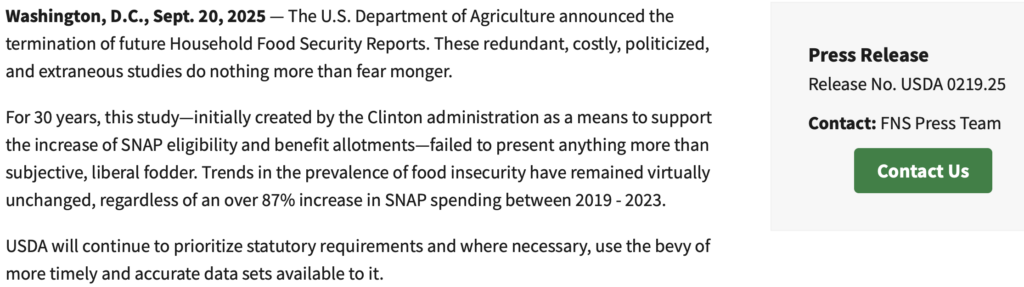
Ummmm, what is this? The Ministry of Propaganda?? Imagine what’s it’s like if you’re a normal person working for the USDA, you just want to do your job, but this is the kind of crap you have to deal with.
But I have a serious question here. The USDA claims that the survey is “redundant, costly, politicized, and extraneous.” Just to go through these:
– I guess the study could be “costly”; to assess whether it’s too costly to be worth it, I guess you’d have to talk about its benefits.
– The study could be “politicized,” but nowadays just about everything is politicized, so that seems kind of irrelevant.
– I can’t see why they are saying the study is “extraneous”; it seems very relevant to USDA-related issues.
But the thing I wanted to focus on here is the claim of redundancy. The USDA says the study is redundant, while the advocates say, no, the data aren’t redundant.
One way for the USDA to address this is to give users help on how to get the equivalent of these data from other sources. I did a quick google and found this page on the USDA’s website:
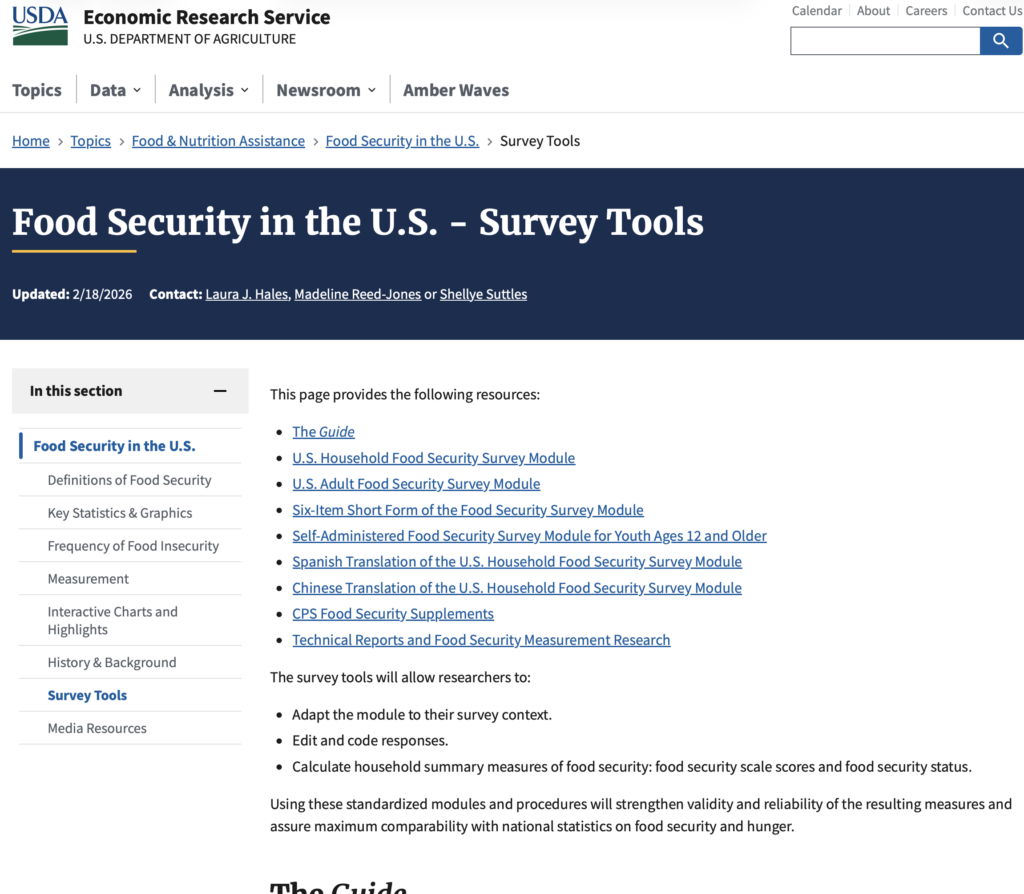
This seems more serious. I assume the people who are in charge of this webpage have no connection to whoever is the hack who wrote that earlier press release.
So here’s my question. Do the data described on that linked page provide the equivalent information to the now-canceled Household Food Security annual report? Actually, both the Food Tank news article and the USDA press release leave me confused, as they refer both to a “Food Insecurity Survey” and to “Household Food Security Reports.” Does that mean they’re canceling a survey and also canceling a report?
If it’s the survey that’s expensive and redundant, then they could still do the report, no?
The obvious conclusion to be drawn from the ridiculous press release is that the government is canceling the survey and the reports for purely political reasons, some combination of wanting to avoid bad news coming out and ideological opposition to aid to the poor. But it would be good to know if they’re correct in saying this survey is irrelevant.
Maybe I’ll contact Karen Perry Stillerman of the Union of Concerned Scientists and ask what is the basis of her claim that the data are not redundant. Also I can contact the USDA economists on this page. The USDA economists have direct emails; Stillerman doesn’t, but there’s an email given for her media contact, who I guess can connect me to whoever is data-knowledgeable at that organization.
I’ll report back to you!
I agree that the announcement does not make clear whether “survey” and “report” should be taken to mean the same thing or not. But I think the public announcement leaves no ambiguity. These studies “do nothing more than fear monger.” So, when this administration does not like the way people react to information, its solution is to remove the information. That was, in part, the problem the CDC ran into with COVID – too many decisions/pronouncements made on the basis of how people would respond at the expense of accuracy. This is much worse – the USDA can cite no higher purpose is what they are doing. Saving money, eliminating liberal fodder, and getting rid of fear mongering are their worthy goals. Also true for climate change. Also true for racial disparities. Also true for US History. Also true for environmental damages. I feel so much better now that I know that everything is wonderful. Except for those masses of illegal alien voters, however. There is a real problem.
I get “Access denied” when I click on that proposal’ link …
Anyway, judging by the short snippet here, has someone at the USDA been snorting Diet-Coke?
My modest proposal: people should eat more dogs and cats.
Olaf,
I added an Internet Archive link. And, yes, it’s disgusting that our government is producing this sort of Soviet-style propaganda.
Given what the administration is doing with climate science (https://www.nytimes.com/2026/07/20/climate/climate-change-manual-national-academy-science.html), why should we be surprised?
John:
I’m not surprised, but I remain horrified. Similar to how I feel when I read about Soviet propaganda. I know they did it, but it’s still unpleasant to think that people were doing this. In Soviet times at least they had the excuse that if they didn’t do the propaganda they might be sent to prison. The apparatchiks at the USDA have no such excuse.
Or, on the issue of food security, how about this from The Bulwark? https://www.thebulwark.com/p/trumps-one-big-beautiful-hunger-crisis
@Dale Lehman, who states “… when this administration does not like the way people react to information, its solution is to remove the information.” At least it has to content itself with information, for now.
I’m no fan of the ‘reductio ad Hitlerum’, but there has, of late, been such an increase in resemblances that a Bayesian analysis feels appropriate.
Yes, it is possible to learn a great deal on this blog. And, I thank Olaf Zimmermann for mentioning this phrase:
————————————————
“The phrase reductio ad Hitlerum was coined by the political philosopher Leo Strauss. He first used it in a 1951 article and then popularized it in his 1953 book Natural Right and History.
Strauss coined the term by analogy with the much older logical technique reductio ad absurdum (“reduction to the absurd”). His complaint was that people were increasingly trying to refute ideas merely by noting that Hitler or the Nazis had held a similar view.”
————————————————
Unlike most contributors to this blog, I was alive when Hitler held sway I therefore reserve the right to invoke Hitler whenever it is convenient and beneficial to the argument I am trying to make.
Dale, I admit that having vegetarians join in at a barbeque isn’t exactly my idea of fun, but I wouldn’t go quite as far.
Sorry, I meant Paul, of course (if there was a God, why did she give me myopia, astigmatism, and latterly presbyopia?)
Olaf:
Funny how you refer to God as “she.” Most of the published testimony seems to suggest that God’s a dude.
It’s an old joke:
The first astronaut to make it to outer space radios down that he has seen God. When he lands and steps out the capsule, he says “Folks, you won’t believe this: She’s Black!”
@Paul Alper:
If you invoke this Adolf Hitler because you were alive during his day and age, then I will invoke that Adolf Hitler because he was (is) around during my day and age:
https://iol.co.za/news/africa/2025-12-01-adolf-hitler-just-won-his-fifth-election-in-namibia/
I think this may be one of the stories that first make you laugh, and then make you thoughtful.
I hereby formally apologise for having, however inadvertently, nay, innocently, confirmed Godwin’s Law.
It shan’t happen again.
Olaf:
Some of the racism and extreme corruption in the current U.S. government reminds me of a milder version of the Nazis, while some of the extreme ideology and propaganda remind me of a milder version of the Soviets. These aren’t the only reference points for corrupt and repressive governments, but they easily come to mind for those of us who grew up in the late twentieth century.
And a somewhat related news item (today): https://apnews.com/article/eeoc-discrimination-dei-andrea-lucas-2f521d784a9d0376416499066dc9f178. Don’t collect the data, declare the reality you want, what’s the problem?
(reminds me of the book, Living in Data, by Jer Thorp: the data you collect, and don’t collect, is a political decision).
It is the hallmark of any insecure government that it tries to keep its citizens ill-informed and insecure. (cf. Bertrand Russell[1940] Freedom and government)
Montesquieu, no democrat he, would be rolling in his grave today.
Justifying cutting programs because food insecurity stayed stable despite an 87% increase in SNAP spending from 2019-2023 is like concluding chemotherapy because the tumor hasn’t grown.
As someone working in this space, and impacted by HR1, no, there is no other equivalent. There are a few sources at the state level, and some states, I believe, are proposing to collect it themselves. There was one study that examined a related concept, nutrition security, using NHANES recently: https://jamanetwork.com/journals/jamanetworkopen/fullarticle/2830803