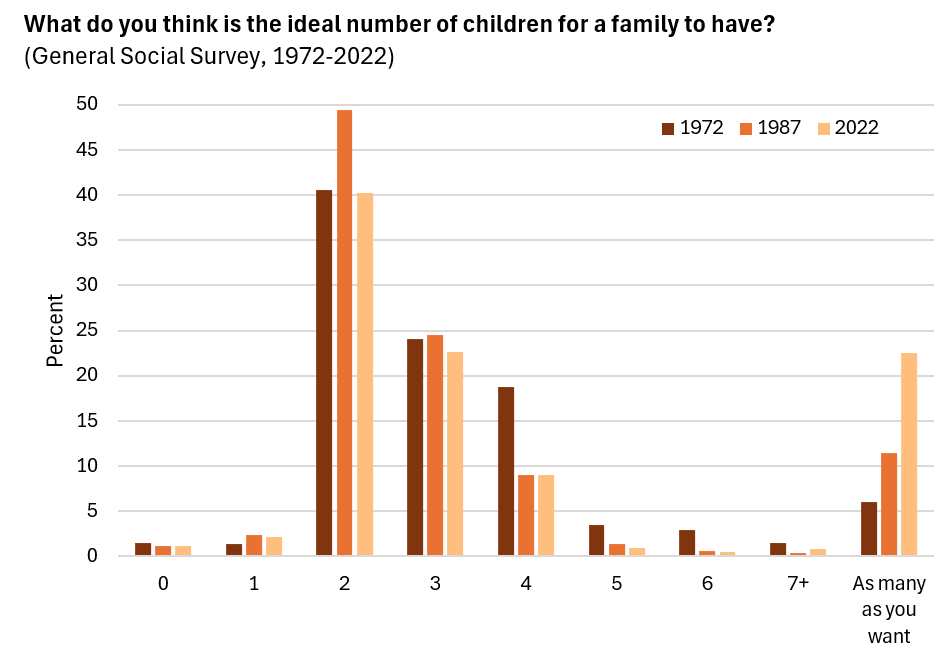
Philip Cohen shares the above graph.
There’s a lot to chew on here. First, what is the question asking, exactly? As Cohen says, “This is a question of normative views, not how many children people want themselves (which we would call intention or preference).” The “normative views” thing is interesting, in part because the ideal number would depend on the family. Indeed, even framing the question as “for a family” could be taken to imply that the number of children would be positive. I’m actually surprised that so few respondents gave “1” as an answer. It makes sense that 2 is the most common response, and it’s interesting to see the time series; I’m just not quite sure how to think about these responses. Indeed, I’m not sure how I myself would respond to the question!
Cohen focuses on a different aspect of the above graph, which is the increasing number of people who respond, “As many as you want.” Whassup with that? Cohen writes:
The category has gotten big enough that you can no longer ignore it, as many analysts have. The worst culprit may be Lyman Stone, who has repeatedly used the contrast between ideal and reality to promote pronatal policy, as here and here, where he used it to declare, “most women achieve less than their desired fertility.” The question does not measure respondents’ desired fertility, but rather their normative ideal.
I agree with Cohen that it does not make sense to use the “ideal number” question to represent “desired fertility.” Lyman Stone writes, “What if we give female survey respondents a bit more latitude, and ask them how many kids they’d ideally like to have?” But the “ideal number of children” question is not asking people how many children they would like to have. Again, this can easily be seen by looking at how few 0’s and 1’s there are on the above graph. There are people out there who don’t want any kids themselves, but they could still think that 2 is “the ideal number of children for a family to have?”
But back to the “As many as you want” option. Here’s Cohen’s explanation:
The major difference is the survey is increasingly done online. From 2004 to 2018, the vast majority — roughly 80-90% — of interviews were done in person. In 2021, because of the pandemic, none were in person, 12% were by phone and 88% were online. In 2022, 46% were online (this is the MODE variable). How does this affect ideal family size? In the 2022 codebook, GSS calls this variable a “classic example of differences in stimulus between interviewer-administered and self-administered modes.” In person, they don’t give people the choice of “as many as you want,” they just record it if people spontaneously offer that opinion. But in the web version, that option is now on the list presented to them. As a result, the number of people choosing this answer has shot up.
In retrospect, it seems a mistake to have included “As many as you want” explicitly on the web version. Instead, maybe they could have allowed a free response for anyone who did not give a numerical answer to the question. It’s too late now for the 2022 GSS, but if you’re asked, “What do you think is the ideal number?”, then, yeah, “As many as you want” seems like a very natural answer to the question–if it is given as an option. If it’s not an option, then it should be clear that the respondent is supposed to supply a number.
There’s more in Cohen’s post–he also looks at time trends broken down by political ideology. Here I just wanted to focus on the measurement issues. It’s an interesting statistical example because measurement problems arise in two separate places: first there’s the interpretation of “ideal number of children for a family to have,” which is not the same as “how many children you would ideally like to have”; second there’s the “As many as you want” response, which got out of control because of carelessness when adapting a face-to-face survey to an online format.
This is an example of something I most dislike about surveys:
“This is a question of normative views, not how many children people want themselves (which we would call intention or preference).”
I don’t think that is a valid statement. The survey may have been designed with that distinction in mind, but that doesn’t mean respondents view it that way. My guess would be that most people express their own preference rather than making a normative statement about others. I could be wrong about that, but I think I am right in saying that the distinction being made is not something respondents are clear about. Many survey designs are guilty of this: the creator of the survey has some subtle distinctions in mind, but respondents (usually not spending much time thinking about the exact wording) are not thinking about those intentions. If you want respondents to distinguish between their personal preferences and their normative beliefs about others, then I think you need to explicitly tell them the difference and clarify what you are asking for. Otherwise you get an incomprehensible mixture of the two responses.
IIRC there’s also some literature suggesting that in certain contexts you get more accurate results by asking people what they think other people think than by asking them what they think, and I wonder if this framing is downstream from that.
Also, with GSS there’s the problem of breaking the series if you change the question, which consistently pisses a bunch of users off
The funny thing is that many people *want* to say “as many as you want” but you recommend not allowing that as an explicit choice. In doing so, you’re biasing the survey, forcing people to provide less than their ideal answer about the ideal number of children. You’re probably also incentivizing lots of people to skip their next opportunity to take a survey. This is the reason I usually pass on surveys and feedback: the answers I want to give are not usually an option. The survey is designed to move the cattle into specific chutes that benefit the surveyor’s interests, not the interests of the survey taker.
The issue of the framing of the question as a general ideal vs. a specific personal question is strange. Who cares about what people think is the general “ideal number” of children for a general non-specific family? What does that tell us about anything?
IMO the “ideal price” for groceries, gas, rent and socks is the same: $0. :) Where does it get us to know that? Asking people specifically about intentions or ideal *for themselves* in the actual real world is the only thing that makes sense or has any utility, isn’t it? :) And by asking a specific personal question rather than the meaningless “ideal family” general question, the issue of “as many as you want” is eliminated.
Thinking this through a bit more now I see why the “ideal family” question is more or less unavoidable. If you ask specifically about someone’s ideal for themselves, “stage-of-life” issues become unavoidable and a simple question that applies to everyone is obvoiusly no longer valid. It doesn’t make sense to ask a 75yr man a question about their personal intentions or even idealized intentions regarding children. This then begs the question: is the simple question any more valid or meaningful because it hides the reality that the question is strongly “stage-of-life” dependent?
Well anyway that was fun to think about
+1 (see below).
‘What if we give female survey respondents a bit more latitude, and ask them how many kids they’d ideally like to have?’
I am not a fan of such a question. It blurs the line between the unconstrained and constrained normative. A respondent might think, ‘If I had enough wealth to afford it and a supportive partner and parents, and if XYZ condition were fulfilled, then I would have X children’, or alternatively, ‘In my current situation, X is the number of children I would like to have.’ These are two very different questions. This is why I am not a big fan of asking normative questions in surveys; it is difficult to convey the distinction between the constrained and the unconstrained normative to respondents.
There’s nothing wrong with the how many you would want to have, but it’s measuring something specific, not necessarily what they want or expect. Question wording really matters here.
I don’t disagree, but the statement “Question wording really matters here” is an easy assertion that often (mostly?) leads to illusions about what surveys are measuring. The more you believe wording really matters, the more you are prone to “carefully” word questions that parse subtle distinctions (such as normative beliefs vs preferences). Unfortunately, the respondents tend not to be so careful. This mismatch between the questioner’s careful design and the respondent’s careless responses is all too common. When such questions are asked in surveys, I think the only reasonable analysis asks why people responded the way that they did, rather than taking their responses as an indication of truth. I see the number of children question that way – the one takeaway from the survey for me is that the belief that people should have the right to decide for themselves is a growing sentiment in the population. I’m not sure I think the response tells us much about the number of children (preferred to idealized), however.
Well normally what should happen is that the surveying organization should run AB tests on the impact of the wording as well as using focus groups to understand people’s interpretation of questions. The GSS does a fair about of this (in my undergraduate methods class we just analyzed some of those experiments). It’s also important to understand the survey encounter as a social encounter, which means that modality (web v. in person, for one, and also the gender and race of the interviewer as another that has an impact on responses).
There’s a similar kind of issue for their abortion series, which asks “should it be legal” not “is it wrong” or “have you ever had” under a series of different circumstances.
But always with survey data you should assume that you are not getting a direct measurement of anything, but rather measurement that has error and should at best be considered an indicator.
Dale, Happy:
On one hand, I do think that people should be able to have as many or as few kids as they want. Ummm, maybe I think 10 kids is too many, but very few people want more than 3 or 4 kids so this is not such a big deal. I also have some idea of the ideal number of kids in a family . . . ok, this depends on the family so it’s not so easy to answer, but this makes sense as a survey question, to ask this. To put it another way, if someone answers that people should be able to have as many or as few kids as they want, I think it would be reasonable to follow up and ask what is an ideal number.
Also, I don’t think someone’s ideal number in an abstract sense is the same as someone’s ideal number for their own family. One reason for this is that people might base their view of an ideal family based on the family they grew up with or the families of their friends.
But there’s a statistical artifact here! The average size of a family, chosen by sampling children, is larger than the average size of a family, chosen by sampling families. For a simple example, consider a world with 1000 families, 200 with 0 kids each, 200 with 1 kid each, 200 with 2 kids each, 200 with 3 kids each, and 200 with 4 kids each. So the average family size is 2 kids. But if you sample by child, the average family size is (0^2 + 1^2 + 2^2 + 3^2 + 4^2)/(0 + 1 + 2 + 3 + 4) = 3. The average family size is 2 kids, but the average kid comes from a family with 3 kids. So, just from this alone, you could see why people might see the ideal family as having 3 children, even if on average they only have 2 children themselves. And this doesn’t even get into the fact that average family sizes have been decreasing over the decades. Indeed, in the data shown in the above post, very few people say that 0 or 1 is the ideal number of children, even though lots of people get married and decide to have 0 or 1 child.
I agree with Dale that it might be possible to ask the question more carefully. The challenge here is that once a question is on the General Social Survey, there’s a high barrier to changing it, because that would mess up the time series. Also, the GSS tests their questions pretty carefully, so this question might be better than you’d think.
Regarding Happy’s post: no, I don’t think the idea price for groceries, rent, and socks is 0. I think that people realize there’s someone on the other side of the transaction. Farmers need to get paid etc. Yes, you do get arguments for price subsidies (I seem to recall that in Iran the price of gasoline, of all things, is kept at an arbitrary low value!) but such arguments are typically paired with arguments about windfall profits etc. For example, proponents of rent control talk about the big profits made by landlords. I’m not saying these arguments are right (or that they’re wrong), just that I don’t think people are making the crude argument that ideal prices are zero–except for various resources that are perceived to be essentially unlimited, such as air to breathe, water to pollute, or places to park. “Too cheap to meter,” as the saying goes.
Regarding the stage-of-life issue: The General Social Survey asks people their age, so you could look at how this survey response varies by age. It’s tricky because of age-period-cohort effects, but the data are there, so no need to merely speculate.
Take your example of the ideal price of groceries. If you ask people, some will say zero and some will not. Some people are saying what is ideal for them personally (wishful thinking) and some are saying what they think is ideal for society (an economists’ balancing of the interests of consumers and suppliers, perhaps with some beliefs about market power thrown in). Given that most survey respondents are not thinking carefully about each question and just want to get through the survey, you end up with a garbled mixture of all of these considerations.
Now, it is true that there are downsides to changing questions on a longitudinal survey, and I think there is an important value that would be lost. But it is also a very strong assumption that the mixture of respondent interpretations is constant across both respondents and time – an assumption I find unjustified. If we look at the responses to the same question over a number of years, can we conclude that people believe in smaller or larger families compared with the past? And, what does the answer “as many as they want’ tell us about their preferred or ideal family size? What it tells me is that the current values (an aspect of populism, I believe) are to support individual choice and freedom. But it diverts from the intention of the question about family sizes. I’m just not convinced that this particular question asked over a period of years or decades tells us much about either the normative or preference attitudes of the respondents.
> I don’t think people are making the crude argument that ideal prices are zero–except for various resources that are perceived to be essentially unlimited, such as air to breathe, water to pollute, or places to park
or childcare, or healthcare, or public transportation, or abortions, or university, or internet, or textbooks
But not groceries, rent, or socks!
Yes I was going to point out that it would be good to know how many children does have (and whether that has already been reported to the interviewer). I suspect that the number that they do have probably would for social acceptability and the tendency to make answers consist would serve as a minimum response.
I think for people who have children (unless they have some very unusual circumstances) it would be hard to say that 0 children would be ideal.
Elin:
I agree with your last sentence. But lots of people have 0 or 1 kid, and almost no respondents gave this answer. I wonder if part of this is essentialism regarding the term “family.” The “ideal family” is some sort of Christmas card picture with mom, dad, 2 or 3 kids, a dog, a cozy fireplace, a backyard with a swing set, and 2 cars in the garage.
Yes exactly, which is why it is normative.
Well I went and ran the table at GSS Explorer and in 2022 of people with 2 children the largest response ( 52%) was 2 children and for people with 3 children the largest response (36%) was 3 children. For those with 4 children it was 4 children (36%). For 0 and 1 children, 2 is the largest response. The bigger families are not so need but those with 8+ children — n =17– over half say 2 and
The definition of a family (first one on google) says it consists of at least one child. So, a person with no kids, will most likely say 1 or more.
People offering a higher number than they currently have might be because they haven’t had time to produce the number of off-sprint they want e.g. first year of marriage.
Or they have produced their ideal number of offspring but some have died.
Andrew:
Could the “statistical artifact” you point out could be just an artifact of definitions in demographics? Perhaps it’s so that demographers refer to married couples as “families with no children” but that seems odd for general public usage. Do ppl refer to the married couple with no children down the block as ‘the “family” down the block’? That strikes me as wierd. It’s even a bit strange to refer to the empty nesters in the neighborhood as “a family”. People often say things like “their family has grown and gone”.
Originally in my comment I wrote about age, but then I realized that age is a poor proxy for “stage of life”. Some cpls have kids in their late teens and early 20s, other cpls late 20s to late 30s, so there’s a range there of at least 20 yrs. Other people never marry or have kids so the question is irrelevant.
My ideal price for groceries, rent, and socks is unquestionably zero! :) If your asking for “ideal [anything]” it seems unreasonable to expect people to take non-ideal factors about reality into account. Probably most people do take non-ideal reality factors into acount in some unknown way and to some unknown degree, but that’s the problem with asking for “ideal” – it introduces a lot of unknowns and since the specific ask is for “ideal” it seems like bad practice to make unsupported inferences or assumptions about how people on average include “reality” within “ideal”.
Happy thanksgiving!
I don’t like surveys that on purpose don’t give people a category that people may want to choose. I would object to not offering the “as many as you want” option because if this is not offered, the survey implicitly communicates that we should have a normative view on how many children some other people should have. I’d rather like it if people didn’t have such a view, and I’d feel bad about a question that pushes them into expressing such a view regardless.
By the way I have the same view regarding a “don’t know/neutral/can’t decide” option in much opinion research. I have heard the argument that people should not be encouraged to sit on the fence, implying that results are somehow more valid if people who would actually prefer to sit on the fence are pushed into not doing that. But how does it help opinion research to not allow people to give the answer they want to give? So then you find out about people’s second choice (or first choice, or a random choice not being able to tick the real first choice, you can’t know that). Some of these surveys online wouldn’t even allow you to continue if you don’t give an answer that you don’t want to give. How nasty is that? (These days I will drop out of any survey that requires me to choose an answer that doesn’t fit for me in order to continue the survey.)
PS I just see that “Happy Thanksgiving” had made pretty much the same point already.
Christian:
As I wrote in response to Happy above, I have no problem allowing the “As many as you want” option, but then I’d want a followup asking for the ideal number.
That sounds completely incoherent. The question already asks for the ideal number. What’s the followup supposed to say?
Q: What do you think is the ideal number of children for a family to have?
A: As many as you want.
Q: OK, but assuming that’s not true and there’s one number that’s correct for everyone, what number is that?
Michael:
First of all, for reasons discussed above, I don’t think the response to “the ideal number” question should be taken to represent the number of respondent’s view of the ideal number of children for their family. That was the original point of the discussion, that there’s been some confusion of these concepts.
Regarding your specific question: Sure, if people respond, “As many as you want,” the interviewer can follow up with something like, “Could you specify a number?” or “If you had to specify a number, what would it be?” This sort of thing is standard survey practice. For example, in political opinion polls, if the question, “Who would you vote for, if the election would be held today?” is answered “I’m not sure,” the interviewer will follow up with something like, “Which candidate would you lean toward, if you had to choose?” Asking this sort of followup question is not incoherent at all!
Andrew
Your example about voting worries me. If someone says they don’t know who they will vote for and the follow-up question is “who are you leaning towards” then shouldn’t there be another follow-up asking how heavily they lean? Then we can ask how sure they are about their answer. Then there is the issue of how those responses are aggregated and reported. By the end of these forking paths I’m not at all sure what the resulting picture tells us. While I don’t like surveys much, I think stopping with the first question and accepting the “I don’t know” answers as a potentially meaningful category is better than asking the followups. In the case of the “ideal number of children” I similarly thing the follow-up questions don’t really clarify anything, especially when comparing those responses with people that did not respond with “As many as you want.” In other words, I think it is not valid to compare follow-up responses with responses that do not call for a follow-up.
Dale:
These “lean” questions have been asked for a long time, and there’s evidence that the survey response after asking about leaning is as good as if the preference were offered in the first place; that is, “leaners” have as strong preferences as anyone else, they’re just responding in a different way. We discuss some of this on pages 425-426 and 450 of this paper: https://sites.stat.columbia.edu/gelman/research/published/bjps1993.pdf
Christian:
+1 Yeah, I often ditch surveys when I find out they’re not going to allow me to express my actual view.
Hi! Lyman Stone here! Cohen is a liar— while I have occasionally used that question out of exigency, I run my own surveys that specifically ask women their desires, and my usual public claims refer to those surveys. None of my arguments at all depend on the GSS question. It is unfortunate that people on the GSS advisory board like Cohen himself have declined to add a personal ideals question while choosing to add a battery of questions about pets!
Lyman:
The two posts of yours linked above (from Cohen’s post) both refer to that GSS question. Can you provide a link to your public claims that refer to your own surveys?
The statement above is true. Lyman doesn’t like me because of other things I said, but I don’t remember lying about him.
I forgot I wrote about the use of the phrase “start a family” to mean “have children”, which seems to have emerged in popular use only in the 1930s. https://familyinequality.wordpress.com/2017/03/26/to-start-a-family-started-to-mean-have-children-more-recently-than-you-think/. That is a very interesting point about whether zero is considered an invalid response to the question. Thanks!
If you think about it, if all of these women were upset that they only had one to zero children in their families, wouldn’t there be more adoptions and clarion calls for reducing the cost of adoptions? I think this is the problem of Lyman’s views and the pro-natalist movement. They want folks to have more children, people don’t, so they have to gin up that people are like them. If women and families were really devastated that they were having only 0-1 children, you would expect them to be at the very least adopting more and calling for the reduction in the cost of adoptions.
An “As many as you want” response doesn’t rule out the possibility that a respondent has a specific numerical ideal in mind. Normative example: The respondent thinks 2 kids is ideal but wouldn’t want that expectation to be imposed on anyone. Personal example: The respondent thinks 2 kids is ideal for their family but recognizes that in the future they might want more.
(Another reason why a follow-up question might be helpful.)