From Private Eye, 1-14 Apr 2022, columnist MD writes:
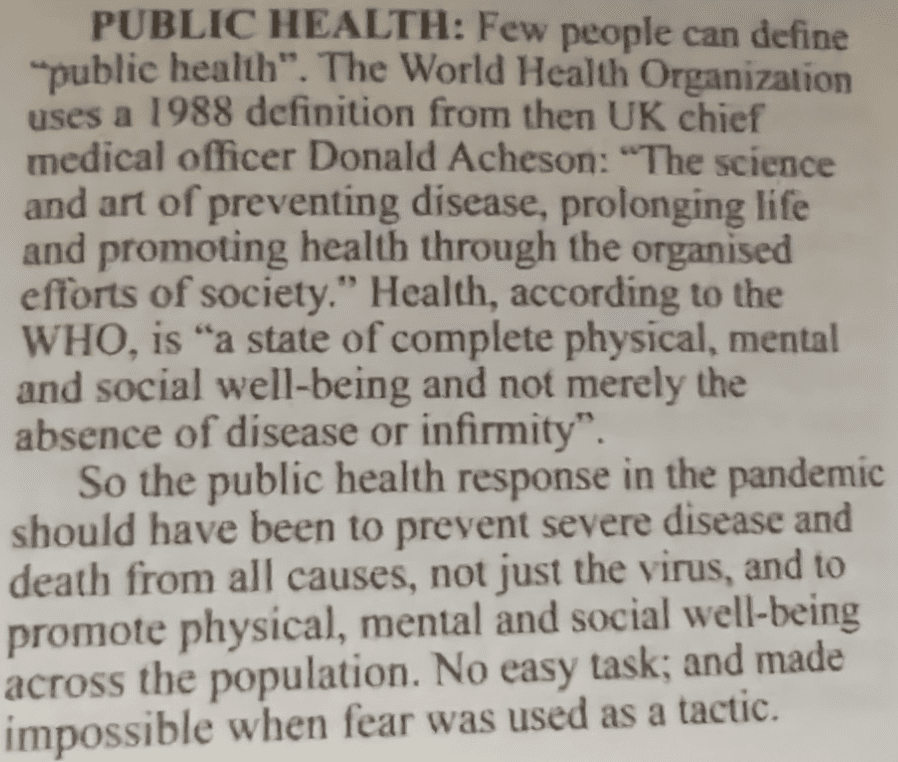

We saw similar things in the U.S., with official and quasi-official sources giving contradictory and flat-out nonsensical advice, all with the overconfident air of science.
Once these behavioural experts get it into their heads that we are irrational and need their guidance, it’s natural for them to slip into offering ridiculous policies such removing the hoops from the local basketball courts.
P.S. Lots of interesting comments below, including this from “JoePH”:
I think people fail to understand the type of planning that was occurring in public health circles. . . . I agree with someone who said that early on, there was a lot of uncertainty, placing PH officials under some intense pressure. Moreover, viruses can mutate – quickly – and this was always on the mind of the infectious disease epidemiologists I worked with during that time.
But with respect to fear – it’s a tool in the proverbial Public Health tool bag. It worked for tobacco. Moreover, research often suggests you use gain-framed for prevention (i.e. vaccines) and loss-framed for screening. With COVID – we needed people to do both. It was challenging.
I mean on one hand, yes, let’s not lie about stuff to scare people into doing things. On the other, the idea that “calmly and consistently talking to people” would actually work seems entirely laughable.
Total:
Yeah, good point. Maybe the best option would be something like, “calmly and consistently screaming at people.”
Stepping back a bit, there are good reasons for having official policies rather than just soft recommendations. Official policies solve some coordination problems. But then you get bad policies, like restricting people to stay indoors . . . it’s complicated!
The coronavirus has killed millions of people and inflicted long-term disability on tens of millions more. Maybe fear is the rational response?
Fear can be a rational state of mind, yes, but isn’t a “response” per se.
I have friends who wore masks outdoors, and if they were walking down the street and someone coming the other way wasn’t wearing a mask, one of them would loudly say to the other “this person isn’t wearing a mask, what should we do?” and then they would cross the street. They told me about this, proudly, like they had figured out the proper way to behave in this situation.
Along the same lines, a masked jogger once yelled at me for not wearing a mask, as I biked past at fifteen miles per hour or so.
I think almost any level of draconian rules were justified, or at least justifiable, in the first couple of months, when there was a lot of uncertainty about fatality rates and who was vulnerable and how rapid the spread would be etc. etc. But it pretty quickly became evident that transmission outdoors is very unlikely, that children are at very low risk of any severe effects, that transmission _from_ children to adults is rather rare, etc. etc.
Some places started out too cavalier and stayed that way — I think Sweden ended up regretting the laissez-faire attitude that they had for the first year or so https://academic.oup.com/view-large/figure/476837647/ckae091f1.tif — while other places, including much of the U.S., was, in my opinion, far too slow to adapt to new information and new capabilities. Once rapid PCR tests were available, it seemed pointless and cruel that nursing homes, for example, wouldn’t let people visit their dying loved ones even with precautions. And although it makes sense that some teachers who felt they were at high risk would not want to teach school, others would have and could have, and given the social isolation kids felt and the negative impacts of it, I think most schools should have opened much sooner, with some reasonable testing regime.
I think the “transmission _from_ children to adults is rather rare” is more a cultural artefact than a general rule. In my country, children didn’t have to wear masks in school and were told the vaccination wasn’t as imperative for children (IIRC) and so many people got COVID-19 from their children. Maybe it’s just my age (and sex) and the age of my colleagues so I have a biased view but it was so common for mothers to stay home because the kids were sick and the next minute they were down with COVID-19 too. One of our first big outbreaks was in a school.
I know there were some studies relatively early (maybe in the first year) that suggested transmission from children to adults is rare — I think those were based on studies of families where the kids were known to have COVID; in many cases the adults never got it.
Hmm, this study https://pmc.ncbi.nlm.nih.gov/articles/PMC10161681/ suggests child-to-adult transmission seems to have been rare early on, but that later variants were more easily transmitted from kids to adults.
I dunno.
Hindsight is 20/20. Not saying that public health authorities did everything right in any country, just that they had to formulate policy with (1) imprecise scientific knowledge, (2) under time pressure, (3) with potentially catastrophic costs if they make a mistake, (4) in a situation that is unprecedented in the memory of people who are alive at the moment (the 1918-1920 Spanish flu is history now, and happened in a very different context for to be directly comparable for policy purposes).
I remember how the people around me switched from denial/mild interest (“some weird virus in a remote location”) to Post-Apocalyptic 12 Monkeys Pandemic Survival Mode when previously healthy 40 and 50 yo people in their wider social network (friend of a friend) started dying. I think that it is the “this could easily happen to me” aspect that scared people.
The period that interests me more than the early pandemic days is the summer of 2020 (which, as it turned out, we got to replay in the early vaccine days in the summer of 2021). I had the strong impression by that time that there was really no evidence of measles-like transmission in outdoor settings where people weren’t talking or laughing or singing into each other’s faces (so outdoor weddings and Hells Angels conventions wouldn’t count). By July or August 2020, keeping parks and hiking trails closed and not letting hair stylists and others provide their services outside (e.g., municipal parking lots could have been devoted to this) began to feel like it would result in serious and probably needless resentment of public health directives.
Kyle –
Methinks the causality behind resentment of public health services. Probably the biggest predictor for how people assess outcomes is their baseline views in public health policies, “the government” etc., mixed with partisan/ideological identity as amediator/moderator and interaction effects.
In Sweden, people place a lot of confidence in their public health officials and not surprisingly thinks they did a good job. Is that because the specific policies of their public health officials were effective, from some objective standpoint? Well, in counties like Taiwan or Singapore or Bhutan they had very different policies, and I’ll bet surveys show their citizens also think their officials did a good job.
Perhaps the thing that unifies all those countries, on contrast to the US, is the belief that “individual freedom” and broadly-based social benefit aren’t inherently in opposition.
Joshua,
Sweden was happy with their response at the time, but ended up regretting it. The Swedish epidemiologist who led their effort said in June 2020 that they should have done more in the previous months https://www.bbc.com/news/world-europe-52903717 and a later review was pretty damning: https://abcnews.go.com/Health/scathing-evaluation-swedens-covid-response-reveals-failures-control/story?id=83644832
Phil –
More recently, Tegnell was taking bows at the Stanford conference to applause from anti-NPI and anti-COVID vaccine skeptics.
And here’s a more recent update on his take which is far more positive:
(usual “www” stuff) Irish times. (usual “. c*m here) /world/2023/03/09/swedish-epidemiologist-defends-light-touch-pandemic-response/
Anyway, I was referencing public opinion. A quick Google (the article note caveats) suggests that favorability was lower for public health response to covid in Sweden than in Denmark, but it was still pretty high. Notably, the favorability rating for the government was lower than for public health authorities.
https://bmcglobalpublichealth.biomedcentral.com/articles/10.1186/s44263-023-00009-2
Joshua:
Seeing as Sweden is brought up, I can’t help but bring up something that’s been on my mind lately. I recently read a study that compared mortality rates between Sweden, Finland and Denmark between 2020 and 2023, adjusting for a bunch of demographics. I’m too lazy to fish it out now but I’m sure it’s easy to find.
They found that Sweden had immensely high excess mortality in 2020, but then returned to lower levels after that. Denmark and Finland were the opposite; low mortality in 2020 but high excess mortality after. Coincident to this, is that Finland and Denmark had extremely strict restrictions while Sweden was very light.
This can certainly be *partly* explained by simple mortality displacement. However an interesting thing to note is that Sweden also has the highest vaccination rate between those countries – one of the highest in all of Europe in fact (in the top 5, last I checked).
My completely unqualified and non-empirical hypothesis is that Sweden’s more visible excess mortality may have provided a lot of extra motivation for people to get the vaccine; combine that with less built-up resentment towards the government due to harsh restrictions, so they were less inclined to fall for anti-vax hysteria. The point being, Sweden’s approach seems to have worked best in the long-term (assuming it is not too soon to call “long-term” yet).
That said, if everyone adopted Sweden’s policies, the conversation we would be having today is why the government didn’t do enough in 2020 with probably the same amount of (perhaps reasonable) self-righteousness. That’s of course assuming everything would have went the same way; and that’s an impossible “if”.
Anyway, I think the point I’m getting at is that Sweden provides some evidence that a lighter touch might be preferable in the longer term. But I recognise it’s a lot easier to say that now than it would have been 4 years ago.
Sweden should be happy with their COVID era policies as they ended up with the essentially the lowest total excess mortality in Europe despite their initial failure to protect the elderly. See e.g. https://www.ons.gov.uk/peoplepopulationandcommunity/birthsdeathsandmarriages/deaths/articles/comparingdifferentinternationalmeasuresofexcessmortality/2022-12-20
When you consider the humanitarian cost of the draconian measures implemented here in the neighboring countries, it is obvious that Sweden might the right choice. On a personal note I also respect them for not interfering in individual liberties despite having an excuse to do so.
Anonymous:
“…they ended up with the essentially the lowest total excess mortality in Europe…”
While they consistently rank quite high, your source only ranks them number 1 on one metric – and the most naive one by my eye. Norway seems to have done better than them overall. Denmark only did slightly worse by these metrics, with Finland performing poorly (relative to the rest of Scandanavia). I don’t disagree with your conclusion, but it’s not quite as clear-cut as you make it sound.
That said, if the trends kept up to 2023 and 2024 and the metrics were re-evaluated accordingly, it wouldn’t surprise me if Sweden outpaced Norway.
While I’m here, here was the study I was referring to in my above comment: https://academic.oup.com/eurpub/article/34/4/737/7675929
Correction to what I said above: they only looked as far as 2022, not 2023. That’s annoying. They also included Norway, of course.
9P:
In hindsight I should have linked more or better sources, but once I had initially in mInd were all in Finnish. The general consensus at least here in Finlandis that Sweden did overall better than us, and the strict lockdown policy was a mistake.
I wouldn’t be surprised if the costs of the lockdowns will continue to materialize over years to come via psychological and developmental issues from isolation to small business owners committing suicide due to losing everything.
Anon:
I think the cost of lockdown is a valid thing to wonder about, and I certainly don’t mean to be dismissive, but this needs to be balanced against the counterfactual. There may have been a far higher cost if we didn’t apply NPIs to the same extent. An overwhelmed healthcare system and many many more dying similar to the scale of what we saw in Sweden and Italy during that first year would surely have left its own psychological scars.
Anonymous –
From what I have read, there were only marginal differences in the measures Sweeden didn’t take relative to other Nordic countries. Especially when you track things like mobility (meaning whether restrictions were mandated kind of misses the point). Further, if your take is right, and the other countries truly were much more “draconian,” and if you’re right about the negative externalities resulting from imposition of NPIs, then you should be able to demonstrate a differential signal in outcomes like educational attainment or psychological health post-pandemic. Have you seen any?
9p –
It drives me nuts how many people argue about the impact of NPIs without actually integrating that they’re making tons o’ assumptions about counterfactuals. How do people know there were “lockdown deaths” if they don’t have the counterfactual for what would have happened absent the NPIs? Without that knowledge, attributing direct impact from the pandemic itself gets conflated with assertions about negative externalities from the NPIs. While I can’t seem to get anyone to engage on that topic, I did at least run across this paper, which interestingly references Sander Greenland who is a friend of this blog but who also was a co-author in what I thought was some pretty weird stuff about health impacts from the vaccines.
Sorry – here’s the link:
https://jech.bmj.com/content/75/11/1031
What happened is that prior information about viruses/immunity wasn’t trusted. Neither were any predictions based on their models. And after the fact, everyone is still wondering.
We need a term to distinguish this from something like astronomers predicting the trajectory of an asteroid, because it is the opposite in every way.
I use “bizarro science”.
Anoneuoid:
Can you point to the specific models you’re talking about here?
The SIR models in particular, but all of them. Eg, the problem of “superspreaders” was already mentioned above.
Also, I remember the CDC had a page of dozens of models and not a single one incorporated seasonality, let alone testing.
Testing is the big one, and essentially impossible to model because it uses “the process” (a term I just got from another thread here).
“The process” can change the error rates of the tests, who gets tested (and how often), and who knows what else. All with little/no indication to the outside world (ie, the modeller).
Also, I remember the CDC had a page of dozens of models and not a single one incorporated seasonality,
As we discussed at the time, that’s at least debatable (and in my view inaccurate).
Pandemic policies created in more cool-headed times were already in place in most countries and regions. These policies were ignored, which is what caused the problems described in the article. Here is the Canadian experience: https://rumble.com/v3qtrom-lt.-col.-david-redman-apr-27-2023-red-deer-alberta.html?e9s
Wiktionary gives the definition of “complacent” as “Unduly unworried or apathetic with regard to an apparent need or problem.” To me, this implies that people who were “complacent” in the early stages of the pandemic were underestimating their personal level of risk. I don’t know what (if any) research was behind this assessment, but if someone is underestimating a risk it doesn’t seem crazy to me to encourage them to view it more accurately. This doesn’t mean that “hard-hitting emotional messaging” is the best way to do this, but the columnist seems to be interpreting the quoted statement pretty creatively, IMO.
I’m not as concerned about the real quote as the newspaper reporter. It stated “The perceived level of personal threat needs to be increased among those who are complacent, using hard-hitting emotional language.” If the “perceived” level of personal threat is demonstrably lower than the “actual” level of threat, then of course you’d use outreach, education, and advertising (which seems to me to always use emotional language) to correct that misconception.
Heck, if we saw someone (in a seat of academic power) claim that misuse/abuse of p-values is not a problem … we’d possibly mock them, point out how it’s led to millions of $$ wasted on TED Talks, try to estimate the number of people killed by vaccine denial, etc. We’d also hopefully “calmly and consistently” talk to them. But if it’s a real disconnect between perception and reality, we wouldn’t resort to a single strategy for everyone.
With H5N1 in dairy herds and a soon-to-be public health official advising us to drink raw milk, I can’t get that worked up about the quotation, either.
I may fault public health authorities for misrepresenting the facts, but I also appreciate the current reality. Appeals to the public good and welfare of others seems to be at an all-time (at least within my lifetime) low. It appears (to my jaded view) that only appeals to self-interest are successful. At least if that is what the public health authorities believed, then some of their errors are understandable. I might wish it were otherwise, but it is hard to find many current examples where the public good trounces more narrow self-interest. We are becoming the economics textbook dream people, for better and worse.
I’m not as depressed as you are. I don’t think people are unwilling to do socially beneficial things so much as they are maximally skeptical that the things authorities are asking them to do are socially beneficial. The fact that the vaccine made personal symptoms milder while doing essentially nothing to stop the spread (unlike, say,, the measles vaccine) and that this was known very early put people in a frame of mind that sequestering themselves was unlikely to do much incremental harm to the vaccinated. And yet the sequestration mandates of various sorts continued unabated even as they were convincing very few,
Add to that the fact that for younger populations, personal symptoms were extremely unlikely to be serious and what appears to be pure personal selfishness may not have been. (And yes, the “may not have been” is weaselly in the absence of a good control.)
Jonathan (ao) –
I don’t think people are unwilling to do socially beneficial things so much as they are maximally skeptical that the things authorities are asking them to do are socially beneficial.
I’d say that is a very culturally bounded orientation, and is largely mediated by ideological alignment.
Consider what JD Vance has to say about what government authorities should impose in the name of social benefit. As one example, he advocates that government should evaluate whether an abused spouse’s pursuit of a divorce benefits society.
And your assumption that Vance’s opinion, when instantiated in actual policy, would command any respect at all is similarly culturally bounded.
I note that the last three elections have seen changes in party. It is astonishing to me that the Labour Party in England has gone from +20 (at the election) to +1 in just a few months of “rule.” Vance and Trump can (and do) say a lot of things. Whether these things command respect in which people take actions that impose private cost for (assumed, arguendo) social gain is, to me, doubtful. None of that affects whether or not people would actually be willing to bear private costs for what they themselves see as leading to social gain, and has nothing whatsoever to do with ideological alignment.
Jonathan –
Your point about Vance’s social engineering goals (which I agree was was valid) aside…
None of that affects whether or not people would actually be willing to bear private costs for what they themselves see as leading to social gain, and has nothing whatsoever to do with ideological alignment.
There’s a ton of evidence that shows your total certainty there (at least as a blanket ruke) is misplaced. My point isn’t merely that willingness to accept cost shows an ideological signal, but also so does the very perception of coss. We could track the willingness to accept the “cost” to society of, say, interracial or same sex marriage. In more modern times we could look at the very perception of cost itself from CO2 emissions, as well as a willingness to accept a cost, which bitj show a very strong ideological signal.
More directly related to the OP, we could look at perceptions of “cost” or reward associated with the HPV vaccine.
Or we could look at perceptions of vaccines more generally. Prior to Covid the community who objected to the cost of vaccination programs showed no distinct ideological signal (the Waldorf school folks were balanced out by the Alex Jones folks). In the matter of only a few years perceptions of cost became starkly ideological.
As you say, vaccine reluctance was once a far-lefty thing; now it seems to be closer to a median-ish righty thing. But again: I think it is a symptom the distrust of leftish elite authority that characterizes the right (odd for a group that seems to have just elected a would-be authoritarian!) and actually has nothing to do with selfishness, just as I don’t think the Waldorfian resistance to vaccines is a statement of selfishness.
The notion that people on the right are more selfish than people on the left is supported in the literature, but it is some of the worst literature around in that (IMO) a fair reading of the literature finds a lot of bias in the questionaires and mistaking a difference in two means as a failure to recognize a ton of overlap. I just read an excellent piece on this, but I can’t remember where.
Finally, it is certainly possible to induce vaccination behavior either by understating the private cost or by overstating the public benefit, or both. My take is that the FDA/CDC authorities are clearly guilty of the latter. The residual question of whether Covid vaccination would be less of an ideological flashpoint today had they not done so is questionable. I don’t know. But Trump’s administration created the vaccine, and no one seems to hold that against him on either side of the ideological divide..
Jonathan:
You write, “vaccine reluctance was once a far-lefty thing.” That’s something that people like to say, but the evidence doesn’t bear it out.
I don’t know why it’s become conventional wisdom that “vaccine reluctance was once a far-lefty thing”—I guess the news media must have reported some left-wing vaccine opponents at some point, I dunno. It’s funny to see this unfounded belief existing, even here in our comment section!
Interesting, Andrew. I had associated this reluctance to the general rejection of capitalist pharma associated with 60’s radicalism. This article https://pmc.ncbi.nlm.nih.gov/articles/PMC9612044/ is I think generally good on this stuff and really doesn’t discuss political valence all that much, but I do note that in Tory-led Britain, Covid vaccine reluctance was a minority-led phenomenon and I think the correlation with the left is a good sign that the reluctance was authority distrust.
And then there’s this: https://theconversation.com/anti-vaccination-beliefs-dont-follow-the-usual-political-polarization-81001 which, crucially is preCovid. Based on a Pew survey: “The more conservative and also the more liberal someone is, the more likely he or she is to believe that vaccination is unsafe.”
Jonathan:
I don’t know enough about the history of this. My vague impression is that in the late 1950s, the developers of the polio vaccine were considered national heroes. There was also Thorazine, Valium, etc.—not vaccine but part of the modern-medicine-will-save-us story. Then in the 1960s there was Thalidomide, concern about pollution, revelation of abuse in the mental health system, . . . a lot was going on. I’m not clear about how it all fits together.
Jonathan (ao)
As you say, vaccine reluctance was once a far-lefty thing;
Except that’s explicitly not what I said. I said there wasn’t a political signal. Andrew beat me to it, but Dan Kahan put up a series of posts that detailed how there was no particular political signal in vaccine “reluctance” (or in views of GMOs) prior to COVID – although there was a widespread belief that it was. If you had spent any time looking at folks like Alex Jones, you wouldn’t have likely had that perception.
I’m also not entirely sure where you got the idea that I was blaming skepticism about Covid vaccines or Covid policies on “selfishness,” as that wasn’t my intended argument. I was saying that often, views on public health policies have ideology at their roots. It’s a situation that similar to when people blame “skepticism” about climate science on climate scientists. Of course the etiology is complicated, but I don’t straight up reaction to perceptions of “cost” is a very deep answer. The striking political signal in public views on Covid vaccines and NPIs, just as with climate change, run much deeper, imo, than simply the communication mistakes of public health officials or climate scientists.
So this The notion that people on the right are more selfish than people on the left…
That Isn’t something that I’ve said or intended to say. I don’t think there’s any “selfishness” differential in how people across the political spectrum view these issues. Although I did note that there’s a very different view in many Asian countries, and even Sweden, compared to the US regarding a perceived tradeoff between acceptance of public health policies and “personal freedom.”
Finally, it is certainly possible to induce vaccination behavior either by understating the private cost or by overstating the public benefit, or both.
I would use “affect” rather than “induce.” The causal mechanism is complicated, and as I’ve said, “private cost” and “public benefit” are clearly, often, associated with or mediated/moderated by ideological predilections.
My take is that the FDA/CDC authorities are clearly guilty of the latter.
And whether or not it’s the case with you, it’s clear that such a view (or a contrary view) is STRONGLY associated with ideological viewpoint. As to whether ideology is causal gets a bit complicated and you can’t assume that the case for any particular individual – but IMO, there’s clearly a interaction effect of some sort.
We’re clearly confused about each other’s arguments. Not sure I can clear it up, but I’ll make one quick try to make my points clear and then withdraw.
Public authorities try to get people to take vaccines by saying the personal costs are low (and usually net positive) and the social benefits are high. They followed that script with Covid. In today’s ideological climate, they are not trusted by the ideological right, so these appeals didn’t work as well as the authorities would have liked. In other times, where the authorities represented The Man, as in say the Vietnam Era, it might have run in the opposite direction, and as the link I gave showed, preCovid, both far-left and far-right distrusted vaccines. (I like Kahan, by the way, and if he has something preCovid that shows differently, please show me.) So if you distrust authority (and that used to be a left thing) and your distrust for authority is strong enough, you might well be thus influenced on the left or the right. Hesitancy will be strongly correlated with ideology, but in a bank-shot through contempt for authority. (The Trump period is confusing because Trump developed the vaccine and then threw shade on Fauci’s advocacy, leaving official gov’t policy in a bit of a muddle. But there is no question that Biden told everyone that the vaccine would stop the spread of the disease, that this was wrong, and I think there’s good evidence that Fauci knew it was wrong, but that last point is not absolutely ironclad.)
But there is a very different argument that I heard at the time, that the right wouldn’t take the vaccine because they didn’t care about societal gains, only their own personal (net) costs. That, for example, is what I take Dale to be saying above. Maybe I’m wrong about what he’s saying as well. But that’s what I disagree with.
If I’ve misinterpreted you or Dale, I apologize.
Jonathan (ao)
So despite the confusion about what each other is saying, we are getting closer to agreement. I agree with most all of what you wrote in that last comment. Not totally, though.
Where I disagree is that I don’t think there’s internal consistency in how people see “authoritarianism.” Jonathan Haidt has written about a proclivity towards authoritarianism among Trump supporters – but I don’t agree with that. I think that Trump supporters just like Harris supporters, like some forms of authoritarianism if it fits with their worldview and dislike others based on how they frame the authoritarianism within their ideological worldview. So whereas you find it inconsistent for people who object to the authoritarianism of public health officials to also support Trump, and say “The Trump period is confusing,” I see that kind of pattern as entirely expected. There are so many examples of where people hold mutually exclusive views on authoritarianism. Perhaps the most obvious example is where “liberals” supports the “authoritarianism” vaccine mandates but object to the “authoritarianism” of laws prohibiting abortion rights and “conservatives” support laws prohibiting abortion rights but get into a tizzy about vaccine mandates.
You speak to how “the left” and “the right” switched sides vis a vis authoritarianism but I would say that people on “the left” and “the right” have always applied motivated reasoning to their definitions of what is or isn’t authoritarian. So that’s part of why I don’t think it was the “authoritarian” nature of COVID policies that caused backlash on the right, but that people with RW-leaning views defined those policies as an unacceptable form of authoritarianism (even though they support a clear authoritarian for president) because of how they frame the policies within an identity-based, ideological framework.
As for Kahan, he did a whole series on identity-protective and identity-aggressive cognition with respect to vaccines, GMOs, and relatedly, “trust in science.” It was a very stimulating series of blog posts and related studies. He also had a guest post from Gordon Gauchat related to “trust in science”(Guachat’s work shows that conservatives used to have more “trust in science” and liberals less, but that changed fairly recently. Interesting, however, is that almost all of the change was concentrated among Tea Party types – although I’d guess more recently the loss of trust has widened to more mainstream Republicans. Kahan basically disagreed that there has really been any trend in “trust in science”). Also, Lawrence Hamilton has done some interesting work on “trust in science” more specifically focused on views related to climate change.
I don’t know what happened to Dan. All of s sudden, one day comments were disallowed at his blog and I haven’t seen ANY output from him since then – which is particularly strange since he was so prolific. I went to look for links to some of his posts that I referenced but just recently his blog material has been completely reformatted and seems far less useful and much less searchable. And the comments are all gone. Weird. My assumption is that there was some kind of major health issue with Dan. Googles turn up exactly zero information. Even his Twitter fell suddenly silent.
I wasn’t thinking specifically about the vaccines, but I would include it in the following sense. Exaggerating the personal risks from COVID (which was a form of lying) is consistent with my claim that selfishness trumps the public good. Ironically, the lie that vaccines would prevent the spread of COVID rather than reducing disease severity downplayed the personal risk in favor of more general protection of the public. So, perhaps that particular lie is not consistent with my claim (although it is muddy – protecting the public from spread was often couched in terms of preventing spread to your personal loved ones). So, COVID vaccines are not the ideal example for what I was claiming about selfishness. I’m still recovering from the election: the major themes for both parties emphasized narrow self-interest. What can/will the government do for you personally? Issues of climate change, poverty, and world peace hardly figured in the platforms. Instead we got $X for first time home buyers, $Y for a child care tax credit, lower prices for eggs and houses, etc. Most of all, we got the idea that the role of government is to promote your self interest – largely gone was the idea that government exists to address things that our narrow self-interest might endanger. It was in that context that I was saying that poor public health messaging might be related to the perceived need to emphasize personal benefits rather than public ones. I was not specifically thinking about COVID vaccines. It may take me a few years before the election wears off.
Dale –
Ironically, the lie that vaccines would prevent the spread of COVID rather than reducing disease severity…
I’m not going to chase that statement down from certain other individuals when they make it, but with you I think it’s worth a comment.
Of course, judging that people are “lying” requires a kind mind-reading that I don’t think anyone has, but when those statements were first made, some evidence showed that vaccines did “prevent” the spread of COVID. But with the more evasive variants and over time, that changed. It’s seems perfectly reasonable to me to to say that top scientists should have known, as my friend here likes to point out, that immunity from an intramuscular shot wouldn’t create a long-lasting immunity from a virus that is spread through mucosal tissue. But that doesn’t equate to the lying. Rochelle Walensky has acknowledged that they weren’t sufficiently circumscribed in their messaging. I suppose it could be argued that they were aware of the deeper science but decided to message inaccurately to maximize the number of people who would get vaccinated – but I’m not sure how anyone can know that, and even if true I wouldn’t be inclined to describe that as “lying.”
There’s a parallel situation with the boosters. Paul Offit, a vaccine advocate, has discussed that public health officials had to make complicated decisions about booster recommendations. They could have made nuanced recommendations and noted that overweight isn’t a risk factor, say, whereas obesity is, or they could have had laddered the recommendations based on other risk profile factors like age. But some in the public health community felt that with including those nuances, many people who would benefit from vaccines wouldn’t get them. Offit disagreed, and he felt that the recommendations shouldn’t be blanket recommendations, but should be differentiated based on risk profile. What I found interesting about what he said was that he distinguished between his view as a scientist – where the uncertainties should be clearly communicated, and public health officials who felt that there should be blanket recommendations. He disagreed with the public health officials but he also respected the difference in the perspective of a scientist, for whom communicating the uncertainties was the focus versus a public health official, where preventing illness and death was the focus.
I’m not saying I agree with the decision to make blanket recommendations – but I do think that the full context should be considered.
Dale –
You may not want to listen, but as it happens in this recent podcast Paul Offit discusses the process by which the public health policies were made regarding whether infection-induced immunity should have been an exemption for vaccine mandates and whether yearly booster shots should have been a blanket recommendation.
He thinks both policies were mistaken but he offers some insight into why the typical anti-public health officials narratives about why those decisions were reached (say, because “big pharma”) are simplistic and facile:
https://open.spotify.com/episode/2UV6RaWYXnfYws1BH24POy?si=V7PS7882TxiVt6rNvqtSyg&t=3504
One thing I’ve wondered about is—was lying (or a less pejorative term, if you prefer) an established part of the public health playbook before 2020? Did public health experts discuss at conferences or in formal recommendations, “Shhh, don’t let this get around too much, but we might need to lie if a pandemic happens”? A big source of my uneasiness is that the misrepresentations were improvised and ad hoc.
Kyle:
I don’t know about lying, but in general there’s a challenge with public health messaging, in that there’s a lot of uncertainty surrounding many health-related decisions, and it’s hard to communicate uncertainty. Often there’s no way to communicate to the public without there being some confusion and some people being misled by the advice.
Andrew: I get it, and (as some might recall), I very much didn’t ascribe bad motives to public health authorities in 2020, but Dr. Fauci, for example, has admitted intentionally telling untruths about masks, for example. I wonder if that decision and others like it were based on preexisting public health concepts.
My understanding is that Dr. Fauci initially (March 2020) advised against wearing masks and said some time afterwards that this was due to a concern over having sufficient protective equipment for health care workers. By April when the information indicated that there wasn’t going to be a mask shortage, the CDC issued updated recommendation for public mask wearing.
That all seems part of the immense difficulty in balancing conflicting concerns during a period of great uncertainty. I wouldn’t call that an “ad hoc” misrepresentation. It was a judgement call that was appropriate for circumstances as they were perceived, and when circumstances were considered to change the advice was changed.
Kyle:
If you want to know the playbook before 2020, listen to the guy who wrote the book for the province of Alberta: https://rumble.com/v3qtrom-lt.-col.-david-redman-apr-27-2023-red-deer-alberta.html?e9s
tl;dr – The policies implemented were the exact opposite of established protocols.
I’ve decided to move to that county where all public health officials weigh threats absolutely perfectly and always nail the risk/benefit ratio of various policies right on the nose.
You know, that country where they always create policies that maximize the benefit to loss ratio, where no one can say they did more than they should to protect lives, and also where no one can say they didn’t do enough to protect lives.
Just as soon as I figure out where that country is, I’m there in a heartbeat.
Obviously I understand that you’re being sarcastic, but your sarcasm seems misplaced… unless you’re suggesting that every public health official should be immune from all criticism, no matter how clearly wrong-headed their decision-making. If that’s what you think then go ahead and sarcas as much as you want but don’t expect anyone to take you seriously.
In the US, the very first response was “early intubation” which had < 10% survival rate, (as expected based on all past experience with ventilators and elderly populations), while filling up ICUs for weeks, thus preventing care of others.
This was based on guidelines that, in turn, were based on anonymous rumors from China. It only stopped when Dr Cameron Kyle-Sidell refused to do it anymore, was demoted to the ER, and turned to social media. This allowed frontline workers to join forces to overcome the public health bureaucracy.
At the same time this most expensive and dangerous intervention based on no evidence or reason was being touted in press conferences, the FBI was shutting down clinics offering free IV vitamin C treatments. Essentially the safest and cheapest intervention, with a theoretical basis (low vitamin C levels in severe patients), and track record of benefitting those with respiratory illness.
That was how it started, and the “science” did not improve as time went on. People eventually just stopped listening to the health authorities on every one of their “science-based” recommendations, instead turning to the far superior method of intuition from personal experience.
I still tear up at the pure bureaucratic evil of the whole thing.
Let’s have a full accounting of how “intuition from personal experience” has worked for people’s health. I share faulting health authorities for poor messaging, contradictory and inconsistent policies, and selective (and often wrong) reliance on the “science.” But the public reaction to stop listening and rely on their intuition has been far from perfect. It seems that many people’s intuition is that COVID never happened, that flu shots are unnecessary, that eating junk food is fine, that wearing sunscreen is not necessary, that getting screened for cancer is unnecessary, and that good health insurance is that which costs little and pays for gym memberships.
There are different views on the use of ventilators.
https://gidmk.medium.com/did-ventilators-kill-people-during-covid-19-c07283933865
lol
If someone has a respiratory disease, I think helping them breathe will be more effective than vitamin C.
The point is that expensive and dangerous interventions were adopted without much thought while cheap and safe ones were actively blocked by the government.
Anyway, “helping them breath” is more nuanced than your post implies. Here is the critical care doctor mentioned above on Mar 31st, 2020: https://vimeo.com/402537849
Once ICUs around the country started ignoring the guidelines, the mortality rate dropped by 10x.
Also, there are other reasons for trouble getting oxygen having to do with the blood. Eg:
https://en.wikipedia.org/wiki/Methemoglobinemia
That is coincidentally a side effect of HCQ overdose, and is treated with vitamin C. In general, the main role of vitamin C in the body is to convert Fe3+ to Fe2+. Even for collagen, that is what it does.
There were also many reports of low vitamin C levels. There was even a clinical trial that met their initial power analysis goals but was ended early anyway. If you are interested I will go find the sources.
Poppycock
Signed- a physician
I am not sure that this blog is the best place to discuss medicine, but based on my fanatical interest in medical evidence I would say:
1. Vitamin C works well for scurvy but not much else
2. Influenza vaccination is close to useless for most of the population
3. Sunscreen reduces the incidence of skin cancer
4. Cancer screening is a personal choice but does not appear to reduce mortality (and that includes breast, prostate, lung and bowel cancer screening)
5. Intubation and ventilation increases mortality in pneumonia
Nick,
I think you’re flat wrong on one of these, and possibly technically right but wrong in an important way on another.
Thirty years ago, treatment for breast caner and some other cancers was not good enough to show up much in the mortality statistics: chemo and surgery might extend the average patient’s life by a year or a few years, but that was not enough to show up much as increased life expectancy or decreased breast cancer mortality. But that’s not true anymore: breast cancer mortality has gone from 32 per 100,000 in 1992 to 18 per 100,000 in 2022. (Mortality is the best thing to look at, not ‘incidence’ or ‘cases’ because ‘cases’ depends on screening. Much of the perceived ‘breast cancer epidemic’ of the 1980s and 90s was due to more screening leading to more breast cancer being identified, independent of whether more people were actually getting it).
As for flu vaccine.. only about 10% of people in the U.S. get the flu each year. The other 90% get no benefit from a flu vaccine. So, you’re technically right that the vaccination is “close to useless for most of the population.” Similarly, seat belts and airbags are “close to useless” for most of the population: most of us will never benefit from them. Same for homeowner’s insurance and many other things. But if you’re trying to imply that the vast majority of people shouldn’t bother with the vaccine (or with airbags, seat belts, or homeowner’s insurance) then I think you aren’t thinking things through. In some years the flu vaccine is very effective at reducing the severity of the flu in people who catch it, and that’s enough to make it make sense for most people.
The emotional alternative to fear-mongering is building up enthusiasm.
In that context, I bring you a quote from an email that appeared in my in-box just a few hours ago from a US government agency (punctuation in original):
“The moment you have all been waiting for…CDC has published the Sexually Transmitted Infectious Disease Surveillance for 2023!”
(I do wonder about the career advancement possibilities of those whose job it is to watch people sexually transmit infectious diseases.)
I think the point about behavioral health policy in the OP is spot on. At least in economics, my field, behavioral research over the past few decades has focused on people’s misperceptions of risk compared to an idealized evidence-weighing alternative. We are prisoners of our predictable irrationality, information cascades, etc., and public health agencies therefore need to blast simple OK/not OK judgments to us rubes.
Well, no. A lot of this research was tendentious at best, and it ignored more complex but realistic hypotheses about human decision-making. I had to deal with this in my own area of occupational safety and health, where I think cognitive dissonance avoidance is widespread but subtle and variable in its effects, but one could see this unfolding in real time during the pandemic too. It turns out we have paid an enormous price, not only in health but also politics, for the simplistic, paternalistic biases of the behavioral policy crowd.
I agree with Peter, it is NEVER good to lie or even to equivocate in a position of expertise and authority. It dramatically undermines your goals. Anoneuoid brought this up for example with WHO saying things like “there’s no evidence that having the disease will confer immunity”. How about “we don’t yet know how long after infection immunity will prevent reinfection”.
Also stupid “COVID is not airborne”. What this meant was “if we tell you the truth and say it’s airborne then laws require us to isolate patients in negative pressure suites and wear powered air purifying respirators and that’s just not viable at the scale of millions of infected patients”. Instead they should have said “COVID is spread in such a way that it can travel through the air longer distances than just a few feet, being in the same room with a COVID positive person is enough to put you at risk of infection” (they had this evidence in March or April 2020).
It’s a bad idea to lie because rapidly people stop believing anything you say.
It wasn’t lying. It is “evidence-based-medicine”: a philosophy built around NHST. That entails the inevitable consequence that they don’t trust any prior information, nor their ability to predict anything.
Well, some of it was straight up lies. Like the stuff about droplets vs airborne. There was a whole group at the CDC who had a whole publication on aerosol behavior. Science was clear on aerosols. But if they didn’t lie then laws kicked in that made them do stuff like set up negative pressure suites and such which just weren’t physically possible at scale.
Don’t think that is lying either. It is the usual over-reliance on argument from authority (eg, textbook authors) by the masses of researchers/practitioners, while the authority figures recognize it challenges their foundational premises. So they try to minimize/ignore it.
Ie, originally airborne vs contact transmission was used an experimentum crucis to distinguish between miasma and germ theories of disease. Thus accepting airborne transmission amounts to weakening one of the foundations of germ theory itself.
The next problem is that it invalidates the assumptions of standard SIR models, and hence the concepts of R0, etc used to justify various interventions. Essentially, incorporating superspreaders rendered their models intractable. Even today, we end up with either an oversimplification or so many unconstrained parameters that we can fit anything.
The exact same resistance played out in the case of measles. I couldn’t find a pdf of this (so quoted generously) but recommend the entire paper:
https://pubmed.ncbi.nlm.nih.gov/6939399/
I had the impression the masks policy was due to unwillingness to listen to those outside the medical field, or outside a very narrow medical field, rather than lying with an ulterior motive (based on reporting like https://www.wired.com/story/the-teeny-tiny-scientific-screwup-that-helped-covid-kill/ ).
Anon, if this refers to the mask issue I raised, Dr. Fauci later admitted that CDC lied (or choose your own weasel verb) in spring 2020 about how effective N95 masks would probably be, in order not to cause people to buy up the mask supply. He also later lied (“fudged”) a bit on how effective CDC expected vaccines to be.
See https://slate.com/technology/2021/07/noble-lies-covid-fauci-cdc-masks.html
Kyle C Thanks for the link. I was referring to the thread I responded to (though I should have mentioned a name), though any counterexample is sufficient. Responding to the article in general, I don’t think all examples given by Slate can be considered noble lies (I see incompetence/bureacracy as more likely in the last case for example) but I do think the vaccine “fudging” you mention is a damning example of lying and Fauci lied somewhere in his statements about masks.
The Slate article mentions that the emails released by FOI show he may have believed masks truly were ineffective, perhaps the later claim that he was worried about mask supply was the lie. Either way, a lie happened.
Final comment here.
Chris: “It was a judgement call that was appropriate for circumstances as they were perceived, and when circumstances were considered to change the advice was changed.”
That’s what “ad hoc” means. Situational rather than principled.
When WHO said that (24 April 2020) they were giving absolutely correct information. There was zero evidence in April 2020 that having the disease will confer immunity and if they had said what you suggest in your “How about” they would have been negligent.
If you look at the WHO April 2020 report you’ll see that it comes with a warning that “This scientific brief is outdated” and refers to the updated information that was obtained when there was sufficient evidence to make an informed statement, which was (inter alia) “Current evidence points to most individuals developing strong protective immune responses following natural infection with SARSCoV-2. “
“
There are millions of papers about antibodies conferring immunity after infection.
In particular, for respiratory viruses like those that cause cold/flu antibodies in the mucus of the respiratory tract protect against infection for a few months or so. Then there may be antibodies in the blood that protect against viremia (virus in the blood) which occur more often after severe illness, but have little impact on infection/transmission.
That is hardly “no evidence” about what to expect. For rational people that was the default expectation.
This was all well known in 2020, and Fauci even published a paper about it a week after he stepped down:
https://pmc.ncbi.nlm.nih.gov/articles/PMC9832587/
The context is important – which is that people were talking about “immunity passports” from infection, with the belief that someone couldn’t get infected twice. The WHO explicitly acknowledged that someone infected would have antibodies to the virus. They were not convinced, without evidence, as to cellular immunity.
WHO continues to review the evidence on antibody responses to SARS-CoV-2 infection.2-17 Most of these studies show that people who have recovered from infection have antibodies to the virus. However, some of these people have very low levels of neutralizing antibodies in their blood,4 suggesting that cellular immunity may also be critical for recovery. As of 24 April 2020, no study has evaluated whether the presence of antibodies to SARS-CoV-2 confers immunity to subsequent infection by this virus in humans
https://www.who.int/news-room/commentaries/detail/immunity-passports-in-the-context-of-covid-19
I think it’s fine to criticize their evaluation of the existing science. But to do so without including the context, specifically the risk of overestimating immunity, seems political and not scientific.
Criticize all you want, but include the full context when you do so.
Agree with anoneuoid. There’s a lifetime of data on how immunity works. We knew there would be some level of immunity what we didn’t know was the extent to which it would prevent reinfection and the timeline for it to wane. It was appropriate to say we don’t know the extent and timeline. It was inappropriate to make it appear like we knew nothing. That’s like watching smoke rise from a volcano and saying “there’s no evidence of any danger” because this particular volcano hasn’t erupted in written history. We know what volcanos do, we may have uncertainty but it’s not like every one is a completely isolated and brand new to science situation.
Contra some of the claims above.
Covid-19 Deaths per one million population
Sweden: 2682
Norway: 1202
Denmark: 1511
Finland: 2153
https://www.worldometers.info/coronavirus/
bks:
This is just Covid deaths though. What I was referring to above was all-cause mortality (although I see now that I never explicitly stated so, so I understand the confusion). It doesn’t surprise me that Sweden does way worse in COVID deaths compared to how badly they handled the first year. But in the time since the first year or so of the pandemic, all-cause mortality has risen in most countries except Sweden. Like I said above, part of this is just down to mortality displacement; if so many people didn’t die in 2020 then likely they would have also seen excess mortality in the proceeding years. But on balance they appear to have fared no worse on all-cause mortality up to 2022. If those trends continued (possibly a big “if”) then Sweden would likely have the lowest excess all-cause mortality between the Scandinavian countries and, by extension, the rest of Europe.
I was at first flabbergasted by the diversity of opinion here. Quick disclaimers: during the lockdowns, I continued to received my academic salary, I got vaccinated, did not get terribly ill, went running most days, my loved ones did not suffer. Due to the uncertainty at all levels, most individuals only got a peek behind the curtain from the perspective of their historical crib. But let me throw another snowball in the flames. (To mix a few metaphors.) How does one truly measure the consequences of an historical event like this magnitude?
As a prof, I was surprised by the unpreparedness of the post-covid cohorts for university. In my jurisdiction, I believe a significant number of students were simply moved through the system during the pandemic. Some profs chose to do business as usual in terms of expectations, resulting in astonishing high failure rates; others chose to accommodate students with some lenience, in effect continuing to move students through the system (good luck in the workplace!) But this is happening at all levels. Grade 3 teachers are dealing with a cohort who can’t read at an appropriate level, grade 9 teachers are dealing with a cohort many of whom are unprepared (in the simple sense of enough experience) for advanced math. And so on.
But it seems to be like asking whether WWII could have been managed better. Are we ready to answer such questions in a meaningful yet comprehensive way? And what do leaders suggest in the meantime? I trust that that is what we are here for, but I’ll conjecture we are a ways from anything definitive.
“Most would willingly make sacrifices for others without themselves living in fear…”
“Once these behavioural experts get it into their heads that we are irrational and need their guidance…”
With all due respect, this blog post frightens me. It signifies a possible slow descent into revisionist history by someone I would have expected to know better. And all seemingly triggered by a recalled personally offensive anecdote – basketball hoops being removed. As a physician who lost patients to COVID and understood what the all-night-long helicopter ambulance noise over my house signified in April/May of 2020, my most vivid memories are probably very different from yours…
Remind me of the outcome of your recent election? From the perspective of the rest of the world, the U.S. is circling the drain. American culture is rotten and it’s your “rugged individualism” that’s driven it into the toilet. Over half your population cares more about its enriching itself than upholding basic human decency.
As your Canadian neighbours, we’re all terrified of getting sucked down with you.
I share your sentiments completely. I am appalled by what I see much of the US public’s understanding of, and concerns about multiple social issues. But I think your focus is a bit displaced. Basketball hoops are petty, but represent the kind of extreme, unsubstantiated, ill-conceived, and paternalistic/elitist policies that accompany the view that the public needs to be deceived for their own good. I frequently feel that way myself – but it only makes things worse to act on that view. Protecting people from their own ignorance/insensitivity is not a solution, in my view. If we can’t appeal to our better selves, then tricking people to act as if they had more understanding and compassion than they do, can provide short-term improvements but ultimately will fail. I don’t believe the bureaucratic state is ultimately the solution, and I’m not sure I can distinguish between such a state and authoritarianism. I’ve always been a skeptic, but I am more pessimistic than ever before.
Es:
The basketball hoops really were removed! This is not revisionist history. I don’t see that anything good was done by sending the cops out to stop people from playing basketball. This was a reduction in our quality of life, along with a diversion of valuable resources.
I wasn’t saying your basketball hoop statement was revisionist history. I believe that you lost your hoop. But I AM saying that a mass amnesia is clearly working its way through the U.S. about what the pandemic was like in its early days. It was catastrophic. The death toll was increasing exponentially all around the world. Doctors were using plastic bags as PPE because the demand vastly outstripped reserves and re-supply. Our patients were dying and so were our colleagues. And, in the midst of all this chaos, some patients, oblivious to the selfishness of their requests, would call my office to ask me to write medical notes to state that they had “medical reasons” why they, and they alone, should be allowed to continue using their public gym or pool.
I’m sorry that you lost your basketball hoop for a few weeks. But implying that any public health over-reaction signified by this measure was even *remotely* as important as the imperative to protect human life in the early days of the pandemic is, indeed, grossly revisionist history.
I remember quite vividly the tents in the streets, the constant wail of sirens, and the bodies piling up in the neighborhood morgues and mortuaries. But I disagree that just doing more or being more draconian necessarily translates to more lives saved.
The people in my neighborhood weren’t dying because people around me were selfish and knowingly endangering each other; they flatly did not believe that there was a problem and they did not think they were endangering each other at all. The authorities had lost their trust, and I think being misleading by overstating the individual dangers over the course of months made that worse rather than better.
Es:
I agree that the basketball hoop was in itself no big deal. I was using it as an example of a stupid policy that was never going to protect human life, an example of public resources in a difficult time being spent in wasteful ways. It was hard enough for people without trying to keep them indoors all day—which is not so good for public health, either.
somebody –
…and I think being misleading by overstating the individual dangers over the course of months made that worse rather than better.
Assuming that’s true, and assuming that they overstated individual dangers knowingly, and assuming it wasn’t because of a measured tradeoff that accurately stating individual dangers would cost illness and lives, how much do you think people in your neighborhood were dying because a large cohort of politicians and “content creators” and “science communicators” understated the individual dangers of COVID?
I get the logic that public health communicators made errors that pushed people away but I think that in balance we had a much bigger problem on the other side. Of course the one doesn’t justify the other, but I’m not sure how the balance could be evaluated.
That’s not what I understand Andrew’s point to be. He has made posts repeatedly about how behavioral “scientists” do their “nudges” and such despite no evidence of effectiveness, usually in non-covid contexts.
The same kind of scientists (sometimes literally the same scientist) says that they can then “nudge” people into being better on covid, when they can’t (see e.g. https://statmodeling.stat.columbia.edu/2020/05/12/2-perspectives-on-the-relevance-of-social-science-to-our-current-predicament-1-social-scientists-should-back-off-or-2-social-science-has-a-lot-to-offer/)
Many such public policy over-reactions occurred as a result of this overconfidence, as he said. They may have even cost lives.
Removing basketball nets wasn’t protecting human lives. Here is a short list of things you would *not* do if you want to protect human lives:
1) Tell people they are in grave danger and the symptoms of a panic attack mean they are going to die.
2) Put people on ventilators that have like 1% survival rate. Then keep them on for weeks after they are doomed, so they fill up the hospital beds until there is no room for anything else.
3) Close small businesses so everyone has to go to the same few big box stores, then make them stand in lines and wear masks so a cloud of whatever they exhale collects at head level (rather than directed towards the ground). Essentially, force an assembly line of transmission.
4) Censor/ban/demote anyone with alternatives to these obviously flawed ideas once people inevitable refuse to listen to you.
In some concurrence with ES, when discussing CDC advisories it is important to consider the context–the ongoing public health catastrophe along with the statements and actions of their ultimate boss–see a linked timeline below
https://doggett.house.gov/media/blog-post/timeline-trumps-coronavirus-responses.
Thanks for that. Quite a read. I’ll give Trump credit for helping development of the vaccines, and I even have some sympathy for the arguments that there were political motivations in the timing of the vaccine approvals in relation to the election (based on too little actual information on my part, so I stand to be educated about this). But the reading as a case study in (bad) leadership, and the incredible disarray that public health messaging found itself in the middle of, speaks tons to the issues raised in the post.
This post-hoc “blame public health” consensus that’s emerging in the U.S. after COVID is analogous to Americans’ attitude toward gun violence. It’s painfully obvious to citizens of every other country in the world that the horrendous US COVID mortality rate and your daily mass shootings were/are due to your society’s severe allergy to government intervention. This is a deep-seated, foundational, profoundly selfish world-view that other global citizens don’t share. We don’t hear citizens of Asian countries or Europeans or Canadians bitching about not being able to carry a gun on their hip in the grocery store- guns are simply not a part of our culture. The mere thought of shooting another human being mortifies us. We don’t hear citizens of Asian countries or Europeans or Canadians bitching about bars being closed for a few weeks during a global public health crisis that ended up killing millions.
Americans’ concern for another 40 children killed in yet another school shooting lasts about 30 seconds. This is quickly followed by your unquestioning worship of your “second amendment.” The rest of the world views your “second amendment” as a horrible error that is destroying your country. The fact that you can’t find the wherewithal to just scratch it from your Constitution, after all those dead children, speaks volumes about your culture.
Similarly, your concern for >1 million American deaths from COVID also seems to have lasted about 30 seconds. Now, completely predictably, you’re blaming everyone but yourselves. You’re reverting to whining about how your government “lied” to you about whether masks worked or not. You’re obsessed with finding someone to blame for the origins of the virus, rather than asking why all those college students decided to continue partying in bars as their city morgues overflowed. You’re focused on everything EXCEPT your own cultural culpability. You’re blaming your globally disproportionate COVID death rate not on your own collective/cultural selfishness, but rather on your “government.” As though desperate attempts of public departments to keep healthcare workers alive by ensuring they didn’t run out of PPE, so they could, in turn, keep as many of your citizens alive as possible, is somehow as morally objectionable as the fact that huge segments of your population simply ignored public health advice not to congregate. Please.
Finally, a good chunk of your citizens are now trying to blame their re-election of a hateful monster on the fecklessness of the Democratic Party, rather than on the cultural cancer that has eaten away the heart of your country. The primary problem with the U.S. is NOT government overreach, nor the Democratic Party’s flaws (which are clear), but rather Americans’ *startling lack of compassion and care for their fellow humans.* Of course, a good chunk of your country is kind, compassionate, and mortified by what is happening. The rest of the world feels sorry for these people, trapped in a nightmare they felt powerless to prevent. But it gets pretty tiring hearing Americans’ constantly avoid acknowledging their cultural rot by deflecting blame to “the government.” It’s your *people* that need to fix *themselves,* not your government.
+100…. until I start thinking about all those other countries and systems out there. Then I’m back to square 0.
Why are you back to “square 0”? There are many countries in better shape, culturally speaking, than the U.S. It’s true, though, that some seem okay on the surface but also have authoritarians waiting in the wings. Frankly, I worry about my own country (Canada) and about U.S. culture creep across our border and often wish it were easier to relocate to Scandinavia or Australia/New Zealand.
Anon –
An intersting comment.
There’s a good bit I disagree with (for example, there has been pushback against COVID NPIs in other countries and owning guns is part of the culture in some other countries), but I do think you capture well the sheer absurdity of focusing on government overreach when looking at the impact of the pandemic or of focusing on the economy or “the Democrats” to explain the re-election (let alone first election) of a straight up authoritarian.
That’s not to say that I think public health officials or “the Democrat elite” should get off the hook or be free from scrutiny, and authoritarians are trending in other countries as well (look at Hungary), but I certainly do think much of the focus is just way out of balance. And that imbalance is quite disturbing.
I will also say that I think “selfishness” is a insufficient explanation. Just consider how many people believe that excess deaths have exploded in association with COVID vaccines. Yes, “selfishness” and related allergy to “government intervention” is part of the explanation for that, but the question of how to deal with the corrupt influence of social media in the US is truly a thorny issue.
“Just consider how many people believe that excess deaths have exploded in association with COVID vaccines.”
Yes, I agree. Selfishness is only half the problem. Knee-jerk contrarianism born of a histrionic constitutional aversion to government “control” (e.g., advice to get vaccinated to protect others), rejection of expertise, poor critical thinking, and prideful lack of curiosity is the other half.
Those who elected Trump defend their actions by blaming the political left for “looking down on” the poor and poorly educated- as if feeling generally aggrieved in life justifies a complete jettisoning of one’s moral compass. But yet again, this is a misdiagnosis designed to deflect attention from the real problem- cultural rot.
*Many* poor and poorly-educated citizens did *not* vote for Trump – they let their *moral compass* and prioritization of human decency drive their votes, not their bigotry, anger, and self-interest. But the specific combination of anger over poverty/systemic inequality, religious zealotry (specifically Christian nationalism), deep-seated bigotry, and defective or absent critical thinking is a potent combination of traits that unfortunately seems to afflict a sizeable portion of the American populace. Such people ultimately end up voting against their own best interest- exactly the scenario that the world’s worst actors have been engineering for years. The rest of the world agrees with the non-sociopathic half of your population- the U.S., sadly, appears to be doomed.
Cultural explanations don’t mean anything. They’re just a way for people to feel superior to others.
Before 1949, “Chinese culture” was used to explain why China had not become communist–and after 1949, “Chinese culture” was used to explain why communism was inevitable.
“We don’t hear citizens of Asian countries or Europeans or Canadians bitching”–we do, quite a lot, actually. Leave your bubble and stop overgeneralizing.
https://en.wikipedia.org/wiki/COVID-19_protests_in_Germany
https://en.wikipedia.org/wiki/COVID-19_protests_in_Canada
Many other countries have a similar rate of gun ownership (percent of households that own a gun) to the the US but have a much lower rate of gun violence–Finland and Switzerland, for example. The gun violence rate tracks the level of income inequality much closer, so that is likely where solutions are to be found.
Trump was re-elected because the economy is bad and people want change. The voters essentially put a giant middle finger into the faces of the people who support the status quo (again). They (mostly) voted against the incumbents, not for him as such, and despite his flaws, not because of them. After 45 years of economic suffering due to Reaganism, what else is there to do?
This applies in other countries too–authoritarianism is on the rise everywhere and in nearly every election in 2024, the incumbent party lost. If the economic problems are not fixed, worse people will appear.
Anon –
You’re also, imo, speaking much too broadly (I say after above I brought up similar issues as those you just raised).
Trump voters voted for an outwardly authoritarian candidate who fear-mongered and scape-goated migrants as the cental plank of 9 years of campaigning (actually even longer during his 25 years of running for political office). He lied about the past election and explicitly tried to overturn the results. He laughably ran as a “peace” candidate despite demonstrating in his previous administration he’s clearly no such thing.
Don’t deny his voters the agency to understand and vote for the candidate they voted for. They’re not stupid.
So some could certainly believe that his administration would improve their economic status. That doesn’t seem logical to me, given his policy proposals, but others can certainly disagree. And some could reasonably be angry about how things have been going and blame the Dems or just want change. And many just want to express discontent by voting for someone who is transgressive.
But you can’t just ignore that in the end they voted for someone who is openly authoritarian and nativist and runs out a constant stream of Nazi-like scapegoating of the “other.” For some that might have meant voting for a candidate despite those features, but certainly it’s logical to assume that there’s no small number who voted for him, specifically, because of those features. Again, don’t deny them agency and don’t assume they’re stupid.
Don’t call it a “cultural” explanation of you want not to, but irresperspective of whether or not you do, it’s absolutely true that in this country it is characteristic for many of our citizens to draw a hard line between “individual benefit” and social welfare in a way that simply doesn’t exist in other countries (on nearly the same level). We could look at Sweden or Taiwan or Japan or Vietnam or New Zealand or Australia, or Canada, or almost all other counties on the planet, and clearly, such a profound tension between those two equations for measuring “benefit” simply doesn’t exist. I happen to think that cross-national comparisons to draw lessons about COVID outcomes causality is extremely complicated due to so many potential confounding factors. Doing so is usually an exercise in confirmation bias. But that said, and despite the causality of outcomes, the level of finger-pointing at public health officials as the primary causative agent is overwhelmingly an American cultural characteristic. And I would day it also partially explains why our outcomes were so poor despite our relative wealth. And that kind of thinking also, I think, runs a through line from the pandemic to this year’s election outcomes.
“But you can’t just ignore that in the end they voted for someone who is openly authoritarian and nativist and runs out a constant stream of Nazi-like scapegoating of the “other.” For some that might have meant voting for a candidate despite those features, but certainly it’s logical to assume that there’s no small number who voted for him, specifically, because of those features. Again, don’t deny them agency and don’t assume they’re stupid. ”
I’m not doing either of those. Certainly, some people voted for him because of those features. The thing I’m trying to explain is *why*. Authoritarian and nativist candidates and parties are gaining power in Germany and Sweden too, to take some examples (AfD and the Sweden Democrats).
People see their economic situation declining and want an explanation and a solution. The far-right parties and Trump explain it with immigration driving down wages. This is not correct, but the American Democrats generally deny that there is even a problem (more so pre-election). I expect center-left parties everywhere do the same.
“clearly, such a profound tension between those two equations for measuring “benefit” simply doesn’t exist…”
Sweden refused to lock down for longer than almost any other country (including the US). Their reputation of individuality is also unmatched, so it’s interesting that you bring it up as an example of the opposite. Again, I don’t think the cultural explanation means much, but it directly contradicts what you say. Taiwan also never had a lockdown, because they never needed one, their contact tracing and testing program worked extremely well (also, in the past, they brought their government to heel through massive protests and forced it to become accountable to them. Maybe we need to do that.)
I take your point about national comparisons, but e.g. the UK’s death rate quite close to the US’s. They also elected Boris Johnson (the British Trump) in 2019. Is it something in their “culture” that explains that?
There are Austrian Trumps and Hungarian Trumps too. Hungary’s covid death rate was higher than the US’s.
Such reasons and counterexamples are why I am skeptical that a supposedly unique trait explains much at all, in addition to the inherent vagueness of such explanations. You can say that something is happening in many countries, but then that makes the cultural explanation even *more* unlikely. The problem is economic.
Anon –
Sweden refused to lock down for longer than almost any other country (including the US). Their reputation of individuality is also unmatched, so it’s interesting that you bring it up as an example of the opposite.
The Swedes invest a great of faith in their public health officials and their policy recommendations, the opposite of here. Now you could say that *because* their public health officials are more competent or less authoritarian, but I don’t think that’s in evidence. The reason is, imo, “cultural.” Their whole “socialist” mentality is further evidence of the distinctions I’m drawing – whereby social benefits is not seen at odds with “individual freedom,” and that is what allows them to invest faith in their system of government and it’s ability to manifest social welfare, as opposed wanting to drown it in a bathtub because tyranny. I’m not suggesting that American COVID policies in and of themselves explain our poor COVID outcomes, but I certainly think that the character of strongly resisting collective action among Americans (the war effort during World Wars are a striking exception) partially explain why our outcomes were so poor. The existence or lack of existence of NPIs is pretty orthogonal to my point there. That said…
Taiwan also never had a lockdown, because they never needed one, their contact tracing and testing program worked extremely well (also, in the past, they brought their government to heel through massive protests and forced it to become accountable to them. Maybe we need to do that.)
Right, they didn’t need more strict NPIs because the citizens invest faith in their government (which relevantly included an epidemiologist vice-president). And so their citizens cooperated with tightly controlled travel and strict testing and quarantining and isolation protocols – exactly the kinds of policies that here are seen as invasions of personal freedoms. They didn’t complain that wearing a mask in public was an affront to liberty! Remember the cell phone tracking in South Korea? How well do you think that would go over here? It’s laughable to even think about.
Is it something in their “culture” that explains that?
Well, actually I think that Brexit represented more or less the same kind of nativist sentiments that largely fuel the Trump movement in this country. And there as well, it was often portrayed as justified sense of economic aggrievement. But when you dig beneath the surface, the best explanation for “leave” votes wasn’t economic or employment status – but attitudes about issues like immigration and the death penalty.
There are Austrian Trumps and Hungarian Trumps too. Hungary’s covid death rate was higher than the US’s.
I’m not saying it’s all completely unique to the US. Nor am I saying that the obsession with individualism necessarily explains COVID outcomes as a single factor. There’s little doubt that the kind of nativism and anti-immigrant sentiments that fuel the Trump movement also fuels an ascendance of nativist movements in other countries as well. So that fits with my view that while economic pain is undoubtedly a factor at some level in this country, it falls pretty flat without looking at other, important factors that have to do with the view that individual freedom is paramount and at odds with collectivism.
Such reasons and counterexamples are why I am skeptical that a supposedly unique trait explains much at all, …
I think your counterexamples need some more work to hold up, as I attempted to explain. The whole “make America great again” and “take the country back” and “they’re poisoning our blood,” and “America first’ and “they’re eating the pets” rhetoric was chosen for a reason. It appeals to people for a reason. And I think it would be a mistake to downplay the extent to which “American exceptionalism” and “individual liberties” are, at least to a significant degree (1) explicitly American and (2) explain why many Trump voters voted for Trump.
You can say that something is happening in many countries, but then that makes the cultural explanation even *more* unlikely. The problem is economic.
Many of those who suffer the most economically, (black working class, and specifically women back working class) voted overwhelmingly AGAINST Trump. I don’t sign on for any single explanation, but you are, and you’re saying it’s all economic, and my point is that looking at that as a single explanation fails to explain a lot. Certainly, there are Trump-like figures in other countries: Berlusconi was Trump before Trump. I don’t think that all the explanatory factors for Trump are exclusively American. But I think there’s a pretty strong case that theres’ a lot to what Anonymous #1 said about the character of American voters.
Joshua,
So your theory is that it’s faith in the government, plus some cultural factors? I was assuming it was US-specific individuality plus nativism resulting in Trump and bad covid outcomes.
Here’s a counterexample to that: Hong Kong. Their government is run by China (it took it over just before the pandemic). They hate China and have no reason to trust it. Yet they isolated themselves and wore masks, resulting in a low death rate. Why? Because of the experience gained from SARS, which hit HK very hard. No “cultural factors” needed to explain this.
“So that fits with my view that while economic pain is undoubtedly a factor at some level in this country, it falls pretty flat without looking at other, important factors that have to do with the view that individual freedom is paramount and at odds with collectivism.”
Well, let me explain why I don’t believe this. Maybe I didn’t explain this clearly in other posts. But here it is: you can’t explain a variable with a constant. Why are all the authoritarians appearing now, and not at another time? Why didn’t it happen in the 1950s? If it’s “cultural”, then why haven’t all the leaders through history in a country with that culture been authoritarian? Why hasn’t every American leader been like Trump? Why hasn’t every British leader been like Boris Johnson? Why did Britain join the EU in the first place if it was so nativist?
If the culture changed, in what way did it change? What made it change? Show that the change even happened, objectively.
This is why I favor the economics explanation. The explanation is this, again: when people are in economic pain, they *become* more authoritarian and are more susceptible to the appeal of such people. They see their own situation and if the government doesn’t solve it or explain it, they lose trust. It’s *changes* in the economic situation more than the absolute level, which is why black people are less susceptible-their economic situation was always bad. It is however true that Democrat vote share has decreased in that group as well over the past decade.
This explains the timing and the fact that it’s happening in multiple countries at once. It explains changes in the authoritarian-ness of leaders. It even makes a prediction: as the economic situation gets worse, people are going to be more susceptible to the appeal of the next authoritarian that comes up. It also suggests a solution: if you explain and solve people’s economic problems, they will become less authoritarian. Vague appeals to “faith in the government” and “culture” don’t satisfy any of these conditions.
This happened in 1920-30s Germany and Italy, which, if you recall, were in terrible economic pain, worse than other countries. It happened in the US, to a smaller extent (there was a law passed banning all non-European immigration in 1924). It is happening again, slowly and not as badly (yet). If the situation is not solved, I fear for what will happen.
There is nothing post-hoc about it. It was all very obvious. Including later claims like “no one could have known at the time”.
In particular:
https://www.apa.org/topics/aging-older-adults/elder-abuse
There will never be an RCT comparing how nursing home residents were treated vs normal. Because everyone knows it was actively harmful. I wouldn’t be surprised at +10% (total pop) excess mortality from that alone.
It seems such interventions are the end game of evidence-based medicine (NHST). The only interventions without conflicting evidence remaining will be those so atrocious no one can ever do a study.
That’s not the Behavioural Insights Team, though; it’s the Scientific Pandemic Insights Group on Behaviours (SPI-B). Its member list is here: https://www.gov.uk/government/publications/scientific-advisory-group-for-emergencies-sage-coronavirus-covid-19-response-membership/list-of-participants-of-sage-and-related-sub-groups#scientific-pandemic-insights-group-on-behaviours-spi-b
Between 3 to 7 people there are members of BIT, out of 48. (No name or affiliation for 4, hence the interval!)
I think people fail to understand the type of planning that was occurring in public health circles. Especially discussions that were occurring very early – like “where do you find enough refrigerated trucks for bodies”. I agree with someone who said that early on, there was a lot of uncertainty, placing PH officials under some intense pressure. Moreover, viruses can mutate – quickly – and this was always on the mind of the infectious disease epidemiologists I worked with during that time.
But with respect to fear – it’s a tool in the proverbial Public Health tool bag. It worked for tobacco. Moreover, research often suggests you use gain-framed for prevention (i.e. vaccines) and loss-framed for screening. With COVID – we needed people to do both. It was challenging.