In a post with the provocative title, “Choose your own anti-science,” Chris Blattman writes, “there are signs that the longstanding opposition to GMOs—mostly left, mainly European—is waning.” The “waning” part seems correct, at least according to this document from the European Food Safety Authority, which reports from Eurobarometer surveys that 27% of respondents in 2019 listed genetically modified ingredients in food and drink as one of the topics that “concern you most when it comes to food,” among those who had heard about at least one food safety topic. By comparison, it says that “66% of respondents in 2010 were very or fairly worried about ‘Genetically modified organisms found in food and drinks.'” The report breaks things down by country, but unfortunately it doesn’t seem to have anything on left-right partisanship. Declining opposition in Europe to GMOs seems like a long-term trend; for example this article reports “a high level of mistrust of GMOs” in the 2001 Eurobarometer.
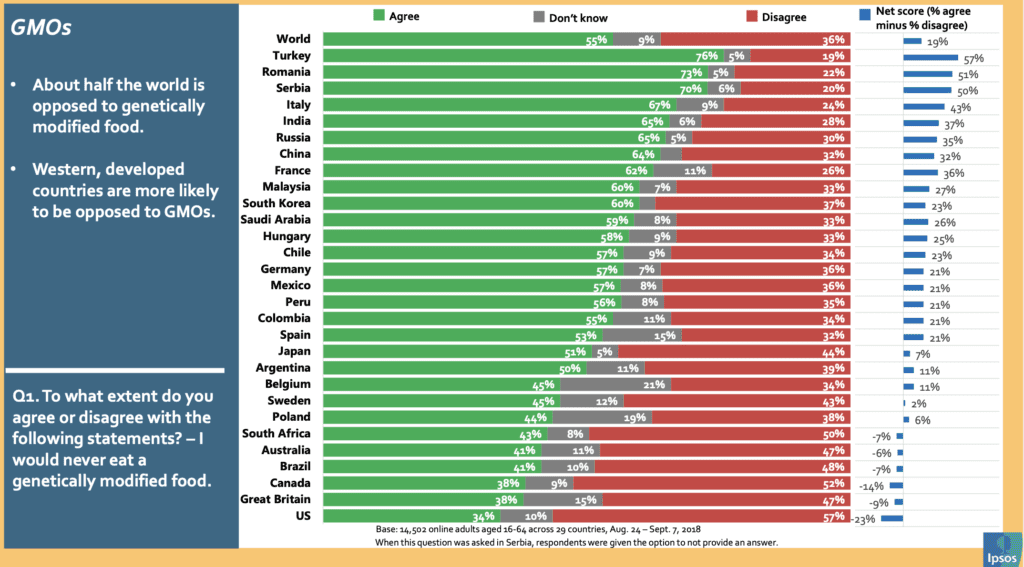
This Ipsos survey from 2018 finds wide opposition to GMOs around the world, with the United States standing out as the country with least distrust of these foods:
Google as I might, I can’t find anything on GMO views and partisanship in Europe, so I’ll go to my home country. That’s much easier . . . from a 2016 Pew Research report:

If you squint real hard, maybe you can see something here: conservatives are slightly more likely than liberals to hold the contrarian position that GMO foods are “generally better for health”—but, nah, a belief that GMOs are bad for you is at a flat 40% for all these party/ideology categories. Elsewhere in the survey, respondents are asked if they “care a great deal, some, not too much/none about the issue of genetically modified foods”: among Republicans, 16% care a great deal, 34% care some, and 49% not too much or not at all; the corresponding numbers for Democrats are 16%, 39%, 44%. Small differences, not much.
Overall I don’t see the evidence for Blattman’s view that opposition to GMOs is “mostly left.” I have seen that perception in the news media, though. For example I found this 2012 article from Slate, “GMO Opponents Are the Climate Skeptics of the Left,” pointing to some left-leaning journalists but without any reference to public opinion.
Policy isn’t just about public opinion, though. In my googling I also came across this from a 2014 article from Politico, “Democrats Have a Problem With Science, Too”:
Concerns about vaccine safety and genetically modified organisms (GMOs) are often held up as evidence of anti-scientific beliefs among liberals. But opinion polls about those two issues rarely ask about political affiliation the way polls about climate change and evolution do. The exception is a 2009 Pew Research survey, which indicated that Democrats and Republicans appear to support child vaccination equally (71 percent of both favor it). . . .
Though some polling has shown GMO labeling support to be about equal among Republicans, Democrats and Independents, looking at GMO-related legislation tells another story.
The most publicized anti-GMO bill, California’s Proposition 37, was officially supported by the California Democratic Party and officially opposed by the California Republican Party. If you look at the sponsors of the various anti-GMO bills making their way through state legislatures . . . the vast, vast majority of sponsors are Democrats . . .
So it’s complicated. Blattman writes:
Another way to think about [incoherent views on science and policy], however, is that people hold coherently skeptical views towards science in that they consistently mistrust certain kind of power. Which power depends on your ideology and identity group.
For example, you could see anti-GMO sentiment on the left as rooted in a suspicion of private companies and unfettered research, a mistrust that is partly ideological but partly earned.
Likewise, I see some of the vaccine and mask opposition as rooted in mistrust in a different kind of authority: a suspicion of elite opinion, paternalistic prescriptions, and compulsory state action. This too is partly ideological but also partly earned.
This doesn’t seem quite right to me. On the masks, maybe. But on the GMOs, no, given that anti-GMO sentiment is about equal among Democrats and Republicans. I mean, sure, you could say that anti-GMO sentiment on the left is rooted in a suspicion of elite business executives and anti-GMO sentiment on the right is rooted in a suspicion of elite . . . ummmm, I dunno, elite somebodies. But then I don’t know what this explanation is getting you. I’d almost kinda like to take this in the opposite direction, and say that people have reasonable reasons for bad ideas, and those reasons don’t always have ideological components.
Right now we’re super-aware of ideology, and the whole anti-vaccine movement has become ideological with its connections to Fox News and Republican leaders such as Ted Cruz. But a chunk of people were suspicious of vaccines a few years ago too, with no real political correlation.
The bigger picture is that this is so complicated. Chris and I are political scientists, so we should be the experts here. But we’re confused too, just feeling things out. This is one reason I’m always talking about the value of descriptive research. It’s great to want to explain the world, but first you have to figure out what you’re explaining. There’s no point in developing a theory explaining why opposition to GMOs is mostly on the left, if this isn’t actually true. Or maybe it is, and I just don’t have the relevant data at my fingertips.
P.S. Chris quotes Joe Rogan as saying:
Do I get things wrong? Absolutely. But I try to correct them . . . I’m interested in finding out what the truth is. And I’m interested in having interesting conversations with people that have differing opinions. I’m not interested in only talking to people that have one perspective.
All I can say is . . . if anyone reading this knows Joe Rogan, please ask him to interview Alexey Guzey! Rogan credulously interviewed that bullshitting Why We Sleep guy. It’s time to correct this and have a conversation with the other side. Guzey’s an interesting guy, really much more interesting than someone like the Ted Talkin’ Why We Sleep guy who makes stuff up and pretends it’s science.
Is it possible that people are conflating concerns about health effects with other concerns? I’ve seen some opposition to GMOs for environmental and legal reasons coming exclusively from the left. In particular, I’ve heard the following arguments:
1. Most genetic modifications are for pesticide resistance, so GMOs often come with drastically increased volumes of pesticides, leading to unpredictable environmental effects
2. GMO patents are ethically unjustifiable and have centralizing effects on the agriculture industry
3. GMOs can have unpredictable effects on local biodiversity
Yes to this!
I don’t have any _general_ objection to genetically modified organisms, but I do have objections to _specific_ GMOs that constitute a large fraction of those on the market. And my objections are not tied to health, which is what the Pew Research question is about.
For example, Monsanto sells crops that are genetically modified to be “Roundup-ready” — or, rather, the seed for those crops — which allows farmers to apply the weed-killing herbicide called Roundup(tm) without killing the crops themselves. Sounds great, but the weeds that are killed include milkweed, which used to grow (benignly) at the edges of farm fields and between rows of crops. The loss of something approaching a billion milkweed plants has contributed to the collapse of monarch butterfly population, which is now less than 1% of historic levels. I think that sucks but I don’t think it means Roundup-ready crops are ‘unhealthy’ in the sense the presumably are asking about in the survey.
I’m not anti-progress or anti-GMO. I have major complaints about some GMO products, though. There are some GMO-related survey questions that I would answer negatively and I would resent it if people interpreted those wrong and said “see, look at these crazy anti-science left-wingers.”
“The loss of something approaching a billion milkweed plants has contributed to the collapse of monarch butterfly population, which is now less than 1% of historic levels. ”
The question is: does this matter? You like butterflies. I like butterflies. But if I had to chose between human well being and butterfly well being, well, being human, I would chose humans.
So what’s the loss to humans if monarch butterfly populations are declining? The wealth produced by increasing technology means lower environmental impact. High yield crops mean less land use. Some people believe we’re already past “peak land use”, and part of that is because of Monsanto and Roundup-Ready crops. So if we’re trading all of one species in the short term for sustainable populations of many others in the long term, seems like that could be an environmental win. Maybe you should do a model….
Anonymous,
Your general point is totally fair, but yeah, I think I’m still allowed to dislike Roundup-read crops. To take corn as an example:
1. Corn yields in the US have increased at a rather steady 2 bushels per acre per year ever since Roundup-ready corn was introduced. On the other hand, corn yields have increased at a rather steady 2 bushels per acre per year ever since 1960. It’s possible in principle that the steady increase was just about to stop, except Roundup-ready corn came along at just exactly the right time to keep things going…but I doubt it. Improvement comes from several sources — better corn genetics, better optimization of fertilizer timing and amounts, better optimization of irrigation timing and amounts, optimization of planting densities, and so on. I’m not claiming Roundup-ready corn hasn’t increased yields — I’m sure it has — but we’d still be over 160 bushels per acre without it, and that would be plenty.
2. 160 bushels per acre would be plenty because half of corn in the US is fed to cows and half of the rest is used to produce ethanol. Everyone would be better off if we ate far fewer cows and stopped producing ethanol.
There are other Roundup-ready crops, like alfalfa (also fed to cows) and soybeans. Perhaps I’d be fine with some of them if I understood them more. As I mentioned, I don’t object to GMOs in general. But I’m pretty secure in my hatred of Roundup-ready corn.
Phil said: “I think I’m still allowed to dislike Roundup-read crops. ”
Of course! :) Preferences that are independent of rational argument are beyond argument, although I reserve the right to oppose them. :)
Somebody:
What’s interesting from the standpoint of this post is that you make no claim against GMOs. You make a claim (which I rate as valid) against government agricultural policy of buying unsold crops; and another claim that Roundup – the pesticide, not the GMO plants engineered to resist it – can have strong negative environmental effects (which I rate as conditionally valid).
So in that sense you provide evidence for how complicated this issue can be.
BTW, the claim “With no pollinators, there is no food. This is first grade science class picture book stuff. ” is incorrect. See the Wikipedia article “Pollinator decline”.
Anonymous,
Thanks for patronizingly allowing me to have opinions, but boo for saying “Preferences that are independent of rational argument are beyond argument” and thereby implying that my preference in this case is an example. I explained why I don’t think Roundup-ready corn is especially useful or necessary. You may think I’m wrong — perhaps you think American society would collapse if corn yields were lower by 2%, or that there would be some other dire consequence that makes the positives outweigh the negatives — but to suggest that I haven’t made a rational argument is just wrong.
Indeed, because I am capable of engaging in discussions more nuanced than picking a side to champion or rail against, and instead responded to specific claims. Like, the original post was about perceptions of political polarization in opposition to GMOs, but referenced survey data about specifically health effects of GMOs, so I pointed out that there are other reasons to oppose GMOs that maybe politically polarized. Likewise, you questioned if there was any reason for humans to care about monarch butterfly populations and I gave you some, and you suggested that the efficiency gains may be worth it through more food per acre used, and I pointed out that agricultural policy has made that impossible for decades.
I suppose you’re referring to the fact that many staple crops are self pollinated. That’s technically true–I didn’t mean literally all food, I was responding to your contention that it doesn’t matter at all to humans if the monarch butterfly goes extinct. If you need the salient points laid out explicitly:
1. There is a human impact to loss of pollinators
2. It has been experienced already through farmers spending more money on pollinator rentals, then ameliorated through government action
3. Most importantly, environmental destruction by unchecked yield maximization has very real human consequences that are not theoretical. The monarch butterfly matters. If you need examples where no environmental stewardship was practiced
https://en.wikipedia.org/wiki/Four_Pests_campaign#Effects
https://en.wikipedia.org/wiki/Dust_Bowl#Geographic_characteristics_and_early_history
If you really want a pro/con hot take on GMOs, it’s the same as this.
https://statmodeling.stat.columbia.edu/2022/05/26/public-opinion-isnt-always-as-polarized-as-you-think-gmo-food-edition/#comment-2057024
GMOs are a process, not a product, they can be engineered to do whatever. I think most of them are bad, but as a result of government incentives for monocropping overproduction, and removing that incentive is better than banning or taxing GMOs.
Phil Said: “Thanks for patronizingly allowing me to have opinion”
:) I apologize, poor wording on my part. I just don’t care to dice up your opinions on specific crops.
Somebody:
No one knows how many species have gone extinct in the Age of Man – thousands or tens of thousands? The reason the life has come this far is that there are **literally thousands** of species competing in *every ecological niche*. Nature is a marvel of redundancy. While you putter around in the weeds having a flip cow about one species, the rest of the world will solve problems and move on.
Yes, and throughout all that time, man-made ecological changes have never induced periods of food scarcity and hardship. Except all the times when it has.
I agree that is a possibility, but it is really hard to know. I think people often have a belief, then choose a reason because it sounds more reasonable. Someone might believe that GMOs are inherently unhealthy. They find themselves being attacked as anti-science, so they change their reason to something about the ethics of GMO patents because it is harder to attack. You see the same thing in the anti-vaccination crowd. Their real reason is they think vaccines cause autism, but they say they just care about personal freedom.
For GMOs, golden rice is a great test case. Most of the “reasonable” arguments against GMOs disappear. If a person is against golden rice, then you know their problem is not patents or pesticides.
GMO food is inherently less healthy, at least when the purpose of the modification is higher yields (which is most of the time). Pesticides, certain fertilzers, and just normal selective breeding does the same.
In general, higher yield means less nutritious. In particular there will be lower levels of trace minerals such as magnesium. The golden rice example is an exception that proves the rule since it was not made to increase yields.
Afaik, this is not at all controversial so I wonder what “science” Blattmann is referring to.
Once again simple answers to complex questions get nonsense results. In the US data, worse for health gets agreement by 37% of high science knowledge people, 47% of medium knowledge, and 29% of low knowledge people. Strange spectrum, no? What is the qualification for being a high science knowledge person?
Everything we eat has undergone extensive modification. There is no wild plant with a modern maize or citrus fruit genome.
Can genetically modified food improve health? Well, there is golden rice that improves vitamin A deficiency.
I am personally disappointed in genetic modification. Why hasn’t anyone put cow genes in salmon? Then I could get lox and cream cheese from one creature.
My remarks are maybe a bit snarky rather than thoughtful. I am a retired oncologist. Products of genetically modified organisms have had a huge positive impact in my field. Treatment for advanced breast cancer was palliative and produced small objective benefits the first twenty years of my career. About thirty years ago, I was sitting in a large hall packed with doctors and a contingent of patients in the back when Dr. Dennis Slaymon presented outcomes from his studies with trastuzumab. I got goosebumps when I realized that a real change had come, and genuine lifesaving treatments were possible. Trastuzumab, rituximab, nivolumab, denosumab, and many others are GMO products that have dramatic positive results against cancer. Yes, this does not mean that GMO technology can not cause harm, maybe even serious harm, but clearly this is a situation that warrants analysis not a survey of the uninformed.
I’m guessing you mean Slamon et al 2001?
https://www.nejm.org/doi/10.1056/NEJM200103153441101
From figure 2 we see after 3 years ~75% of people in the trastuzamab group had died. The same as in the standard chemo group.
It looks like it may slow progression and death by a few months on average, which is fine but hardly dramatic or deserving of goosebumps.
Anonyd00d/Nonbel, it’s been well established on this message board that you have reading comprehension issues.
Let me help you interpret Oncodoc’s comment. Oncodoc got goosebumps because, prior to 20-30 years ago, there were no good advancements for adjuvant therapeutic options for certain cancer types/subtypes. Studies were just starting to come out that showed that certain **novel treatment pathways** could help. It was a paradigm shift in cancer therapy, similar to what we are seeing now with companion diagnostics and targeted cancer therapies.
The first figure, PFS (progression-free survival) is pretty dramatic. Progression-free survival is an indicator of time spent in remission, translating to better quality-of-life. This is on top of the modest gains in overall survival indicated in Figure 2. The 3-year endpoint in Figure 2 is irrelevant (nice cherry-picking, though, to suit your narrative)–there are only two (2) to thirteen (13) subjects in the various subgroups by year 3–not enough to make inferential statements on. The consistent delta between the two survival curves is the more relevant visual.
I feel your “contributions” are better suited for ycombinator, Twitter, or 4chan: you can troll, make bad-faith arguments, and exhaust the readership over there.
I understand both figures perfectly. The trastumazab group progressed a few months slower and died a few months later.
Also, 3 years is not arbitrary, that is when the mortality became approximately equal. The arbitrary cutoff is 1 year as they reported in the abstract.
Taken at face value these results are essentially the doctor telling you “you’ve got 2 years to live” rather than “you’ve got 1.5 years to live”.
The numbers are low because 75%+ of the patients had sadly died by then.
“Is it possible that people are conflating concerns about health effects with other concerns?”
That’s it. In that sense, this data is like the abortion data, where some people care about babies and others care about sex, making the opinion data mostly meaningless.
I am against GMO implementation because I am convinced that it never received a proper hazard analysis, and if it did, we would not be implementing it the way we are. Specifically, it fails in multiple ways when tested by what is now the worldwide standard for hazard analysis, ANSI/GEIA-STD-0010-2009. This is why the European Union originally blocked implementation, not because of some squishy leftist pearl-clutching.
The data washes together simplistic objections with sophisticated ones, a big pit for opinion data to fall into and a big problem in climate as well.
The really annoying aspect is the degree to which people who really don’t know anything except a few opinion pieces by sources they trust are so dismissive of other people’s views as unscientific. After reading the linked piece by Blattman, he falls in that category for me. It seems he just read some stuff about how silly the arguments against GMO are, written by folks who have gained his trust. And yet somehow that puts him in a position to be dismissive of folks who hold a different opinion.
I’d be interested in watching Chris Blattman explain to Nassim Nicholas Taleb why concern over GMO’s is anti-science. Or why it emanates from Taleb’s “leftism”, for that matter. (Not taking a position here on the force of Taleb’s argument.)
From a more sociological perspective, regardless of the validity of GMO opposition in particular, I think it’s fair to say that there has been a strong skepticism about science on the part of many self-identified leftists in the US for decades. I suspect the struggle over nuclear power had a lot to do with it, but also conflicts between feminists and common medical practice (which may have diminished because of the influence of the former on the latter). A further aspect is the loose connection between leftism and “alternative spirituality”/New Age beliefs. My impression is that this connection is even looser in Europe, but I don’t really know. For a long time, during the hegemony of Marxism in the European world of left wing thought and politics, Science (with a capital S) was taken to be progressive and correct. But that hegemony has collapsed, and science resistance seems to have increased on the left in countries like Germany and France. (I am using “the left” to denote political thought and activism to the left of social democracy.)
GMO is a process, not a product (genetic engineering is a better term than GMO), so simply being GMO does not make something either good or bad. But, I agree with your concern about hazard analysis. For example, years ago corn got modified to produce delta endotoxins using genes from Bacillus thuringeiensis. Millions of acres were planted before someone figured out that the plants were exuding the toxins from their roots, not just storing them in their tissues. Fortunately, It seems not to have a big effect on soil ecosystems, but still ….
“Specifically, it fails in multiple ways when tested by what is now the worldwide standard for hazard analysis, ANSI/GEIA-STD-0010-2009. ”
Care to identify some ways in which it violates this standard? From what I know genetic modification has no more hazard than breeding modification, which I trust doesn’t violate this standard.
“Care to identify some ways in which it violates this standard? From what I know genetic modification has no more hazard than breeding modification, which I trust doesn’t violate this standard.”
The paradigm that you invoke, that genetic modification is just selective breeding without the inefficiency, is a particularly pernicious falsehood. I will believe it when someone proves that you can breed poplar trees until you get a functional fish gene.
As for how GMO violates hazard mitigation requirements, I will pull two statements from “somebody’s” comment at the top:
1. Most genetic modifications are for pesticide resistance, so GMOs often come with drastically increased volumes of pesticides, leading to unpredictable environmental effects.
This is clearly a hazard, and so requires scientific studies that show that bad things will not occur, or mitigation. Proving the negative is difficult but not impossible, but that has not been accomplished. So then what is the mitigation that has been applied prior to implementation? Didn’t happen.
2. GMOs can have unpredictable effects on local biodiversity.
Again, clearly a hazard. We know that in biological systems organisms can increase exponentially, like from one grain shipment contaminated with cheatgrass seeds to an entire half a continent covered with cheatgrass. With that in mind, it is not only a hazard but a “high severity” hazard according to the rules. How is the potential for this sort of thing, which is actually more likely with GMO plants, currently mitigated? There is nothing.
Matt Skaggs writes, “The really annoying aspect is the degree to which people who really don’t know anything except a few opinion pieces . . . are so dismissive of other people’s views as unscientific.”
+1. But, I don’t think it is just “people.” Monsanto has had an intentional strategy of pushing this ridiculous comparison between anti-science vaccine opponents and anti-GMO opponents. It is a stupid comparison. Vaccines have been around for a century and each one is extensively studied in randomized clinical trials. Vaccines prevent deadly diseases. What is unscientific about wanting GMO to meet similar rigorous testing a weighing a benefits and risks. If anything, GMOs should meet a higher standard. Each time a GMO is released, a potentially invasive species is introduced into the environment. Each time a GMO is released a potentially new chemical compound is introduced into the food supply. And, as far as I understand, the current level of scrutiny is, “Monsanto says its safe.”
There’s an interesting interview with Neal Stephenson in the New York Times Magazine of 1/16/22, which includes 4 trans-historic methods on how people form beliefs. They are, briefly, () tenacity (decide what to believe and stick to no matter what); () authority (agree with a bunch of others to believe whatever some authority figure tells you); () a priori (appeals to common knowledge, but perhaps light on evidence); () formal methods (eg the scientific method, or (I would argue) the formal reasoning of a functioning legal and court system).
Science folks act with shock (as do I) when the methods of belief formation deviate from formal methods. But we are not so far, genetically or culturally, removed from periods when these alternate methods of belief formation were more in fashion. (Two books that also may be of interest from that interview: Shapiro “A Culture of Fact” (re how “facts” as we think of them are somewhat new), and “The Fixation of Belief” by Sanders Pierce, ca 1870, from which the 4 main belief-formation methods were taken.)
I also recall reading that certain people (here, loosely speaking, anti-vax populists) don’t want to listen to folks like Fauci because they feel he doesn’t adequately reflect their value system. Fauci could have probably saved a few hundred thousand American lives if, during a handful of his briefings on the dangers of Covid and the importance of being vaccinated, he wore a MAGA hat.
Don’t know about that last statement. Trump himself got booed when he promoted vaccination.
《 4 trans-historic methods on how people form beliefs》
Has Stephenson read Buddha’s advice, in the Kalama Sutra? https://www.buddhasutra.com/files/kalama_sutta.htm
《Do not go upon what has been acquired by repeated hearing; nor upon tradition; nor upon rumor; nor upon what is in a scripture; nor upon surmise; nor upon an axiom; nor upon specious reasoning; nor upon a bias towards a notion that has been pondered over; nor upon another’s seeming ability; nor upon the consideration, ‘The monk is our teacher.’ Kalamas, when you yourselves know: ‘These things are bad; these things are blamable; these things are censured by the wise; undertaken and observed, these things lead to harm and ill,’ abandon them.》
In other words, where do beliefs based on personal experience fit into Stephenson’s (or Peirce’s) taxonomy?