University of Oregon physics professor Raghu Parthasarathy writes:
How can we make a large class more lively? I [Raghu] tackled this question last term by allowing students to self-partition into different sets, with dramatic, and remarkably encouraging, results. . . .
I often teach “general education” classes aimed at non-science-majors, including this one a few times previously. The prior term . . . was painful, with a lack of student engagement that was depressing for me and for the students who were enthusiastic about the topic. “Active learning” activities, especially involving discussions among groups, fell flat; questions were minimal; the atmosphere was lifeless. Outcomes of learning assessments (quizzes, exams) were also poor. . . .
What can we do about a listless class? Especially: What can we do that isn’t paternalistic — that acknowledges that students are adults and can participate or not as they wish . . .
I realized that engagement requires a critical mass: if you’re an engaged student, there’s a question posed that asks for discussion among students, and the students near you are zoned out or watching videos on their phones, your engagement is futile. . . . You’ll need other engaged students to sustain any activity.
What to do about this? Raghu came up with an idea and tried it out:
How can we make a supercritical concentration of enthusiastic students? By putting them all together. After the first week of the term, when students had a sense of what the course is about and my approach to asking and inviting questions, I asked students to move. We’d have two zones in the classroom, an “active” zone in which I’d expect students to interact with me and with each other, and an “inactive” zone, in which I’d have no such expectation. I made clear that there was no grade advantage or penalty associated with either choice. . . .
The classroom is a large lecture hall, shown below, about 18 seats wide and 14 rows deep, with a capacity of about 220. The class enrollment was about 110. The “active” zone would be the front half of the middle part (green shading in the photo); the “inactive” zone would be the back half of the middle and all of the sides (orange).
For the rest of the term, the students self-segregated. What happened next?

Next comes the evaluation:
The clearest outcome: a lively classroom! This exceeded my expectations — students in the active section were very active, talking to each other, asking all sorts of questions, and commenting in ways that spurred other students to comment. The active contingent was around a third of the class, but the room was perhaps twice as animated as any general-education class I’ve taught in many years. . . .
Student questions and comments are valuable for everyone regardless of where they sit; they often clarify topics, or bring up issues that students especially care about.
After every class, students had to submit “post-class notes,” brief summaries that could also include questions or requests that I would (almost always) address at the start of the next class.
Good to be reminded that there’s no reason that active learning should come at the expense of other forms of feedback. Raghu’s post-class notes sound very similar to my pre-class requirement that students post a question or answer in a Google doc, which provides a basis for class discussion.
But back to Raghu’s experiment:
How well did students in the different zones learn the material? Here’s a graph, one of many I made, that shows scores on the midterm exam sorted by seating section. (I asked on the exam: What area do you usually sit in?)
I was expecting a sizeable difference, but I was stunned by the contrast between the zones: on average, a two letter grade difference. . . . Actually, I wasn’t that stunned because I had made similar graphs in prior weeks for quiz results that revealed a roughly one letter grade difference. Notably, I showed these graphs to the class. We discussed the data and potential mechanisms, noting that “correlation is not causation,” etc. The active-area students were themselves the best advocates for their area, encouraging others to come. Few students moved, however. . . . The graph for the final exam is almost identical. . . .
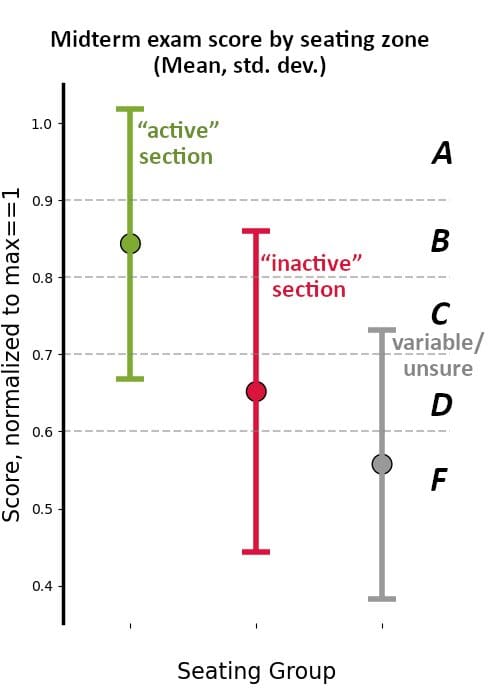
And, yes, he is fully aware that the differences in the groups can quite possibly be explained by selection rather than any effects of class participation. That said, I do think class participation improves learning, so I’d expect that these differences are not entirely explained by selection.
Raghu talks about how he plans to implement this the next time he teaches. My suggestion is to include a pre-test—that’s just about always a good idea if you’re trying to estimate how much is being learned and to compare among students.
P.S. I like Raghu’s idea. I would not do it in my own classes because I want all my students to be active. But I understand that what works in a small class at Columbia might not work in the larger classes that Raghu teaches.
> Good to be reminded that there’s no reason that active learning should come at the expense of other forms of feedback. Raghu’s post-class notes sound very similar to my pre-class requirement that students post a question or answer in a Google doc, which provides a basis for class discussion.
I haven’t taught in a few years, but a few strategies I used along similar lines:
1) as class was starting, I would pass around four different colored stacked of post-it notes (colors chosen according to class colorblindness composition) for students to take one each of. Throughout lecture, these would be used for multiple choice polling — more efficient than going through options w/ raised hands 1-by-1 and easier + more reliable to implement than clickers (students don’t have to buy anything and can’t forget to bring a thing to class… also felt it elicited more participation). In the last minutes of class, I’d have them take eg their blue post it note and write down what they thought was the most important thing they learned was, and on their orange note to write what they thought was unclear or confused them, and then to stick the note on the wall by the door as they left. I’d review these and try to address common confusions in the latter, and follow-up on common interests in the former.
Helpful too for real-time, streaming / online polling — since most students had laptops, I would ask them to stick eg the blue note on the back of their laptop if they were following along smoothly, and the orange one if they were confused, lost, or struggling. At a glance I could tell if I needed to slow down etc. a bit more reliably than gauging the distribution of glassy eyes or furrowed brows. For interactive modules involving stuff like coding or neighbor discussion, I could also have something where eg {blue = I am done and ready to move on to the next section}, {orange = I am still working but making progress}, and {red = I am stuck and need help}, with the third one dispatching myself or a TA to their location for targeted assistance. This would free students from having to keep their hands raised or on the lookout for available TAs, and let me know when almost everyone had finished with the current chunk so I could move on to the next one.
2) instead of google docs, I had students use etherpad.org (free, persistent instances / hosting here: etherpad.wikimedia.org). It’s a bit more lightweight and easier to share, and I liked the automatic color assignment to each user — students would collaboratively take notes and ask questions (whose importance did not rise to the level of full class discussion) throughout lecture on it, and other students would come in and answer them, and if those initial answers were wrong more students would come in and respond to those answers etc. Really good uptake overall! After class, I would go in and skim through their notes, correcting minor mistakes in the document and addressing larger ones at the start of next class (and also praising particularly good anonymous answers).
My takeaway is that 1/3 of the class belonged in the course with the rest not so much. I’ve taught for many years and there are always some students that don’t really care about the material – a larger portion of undergrad classes than grad classes (where it is a distinct minority). Yet our educational “system” demands that these students take these classes. It seems a waste to me: it looks like they don’t get much out of the course, and potentially destroy the experience for the others. This experiment seems consistent with that – but I’m left wondering why the inactive students need to be there at all.
Also striking is the 3rd group, who did worse than the other two. I guess if they aren’t sure which group they usually sat with, they were actively engaged with something, just not the class they were in.
“My takeaway is that 1/3 of the class belonged in the course with the rest not so much.”
You’re correct, and this is the dismal conclusion that is widely acknowledged in private but forbidden to state in public: a sizeable fraction of college students shouldn’t be in college. This isn’t a criticism of the students; they’ve been beaten over the head with the idea that going to college right after high school is the only acceptable path, whether they have any actual interest or motivation to do so. Not coincidentally, the university needs their tuition dollars. It’s sad to watch.
@Dale Lehman & Raghu Parthasarathy:
Let me play devil’s advocate for a moment: Large parts of life are unpleasant. Getting through the less pleasant parts unscathed is a skill that should be practised.
Not being devil’s advocate anymore, even in classes that are unpleasant for a student, one can learn a thing or two. The worst class I had in my undergraduate career was a class called ‘Economic Dynamics’ (why it was so bad is irrelevant to my argument). It should have been called ‘Differential Equations, with an Application to Economics’. In retrospect, even though I hated the class and got very little out of it, what I did get out of it is highly relevant to both theoretical and practical modelling. So even if a teacher does not get his class to where it should ideally be, maybe something sticks that will be relevant later on.
Another point: Often students are not really sure what they want to do in life. Some are even unsure after graduation! Compulsory courses can help with orientation.
What I see as problematic is when there are courses that do not fit properly into the curriculum and are taught for historical reasons, e.g. a law course for economics students or a statistics course for medical students. These classes could be removed from the curriculum without any loss to the students’ education. While I probably sound very much opposed to what you say, my opinion is probably quite close to yours.
There are many reasons for a course to be “bad.” Depending on the reason, I agree that some “bad” courses still are worth taking and may impart important knowledge. Also, depending on the reason, some “bad” courses should not be required. As Raghu says, some students should not be in college. But even for those where college is appropriate, some students should not be in the courses they are in. Years of general education requirements changes (and I’ve seen at least a dozen in my career) have mostly failed to comprise an intelligible body of knowledge that all students should have. They can’t shake the fact that general education is used to protect employment in subjects that are not very popular (particularly when colleges focus on the number of students majoring in a subject rather than the number taking courses in a subject).
The whole idea that this course is unpopular, students aren’t motivated, but they learn important stuff anyway has never sat well with me. These are symptoms of deeper problems and an excuse for not addressing them. These deeper problems include: curriculum that is not well designed, teaching quality that is poor, students who shouldn’t be in college to begin with, and universal requirements that don’t fit the individual students, at a minimum.
I’m with Dale. For example, a lot of general Ed requirements require some kind of composition class (writing) and some kind of public speaking class. I personally think both those topics are important, but they can certainly be taught by incorporating writing into the major topic… And have say composition labs where English / Journalism etc majors help say Engineering or Economics or Computer Science majors write reports or presentstions on topics related to their major coursework.
Similarly instead of taking Calculus and Physics a Physics major could learn Calculus by doing physics problems complete with some proofs of various types. A Biology student could learn Calculus by taking a course in population dynamics or metabolism or whatever, and doing projects related to their major. People can learn programming by solving problems using simulation, with lectures on program design and data structures and such incorporated into lab elements.
Integrated topics and project based learning is the proper future of most learning. The trouble is for the most part the university doesn’t really play any role in project based and integrated learning. It’s too siloed and it takes apart the economic power structures involved…
I’d guess that Kahn Academy has already done more for raising math literacy than all universities combined… Just based on the number of people I’ve seen online say ” I hated math but I suddenly decided I needed to understand it better and Kahn Academy really changed my whole view of math.”
What a world we live in where pearls of knowledge are cast out on YouTube and the world parses it as valueless because no one is paying big bucks and taking out loans to get access…
Here’s a small enhancement to this experiment. Do this splitting after the midterm. Then, we can measure the selection effect based on midterm scores; also, the evaluation can then be based on score improvement, rather than total score.
Kaiser:
1. I prefer using a pre-test, as suggested in the second-to-last paragraph of my above post. But a midterm would be fine too.
2. As discussed in chapter 19 of Regression and Other Stories, the recommended approach is to fit regress post-test on treatment and pre-test, which is equivalent to regressing gain score on treatment and pre-test.
Good idea in principle, but I wouldn’t do this: (i) hardly anyone would move after 5 weeks of being in the same spot, and (ii) I’d have to endure 5 weeks of a lifeless classroom.
Raghu: Awesome idea! IMV whether or not the grouping directly improved peoples grades or whether the better students self-selected into the active group is irrelevant. I’m betting the grouping made the class a lot of fun for the students in the active group and a lot more fun for you to teach. Even if it didn’t pay off directly in higher grades or more knowledge in your class, it may pay off down the line in encouraging students to open up and express their interest in other subjects and make it a little less geeky to enjoy learning things. Also it’s just very important that the students who really want to be there get the most out of the course and aren’t inhibited by the comotose social environment that’s normally imposed on them by the 70-80% of students that don’t give a shit.
Awesome!
This seems like a great strategy for a large class. I used to teach a large class that did not fit into the available lecture halls. I was live in the largest hall, and then streamed to other halls and to the internet. I never had any trouble getting most of the couple hundred students in my lecture hall engaged in discussion, asking questions, and responding to simple polling (by an app on their phones for which the course paid). I think they quickly self-sorted into the active and inactive lecture halls. It would have been interesting to ask on the exams where they chose to sit. There was a covariate, however, as those who tended to be late to the 8 am class or chose to eat their breakfasts during lecture time sorted into the adjacent halls, but I do think that the most active students mostly gravitated to the live lecture section.
Els:
I like teaching at 8:30am: I can wake up at 6:00, spend two hours preparing for class, then get there all fired up! And my attendance was pretty good, as a percentage of the number of students registered for the course. It helps that class participation is 40% of their grade. The big problem was that total attendance was low. It bums me out to teach this great class and only have 30 students in the room. So with reluctance I switched to the 10am slot.
Andrew: A pre-test would be informative, but it would be hard to implement. If the pre-test doesn’t count towards the grade, many students won’t bother putting any effort toward it. (Again, note that this isn’t an upper division course of enthusiastic majors. Rational unenthusiastic students will use the time for other, more directly beneficial activities.) If it does count, students will correctly complain that they’re being assessed before being taught.
Perhaps there are effective methods to do pre-tests; I haven’t looked into this.
Another, maybe similar, strategy would be to look at correlations with how well students are doing in other courses — do 3.0 GPA students in the active group do better than 3.0 students in the inactive group? Such data is next to impossible to get, though. The university could potentially make such studies possible, but, like at other universities, there is close to zero interest in assessing student learning.
Raghu:
Ahhh, yes, good point. It would have to be a midterm exam or some other assessment done during the first part of the semester.
Perhaps you could split the difference by giving an early exam which would function as a pre-test but would ostensibly cover material learned during the first few weeks. This effectively-a-pre-test could just count for a small bit, maybe just 5% or 10% of their total grade, enough to motivate them to show up and do it but not enough to upset them if they don’t do well.
I realized I could do a rough version of this with the first quiz (small, given in week 2). I made a ranking of Quiz 1 scores and Final Exam scores and then calculated how much each student’s ranking changes, defining the change as quiz rank – exam rank, so a positive number is good. I then looked at the rank change for students who, at the end of the term, indicated they were in the active section or not. The mean +/- std dev change for active-zone students was 5.1 +/- 27.7 (relative improvement!); inactive -8.7 +/- 26.3 (relative decline!). It’s a noisy measure, especially because Quiz 1 is so small the rankings are coarse. The result is again open to different interpretations, but it’s consistent with sitting in the active area causing, to some extent, improved grades. I’ll emphasize though that even if there were no improvement in grades, I’d still call this a great success just for the impact on the atmosphere!