I have a story for you about a success of preregistration. Not quite the sort of success that you might be expecting—not a scientific success—but a kind of success nonetheless.
It goes like this. An experiment was conducted. It was preregistered. The results section was written up in a way that reads as if the experiment worked as planned. But if you go back and forth between the results section and the preregistration plan, you realize that the purportedly successful results did not follow the preregistration plan. They’re just the usual story of fishing and forking paths and p-hacking. The preregistration plan was too vague to be useful, also the authors didn’t even bother to follow it—or, if they did follow it, they didn’t bother to write up the results of the preregistered analysis.
As I’ve said many times before, there’s no reason that preregistration should stop researchers from doing further analyses once they see their data. The problem in this case is that the published analysis was not well justified either from a statistical or a theoretical perspective, nor was it in the preregistration. Its only value appears to be as a way for the authors to spin a story around a collection of noisy p-values.
On the minus side, the paper was published, and nowhere in the paper does it say that the statistical evidence they offer from their study does not come from the preregistration. In the abstract, their study is described as “pre-registered,” which isn’t a lie—there’s a pregistration plan right there on the website—but it’s misleading, given that the preregistration does not line up with what’s in the paper.
On the plus side, outside readers such as ourselves can see the paper and the preregistrations and draw our own conclusions. It’s easier to see the problems with p-hacking and forking paths when the analysis choices are clearly not in the preregistration plan.
The paper
The Journal of Experimental Social Psychology recently published an article, “How pledges reduce dishonesty: The role of involvement and identification,” by Eyal Peer, Nina Mazar, Yuval Feldman, and Dan Ariely.
I had no idea that Ariely is still publishing papers on dishonesty! It says that data from this particular paper came from online experiments. Nothing involving insurance records or paper shredders or soup bowls or 80-pound rocks . . . It seems likely that, in this case, the experiments actually happened and that the datasets came from real people and have not been altered.
And the studies are preregistered, with the preregistration plans all available on the papers’ website.
I was curious about that. The paper had 4 studies. I just looked at the first one, which already took some effort on my part. The rest of you can feel free to look at Studies 2, 3, and 4.
The results section and the preregistration
From the published paper:
The first study examined the effects of four different honesty pledges that did or did not include a request for identification and asked for either low or high involvement in making the pledge (fully-crossed design), and compared them to two conditions without any pledge (Control and Self-Report).
There were six conditions: one control (with no possibility to cheat), a baseline treatment (possibility and motivation to cheat and no honesty pledge), and four different treatments with honesty pledges.
This is what they reported for their primary outcome:
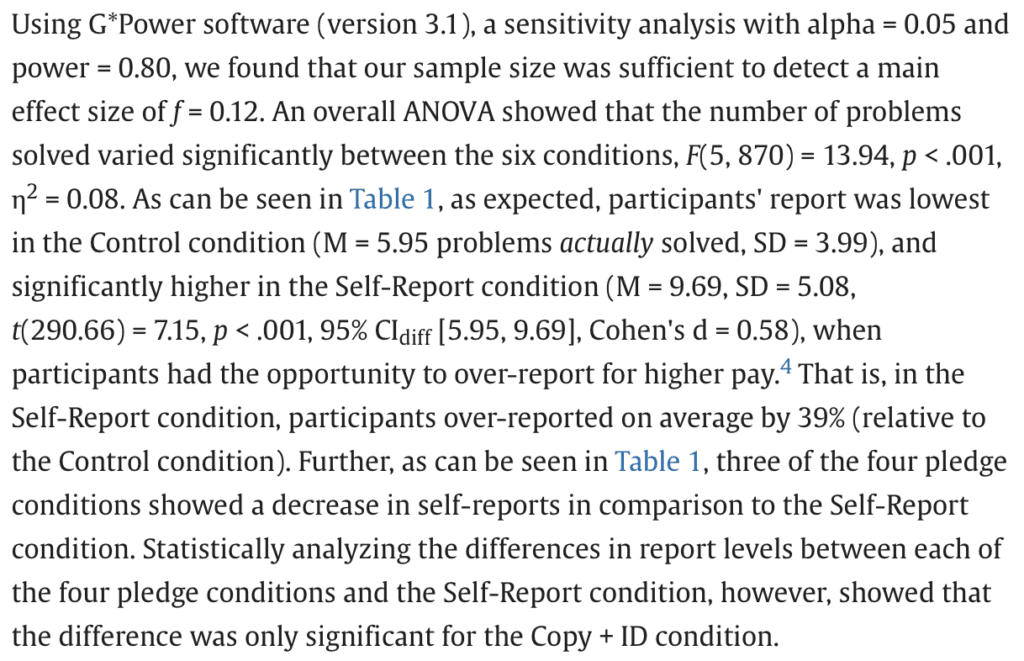

And this is how they summarize in their discussion section:

Interesting, huh?
Now let’s look at the relevant section of the preregistration:

Compare that to what was done in the paper:
– They did the Anova, but that was not relevant to the claims in the paper. The Anova included the control condition, and nobody’s surprised that when you give people the opportunity and motivation to cheat, that some people will cheat. That was not the point of the paper. It’s fine to do the Anova; it’s just more of a manipulation check than anything else.
– There’s something in the preregistration about a “cheating gap” score, which I did not see in the paper. But if we define A to be the average outcome under the control, B to be the average outcome under the baseline treatment, and C, D, E, F to be the average under the other four treatments, then I think the preregistration is saying they’ll define the cheating gap as B-A, and the compare this to C-A, D-A, E-A, and F-A. This is mathematically the same as looking at C-B, D-B, E-B, and F-B, which is what they do in the paper.
– The article jumps back and forth between different statistical summaries: “three of the four pledge conditions showed a decrease in self-reports . . . the difference was only significant for the Copy + ID condition.” It’s not clear what to make of it. They’re using statistical significance as evidence in some way, but the preregistration plan does not make it clear what comparisons would be done, how many comparisons would be made, or how they would be summarized.
– The preregistration plan says, “We will replicate the ANOVAs with linear regressions with the Control condition or Self-Report conditions as baseline.” I didn’t see any linear regressions in the results for this experiment in the published paper.
– The preregistration plan says, “We will also examine differences in the distribution of the percent of problems reported as solved between conditions using Kolmogorov–Smirnov tests. If we find significant differences, we will also examine how the distributions differ, specifically focusing on the differences in the percent of “brazen” lies, which are defined as the percent of participants who cheated to a maximal, or close to a maximal, degree (i.e., reported more than 80% of problems solved). The differences on this measure will be tested using chi-square tests.” I didn’t see any of this in the paper either! Maybe this is fine, because doing all these tests doesn’t seem like a good analysis plan to me.
How do we think of all the analyses stated in the preregistration plan that were not in the paper? Since these analyses were preregistered, I can only assume the authors performed them. Maybe the results were not impressive and so they weren’t included. I don’t know; I didn’t see any discussion of this in the paper.
– The preregistration plan says, “Lastly, we will explore interactions effects between the condition and demographic variables such as age and gender using ANOVA and/or regressions.” They didn’t report any of that either! Also there’s the weird “and/or” in the preregistration, which gives the researchers some additional degrees of freedom.
Not a moral failure
I continue to emphasize that scientific problems do not necessarily correspond to moral problems. You can be a moral person and still do bad science (honesty and transparency are not enuf); to put it another way, if I say that you make a scientific error or are sloppy in your science, I’m not saying you’re a bad person.
For me to say someone’s a bad person just because they wrote a paper and didn’t follow their preregistration plan . . . that would be ridiculous! Over 99% of my published papers have no preregistration plans; and, those that do have such plans, I’m pretty sure we didn’t exactly follow them in our published papers. That’s fine. The reason I do preregistration is not to protect my p-values; it’s just part of a larger process of hypothesizing about possible outcomes and simulating data and analysis as a prelude to measurement and data collection.
I think what happened in the “How pledges reduce dishonesty” paper is that the preregistration was both too vague and too specific. Too vague in that it did not include simulation and analysis of fake data, nor did it include quantitative hypotheses about effects and the distributions of outcomes, nor did it include anything close to what the authors ended up actually doing to support the claims in their paper. Too specific in that it included a bunch of analyses that the authors then didn’t think were worth reporting.
But, remember, science is hard. Statistics is hard. Even what might seem like simple statistics is hard. One thing I like about doing simulation-based design and analysis before collecting any data is that it forces me to make some of the hard choices early. So, yeah, it’s hard, and it’s no moral criticism of the authors of the above-discussed paper that they botched this. We’re all still learning. At the same time, yeah, I don’t think their study offers any serious evidence for the claims being made in that paper; it looks like noise mining to me. Not a moral failing; still, bad science in there being no good links between theory, effect sized, data collection, and measurement, which, as is often the case, leads to super-noisy results that can be interpreted in all sorts of ways to fit just about any theory.
Possible positive outcomes for preregistration
I think preregistration is great; again, it’s a floor, not a ceiling, on the data processing and analyses that can be done.
Here are some possible benefits of preregistration:
1. Preregistration is a vehicle for getting you to think harder about your study. The need to simulate data and create a fake world forces you to make hard choices and consider what sorts of data you might expect to see.
2. Preregistration with fake-data simulation can make you decide to redesign a study, or to not do it at all, if it seems that it will be too noisy to be useful.
3. If you already have a great plan for a study, preregistration can allow the subsequent analysis to be bulletproof. No need to worry about concerns of p-hacking if your data coding and analysis decisions are preregistered—and this also holds for analyses that are not based on p-values or significance tests.
4. A preregistered replication can build confidence in a previous exploratory finding.
5. Conversely, a preregistered study can yield a null result, for example if it is designed to have a high statistical power but then does not yield statistically significant preregistered results. Failure is not always as exciting or informative as success—recall the expression “big if true“—but it ain’t nothing.
6. Similarly, a preregistered replication can yield a null result. Again, this can be a disappointment but still a step in scientific learning.
7. Once the data appears, and the preregistered analysis is done, if it’s unsuccessful, this can lead the authors to change their thinking and to write a paper explaining that they were wrong, or maybe just to publish a short note saying that the preregistered experiment did not go as expected.
8. If a preregistered analysis fails, but the authors still try to claim success using questionable post-hoc analysis, the journal reviewers can compare the manuscript to the preregistration, point out the problem, and require that the article be rewritten to admit the failure. Or, if the authors refuse to do that, the journal can reject the article as written.
9. Preregistration can be useful in post-publication review to build confidence in published paper by reassuring readers who might have been concerned about p-hacking and forking paths. Readers can compare the published paper to the preregistration and see that it’s all ok.
10. Or, if the paper doesn’t follow the preregistration plan, readers can see this too. Again, it’s not a bad thing at all for the paper to go beyond the preregistration plan. That’s part of good science, to learn new things from the data. The bad thing is when a non-preregistered analysis is presented as if it were the preregistered analysis. And the good thing is that the reader can read the documents and see that this happened. As we did here.
In the case of this recent dishonesty paper, preregistration did not give benefit 1, nor did it give benefit 2, nor did it give benefits 3, 4, 5, 6, 7, 8, or 9. But it did give benefit 10. Benefit 10 is unfortunately the least of all the positive outcomes of preregistration. But it ain’t nothing. So here we are. Thanks to preregistration, we now know that we don’t need to take seriously the claims made in the published paper, “How pledges reduce dishonesty: The role of involvement and identification.”
For example, you should feel free to accept that the authors offer no evidence for their claim that “effective pledges could allow policymakers to reduce monitoring and enforcement resources currently allocated for lengthy and costly checks and inspections (that also increase the time citizens and businesses must wait for responses) and instead focus their attention on more effective post-hoc audits. What is more, pledges could serve as market equalizers, allowing better competition between small businesses, who normally cannot afford long waiting times for permits and licenses, and larger businesses who can.”
Huh??? That would not follow from their experiments, even if the results had all gone as planned.
There’s also this funny bit at the end of the paper:

I just don’t know whether to believe this. Did they sign an honesty pledge?
Overkill?
OK, it’s 2024, and maybe this all feels like shooting a rabbit with a cannon. A paper by Dan Ariely on the topic of dishonesty, published in an Elsevier journal, purporting to provide “guidance to managers and policymakers” based on the results of an online math-puzzle game? Whaddya expect? This is who-cares research at best, in a subfield that is notorious for unreplicable research.
What happened was I got sucked in. I came across this paper, and my first reaction was surprise that Ariely was still collaborating with people working on this topic. I would’ve thought that the crashing-and-burning of his earlier work on dishonesty would’ve made him radioactive as a collaborator, at least in this subfield.
I took a quick look and saw that the studies were preregistered. Then I wanted to see exactly what that meant . . . and here we are.
Once I did the work, it made sense to write the post, as this is an example of something I’ve seen before: a disconnect between the preregistration and the analyses in the paper, and a lack of engagement in the paper with all the things in the preregistration that did not go as planned.
Again, this post should not be taken as any sort of opposition to preregistration, which in this case led to positive outcome #10 on the above list. The 10th-best outcome, but better than nothing, which is what we would’ve had in the absence of preregistration.
Baby steps.
Interestingly, one of the authors Nina Mazar also published an article “Toward a Taxonomy and Review of Honesty Interventions” which references many papers by Ariely and also by Gino, including the infamous signing at the top versus the bottom paper. The published version of that article is supposedly open access, but I couldn’t find the full text, so I relied on the SSRN version which was available. But the paper cites the Ariely, Gino, et al paper with no mention of its retraction or issues.
Now, to be fair, the published article is about a taxonomy of the literature and does not claim that these papers are accurate or honest, only looking at the nature of the research in terms of what/how was studied. So, perhaps there is nothing to be concerned about here. On the other hand, looking at the list of references makes it clear to me that the reputation of these authors continues to evade damage in many ways. They remain the established “experts” in this field, despite the issues with their past research. The question to me is: should they?
Dale:
I agree. At some point the editors should step in and consider what they want to be publishing in the Journal of Experimental Social Psychology.
Dale, not sure if you noticed, but Nina Mazar has collaborated with Ariely and Gino in the past, including the retracted PNAS paper. She has also participated in the manyauthors.org project from Gino’s coauthors to review past papers for possible fabrication.
Also, if you dig into the full Harvard report, Gino very strongly suggests that Nina Mazar was the likely culprit and did so maliciously through Gino’s own computer and accounts. It’s absurd, but it is what it is.
I don’t have a point here other than just adding some context.
Yes, the first paragraph is what prompted my comment. The second paragraph is news to me. This cabal of honesty experts gets better and better.
Nina Mazar first got caught in the crossfire associated with Ariely’s fraud, not Gino’s.
In the Ariely insurance company fraud, Mazar was in a position to say a few choice words that would have deflected attention from Ariely, or at least muddy the waters, but to her credit she refused. At this point Gino could feel the proverbial sword hanging above her, and she very much noticed that Mazar was not being a team player (her own words in the transcripts support this). Gino may have even thought that if Mazar had provided cover for Ariely, Gino’s transgressions may have never fallen under the Data Colada panopticon. So when the sword fell Gino needed someone to blame and Mazar was an easy choice.
I think I am missing something when you recommend ‘simulating the experiment’. Do you mean to create a dummy dataset and then run the preregistered analysis? I like the idea, and I do it myself, but I don’t see how this would help me see if the endeavour is doomed from the start? I remember your post on the beauty-and-sex ratio, which proved that the sample size was far too small to find an effect of such small magnitude (or was it in the Type S/Type M paper?). I can see how this would work in an experimental setting – simulate a bunch of data sets, do your analysis, compare it to the true effect of the data generation process. But how do I apply this to observational data, especially with a large number of variables (number of interactions scales in O(p²))?
Raphael:
Yes, that’s what I’m suggesting: create a dummy dataset and then run the preregistered analysis. Not the preregistered analysis that was used for this particular study, as that plan is so flawed that the authors themselves don’t seem to have followed it, but a reasonable plan. And that’s kind of the point: if your pre-analysis plan isn’t just a bunch of words but also some actual computation, then you might see the problems.
In answer to your second question, you say, “I can see how this would work in an experimental setting,” and we’re talking about an experiment here, so, yes, it would’ve been better to have simulated data and performed an analysis on the simulated data. This would require the effort of hypothesizing effect sizes, but that’s a bit of effort that should always be done when planning a study.
For an observational study, you can still simulate data; it just takes more work! One approach I’ve used, if I’m planning to fit data predicting some variable y from a bunch of predictors x, is to get the values of x from some pre-existing dataset, for example an old survey, and then just do the simulation part for y given x.
Thank you! Maybe not the silver bullet I had hoped for, but now I believe I understand what you mean.
Raphael:
There is no silver bullet; there is no golden path to discovery. One of my problems with all the focus on p-hacking, preregistration, harking, etc. is that I fear that it is giving the impression that all will be fine if researchers just avoid “questionable research practices.” And that ain’t the case.
Digging deeper into JESP, I see that they recently introduced a Pre-Submission Checklist (Checklist: https://www.sciencedirect.com/journal/journal-of-experimental-social-psychology/about/news#jesp-editorial-guidelines“). Even more puzzling is the 9th step in the checklist:
“9.) Preregistered Studies: The manuscript reports all deviations from the original plans for any preregistered studies, either within the narrative of the main text or in the form of a table in the Supplementary Materials.”
So, the authors had direct requirements to comply with, and they failed to do so! But let’s see pg. 5 (footnote #5):
“In the pre-registration of this study, there was a mistake as in one instance it
said that the task included 20 problems (but earlier in the document it correctly
stated it had only 10 problems). As the materials on OSF show, the task had
indeed only 10 problems. ”
So now for this smaller issue of reporting the study materials accurately, the authors complied with the 9th step in the checklist. Baby steps, indeed.
“– The preregistration plan says, “We will replicate the ANOVAs with linear regressions with the Control condition or Self-Report conditions as baseline.” I didn’t see any linear regressions in the results for this experiment in the published paper.”
Isn’t ANOVA the same thing as regression anyway?
Stuart:
It’s not clear because they did not specify the details, but in some applications the terms “Anova” and “Regression” can have different meanings. Sometimes the term “Ancova” is used for regression analyses that adjust for pre-treatment variables.
I think what Stuart means is that if you do an ANOVA (or repeated measures ANOVA), underlyingly it’s just a linear (or linear mixed) model, but with aggregation.
Maybe they were trying to check if this is really true (that you’d get the same results with both approaches, assuming balanced data). It could be news to a lot of people.
We have a paper talking about this (although the main point is to not do omnibus ANOVA and just get to the comparisons of interest directly, like the psychologists in the 1970s had pointed out):
Daniel J. Schad, Shravan Vasishth, Sven Hohenstein, and Reinhold Kliegl. How to capitalize on a priori contrasts in linear (mixed) models: A tutorial. Journal of Memory and Language, 110, 2020.
Shravan I quite like that paper and have sent it to a bunch of people. It also pairs well with the Gelman multiple comparisons paper. ⭐
Thanks Matti. BTW, one of my former students is a professor at Tilburg. Bruno Nicenboim. Lots of overlap with you in terms of interests; probably you know him already.
“I had no idea that Ariely is still publishing papers on dishonesty! It says that data from this particular paper came from online experiments.” He does, with plenty of people who should know better:
https://a-ortmann.medium.com/about-that-new-mega-study-on-the-effectiveness-of-honesty-oaths-bbc796626f40
Dishonestly publishing papers is a huge problem. It not only disrupts other papers that are true and correct, but it also hurts the field of research. If papers are published dishonestly, it is hard to tell who is telling the truth and who isn’t. Making the distinction between true and false papers is very critical when doing any sort of research. Papers that get published with misinformation and or disinformation can be very harmful to all parties include, and even some that had nothing to do with the study.
Birdpipe:
I agree. I also suspect that a much bigger problem is researchers who are honest but are working under a mistaken paradigm. Without making any comments on the honesty of the authors of the above-discussed article, I think they are operating under a fundamental understanding of science, which leads them to produce useless research and publish and promote useless papers. Unfortunately much of the academic establishment is laboring under this same flawed paradigm. The dishonesty part is horrible; also the honest-but-doomed-to-fail research is harmful.
Hello, I’m the first author of that paper. We just published a Corrigendum clarifying the issues here – https://www.sciencedirect.com/science/article/pii/S0022103124000544?dgcid=author. We’d be happy to respond to any additional questions. Best, Eyal
Thanks. It’s always good to see this sort of thing.
Update: Sept 2024, a corrigendum by the study authors explains the deviations.
Corrigendum to “How pledges reduce dishonesty: The role of involvement and identification” [Journal of Experimental Social Psychology 113(2024) 104614]
https://www.sciencedirect.com/science/article/pii/S0022103124000544