So, a few people emailed me about this story about fraud among high-profile business school professors. There was this news article by Stephanie Lee, who’s reported on some notable examples of bad research in the past. From her recent article, “A Weird Research-Misconduct Scandal About Dishonesty Just Got Weirder”:
Almost two years ago, a famous study about a clever way to prompt honest behavior was retracted due to an ironic revelation: It relied on fraudulent data. But . . . the study contained even more fraudulent data than previously revealed and it’s now asking the journal to note this new information. . . .
The head-spinning saga began in 2012, when a team of five researchers claimed that three experiments they’d done separately, and combined into one paper, showed that when people signed an honesty pledge at the beginning of a form, versus the end, they were less likely to cheat on the form. . . .
But by 2020, it was falling apart. The researchers, plus two others, reported in a new paper that they were unable to replicate the effect. . . . in the summer of 2021, a trio of data detectives wrote on their blog that a close examination pointed to fraud in experiment No. 3 . . . The alleged new problems involve experiment No. 1 . . .
At a more technical level, Uri Simonsohn, Joe Simmons, and Leif Nelson, the above-referenced “data detectives,” took a look at experiment No. 1 and found some problems. Simonsohn et al. write:
This is the introduction to a four-part series of posts detailing evidence of fraud in four academic papers co-authored by Harvard Business School Professor Francesca Gino.
In 2021, we and a team of anonymous researchers examined a number of studies co-authored by Gino, because we had concerns that they contained fraudulent data. We discovered evidence of fraud in papers spanning over a decade, including papers published quite recently (in 2020).
In the Fall of 2021, we shared our concerns with Harvard Business School (HBS). Specifically, we wrote a report about four studies for which we had accumulated the strongest evidence of fraud. We believe that many more Gino-authored papers contain fake data. Perhaps dozens. . . .
Their punchline:
Two different people independently faked data for two different studies in a paper about dishonesty.
And here are some details:
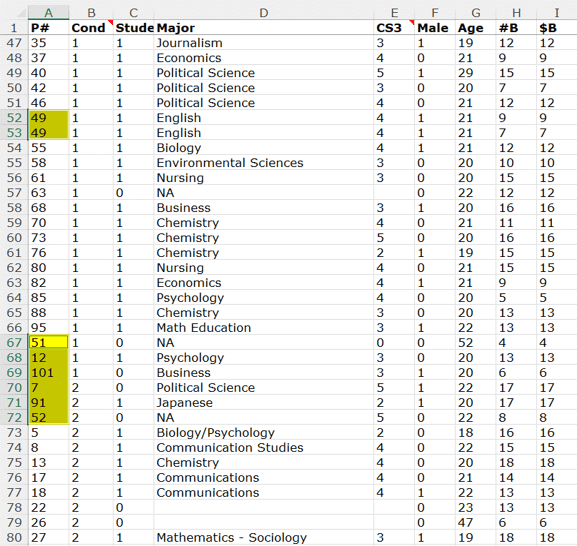
We’ve highlighted 8 observations that are either duplicated or out-of-sequence . . .
Participant ID 49 appears twice in the dataset, with identical demographic information. In addition, there are 6 participants in adjacent rows with IDs out of sequence, three from condition 1 (Sign At The Top), then three in condition 2 (Sign At The Bottom).
This is much more problematic than it may appear.
There is no way, to our knowledge, to sort the data to achieve this order. This means that these rows of data were either moved around by hand, or that the P#s were altered by hand. We will see that it is the former.
If this data tampering was done in a motivated fashion, so as to manufacture the desired result, then we would expect those suspicious observations to show a particularly strong effect for the sign-on-the-top vs. sign-on-the-bottom manipulation.
And they do. . . .
Finally, two correspondents sent in their takes.
In an email titled “The honesty paper is even more dishonest than we thought,” Tony Williams wrote:
You’ve no doubt already gotten at least a dozen emails about this. Remember the Dan Ariely PPNAS paper on honesty that had to be retracted due to Ariely’s fake data in Study 3? It turns out that best-selling popular author and TED Talk-er Francesca Gino faked the data in Study 1. . . . the subtitle of her book Rebel Talent is “Why it pays to break the rules at work and in life.”
Jamie Elsey provides further background:
Obviously there is something very ironic about researchers on dishonesty being entirely dishonest, but this case seems to go even further. I googled Francesca Gino and found her book is literally about how it is good for society (as well as good for one’s employer and one’s own career prospects) to break the rules: “why it pays to break the rules in work and life.” I haven’t read the book but the blurb and overall sentiment seem very telling: “the most successful among us break the rules, and how rebellion brings joy and meaning into our lives”:
“They love their jobs, they break the rules, and the world is better off for it. They are rebels. From an early age, we are taught to be rule followers, and the pressure to fit in only increases as we age. But conformity comes at a steep price for our careers and personal lives. When we mindlessly accept rules and norms rather than questioning and constructively rebelling against them, we ultimately end up stuck and unfulfilled. As leaders, we are less effective and respected. As employees, we are more likely to be overlooked for top assignments and promotions” (from the Amazon page:)
Of course it is good to not just stick to the program and to think outside the box, and there are few hard and fast rules that are always good. But this just really got me wondering about the mental gymnastics and self justification that goes on in these people’s minds. Is this someone just lording it over everyone almost mockingly – like you won’t believe what I’m doing and here I am writing about it, right in your face you sheep!? Or is it an effort to justify one’s actions to oneself in some way? Does Gino just “know” that what she is saying is true, and it is good for society if they know it, and so why not just generate data and make some “science” like a rhetorical device to convince people for their own good? Or is it simply good because people seem to like it and reward her for it and therefore it is good – it certainly helped her own and Harvard Business School’s bottom line? Maybe there simply is no connection between what she writes about in these books and what she is doing. (I’m more speculating about this general phenomenon and obviously don’t know what she personally is like.)
I’m not sure what it is, but generating fake data in various studies about dishonesty and then writing a book about why you need to be a rule-breaking rebel seems like something you just couldn’t make up.
I’ve wondered about this, because this person is not the first purveyor of suspect research to have danced on the edge in this way. Recall:
– Disgraced primatologist Marc Hauser wrote a book, Evilicious: Why We Evolved a Taste for Being Bad, and also wrote a not-so-charming article for the notorious Edge Foundation where he criticized people who “point the schoolmarm’s finger at those who don’t” think like scientists and wrote that it is “healthy” to “explicitly ignore empirical work.” He would’ve done better to consider his own struggles with being bad and to have ignored rather than falsifying his own empirical work.
– Psychologist Dan Ariely, he of the mysterious paper shredder and the retracted article with faked data, also promoted a company making fishy claims about insurance algorithms . . . and wrote a book, “The Honest Truth About Dishonesty: How We Lie to Everyone—Especially Ourselves.” He also participated in a radio show called, “Is Everybody Cheating These Days?,” and gave this amazing-in-retrospect quote to the ever-credulous hosts at National Public Radio:
One of the frightening conclusions we have is that what separates honest people from not-honest people is not necessarily character, it’s opportunity . . . the surprising thing for a rational economist would be: why don’t we cheat more?
– And then there’s Brian Wansink, the famous business-school professor and Game-of-Thrones-hater who blew the whistle on himself with a notorious post bragging about his p-hacking strategy. I did a quick google here, and I was surprised to see that my first post on the topic was from 2016, and it was already clear then that his articles were full of contradictions (for example, various sample sizes that didn’t add up, and also stating at one point that a certain student had collected and analyzed data in a study, and later stating that the study had been designed and the data collected before the student had arrived). Wansink never wrote a book about how we are liars or evil or rule-breakers—but he made a lot of untrue statements in plain sight and then talked loudly about them, in what would almost seem like a plea to get caught.
– Bruno “Arrow’s other theorem” Frey published the same material in multiple journals presumably as an attempt to increase the visibility of his work, with each of his papers carefully avoiding citing any of the others so that journals would be fooled into thinking that each manuscript represented original work. He made the mistake of publishing these repeats in big-name journals including Journal of Economic Perspectives and Proceedings of the National Academy of Sciences and eventually was discovered. Before this happened, though, he’d criticized the science publication process:
Research rankings based on publications and citations today dominate governance of academia. Yet they have unintended side effects on individual scholars and academic institutions and can be counterproductive. They induce a substitution of the “taste for science” by a “taste for publication”.
What’s going on?
I have a few theories. The first is that cheating researchers are both cheaters and researchers. That is, they are willing and able to break the rules and misrepresent the facts for their personal benefit, and they are researchers who are genuinely interested in cheating.
Think of it this way: suppose you are a researcher in psychology or a related field, then it makes sense that you might be particularly interested in phenomena that involve you personally. Fair enough: I’m interested in politics, so I study political science. These people are susceptible to dishonesty, so they study it, or in the case of Wansink, they write openly about it.
OK, I’m not saying that everyone who studies dishonesty is personally dishonest; not at all. Many of us are victims of academic dishonesty or are disturbed by the effect of dishonesty on science. I see no evidence that Nick Brown or Anna Dreber or Uri Simonsohn or various other researchers on bad science have done anything dishonest—nor do I think that I’ve been academically dishonest! My speculation here is going the other way: why is it that so many prominent perpetrators of scientific misconduct have been so brazen about it that their writings can almost be seen as confessions? And my speculation is that they’re so interested in the topic, they just can’t stop writing about it.
Another factor is that scientific misconduct is often rewarded. Until their eventual exposure, Gino, Hauser, Wansink, Ariely, and Frey were riding high. Their research tactics had succeeded for years, so they had every reason to believe they could keep doing their thing and just brush aside any objections. Lots of people in authority don’t care, or don’t want to know. Once you’ve been doing it for awhile and nobody in power has called you on it, you might feel yourself invincible.
The other thing, and this is speculation too, is that maybe the kind of people who will cheat in this way don’t have the same moral sense as the rest of us. I’m thinking here of a Columbo episode where the detective cleverly traps the killer by taking advantage of her lack of empathy. Similarly, I kind of wonder if these science cheaters really understand that cheating is wrong. I suspect that many of them either think that everybody does it, or they think that those of us who play it straight are “schoolmarms” or suckers or losers.
After all, who would write a book called “Why We Evolved a Taste for Being Bad” or “How We Lie to Everyone”? These sound like the writings of people who believe that “we” cheat. From that point of view, they might not realize that they are implicitly confessing anything! They might just think they are saying aloud what everyone is really thinking. From their (confused) perspectives, they’re the truth-tellers about human nature and it’s the rest of who are hypocrites.
Or maybe not, I’m not sure. Ultimately it’s my impression that these people don’t understand science very well. They think their theories are true and they think the point of doing an experiment (or, in some cases, writing up an experiment that never happened) is just to add support for something they already believe. Falsifying data doesn’t feel like cheating to them, because to them the whole data thing is just a technicality. On the other hand, they know that the rules say not to falsify data. On the other hand, they think that everybody except “schoolmarms” do it . . . It’s a tangled mess, and the apparent confessions in these book titles do seem to be part of the story.
P.S. Fraud is horrible. Also bad for science are studies for which there’s no reason to suspect fraud of any sort, but the quality of the research is so low that they provide essentially zero information about their subject area or which do not at all support the claims made in the papers where they appear. We’ve discussed a few zillion examples of these sorts of studies over the past twenty years.
In some sense, the worst things the cheaters do to science is not the particular misleading things they publish, or even the trail of distrust they leave in their wake, but rather the way that they distract us from run-of-the-mill, bread-and-butter junk science, the sort of thing that fills the NPR / Ted / Gladwell / Nudge need for continuing inspirational science content. We laugh at the cheaters, but the people who get the last laugh are the researchers who successfully do bad science without cheating at all. And I have no reason to think the everyday practitioners of bad research are bad people! My guess is they’re trying to do their best, following the rules that have been laid down for them. The cheaters just make their lives easier by providing shiny distracting objects for all of us.
That said, it’s not a great sign that so many cheaters have had such high positions and awards. It does kinda make you wonder if some subfields have systematic problems that they celebrate such bad work. A lot of these papers make such extreme claims . . . even when they’re not the product of fraud, you’d hope that more leaders in these fields would have enough common sense to be kinda skeptical.
P.P.S. This latest cheater touches all the bases: not just Harvard, but also Freakonomics, Psychological Science, the ever-credulous British Psychological Society Digest, Ted, PPNAS “edited by Susan T. Fiske,” and NPR’s Hidden Brain show, which is pretty much the ultimate tar baby for junk science in this country.
The Ariely/Gino cases have a number of features that puzzle me. Given their resumes, if this is an isolated case of fraud, then why bother – did they really need another publication/Ted talk so badly? Or, if it is not isolated, then they have built their careers (with substantial records) on repeated bad behavior – this surely makes the peer review and academic review processes look horribly incompetent. The consequences of their behavior is also worrisome: Ariely appears to have not been affected and the jury is still out on Gino (she is on administrative leave, but it is unclear what will ultimately happen – and she continues to post on Twitter).
Another puzzling aspect is that Uri Simonsonn has coauthored work with both Ariely and Gino. Did this give him unique insights to their behavior?
I’m still struggling with the idea that these 2 studies, both part of the same published work, were truly independent cases of fraud. Occam’s razor would suggest that it is more likely that they were not independent, despite being totally different experiments. This would entail collective fraud, not just serial fraud.
Finally, I am becoming more sympathetic to Wansink. He was mostly sloppy rather than committing outright fraud (though there is the case of the fictitious bottomless soup bowl). I think he truly believes that his research had good public purposes (to improve nutritional practices – although as many have pointed out, there is an opportunity cost that make the results of such research not so innocent). It is hard to find the public good justification for research that purportedly demonstrates how much we lie and the ability of nudges to influence that (sure, nudging people to be more truthful can be a good thing, but not as good as getting children to eat well).
Given how many of the high profile cases there are, it may be a good idea to start distinguishing different types. Lumping them together may lead to flawed diagnoses and inappropriate responses.
Dale:
My quick answer is that successful people typically keep doing what made them successful. In this case, success came from publishing sloppy research and making dramatic claims. I don’t know the history of which of the past papers were based real or fake data, but perhaps, to these people, it didn’t really matter. The point of the papers was not the data, after all, it was the conclusions. And maybe there’s not so much difference between coming to dramatic, common-sense-violating, NPR/Ted/Gladwell/Freakonomics/Nudge-pleasing conclusions via fake data, p-hacking, or the even simpler strategy of putting things in the title, abstract, and publicity material, that weren’t in the paper itself. From that perspective, deciding to fake your data isn’t such a big deal, it’s just one more way to get to the desired endpoint. Recall Clarke’s Law.
“Finally, I am becoming more sympathetic to Wansink. He was mostly sloppy rather than committing outright fraud (though there is the case of the fictitious bottomless soup bowl). I think he truly believes that his research had good public purposes (to improve nutritional practices – although as many have pointed out, there is an opportunity cost that make the results of such research not so innocent). ”
Please don’t be more sympathetic to Wansink. All sorts of people believe all sorts of things have good public purposes, and rationalize using deceit to further those causes. Far beyond opportunity costs, it is now widely believed that scientists and other experts cannot be trusted and are just as self-dealing as corporate executives and politicians. This erodes general trust in science itself, and erodes social cohesion. The consequences of that are far-reaching and extremely pernicious. Yes, a handful of studies by one investigator are only a tiny piece of that, but they both reflect and contribute to the growing culture of deception eating away at our world.
And if one can’t come up with honest evidence in favor of one’s pet public good, shouldn’t that give one pause to reconsider?
I also see Wansink as different: he “told on himself” because he was so ignorant (his background being in marketing rather than stats/social science) he didn’t understand his advocated strategy was known as p-hacking and explicitly derided (even if it was still practiced by many). That’s much more honest than the people who knew their faking of data was fraudulent but could never admit what they were doing.
No because the field of Marketing is very methodologically and statistically advanced. Quite likely moreso than the field of nutritions There is simply no way this was a case of ignorance (and as he knows, his field has had a substantial problem with fraud issues and p hacking in the last decade).
If he wasn’t ignorant then why would he publish a blog post about how he got his grad student to p-hack, encouraging others to do likewise?
+1
Perhaps certain research topics should come with a Nietzschean warning attached. More seriously though, I think the best explanation is that the intersection of the set of headline-grabbing research findings and the set of ‘honestly and rigorously conducted’ research findings is small, so if we’re looking at the researchers who come up with headline-grabbing findings we’re more likely to find dishonest researchers.
Generally though I do think Francesca Gino is right and that people break the rules far more often than we’d like to admit. and they’re often rewarded for it. Sometimes it’s extremely blatant, I work for a relatively small company and a common tactic among large companies is just refusing to pay their bills on time. You’ll have to hound them for 1-2 years even for paltry sums of a few thousand dollars, often they’ll offer to pay faster if you accept a smaller amount. This happens regularly, and everyone knows about it, despite it being clearly illegal and a violation of the signed agreement.
“Generally though I do think Francesca Gino is right and that people break the rules far more often than we’d like to admit.”
For sure. You don’t need to gin up an entire data set and/or create an entire fake study to break the rules. That seems like a major risk that most people wouldn’t be willing to take. There’s a continuum between fraud, fudging, egregious bias, “normal” bias (whatever that is), unbiased and complete and total honesty with a full effort to protect against fraud and bias. My guess is that many researchers feel that a little fudge here and there – especially when its for a good external cause or a career leg up – is somewhere between perfectly acceptable and regrettable but necessary. And probably completely unidentifiable.
I was one of the “few people” who emailed Andrew “about fraud among high-profile business school professors.” But, I also noted to Andrew that from
https://en.wikipedia.org/wiki/List_of_scientific_misconduct_incidents
“Gino is not listed and Mark Hauser is. So too are a bunch of others, including Darsee of many decades ago. No mention of Stanford. Or, of Robert Slutsky.”
A larger point, at least in my mind, is that Gino’s sin, a claim that
“people are less likely to act dishonestly when they sign an honesty pledge at the top of a form rather than at the bottom of a form” is monumentally far fetched. Consider the more consequential news of today
https://www.washingtonpost.com/politics/2023/06/21/heres-what-you-need-know-about-latest-supreme-court-ethics-bombshell/
regarding Samuel Alito and his vacationing with a billionaire who had cases before the U.S. Supreme Court. Even if Gino’s studies were legitimate, that is, signing at the top is consequentially and “significantly” different from signing at the bottom for students at Harvard, it remains to be seen that generalizing to the U.S. Supreme Court is valid.
“regarding Samuel Alito and his vacationing with a billionaire who had cases before the U.S. Supreme Court. ”
I never thought I’d ever write something defending Alito, of all people, but here we are.
According to what I’ve read about this, which, of course, may be wrong, the cases before SCOTUS involved business with which the billionaire in question, Paul Singer, had interests, but Singer was not personally a party to them. And Alito has said that he did not know that Singer had interests in those business. Now, color me seriously skeptical, but it is possible that the failure to recuse was innocently done. (That doesn’t, however, excuse failing to disclose in his reports.) It is unfortunate that the probability that this will ever receive a serious investigation is some kind of epsilon.
Clyde
I think you could paraphrase your response to my Wansink comment and apply it to yourself. Please don’t find sympathies for Alito for his behavior. It just fuels the growing distrust of public officials. The Supreme Court is already devoid of legitimacy in the minds of many.
Dale,
You’re right, and I regret my post from 1:16 PM. I was fixated on the fact that Paul Alper’s post made an accusation that has some probability of being false. But even assuming Alito’s denial is true, the large gift and the failure to report it are not in dispute. And even putting aside the regulatory violation of reporting requirements, it’s just plain inappropriate for judges, at any level of the judiciary, to be accepting large gifts from anybody at all. It smells of corruption and it contributes to the ongoing degradation of public trust.
On top of that, Chief Justice Roberts’ resistance to imposing and enforcing a code of ethics with some real teeth makes matters worse..
“It’s just plain inappropriate for judges, at any level of the judiciary, to be accepting large gifts from anybody at all.” That seems to say it all.
Is it ironic that Gino’s second most cited work is “Contagion and differentiation in unethical behavior: The effect of one bad apple on the barrel” with Airely? Could it be be retracted and approved with the title “…The effect of two bad apples…”
what should co-authors and journal editors do with prior publications? put them in a penalty box until they can checked?
Next in the research pipeline:
– Cheaters are 36% more likely to have girl babies
– Hurricanes with boy names are more likely to inspire cheating
– Cheating increases lifespan by 5-10 years
– Refilling soup bowl reduces the motivation to cheat
– People more likely to cheat if their age ends in 9
– Cheating is a substitute for air rage
– Cheaters are 3 times more likely to wear red or pink—but only in warm weather
– Voodoo-doll study of cheating
– The Too-Much-Cheating Effect: Team Interdependence Determines When More Cheating Is Too Much or Not Enough
– Gremlins in the cheating data
– An Excel spreadsheet mistake caused me to think that when the cheating rate exceeds 90%, the system will collapse
– The Out of Cheating Hypothesis, Human Genetic Diversity, and Comparative Economic Development
– Why We Cheat: Unlocking the Power of NPR and Ted
– The cheating airplane that took off in a fierce tailwind
– Predicting cheating with 94% accuracy in the training set
– Cheating increases stock prices: A regression discontinuity study
– Estimating the effect of state-level cheating using a regression with 50 data points and 38 predictors
– Roadmap for Cheating
– Cheaters are 20 percentage points more likely to support Barack Obama during certain times of the month—but only if they’re married or in marriage-like relationships
– Fat arms and cheating
– The cheating rate is statistically indistinguishable from 100%
. . .
Exercise for the reader: find the referents to all the above in past blog posts.
Bridge players who bid No Trump are 23.684% likely to cheat.
*** less **** likely, obvs.
The positive effect was preregistered, but then the data showed a negative effect at p less than 0.10, and we realized that our theory suggested a negative effect all along.
> *** less **** likely, obvs.
From your politics I thought it could go either way.
N: 1 Heart
E: pass
S(after long pause): 1 No Trump
W: pass
N: why the long pause?
S: I was being Pence-ive
N: No, you had no idea what to do and you were just Biden your time
S: Stop Harris-ing me ….
“I suspect that many of them either think that everybody does it” Spot on, Andrew.
Chui, Celia, Maryam Kouchaki, and Francesca Gino (2021), ““Many others are doing it, so why shouldn’t I?”: How being in larger competitions leads to more cheating,” Organizational Behavior and Human Decision Processes, 164, 102-15. https://doi.org/10.1016/j.obhdp.2021.01.004
“Across four studies, we found that a larger (vs. smaller) number of competitors led participants to cheat more in a performance task to earn undeserved money. We also explored the psychological mechanisms of competition pool size to explain why and how being in a larger competition pool increases cheating. Our findings reveal a serial mediation pathway whereby having a larger number of competitors increases expectations of the absolute number of cheaters in the competition group, which heightens perceptions that cheating is an acceptable social norm, which leads to more cheating.”
This sounds like a lemons problem. If you can’t tell who is cheating, assume everyone is average cheaters – the more than average cheaters will prosper while less than average cheaters don’t play, so it is rational to assume more than average cheating. And so on, until (potentially) only cheaters remain. Perhaps things have been getting worse and we are witnessing the evolution to the equilibrium where all remaining researchers are cheaters. I know that Andrew (and many others on this blog) are not cheaters, but your days may be numbered, as you realize that the assumed level of cheating makes it not worth continuing.
Dale:
I continue to think that the big problem is not so much the cheaters as the people who were taught bad statistics and believe their teachers and bad stuff in the published literature.
For example, I have no reason to believe the authors of the paper criticized here are dishonest or cheaters in anyway, but (a) they published a paper that made a conclusion that was implausible on its face and on careful analysis was not supported by their data, (b) their model, if taken seriously, has additional implausible implications, (c) their regression excluded the most obvious predictor, which when included had a huge effect as would be expected (I suspect they excluded it not out of any dishonesty or manipulation but just because they were following some bad statistical practice in the literature), and (d) did not back down at all after I pointed out these problems.
OK, if you ask the authors they’ll give a different story, saying something like: (a) the claimed effect is not so ridiculous, (b) the other implications of their fitted model are irrelevant as they only cared about this one coefficient, (c) they model they fit was a standard, recommended choice, and thus (d) they had no reason to back down.
My point is that you don’t need cheating to do bad science, and also it’s very possible for non-cheaters to use bad methods and still come up with Ted-talk-worthy material.
> it’s very possible for non-cheaters to use bad methods and still come up with Ted-talk-worthy material.
Not just possible, it’s practically required!
> It does kinda make you wonder if some subfields have systematic problems that they celebrate such bad work. A lot of these papers make such extreme claims . . . even when they’re not the product of fraud, you’d hope that more leaders in these fields would have enough common sense to be kinda skeptical.
> It does kinda make you wonder
This is a very diplomatic way of making the point. For my own part, I think that we’re past the wondering stage.
I think the interpretation you give of the assumption everyone is cheating and sees the world in this same way (or at least to some degree), but they are just hypocrites, is interesting and could be the case. It reminds me of the ‘typical minds fallacy’ – that we assume other people’s minds operate just like ours. If it is hard to see in this case then there are other situations where it may be more obvious, e.g., at university some of the people who were most afraid to raise their hand or ask a ‘stupid’ question where also extremely judgmental of others who did so – presumably they think other people will judge them just like they are judging others.
One further possibility. Stretching a bit but this sort of risky cheating may be associated with other traits (e.g., narcissism) that also cause the person to really want to talk about themselves – maybe the faking, desire to be seen on TED talks, to associate with the movers and shakers, ‘rules do not apply to me’ AND the seemingly odd need to then be talking/writing about it all come from the same underlying traits.
Until courts begin to impose legal liability on authors and predatory journals, nothing will change. See: https://papers.ssrn.com/sol3/papers.cfm?abstract_id=2669118
I personally find Hidden Brain (and its predecessor hosted by Guy Raz (sp?) to be embarrassments that should horrify NPR and their staff. the fact they they continue with such absolute rubbish is a black eye for public broadcasting.