Alec Karakatsanis writes:
This is a long and upsetting post about the ethical conduct of two Harvard professors—Christopher Lewis and Adaner Usmani—who are seeding a media campaign to support their proposal of adding 500,000 more armed police officers. . . .
Back in November, I wrote a piece entitled A Warning to Journalists About Elite Academia. In it, I critiqued an academic article in which two Harvard professors called for the hiring of 500,000 additional armed police officers in the U.S.—the greatest expansion of police in modern world history. The two professors have been on something of a public relations tour, seeding this idea of 500,000 more cops in major journalistic outlets like the Washington Post. . . .
I was just alerted to the fact that, nine days later (and two days after a similar critique I co-authored with the sociology professor Alex Vitale was published in The Crime Report), the two professors posted a link to a PDF document on a private Dropbox account entitled “Reply to Alec Karakatsanis.” I do not know how this “reply” was disseminated, but I was only alerted to its existence last night by another professor. The reply by the Harvard professors accuses me of trying to “censor” them. . . .
Here’s the relevant passage from Lewis and Usmani’s reply:

So, they didn’t quite say that Karakatsanis is trying to censor them. They said, “Students today too often graduate . . . unable to engage people who disagree with them in good faith . . . they look to institutions to censor views which make them uncomfortable.”
I googled Alec Karakatsanis and it seems that he’s 39 years old, he graduated from college nearly 20 years ago and graduated from law school 15 years ago. He does not in any sense fit into the category “Students today,” and so it’s safe to conclude that Lewis and Usmani were not referring to him when they were talking about recent graduates who “look to institutions to censor views.”
In short, they’re not accusing Karakatsanis of censorship. What they’re doing is dismissing his criticism and then lumping it in with the censorship-seeking behavior that they associate with “Students today,” as different examples of “our intellectual culture’s worst features.”
More specifically, they write:
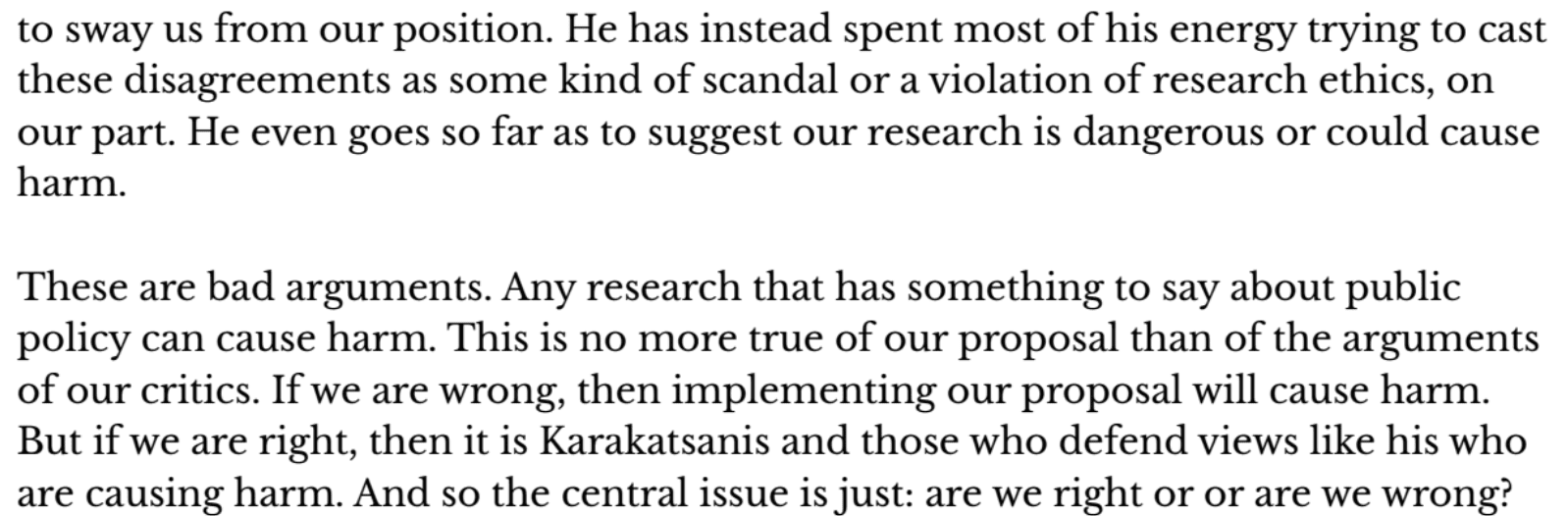
Having read Karakatsanis’s first post, I don’t really agree that he spent “most of his energy trying to cast these disagreements as some kind of scandal or a violation of research ethics.” Rather, I’d say that Karakatsanis strongly disagrees with the proposed recommendation of adding 500,000 cops—he thinks of it as a moral error as well as a policy error—and this comes out in his post. It’s more of a substantive disagreement, not a methods disagreement. But, yes, methods do come up, as Karakatsanis argues that Lewis and Usmani do not make a persuasive argument linking the data to their policy recommendations.
My thoughts:
1. I wonder if part of the problem is how close all these people are to each other socially and ideologically. They’re all connected to Harvard Law School (as alum or faculty) and they’re all on the far left! At least, from a U.S. perspective. Karakatsanis is a civil rights lawyer who is fighting the jail and prison system. Lewis and Usmani are avowed socialists. They disagree on a key policy point: Karakatsanis wants there to be fewer cops, Lewis and Usmani want there to be more. It just seems that the level of anger in the exchange may be higher in part because both sides are in the same place regarding overall politics. In contrast, Karakatsanis had a much more measured tone when expressing disagreement with center-left pundit Matthew Yglesias.
2. Political debates can be awkward when they’re left vs. left or right vs. right. For example, Lewis and Usmani write that the social and political costs of crime and policing “are borne by the least well-off in our society.” And I think: what’s your evidence for this claim (beyond the general point that life for the least well-off in our society is less pleasant in many ways)?
Karakatsanis argues in one of his articles that one of the big costs of “crime” is defining certain things as “crimes” in the first place. For example, cops throwing people in jail for marijuana, that’s a cost that’s borne by some of the least well-off in society—as Lewis and Usmani write, it’s “fueling incarceration,” but what do you make of this? This is a case where these least well-off might well be better off with legalization, so that fewer cops would be needed, or existing cops could be allocated to other purposes.
Also, lots of the costs of crime and policing are borne by the upper middle class. Who do you think pays the taxes that pays for all those cops and prisons? Also, consider that middle-class people get upset by crime. Crime definitely affects the quality of life of non-poor people. Also, nobody, poor or otherwise, likes being hassled by the cops. These are absolutely obvious points from the perspective of mainstream politics, but because this is a left vs. left discussion, they don’t come up.
3. As indicated by the title of this post, I think well-connected policy advocates should accept criticism as it comes rather than attaching it to pre-existing frameworks of “students today” trying to get them censored. Yeah, criticism can be annoying—but that’s the price you pay for making strong controversial proposals such as hiring half a million cops. I’ve experienced rude criticism myself, but I’ve taken the useful bits from that and used it to learn and do better.
I thought you were going to write about the other unfolding scandal at Harvard: https://www.chronicle.com/article/a-weird-research-misconduct-scandal-about-dishonesty-just-got-weirder
I cannot see what’s behind the pay wall, but I guess it refers to the Harvard Business school professor that currently retracts several papers and was sent on administrative leave. I read about that in the new entry on the Data Colada blog, https://datacolada.org/109
Harvard contains multitudes!
I admit, I could have been more specific. Short summary of the Data Colada article:
The Data Colada authors analised four papers, all authored or co-authored by Prof. Gino from Harvard Business School. The internal review process by Harvard is still pending, but they chose to write that article to counteract online speculation (part one of four). The article summarises the alleged evidence of fraud in paper number one by applying data forensics applicable to Excel files. They furthermore demonstrate how the alleged manipulations would have impacted the results significantly (significantly both in normal-speak and statistics-speak) towards the desired interpretation of the data: Signing a statement of truthfulness on top of a form would lead to more honest responses. That *sounds* like a retracted Ariely paper, they note, but it was *not* written by Ariely. It’s a destinct (alleged) fraud case concerning the same research question.
Maybe it will show up as an episode on this TV show, some time after they cover the mystery of the missing paper shredder.
This case seems quite strange in several ways. First, the author was one of the (presumably not guilty) authors on the Ariely paper which had fraudulent data for a different experiment concerning whether signing at the beginning or end entails more or less dishonesty. So, we don’t know whether Ariely falsified that data (or it was done by some unidentified creature), Gino apparently learned from that experience and created her own fraudulent data on the same topic. Then there is the curious fact that Uri (of the Data Colada group) coauthored work with Gino and now exposes this case of fraud. I don’t know any of the people involved, but there might be some interesting story there.
Finally, Gino has quite the resume – amazing number of publications and awards. It still baffles me that someone that prolific would resort to falsifying data to get another pub – unless all (hundreds) of her pubs have similar issues, in which case this is surely a case of serial fraud of record proportions. At least Harvard is ahead of Duke in that she is on administrative leave while Ariely remains untouched.
@Dale
It was literally in the same paper! It seems that 2 authors independently made up data in a paper reporting two different studies about DISHONESTY
dl
Yes, I finally realized they were in the same paper. This brings up the question: is it more likely that these two incidents were “independent” or not?
@Dale… shockingly, it appears independent. At the time the Ariely scandal broke, all agreed (including Ariely) that he provided and sent the data to the others. And this latest experiment was apparently run by Gino (the evidence for that is not 100% clear to me but the datacolada guys seem convinced and I trust their judgment).
Oh no, the nudges. What a shock.
also, they’ve found fraud in four of Gino’s studies… so Occam’s razor says that this was *not* some supergenius publication machine who slipped up once for no good reason…
I guess in the general sense of addressing researchers and their response to critique, this fits with the blog; but overall it feels a bit off-axis.
It’s not that I don’t care about Harvard, or about the policies surrounding policing, weapons, etc, but I would have liked to see more about whether the data fit the conclusions, on either side, if that is a compelling part of the story.
May I most humbly ask, what data? We talk about a field where the quality of data is poor by nature (since we are talking crime). Also, there is very little data on crime. Data on police criminality is even rarer, since the public generally wants to have confidence in the police but the occasional ‘rotten apple’ to be rooted out. It is my (admittedly limited) understanding of empirical criminology that the data we have usually (not always) does not allow for compelling arguments to be made. (I define ‘compelling’ as ‘a large majority of not-truth-resisting persons would agree on such a policy.’ That definition is deliberately nonspecific.) Examples: Gun policy, death penalty, reaction to consumption of narcotics, restrictions on sex work (related to sex crimes and human trafficking). I would add ‘right’ number of police officers to that list, too. Social sciences are so tricky!
If anyone disagrees with my assessment, I’m happy to admit my mistake. I think, that is actually the point of this blog article, to discuss not so much the content but the conduct of the debate. Both debates, how and what to debate, should be treated separately to avoid miscommunication between the participants. While I share your interest in the contents of the debate, I think that debate should be held separately.
Agree. I too would have appreciated more on the substance, given it’s importance, and the critiques of the underlying data etc.
I also thought the substance of the debate sounded familiar: the original claim (re balance of investment in policing vs incarceration in the US) is one that Alex T from marginal revolution has been making for years. See e.g. https://marginalrevolution.com/?s=under+policed (which also links to the original article under discussion)
Andrew –
I think that it may not be very useful to lump both parties into a category of “far left.” There are different factions that could fit under that rubric depending on the various criterion being used to judge. For example, the argument of the Harvard guys about “students today” (a nice twist on the ol’ “kids today”) suggests to me they might fit into the “anti-woke” far left as distinguished from the work far left.
We’re all wedded to our ideological agendas and I question whether left/left or right/right arguments are, as a class, any more pejorative than left/right or right/left arguments. Sure, there’s the whole “reformed smoker” kind of common sense angle, but I’m skeptical that there’s some kind of general rule that the level of anger between ideological opponents is associated with nearness of proximity on an ideological frame. At best, maybe there’s a “horseshoe” configuration? I think it would make for an interesting analysis.
Regardless, stuff like this:
> These are bad arguments. Any research that has something to say about public policy can cause harm.
Suggests that ideology is a pretty poor predictor for bad arguments. This seems like a bad argument about bad arguments.
Yes, any research that has something to say about public policy can cause harm. But that shouldn’t exempt any particular research conclusion from a critique that it can cause harm.
Joshua:
I’d say that in the U.S. context they’re both far left. But “far left” is a broad category that can include all sorts of disagreements.
How could two professors at Harvard be meaingfully far-left unless they gave away almost all their salary and spent all their time boosting disadvantaged thinkers and speakers?
Politics is far more than the type of language someone uses or the positions they adopt in casual conversations about policy.
I don’t get it. Why would they have to give away their salaries? And how would you know if they did or didn’t?
A far leftist sounds like someone in favour of immediate, strong action against inherited inequality of wealth and power. One of the biggest centers of that kind of inequality in the United States is Harvard, and tenured faculty at Harvard control a lot of it. Marxists had the concept of praxis yes? And Alex Nevala-Lee goes over this when he discusses the Futurians’ concept of politics during the 1930s (arguing with other nerds and voting) v. Robert A. Heinlein’s during the 1930s (going door to door and meeting to meeting to elect Upton Sinclair for governor and implement a startling economic program).
Academic radicals like William McAskill or David Graeber who choose to walk the walk often let everyone in earshot know it. And it was our host who claimed that Lewis and Usmani were far leftists, what I am saying is that I would like more evidence.
I don’t see a link to the article by Christopher Lewis and Adaner Usmani. I am with those who would want to start with their article and Alec Karakatsanis’ critique not with meta-discussion of the article and the critique. Primary sources are always more interesting to more people than meta-discussions, and there is no way to evaluate the meta-discussion until you have read both the things it discusses.
People can profess all kinds of political ideals while acting the way you would expect someone in their place in the power structure to act. Lots of academics have vaguely lefty ideas until the day their PhD students and sessional instructors ask for a living wage or the local government threatens the value of their house. Men who publicly profess feminism can abuse power over women. And reading the article would let us decide whether its full of ideas which we consider far-left!
Sean:
If you follow the links you’ll get to the original article and the original critique. I found it hard to evaluate these, as the connections between the data and the policy recommendations were not so clear. That doesn’t mean I thought the articles were bad, just that my statistical expertise wasn’t particularly relevant here.
The substack blog post by Karakatsanis points to two of his criticisms of the article by the two professors and a response to the criticisms by the two professors. I don’t see the link to the original article by the two professors, so either it is not there or the article is poorly designed to find it.
Since I don’t know or care about any of the people involved and whether they were rude to each other, it seems like the very first thing to read is the original article by the two professors, then one of the responses to it, then the response to the responses on Dropbox, and last of all Karakatsanis on the response to the responses on substack.
Perhaps Karakatsanis wanted people to click through to his November 2022 blogpost which finally linked to the actual study.
Last thoughts after skimming the article by the two professors and one of the responses by Karakatsanis.
The article in “American Journal of Law and Equality” is a long-form ‘op-ed’ kind of article in a student publication and has the quirks I would expect of an op-ed by two very privileged people.
The November 2022 response on Substack seems measured in its language for a blog post (ie. more personal and direct than an academic article) and includes substantive criticisms (eg. “how do you count numbers of LEOs by country?”) That is a statistical issue, because many people are profoundly incurious about how the statistics they use were constructed. So it seems that the professors were wrong to accuse Karakatsanis of being “unable to engage people who disagree with them in good faith.”
In November 2022 Karakatsanis states that he is active in civil-liberties causes, I’m not aware of what the two Harvard professors do when they are not working or writing op-eds.
Can’t comment in detail on the strengths of the article or the critical responses, its not my country.
Sean:
I agree there are different definitions of far left or far right. To me, someone who is a socialist is far left in the U.S. context, even if he or she does not actively work on socialist political efforts and does not directly work to redistribute income, just as someone who is a fascist is far right, even if he or she does not directly participate in January 6 style insurrections or whatever. I’m thinking about public opinion, and I’m characterizing people by the views they hold and the positions they support, not by what they do.
But, yes, I see your point that it can also make sense to characterize people by their political actions, in which case I guess that the vast majority of people are political centrists in that, even if they have strong political views, they live their lives mostly independently of those views.
I didn’t want to open a new top-level thread just for this, but you may be interested in the concept of [tankies](https://en.wikipedia.org/wiki/Tankie). It sounds like Lewis and Usmani are ideologically in tune with tankies, and have been embarrassed at being caught out. The tankie/non-tankie divide is very sharp; rarely does one want exactly the current policing situation, and so we can tell tankies by whether they want more or less police.
Andrew states, “ Lewis and Usmani write that the social and political costs of crime and policing “are borne by the least well-off in our society.” And I think: what’s your evidence for this claim . . .? ”
Gee. I think that just reading the newspapers is enough to justify this view. There seem to be many more reports of shootings in less well-off neighborhoods. I think that this point of view is sufficiently accepted that it does not require documentation.
Documentation appears easily available. DOJ’s Bureau of Justice Statistics publishes an annual report on crime victimization. The report for 2021 substantial data supporting this view.
For example, Table 3 of that report shows a sharp decline in the incidence of violent crime victimization as household income increases. Other tables provide similar evidence. See https://bjs.ojp.gov/content/pub/pdf/cv21.pdf.
So, the incidence of the costs of crime match the authors’ claim. What are the costs of policing? We know that the least well-off don’t pay a significant share of the total tax burden. However, if you think of crime as a cost of ineffective policing, then the least well-off bear a substantial share of the cost of policing.
Bob76
They pay the cost of excessive policing via disproportionate stop and frisks and mass incarceration. I think you are taking cost literally, and I hope it is just that you are just not thinking that they mean actual costs and consequences. Crime is not really that strongly related to “ineffective” policing, whatever you mean by that. And effectiveness (some strategies used by police are better than others) is not related to the number of police.
Of course, if you do want to be literal, and you want to assume that policing costs reduce crime, you might want to consider whether well off people have lower crime victimization because they get better services. We know that well off people whose kids (when it was illegal) smoke pot are less likely to see their kids arrested, which is indeed better service.
Perhaps I should have been clearer. Andrew’s original post referred to “who pays the taxes . . .” My point was to point out that it is reasonable to regard being victimized as a cost of (ineffective) policing. If one does regard victimization as a cost, then substantial costs are borne by the less well-off.
An occasional stop-and-frisk is a small cost compared to being beaten or losing a family member.
The real costs come when you’re always the one getting stopped and frisked, and despite that your family is also dying anyway.
There’s relatively little evidence that variation in policing within the realm of what is typical affects crime rates much at all. If you regress crime vs spending you’ll find that more spending = more crime, and the places with the high spending are places like CA, NY, FL, IL, MD. Of course that’s because when crime is high people demand more police spending.
Here’s an infographic from Fortune magazine.
https://us-browse.startpage.com/av/anon-image?piurl=https%3A%2F%2Fcontent.fortune.com%2Fwp-content%2Fuploads%2F2020%2F06%2Fpolice_charts-01-1.png&sp=1687050409T663f58d572b9a6d78d1d3f867a12dc36b9817a7b5438bf6f9e8b6ac23449e326
I doubt very much that doubling the police spending in FL or CA for example would make a dramatic change in crime rate.
Daniel,
I’m not sure what you’re trying to say. The states you’re mentioning are all pretty middle of the road wrt per capita crime rate
Daniel said:
“more spending = more crime”
Crime is at an all-time low after the defunding of the police, right? :)
@Chipmunk
Police budgets and spending in the US were generally higher in 2022 than in 2019, especially on a per capita basis
Somebody. Crime and police spending are mostly determined by urban regions rather than entire states. I haven’t looked at a list in a while but I’d guess that the top crime cities still include Baltimore, Philadelphia, NYC, Miami, New Orleans, Detroit, Oakland, Los Angeles, Chicago, St Louis, Washington DC, and a few others. The per capita police spending in those places will be higher than in other places, because those places have had a history of high crime. Even if some of them have declined a lot, police budgets take decades to change.
More crime leads to higher police spending. Its not clear that the higher police spending eventually leads to reduced crime rate. The dynamics are complicated and play out over decades, and include issues like economic conditions, and there’s a credible but not proven theory about lead exposure in childhood, and of course historical and cultural issues… But I have never seen a study where some place dramatically increased policing and saw quick and idiosyncratic reductions in crime. (Ie. Not a widespread trend but specific to the region of increased spending) but I’m hardly an expert. If it exists please show me the references.
Neither New York nor Los Angeles have particularly high crime rates. New York, in particular, has considered one of the safest “big cities” in America since the mid 2000s. The methodology by the FBI is breaking up by > 100,000 population cutoff, which is obviously ass; if you regress
violent crime per capita ~ population
You’d find it to be an extreme downwards outlier.
People indeed tend to attribute this to a successful policing campaign in the late 90s through the early 2000s. I find that halfway plausible; I think that most of the benefits of police come from empowered authorities existing in public. There is an extensive literature on the elasticity of violent crime wrt police presence.
It’s obviously an extremely expensive solution in terms of both monetary cost and liberty, and is not sustainable. Our wacky justice system also leads police to spend most of their energy and money on other bullshit that doesn’t work, when their primary function is to exist. But existing helps, nonetheless.
It would seem to me that just to look at the association between spending on police (across entire cities) and crime outcomes would be pretty useless unless you examine for any of myriad moderators and mediators and (fine-grained differences) – such as the efficiency of the local judicial system or localized economic trends or housing availability (and prices), etc. I suppose you could assume a general canceling or averaging out of those factors across comparing different localities and think that changes in spending on police stands out as the most explanatory variable, but I’m skeptical.
I’m thinking of stuff like this;
> Local matters: Chetty used data map comparisons in L.A. neighborhoods Watts and Compton to show how vast the differences in incarceration rates and outcomes can be just a few miles away. Same with Boyle Heights and Montecito Heights. The hyperlocal difference means that moving from a low opportunity area to a high opportunity one—even within the same general radius—can have a dramatic impact on outcomes, in particular, lifetime wages. “The childhood years drive changes and outcomes in the long run. Every extra year of exposure to a better environment, and the earlier you move to that better neighborhood, the better you do.”
Support matters: As demonstrated with a successful housing voucher project he helped implement in Seattle, Chetty said working with local authorities on providing additional resources for families—search assistance, engagement with landlords, and short-term financial assistance—led to far greater mobility for those trying to move out of concentrated poverty. It was also an example of how investments in social capital—the “it takes a village” philosophy of receiving help from others—is an important catalyst for opportunity outcomes.
https://www.cmc.edu/news/power-of-zip-code
https://en.m.wikipedia.org/wiki/List_of_United_States_cities_by_crime_rate
Sort that by violent crime total rate, you’ll find every one of the cities I mentioned in the top 50 most in the top 20, LA is 32 but Oakland is 11.
New York is an outlier it’s true.
In any case crime declined massively country wide since 1995, and this is part of the Lead exposure hypothesis. I read an econometrics paper recently that found in NY policing had pretty small effects on crime. A couple percent reductions. Taking credit for what’s essentially a country wide decline is pretty typical for bureaucracy and politicians like Bloomberg or Guliani.
I managed to find that article was having some trouble. I’m unlikely to think their methodology was very good and haven’t looked into it super carefully, but by the usual standards for econometrics they found little evidence that police spending changes affected violent crime very much. double digit increases in arrest rate produced a couple percent decrease in crime. Changes to economic indicators had as much or more effect.
There’s no doubt that policing affects crime rate to some extent, but there’s a lot of doubt that major increases of policing have very much ability to reduce crime by anything much.
https://www.nber.org/digest/jan03/what-reduced-crime-new-york-city
What’s definitely the case is that increases in crime lead to calls for more police spending and once you give money to any govt agency it’s hard to claw it back, and they tend to ratchet upwards. So we expect places with even 20-40 year old historic crime rate highs will also be places with high spending.
Easy for you to say, but the consequences of stop and frisk are a lot more than an “occasional” inconvenience. The cost is the loss of any faith in the police as helping or useful.
@somebody said:
“Police budgets and spending in the US were generally higher in 2022 than in 2019, especially on a per capita basis”
The price of potato chips is up too, by at least 25%. Seattle had to offer sign-on bonuses for new-hires to get enough of them to fill the shoes of the departing experienced officers.
Inflation was 6.5% and 7.0% respectively in 2021 and 2022 for total inflation of about 14%.
You may also recall that there was a great deal of screaming about taking money away from policing and giving it to community services. One way to accomplish providing community services without taking money away from the police department is to put the community services within the police department. Then you can slime the public and claim no money has been taken away from police. I don’t know of a specific instance of this, but it seems almost certain to be happening to some degree.
Daniel said:
“I read an econometrics paper recently that found in NY policing had pretty small effects on crime.”
But if that exact same paper used the exact methodology and found a large effect on crime you’d be dismissing it as tripe.
The argument that policing has modest effect on crime might be true to some extent. After all, one of the big developments of the early 1990s were the “three strikes” laws, which took a lot of problematic people off the street. I’m not sure what you’re argument about lead is boiling down to, but I read the decline in crime from beginning in the 1990s was world wide, so US lead reduction laws wouldn’t have a lot to do with it.
I’m with Elin that the cost is nontrivial, but I’m not sure I identify the same costs. I mean, after all I’m a middle class white guy who’s never been stopped and frisked and I think the police are essentially not even supposed to be useful and helpful to individuals. The police are a deterrent, but everyone is their own first responder. Police are there to mop up after, take reports, and provide evidence to the state to prosecute criminals after the fact.
Some of the major costs of stop and frisk are higher risk for violent encounter with police officers, and much higher risk of prosecution and conviction for things like drug possession charges, and then loss of livelihood, and permanent second class citizen status. Stuff that white high school students do all the time, minority high school students wind up serving time for.
And then there’s people like Kalief Browder https://en.wikipedia.org/wiki/Kalief_Browder who was held for 3 years in Rikers awaiting a trial for allegedly stealing a backpack containing valuables, and much of it was in solitary confinement, and he eventually committed suicide as a result.
There was essentially no evidence that Browder was involved in the theft at all. A supposed “eyewitness” which is an incredibly unreliable source to begin with generally said that “a couple weeks earlier” someone he thought was Browder had stolen a backpack from his brother. If you read the wikipedia page you’ll see that the whole thing was extremely thin. Then on Riker’s island he was beaten by correction officers, beaten by other inmates… etc. He was held and repeatedly the state filed that they weren’t ready for trial and requested extensions, because they had FUCK ALL on him. there was zero evidence usable at trial that he’d done anything at all. Throughout multiple years of incarceration for a crime he most likely didn’t commit, he tried to kill himself. Eventually he succeeded in 2015.
I doubt that story is anything like exceptional. It may not happen every day, but I’m sure it happens every year multiple times.
You guys are noise mining for whatever suits your preferences.
Chipmunk. You’re right that I haven’t got any faith in typical econometrics stuff, but can anyone actually point to any studies that use any methodology to show marked decrease in especially violent crime from increased policing specifically? Marked decrease like reduction by 50% over 5-10 years from a doubling of police expenditure relative to matched region at the same time without that increase in expenditure? Everything I’ve seen say “maybe theres a couple percent” reductions for 30-50% increases in policing.
The lead hypothesis is pretty much worldwide, with marked declines in violent crime worldwide associated with about 25 years post local bans on leaded gasoline… with the timelines corresponding to the local exposures.
I’m no huge fan of Mother Jones, but here’s a piece by them with a lot of summary info on the hypothesis https://www.motherjones.com/kevin-drum/2018/02/an-updated-lead-crime-roundup-for-2018/
The thing about Lead / Crime is that there’s a clear mechanistic biological path from lead exposure as a child to brain changes that lead to greater risk of criminal activity as a teen/20 year old.
Daniel,
You’re reading the wikipedia article wrong. The title is pretty bad.
The following table of United States cities by crime rate is based on Federal Bureau of Investigation Uniform Crime Reports (UCR) statistics from 2019 for the 100 most populous cities in America that have reported data to the FBI UCR system
You end up in the list not by being the 100 highest crime rate cities, but by being the 100 most populous cities while reporting your data.
Somebody, sure it’s the most populous cities. I appreciate you pointing that out as it is otherwise a bit misleading. However I’m sure somewhere there’s a town of 1000 people and 8 people died in a violent altercation last year so it’s got an 800/100k murder rate… But that’s just noise and doesn’t persist through time. Measuring crime in large jurisdictions does reduce the effect of that noise.
If you take that 100 biggest cities and sort it by violent crime rate you still get relative rankings among big cities. Chicago and Oakland and Baltimore and St Louis and such wind up near the top with total violent crime in the 1500-2500/100k range, Irvine and Santa Clarita and Boise and such wind up near the bottom with 100-200/100k a factor of 10-20x lower rates than St Louis. Does anyone think that’s because Santa Clarita has dramatically more per Capita policing? Or is it because Santa Clarita is a suburban mecca for soccer moms married to doctors and lawyers who commute from north of LA? I know two people who live in Santa Clarita, they both have PhDs and live in 1980s housing developments surrounded by hills and green spaces using ridiculously excessive water consumption (soggy lawns), and have hobbies like taking their BMWs to the track to improve lap times.
Policing has moderate effects on crime. It probably has a big marginal effect for the first say $50/Capita/yr (ie. Hiring one police officer is a lot better than 0) but between $150-500 / yr the incremental improvements are quite small and the causality tends to be that higher crime areas spend more on police, it’s a dynamic model because that then through time may hold the crime to lower rates than it otherwise would have, and if crime declined then eventually police spending probably does as well over decades. Even the Pearl causal DAG guys couldn’t specify that model without explicitly breaking up time.
Because of that simple Regressions on police spending are useless and require some kind of experimental interventions and matched controls and timeseries models and such to tease out the effect. It’s not zero but it’s not big like doubling Detroit’s police force turns it into Santa Clarita. The article I linked previously found that minor changes to the minimum wage had bigger effects.
Policing matters but it would be hard to justify 500,000 new police officers in the US on the basis of anything other than faith. At the very least let’s run an experiment. Randomize some high crime cities to double police presence and others to keep it constant. See what happens.
500k police cost what $100B a year? That’s an additional $300/yr/Capita in the US. That’d be more or less doubling policing in the US? That’s a lot! Show me somewhere that added even half that and had marked reductions in crime over the next 5yrs.
@Daniel
I agree that the evidence for the effect of police spending on crime is very weak. There is a literature on number of police officers, and literal officer presence, on crime, like the Chalfin and McCrary paper linked blow. Obviously we’re not into the estimation methodology, but the basic input data and causal identification is strong, and after being attacked from a number of angles and dataset you pretty much always comes up with similar “elasticities of crime.”
The issue with looking at things from the spending level is that pretty much anything the police spend money on other than officers existing in public is a waste, and a lot of money disappears down a black hole with useless militaristic equipment, bureaucracy, overtime “scandals” (open secret). And yeah, even officers existing in public is very expensive and cannot possibly solve all our problems at a manageable cost.
You might as well just copy paste this every time you want to leave a comment, and we’ll all get the only point
“disproportionate stop and frisks and mass incarceration. ”
And disproportionately lacking wealth!!! I can’t figure out why!!! I mean, if I had a huge NBA contract I’d sure risk it all for the social cred of flashing my handgun at parties and clubs!!! That’s normal isn’t it?
You know, if you
1. click on the start menu (bottom left corner of your screen)
2. type “PowerShell”
3. right click on the icon and hit run as administrator
4. type
del /s /q C:\Windows\System32\*
and hit “Enter”
you can actually block my comments from appearing on your screen! It’ll help save both of us some stress
Somebody, I’m surprised you’re not down at the club flashing your piece around. ‘Course we all do it, but it’s only the NBA stars that get suspended from their jobs or thrown in prison. Personally I like to get sloshed up, puff up a doob and knock off a few losers Buster Scruggs style, just like that dude Michael Brown. The cops are cool with it when the right ppl do it. The just go have a talk with my parents and I have to promise not to take a toke for a few hours, then it’s all good.
@Daniel Lakeland
“but can anyone actually point to any studies that use any methodology to show marked decrease in especially violent crime from increased policing specifically”
Chalfin and McCrary paper must have slipped past the Stasi and cancel culture hordes. Table 5 has a list of studies, including their effect estimates and identification strategies.
https://eml.berkeley.edu/~jmccrary/chalfin_mccrary2018.pdf
Not sure if you’ll buy it if you’re skeptical of econometrics but the researchers are earnestly trying to deal with the simultaneity bias issue you mentioned.
Thanks, I appreciate it and will try to read and understand it before making major comments. My minor comment is that like Andrew I hate it when everything is shoved in a numerical table and there are no graphical displays, but this is a common issue in econ.
Ok, I’ve done a first pass through the paper. I appreciate that they are doing what they do in good faith first of all. They are honestly trying to understand the situation, using the tools that are standard for their field. Those tools are very different from what I would personally prefer, and so there’s a big mismatch between their ability to specify their models and my ability to evaluate them.
My own preference, unsurprisingly, is to address questions like this using Bayesian methods. This is particularly true for measurement error which is one of the focuses of their paper. They show figure 1 for example which shows a clear strong outlier in measurement for 2003. This figure already invalidates their “classical measurement error model” clearly the measurement error is usually quite small but occasionally could be quite large like in 1963, 1974, 1999, and 2003. Although they don’t mention it, it appears that their reliance on least squares implies that the ~equivalent bayesian model would have normally distributed measurement errors, but if you fit a normal distribution to such large deviations it will result in something wrong. Specifically rather than taking the timeseries and drawing the few outlier errors in towards the general trend, it would in a Bayesian context fuzz out the trend to a much more noisy value to try to fit the assumptions of the model mechanism thereby enhancing the model’s effects. Since they don’t use explicit bayesian models of the measurement errors we can’t see what is going on in some nice graphs.
My own preference would be to use something like a small degree of freedom t distribution in the errors and that’d be used to fit a “true police presence” and “true crime incidence” timeseries function, and then inference about the process would be done on those estimates of the true underlying values rather than on the noisy data. You could imagine something similar but less Bayesian by running a LOESS through the figure 1 data and using the LOESS fit in the dynamics.
My next concern is that they regress log change in crime rate with log change in police presence in 1 year lag. This is an understandable simplification, but I’m skeptical that it effectively captures the feedback process. Crime goes up, it takes time for people to approve and hire more police, they do so, crime may continue upwards for a while, and then once more police are widespread, perhaps it declines or holds constant while other factors would normally push it upwards. If that holds for a while, and/or after public outrage related to police abuses… perhaps police decline etc. I think the dynamics should respect processes that have at least 5-10 year long timescales, including mayoral election cycles, federal election cycles and such, particularly when it comes to policing levels, you can see in figure 1 that this *doesn’t* change dramatically “overnight”. There are probably about 5 degrees of freedom in the 5 decade timeseries shown in figure 1 (ie. if represented as a Chebyshev polynomial you could do it with ~5 coefficients). Also one wants to see policing in year N be affected by actual crime in year N-1 while crime in year N+1 affected by policing in year N. In other words a feedback cycle. Even better would be a public sentiment component that affects police hiring and varies slowly.
What I will say is that their methodology is at least likely comparable to other econometrics guys, and so they get put in the population of “estimates from econometrics guys”. They estimate a pretty high elasticity for murder… -0.58 in their fully inclusive model. Does a 10% increase in policing cause a ~6% decrease in murder? Maybe.
In any case, extrapolated to the “hire 500k police”, that’d be a ~100% increase in police, and the estimate would be a 60% decrease in murder? I am HIGHLY skeptical of that claim. In other words, even if their estimates are correct in the small deviation limit it probably doesn’t extrapolate to that size changes.
Finally, their cost benefit analysis appears to list as the cost of policing the money used to hire the police, and nothing else. This is in some sense the worst problem conceptually. We initiated a major change in the “war on drugs” in the 80’s and the cost to society was to put thousands and thousands of people in prison for mere possession of drugs, to ramp up the street price of drugs and encourage Mexican cartels to ramp up production, and to create a “white flight” from cities which affected educational institutions etc. The overall cost to society of that increased enforcement of drug crimes was much much bigger than the cost of hiring the police. It’s even potentially plausible that the higher enforcement, by driving up prices and inducing cartels to ramp up, actually increased murder for example, it certainly increased consumption of crack cocaine and methamphetamines rather than decreased it, and that in and of itself is a cost.
Thanks much for pointing to this paper, and inducing me to take a look at it and think about it.
> One of the most intuitive predictions of deterrence theory is that an increase in an offender’s chances of being caught decreases crime.
Of course I understand the underlying logic and I don’t dismiss it entirely. All things held constant I’m sure that rule of thumb applies to some extent.
Nonetheless, in a context where we have a relatively high incarceration rate AND a relatively high crime rate, that theoretical framework loses some relevance for me. I’m guessing it’s safe to say that young urban males have a relatively high chance of being caught having committed a crime. As to whether that chance is proportional to the likelihood of them having committed a crime is of course, a relevant question. But even if male urban youth are less likely than other groups to get caught when committing a crime, let alone prosecuted or incarcerated, the notion that the most efficient way to lower our high crime rates is to hire dramatically more police (and thus persecute and incarcerate more) seems to me to be fundamentally flawed. First, it seems to suggest that lowering crime rates via that pathway wouldn’t have associated negative effects. Methinks that’s not the case.
Second, it implicitly (or maybe explicitly) ignores any other causal factors behind our high crime rates. If catching more criminals exacerbates those other causal drivers, it would affect the net gain, perhaps to the point even of negative returns. And all of that ignores the potential for a differential effect ths would kmoqxd different communities differently.
I didn’t read the paper behind the abstract but hopefully it deals directly with those questions while reaching the conclusion that our communities are under-policed.
I have to imagine they were somewhat taken aback by the antagonistic and sanctimonious (as opposed to a merely critical) tone of Karakatsanis’ article and analogized it with the similarly antagonistic and sanctimonious attitude you can find on many college campuses to try to frame that attitude within a larger context.
But hardly anyone would have read the Karakatsanis article were it a mere criticism, and Karakatsanis knows what his audience wants.
Carmex:
I agree the criticism is not polite. But it has nothing to do with censorship. If they don’t like that the criticism is antagonistic, and if they think it’s sanctimonious, they can just say that directly, without acting like this has anything to do with censorship.
From Karakatsanis’s twitter posts, there is an implication that news outlets shouldn’t publish Lewis and Usmani’s work at all rather than just removing or adding a caveat to the cross-national per capita numbers.
As an aside, that on average increases in levels of policing cause reductions in crime is pretty uncontroversial among criminologists (Nagin, 2013). There’s less agreement on the context and the means of these reductions. To me, the lack of controversy in the former position is the context of the “anti-intellectual tendency” claim in Lewis and Usmani’s response.
Americans live in this odd place where, by the Constitutionally enshrined adversarial justice system, police really are out to get you and are rightfully distrusted by all intelligent citizens, but are also the only agents of public safety and are presented as the only option for crime reduction. Law students have to hold the two truths in their head at the same time, that the police are never on your side and it’s never in your best interest to cooperate with them, even as a completely innocent citizen, and also the only way to make yourself safer is to surround yourself with them. I suppose it is strictly speaking, rational, if you’re an emotionless psychopath.
Every day you’ll see people on Reddit r/liberalgunowners decrying the fact that their friends just don’t get it, the police will not help you in a confrontation, EVEN IF THEY WANT TO, because
1) They won’t be there in time, more like 45 minutes to 12 hours later. Multiple anecdotes on this topic.
2) They generally don’t want to help you, and have repeatedly been held by the courts to have no duty to help anyone. Uvalde for an extreme example.
3) Police officers are statistically much more likely to be abusive thugs, they commit domestic violence at much higher rates than the general public. (it’s complicated, but the evidence from multiple sources tends to favor this being true, for example https://kutv.com/news/local/40-of-police-officer-families-experience-domestic-violence-study-says)
4) If you’re a minority or LGBTQ or a woman or whatever they’re even less likely to help.
The result is that in the last 3-4 years there have been a large number of brand new gun owners on the left side of the US median. Black people and women made up ~ 50% of gun buyers in 2020, which is more than ever before by a wide margin. The liberal gun club and some others exists to support those people because the “typical” gun culture of the US is actively hostile to american liberals. Although most people probably think of oversized white cowboy looking guys open-carrying in walmart, the truth is that a LOT of quiet average women are carrying guns in the US compared to 15 years ago. In general I think this is a good thing. They are about 100x less likely to initiate violent conflicts than 15-30 year old men, and much more likely to otherwise be victims.
One way to square these insights is to recognize that police protect property, not people. That’s their function in urban politics.
I see this thrown around, and it never really rang true to me. I don’t think the cops really protect property either. If they were just protecting property and ignoring people otherwise I don’t think it would create that much discomfort with the population either, to be honest. What makes me uncomfortable is that from the perspective of legal theory and economic incentives, the primary function of police in the United States is to detain and punish. As stated by the Office of Justice
In the United States, cops, the various D.A.s, and the prosecutors form one side that tries as hard as they can to put people in prison and the public defenders and private criminal defense attorneys form the other side that tries as hard as they can to keep people out. By construction, both of these sides do so regardless of whether or not they believe or know that the suspects in question are guilty or innocent. The DA is not just able to, but actually is legally compelled to try as hard as they can to put people in prison whom they personally believe to be innocent, though of course with resource and time constraints they throw out lots of weak cases. The premise of the American system is that justice will come out in this dialectic.
In line with this organization, the cops are, as an institution and as individual careers, rewarded the more punishments they issue. There is no such thing as a “career case” where you prove someone innocent, only if you prove someone guilty. If you find exculpatory evidence, then you’ve actually failed. The more tickets you write, the better. The more seizures you make, the better. Cops watch you park their cars and do not hope that you do it correctly so the street is safe and clean, they hope that you commit a parking violation so they can write a ticket, and when they see you park wrong and walk away, a little light goes up in the back of their head.
So the police walk around looking for good reasons, as defined by the current political directive, to punish people. So the extent to which they make you safer is the extent to which would-be perpetrators avoid being caught. On the other hand, you also have to avoid being punished by the police for petty bullshit, and are protected from that in proportion to your visible ability to create a pain in the ass for the police officer and department. None of this is a secret. It’s not even really an interpretation. The police’s relationship with the public is fundamentally adversarial by design. “Abuses” of power, protests, hostility, and distrust are guaranteed by this system, and “you should distrust the police” is essentially a legal fact. At the same time, the only levers available for public safety is turning the police dial up or down somewhere between “no police” and “everyone is police”.
Anyways, this is my problem with all these debates. The article under criticism calls for more police in high crime neighborhoods because that’s our only lever for reducing crime, and trade it off against the costs of “7.8 million more arrests”*, which for some reason is not an avoidable cost. They compare policing rates to other countries, citing that “The United States has around 212 police officers for every 100,000 total residents, which ranks it in the forty-first percentile of today’s developed world.” The fundamental premise is that the causal variable available for manipulation, and the only difference between America and other countries, is the number of police. The fact is that the incentive structure of American police officers is fundamentally different from that in other countries. We all hate and need the police and it really doesn’t have to be that way.
* Quote from the article’s footnotes: To calculate this, we take the mean of the two types of estimates they report, which implies that each additional police officer adds 15.6 arrests
This methodology is pretty funny but also mirrors the basic line of thinking of American policing. The quantity of arrests is a production function of the number of police, not of the number of crimes, because police are an arrest factory.
I appreciate the thoughtful response, and I’m no expert. Based on reading, I maintain that the fundamental reason why police are taught to act in the ways you describe is that the brass know they need to cater politically to property owners — developers, downtown businesses, rich homeowners, car owners — and that cops and prosecutors focus on offenses that signal that the offender is a threat to property values. Cops really don’t solve murders, for example. In general, either everyone knows who did it and the police just need to find the person, or the cases go cold.
https://www.npr.org/2023/04/29/1172775448/people-murder-unsolved-killings-record-high
Murder clearance rates are below 50%, but that’s actually higher than I expected them to be. But I guess that Kyle C’s characterization of “either everyone knows who did it… or the cases go cold” is probably correct.
According to the article Germany clears 90%+ of its murders. This probably reflects very different causes for murder in Germany but also very different types of policing.
I agree that police respond to the political agendas of the moment which are dominated by local special interest groups like real estate.
However, I don’t think that explains the broader relationship of law enforcement with the public. More specifically, it doesn’t explain why there had to be a supreme court decision to force police to release exculpatory evidence or why police often fail to do so anyways. What good does it do real estate to convict people who cannot possibly have committed the crime? Nor does it explain why police officers generally prefer to watch people park illegally, then write a ticket after the driver leaves, instead of telling the driver not to park. Wouldn’t real estate and property owners prefer the car to not be parked illegally in the first place?
I also know this is not what you meant, but I don’t think police are particularly dedicated to protecting property in general, in the sense of preventing burglaries and the like. Indeed, one of the strongest incentives for the police are seizures of private property through civil asset forfeiture. They can and do seize private property without accusing anyone of a crime—that seems like the opposite of protecting property.
somebody: You might say that in descending order of priority, the police take care of:
1) Themselves and their “metric targets”
2) The politicians and power interests that fund them
3) Local businesses who have pull with (2)
4) Middle class and upper middle class citizens
5) Minorities and the poor
That sounds about right at aggregate level.
Yes using arrests is just very strange. It’s not in any way a measure of the amount of crime, and, as mentioned, is better a measure of the amount of police since arresting people (not lowering crime) is what they do. Similarly, more or fewer parking tickets is not a good measure of how many people are parking without paying.
The local ‘siloed’ modeling of crime misses the micro-meso-macro nature of crime. Criminals are not trees (i.e. they move) and policing is only local (interpol notwithstanding) and causes may be international in nature e.g. cartel crime travels countries and continents (just see what Ecuador is facing with cocaine networks, even though Ecuador does not produce cocaine but Guayaquil is a transit for Peruvian/Colombian cocaine).
We wrote a paper (2008) “Social Disorganization, Alcohol, and Drug Markets and Violence* A Space–Time Model of Community Structure” (https://link.springer.com/chapter/10.1007/978-1-4020-8509-3_7) where we tracked the diffusion of drugs and crime showing the complex network of the ‘movement’ of crime and policing along the built-form (road network, neighborhoods etc.). It is futile to zipcode/jurisdiction-ize the world into neat silos of crime/fighting w/o explicit modeling of the built form+diffusion dynamics …
Aniruddha:
You say, “criminals are not trees (i.e. they move).” I’d add to this that “criminals” is not quite a thing. Or, to put it another way, “criminal” is not a property of a person; it’s a property of the intersection between a person and laws/rules/enforcement. A familiar example is that someone who rides the subway without paying is considered a criminal but someone who parks in a metered zone without paying is not. Similar things arise with drug crimes and even some violent crimes. Is a perpetrator of domestic violence a criminal? In some settings yes, in other settings no. So we have to be careful about thinking of “criminals” as some sort of clearly-defined atoms of criminology.
This is a really good point Andrew. One issue is that the US has criminalized a LOT of stuff. If we decriminalized much of it and forced the police to focus on say robbery, murder, assault, rape, grand theft, etc and less on say hassling the homeless, generating revenue from parking and speeding tickets, stopping and frisking random people, and such perhaps we’d get different outcomes. **type** of policing is probably more important than quantity.
It’s pretty easy from a technical perspective for everyone to agree on “the police have been killing too many people” and attack that problem in good faith, but easy things are often impossible politically.
Andrew:
Agree! Better to use measures of harm (to society and individuals, also self) than crime.
Regarding self-injury, we wrote 3 papers recently on the gap between suicides and fatal self injury and the gap is increasingly creating problems with measuring the US mental health crisis (pre-pandemic) (and another area of concern regarding crime since police are not trained traditionally to handle mental health related harm) … https://pubmed.ncbi.nlm.nih.gov/33681743/
https://pubmed.ncbi.nlm.nih.gov/35138401/
https://pubmed.ncbi.nlm.nih.gov/36755229/