Last week Andrew commented that we need a more transparent workflow for survey statistics. So I looked in the new Bayesian Workflow book:


Chapter 19 “Building up to a hierarchical model: Coronavirus testing” is a case study about a 2020 survey that tested n = 3330 residents of Santa Clara County, California for SARS-CoV-2 antibodies (Bendavid et al. 2020a, 2020b). y = 50 people tested positive.
To estimate population prevalence, they want to account for measurement error in the test (“Measurement“) and differences between sample and population (“Representation“), both sides of Groves et al. Figure 2.5:
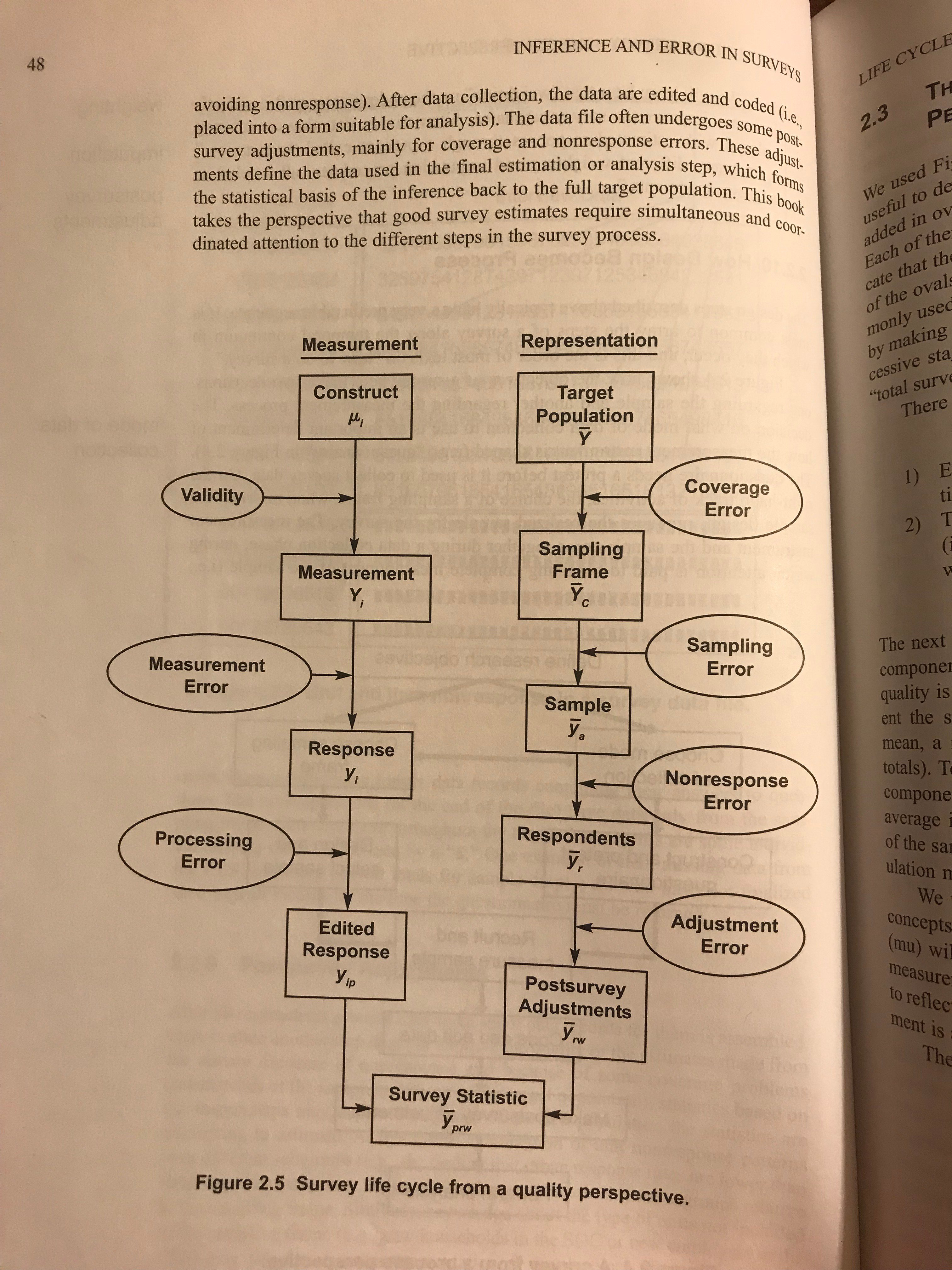
The measurement error model includes specificity gamma = P[test negative | no disease] and sensitivity delta = P[test positive | disease], which take population prevalence pi to test positivity rate p:

Bendavid et al. (2020a) analyzed their data using gamma = 0.995 and delta = 0.80. But these aren’t known exactly, so Gelman and Carpenter 2020 recommended using priors from previous studies to reflect uncertainty:

They extend these priors to account for multiple studies. They look at sensitivity to these priors (overloaded term here: “sensitivity”). Cool stuff !
In this Survey Statistics series we hadn’t yet talked about models for measurement error in the outcome variable y. We’ve seen measurement error in an adjustment variable X, e.g. recalled vote (“is a mismeasured X better than none at all ?”, “more adventures in mismeasured X”, “more on recalled vote”, “it is (still) the people”).
On the “Representation” side, Bendavid et al. (2020a, 2020b) adjusted for differences between sample and population using weights and encountered the difficulty we saw last week: adjusting for lots of variables can lead to very large weights. Maybe modeling can help (see last week’s “structured MRP to smooth survey weights”).
So Gelman and Carpenter 2020 proposed replacing (19.2) above with
y_i ~ bernoulli(p_i)
p_i = (1-gamma) (1 - pi_i) + delta pi_i
and using Multilevel Regression and Poststratification (MRP):

I thought this story sounded familiar and remembered Andrew talked about it at his Birthday workshop‘s closing talk (this part on YouTube, minute 2 to minute 8).

Andrew said that when his friend tried the method from Gelman and Carpenter 2020 it “crashed and burned” ! There is a new paper about this: Kuh, Kennedy, Chen, and Gelman 2026. They present “a statistical workflow for diagnosing unexpected results in complex models”. These authors have researched a lot about evaluating MRP models (see “should MRP workflow include LOCO-CV ?”). We will have to revisit their new paper later in this series.
I feel pity for non-native speakers having to puzzle over the meaning of “waiting procedures” – as per speech-to-text (groan!). This being said . I for one have zero,zip,nil,nada, no problemo with the content.
PS Misunderstanding has been, with AI close on its heels, my main research topic since around 1980 – not done yet (The worst journal I ever came across was the Journal of Cross-Cultural Psychology – a little tourism no expert maketh)
Olaf, I’d love to hear more about what your research on Misunderstanding has to say about the examples Andrew discusses (and about your research in general). What an important topic !
Give me a little time to prepare something worthy of your time – also because I don’t want flood your blog. You should have my email address (yes, it’s real!) in your database. Meanwhile (as regards speech-to-text translate) find “Prisencolinensinainciusol” (the 5:27 version) on youtube, wait for the singing to start, and have a giggle.
Thanks, Olaf ! Found your email.
And found the video and added to my watchlist :)