Three weeks ago we modeled vote choice with candidates C = {Left, Right, Other} as a multinomial logit:
P[voter i chooses candidate c from C] = exp(f(X_ic)) / sum_c’ exp(f(X_ic’))
We saw this model implies independence from irrelevant alternatives (IIA):
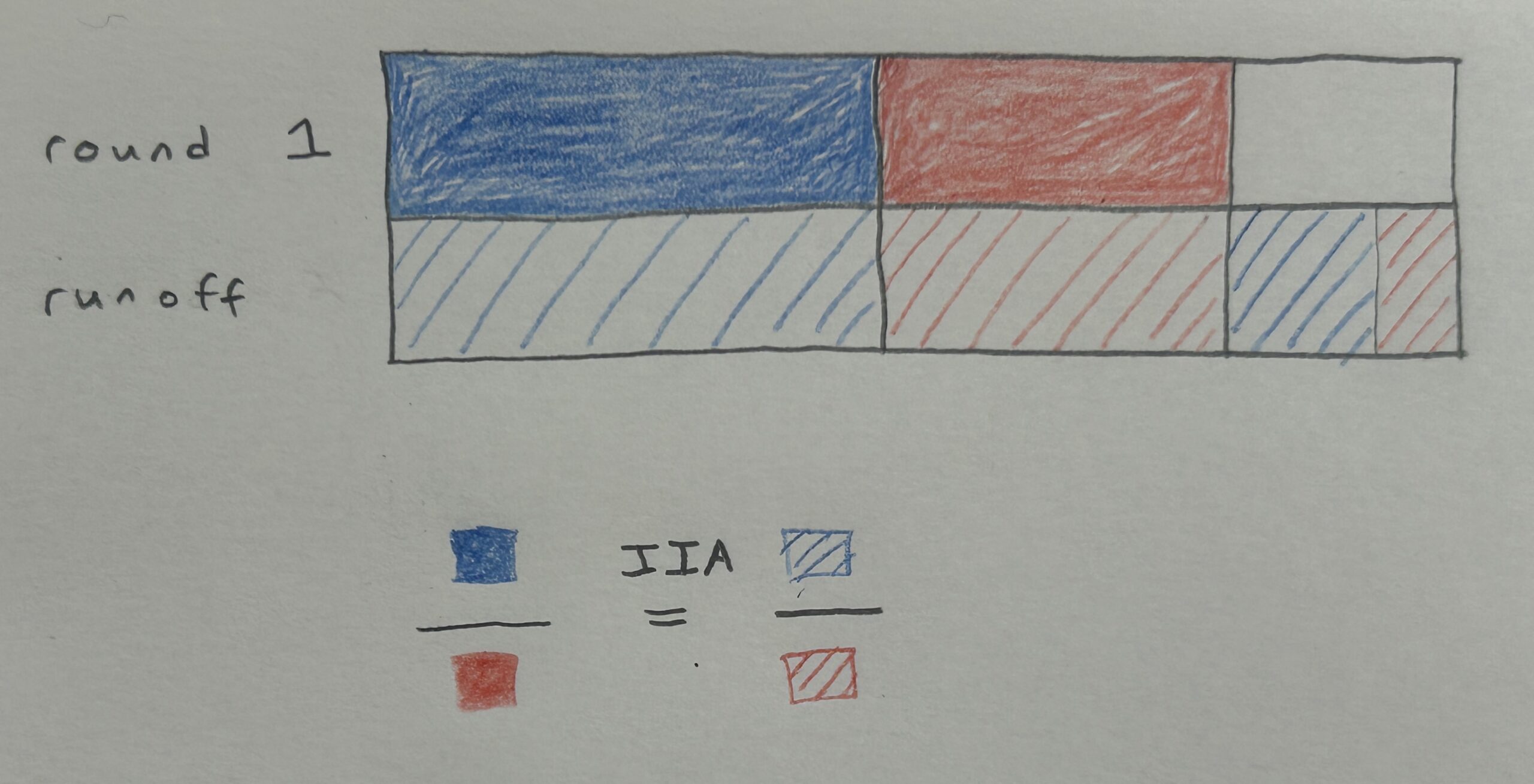
gec commented about accounting for non-IIA, suggesting expanding the model above to include choice set C within the logits: f(X_ic,C). So in gec’s model:
P[i chooses Left from C]/ P[i chooses Right from C] = exp(f(X_iLeft) + K[Left,Right] + K[Left,Other])/exp(f(X_iLeft) + K[Right,Left] + K[Right,Other])
compare this to:
P[i chooses Left from {Left,Right}] / P[i chooses Right from {Left,Right}] = exp(f(X_iLeft) + K[Left,Right])/exp(f(X_iLeft) + K[Right,Left])
These are equal (i.e. IIA holds) if K[Left,Other] = K[Right,Other]. Train (2009) proposes this as a test of IIA in Chapter 3. This requires some survey questions where folks are given the full choice set and some where they are only given two parties {Left, Right}, though Train doesn’t talk about these aspects of survey questionnaire design. Can folks recommend other references ?


This inspired me to clarify the IIA assumption to myself, and I posted a note on my website: https://ang-yu.github.io/posts/2026/05/blog-post-1/
I really like this way of framing it as simply the assumption that relative probability of 2 outcomes conditional on the outcome not being something else is equal to the unconditional relative probability. Short, to the point and easy to understand. Nice!
Thank you, Ang, for writing this out ! https://ang-yu.github.io/posts/2026/05/blog-post-1/
In your notation, we observe Y, a choice among the full choice set. Say we want to know the counterfactual Y*, a choice among the choice set excluding alternative l. To get there, we could make the assumption that:
P(Y | Y \ne l) = P(Y*).
You make an analogy to causal inference, where we observe Y(1) for treated folks T = 1. Say we want to know the counterfactual Y(1) for untreated folks T = 0. To get there, we could make the (unconfoundedness) assumption that: E(Y(1) | T = 1) = E(Y(1) | T = 0).
(Both these assumptions could be conditional on X variables.)
Let me know what I’ve missed !
Hi Shira, you missed nothing! Indeed one is free to make a counterfactual assumption equating a factual relative probability to its counterfactual counterpart under interventionally excluding a third choice. My point is simply that IIA isn’t that counterfactual assumption. IIA, as a functional form assumption justifying the use of a multinomial logit, doesn’t have any counterfactual content.
I do not like multinomial logit regression. The great thing about linear models is that they are easy to understand. Logit is not quite the same as that – you can still understand the parameters to some extent, but it is not as simple as a linear regression. Multinomial logit is much, much less easy to understand than the univariate logit. The parameters are still interpretable, but only an expert would know exactly what is going on. I would much rather use a black box model and use partial dependence (PD) plots to evaluate the effect of an individual variable. The model is likely to have greater explanatory power, and even laypeople will be able to understand the PD plots.
In short, I feel like multinomial logit combines the worst of two worlds: poor interpretability and instable, often overfitting linear models.
If a researcher wants to have the IIA assumption, it is possible to get that with black box models, too; however, vanilla approaches usually do not enforce an IIA assumption.
I hear you, Raphael ! Ideally these models would include some regularization for stability.
Thanks for highlighting my admittedly clunky idea, and especially for clarifying its connection with IIA in the typical logit formulation!
I finally remembered to look up Decision Field Theory (DFT) and, indeed, that model includes pairwise interaction terms between options to account for context effects that violate IIA:
https://en.wikipedia.org/wiki/Decision_field_theory
The terms in DFT are parameters that describe how attention shifts during the deliberation process and the degree to which choice options inhibit one another. While DFT is a dynamic model, I’ve often seen it used to predict choice probabilities by assuming a fixed deliberation time.
It’s worth pointing out that, in contrast to how Raphael describes multinomial logit in a regression context, DFT (like expected utility theory or prospect theory) is a theory of human decision making, so it functions as an explanatory/mechanistic model rather than a descriptive one.
Thanks again, gec ! I was looking for things about this in the Train book’s index, but can’t find anything yet: https://eml.berkeley.edu/books/choice2nd/Index_p385-388.pdf