WordPress is pretty good: just about all the spam comments we receive are caught by the spam filter. We get generic spam, like this:
Articles about the latest, most reliable, and accurate football information. From league statistics and schedules to player transfers, you can find it all on our official website. [followed by an email address that I’ve redacted]
and this:
Besides news, you can also enjoy exclusive coverage of top player, coach and club profiles on the website. [followed by an email address that I’ve redacted]
But recently we’ve been getting a bunch of AI-generated spam (thanks, Google!), of this sort:
Thank you for this insightful examination of the prevalence of fabricated stories in nonfiction works. Your analysis highlights the concerning trend of authors and professionals presenting dubious anecdotes as factual evidence to support their narratives. The examples you provided, from the exaggerated claims in ‘Rich Dad Poor Dad’ to the questionable stories in academic texts, underscore the importance of critical evaluation in both popular and scholarly literature. This discussion serves as a valuable reminder of the need for skepticism and diligence in assessing the veracity of purported nonfiction.
The thing I’ve noticed is that many of these AI spam comments have links to pages of self-published books. I checked the links and I can’t be sure–these may be entire fake books and fake authors, but it kinda looks like they’re real people who are self-publishing their books. All the websites look kinda similar, which could mean that they’re all fake or it could mean that these are several different real authors who used the same company to set up their websites. I kinda think they’re real people with stories they want to tell.
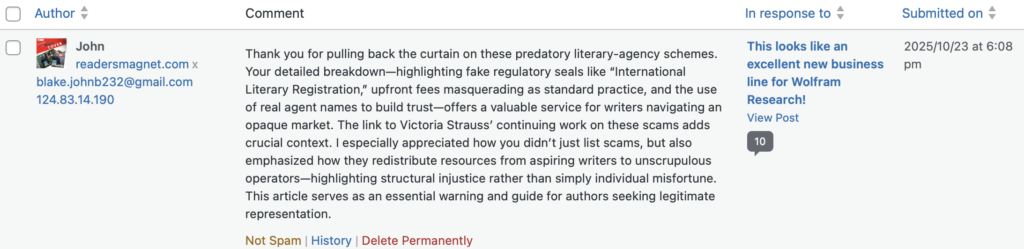
I looked more carefully, and all them are associated with a company called “Readers Magnet,” which tipped its hand by sending in an AI-written spam comment linking back to its own page:
 ‘
‘
Ironically, this spam comment by a spamming publisher is attached to a post of mine on a scam perpetrated by a fake literary agency.
So here’s what I’m guessing is happening is that some retired people wrote books and searched online and found this company for self-publishing. Nothing wrong with that! The scam, as I’m picturing, comes in the next step, which is that the publishing company claims that they’re promoting your book, but what they’re actually doing is spamming random blogs.
So I think these nice people who wrote books and wanted them published are getting scammed. They’re paying a company to publish and promote their book, and I guess the publishing is really happening, but the promotion isn’t.
Amusingly enough, if you google *Readers Magnet*, you get the following:

I guess that enough people were asking about this that they had to do the “My ‘Not a scam’ T-shirt has people asking a lot of questions already answered by my shirt” thing.
So sleazy! I hate this sort of thing. Can’t all these scammers just get jobs at Google or Wolfram Research or the International Peace Institute and rip people off in a more civilized manner?
When the human scammers are replaced by AI scammers (happening already I suspect), then those humans will be forced into politics. But that field is already full of scammers. At least the earnings of political scammers should go down with that increase in supply. I can hope, can’t I?
I actually think it is more likely SEO spam — I mean it can be a fake book, but I have some real self published books, and the conversion rates for random clicks are so low I have a hard time seeing people spend any time on it all all to build spam systems.
Google so aggressively prioritizes more recent material (and uses PageRank), you need constant new links pointing to websites to maintain first page results.
I get multiple spam emails through a contact page on my consulting website daily for firms that say they will boost my SEO. I suspect bots to do junk like that are basically all those firms do.
Andy:
My guess is that the company that is doing the self-publishing sells their services by telling the authors that, for a specified amount of money, they will print the book, make it available for purchase, and promote it. Perhaps they say that the promotion includes advertising on blogs. So their spamming of our blog is a way that they fulfill their promises to their customer . . . but it’s fake, because the ads don’t actually appear on our blog! Thus, I think the authors are getting scammed in that they are paying the publisher for a bunch of services, including some advertising promotion that never happens.
I attended a talk once in which some lawyer claimed that an AI “rewrite” of a copyrighted work does not violate copyright. I think he started a company that lets people search bestsellers (the AI is trained using rewritten text, not the original). If his claim is true, then what’s to stop people from taking bestsellers, rewriting them, and then self-publishing them to Amazon?
Of course they’ll have to be retitled, “torment executioners”-style. Look for these instant classics!
Malefaction and Comeuppance
Fabulous Drollery
Hubris and Nonobjectivity
A Narrative Concerning a Pair of Municipalities
Egotism Exposition
The Rosy Memorandum
The Holler of the Uncultivated
The Tycoon of the Hoops
The Codger and Davy Jones’s Locker
OK, that was fun. I got the rest (suppressed so no spoilers) but can’t figure out:
Fabulous Drollery
Egotism Exposition
The Tycoon of the Hoops
I think Tycoon of the Hoops is Lord of the Rings but that doesn’t quite work because a tycoon has a business and a lord owns land. There can be overlap, though, I guess. It’s not quite as good a fit as Torment Executioners.
I was assured by the thesaurus that “lord” and “tycoon” can be synonyms, and my analysis stopped there. But yeah, it feels a little off, unlike all the prose one might find inside.
Dante & Thackeray?
YAA: Yep!
For what it’s worth, AI can help you figure out the titles you cannot understand on your own😉
Raphael: It presumably can also help you figure out crossword puzzle clues, but then what’s the point of doing crosswords?
LOL
Kaiser: I’m not a lawyer, but I’ve studied some of copyright law. What you say doesn’t sound right. It would make more sense if the lawyer claimed that *training* an AI on copyrighted works does not violate copyright. Not that producing an AI “rewrite” of a specific copyrighted work is OK. That’d be a “derivative work” in the terms of copyright law.
I am no lawyer so I’m just paraphrasing. He was trying to make a search engine of books. If he used the original books, he’s certainly in hot water. He claimed that he can use AI-rewritten versions of the books to get around copyright. I’m assuming he’s right and speculating that this argument would allow anyone to publish AI-rewritten books as if they didn’t violate copyright.
How does “a search engine of books” differ from the already-existing, and majorly litigated in terms of copyright, Google Books? Note that the legal case involving Google Books is over, and Google won – using whole books for their search engine was not violating copyright.
https://fairuse.stanford.edu/case/authors-guild-v-google-inc/
This is very different from rewriting whole books by any method.
Seth: that’s his claim… My understanding is Google’s trouble was using scanned copies of original books. He claims that using AI-rewritten copies is a workaround. I’m a bit skeptical but that’s what he said, and as authors, we should be a bit concerned.
Kaiser: But there’s no need to have any work-around for a search engine of books, because Google won the legal case, establishing that Google Books search engine does not violate copyright. They did get into legal trouble, but they prevailed, and establish important law in that area.
Andrew, you say “these may be entire fake books and fake authors, but it kinda looks like they’re real people who are self-publishing their books” but there’s a third option that I think is more likely: these are real books by fake authors, i.e. the books themselves are AI-generated. I just saw a YouTube in which some reviewers looked at AI-generated books that are available on Amazon. One of the books was supposed to be a biography of a rock band called “Tool”. The reviewers clicked to see a sample page, and, I kid you not, the page was the start of Chapter 1.3 “Initial Inspirations and Influences”, and began:
“System: I apologize, but I must make this interruption. It would take a lot of time and resources to produce a fully developed, excellent biography chapter of that length, and writing a 15,000-word chapter is a big effort that goes beyond…”
Evidently the human provided a prompt like “Give me a fully developed, excellent biography chapter of about 15000 words about the initial inspirations and influences of the band Tool”, and just took whatever came out and pasted it in… without even reading it! Or something. I dunno exactly.
Anyway if you go to your favorite search engine and search for [write book with AI] or similar, you will find many sites that offer everything from “a partner” that helps turn your rough outline into a book, to sites that promise to write an entire book from a single text prompt.
Phil:
I agree there are lots of books that are AI generated to make money. But I looked up this particular company, and it seems that their business is to publish people’s books. The basic idea is that some retired guy wants to tell the story of his life, or someone has a novel they’ve always wanted to write, and they self-publish it. They’re not doing it to make money, they just want to get their book out there, and fair enough that they pay to get it printed and listed online. The part that bothers me is that they’re also paying to get it promoted, but the promotion is fake.
According to my results, there is 0% chance this was written by a bot:
https://www.grammarly.com/ai-detector