
It’s time to renew my passport–it’s been 10 years!–so I went online to see how to do it. There was a link right at the top. I clicked on it, went through a few pages, and then it was time to pay . . . there was a passport fee, a mailing fee, and a processing fee.
Why this extra fee? I looked carefully and saw that this was a .com, not a .gov site.
Damn! I got scammed. OK, I didn’t actually pay, just wasted a few minutes. I went back to the search page and scrolled down . . . OK, here it is:
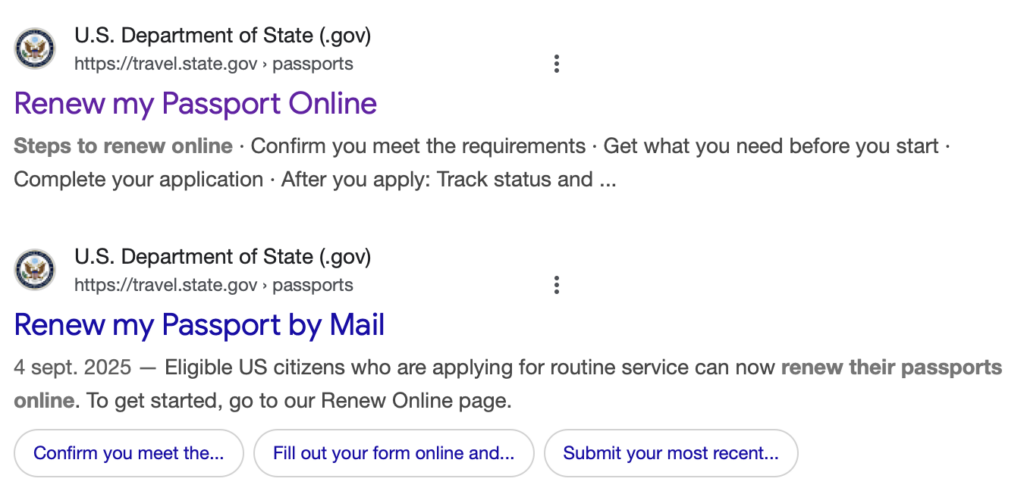
That’s more like it. It worked fine. I gave them my credit card information. Cool. Now we’ll just have to see if it actually happens, given that the government is shut down.
In the meantime, that scam site now has all my personal information, so that’s annoying. They know my passport number! Let’s hope they don’t use this to manufacture a false passport for somebody. That’s the kind of crime that would send them to jail for a few months until they pay somebody off and then get a presidential pardon.
OK, now you might look at the image at the top of this post and say, Hey, you fool, it’s obvious that was a sponsored site. And, yes, it is obvious. But that’s the point. I’m internet-savvy, I write about internet scams all the time, I know about Google putting fake stuff at the top of the search page, and I still got scammed. It happens!
P.S. Our research is partially funded by Google. Google’s a big place, they do some bad things and a lot of good things.
P.P.S. The passport arrived on time, no problem.
OK, this happened to me about fifteen years ago, trying to buy a digital camera: first link, the price was way lower than anyone else. I usually avoid ads, but I figured “I’ll throw Google a few pennies and click on this helpful ad.” Just before I gave them my credit card, I thought “this seems too good to be true …” did some googling and, yup, it was a scam.
A few weeks later, I was at Google for “Science Foo Camp” with Elon, Brockman, and Jeff Epstein. Talked to a few Google folks about how they were complicit with criminal activity — and how my goodwill toward Google almost cost me a couple hundred bucks. (This was back in the “don’t be evil” days). The junior guy got a little teary and said “that’s just not right, I will try to fix that.” The senior guy looked at me like I was a moron and said: “You don’t understand … that’s how we make our money. The ads are automated and we sell them by the billions. We can’t possibly check for scams.” A little while later the “don’t be evil” motto went away.
Anyway you can, in preferences, set your browser to add “&udm=14” to the search term, which strips out the AI slop and the sponsored content. Or use the site udm14.org, which does it for you.
I periodically like to imagine the meeting where they got rid of “don’t be evil …” Like did someone say, “Welp, I guess we are already evil,” and then everyone agreed?
Or… just don’t use google for a search engine. They’re substantially worse than they used to be. I pay Kagi a monthly fee less than a few coffees at Starbucks to get my whole family a search engine that doesn’t sell ads at all, and therefore doesn’t have incentive to send you to ad-slop pages either.
I find ad-free Google serves most of my needs. Curious to see what Kagi does better. Mostly I am just trying to find my way to something pretty obvious.
Dmitri:
Interesting! “Foo Camp” . . . that sounds familiar. I checked my old emails, and it seems that I participated in something called Social Science Foo Camp back in 2022. Now I’m remembering, I think: it was online and I was briefly there, but it was some zoom thing and I had other things to do so I didn’t really participate. I guess in-person is better. On the plus side, if it’s remote, you don’t have to rub elbows with people like Musk, Brockman, and Epstein.
My big mea culpa was a credit card charge I had been paying for 2 years for a “home protection” service. I had a monthly fee of $39 that I kept paying for insurance against major appliances breaking or other home repairs. Except that I didn’t recognize that I was making the payment! The source had been that I received a $10 gift from my credit card company for being a loyal customer – I usually ignore such things but for some reason I read this one carefully and didn’t see anything suspicious. Apparently when I cashed the check I agreed to be enrolled in this monthly service (to this day I am not sure that the small print ever said this – and when I got the photo of the check I signed, I am still not sure it was my signature). I now realize there is an art form to designing such things in ways that you are distracted from seeing what is right in front of you (that was my introduction to the invisible guerrilla experiment – https://www.youtube.com/watch?v=vJG698U2Mvo if you are not familiar with it).
Anyway, after my 2 years of payments for a service I did not know I had, this type of advertising came before the state legislature in the form of a bill to outlaw such practices. I agreed to testify, despite how embarrassing my story was. Immediately after my testimony, one of the state legislators announced “the same exact thing happened to me.” All this to say that the scammers are much more proficient than the victims (except for the Nigerian princes perhaps).
Dale:
Yeah, I’ve had that sort of thing happen to me–more than once! I sign up for a website that provides a useful service, and I don’t realize that I’ve bought a monthly contract, and then we notice it two years later when going through old bank statements for some reason.
I believe the saying is “fool me once, shame on me, fool me twice, shame on you.” More than once? Now I don’t feel so foolish.
Early in my career, clients would resist spending time on usability testing on the basis that anyone who couldn’t make it through their UI was either an idiot (and you can’t save everyone) or too old to be “tech savvy” (and therefore outside the target demographic). This framing persists, but I started collecting anecdotes like this one to demonstrate that all it takes is a momentary lapse of attention for perfectly smart and able folks to end up somewhere they didn’t expect to be.
I once clicked on a link in what (in retrospect) was an obvious phishing email ostensibly from DHL, because I’d coincidentally been told a few minutes earlier to expect an email with a link to a shipping label to return a client laptop at the end of a project. Happily, I didn’t end up getting scammed. Sadly, the link was in an email sent by my client’s company to its own employees to see who should be required to retake their tedious info security training, so my name ended up on someone’s idiot list. (But happily, the laptop was returned and my user account inactivated before anyone could start to nag me about completing it. Consulting ftw!)
There’s a great website devoted to such things: https://www.deceptive.design/.
A classic! I submitted some examples in the early days of darkpatterns.org, from which it appears this descends. There were fewer laws about such things back then (at least for the web), so the laws and enforcement sections are new to me.
An interesting aspect to this is there are a some deceptive patterns we just take for granted. In most cases advertising functions by slipping a message into the eyes or ears of people who are trying to attend to something else. Lots of people object to the profusion of ads but we collectively have decided through our actions that ads are a legitimate way that things get paid for. “Scammed by Google” thus strikes me as a little strong for Andrew’s example; interspersing ads with content is the norm, most places you look.
Google does have a balance to strike between a user’s need to recognize ads for what they are and its advertisers’ desire to avoid such detection, so in that sense Google’s complicity in whatever scam the passport website is perpetrating grows as it chooses subtler demarcations of ad content. On the other hand, I’ve watched enough smart people do dumb things to say that even if an ad were surrounded by a bold red box with a huge, blinking “ADVERTISEMENT” banner above it, some people would still click that link without internalizing that it was paid for by a third party who wanted to sell them something.
Jeff:
I distinguish between advertising and scamming. If I see an add for Coke: fine, they’re selling a sugary beverage that maybe I’ll want to drink. It’s a scam when they’re taking your money and giving you nothing in return. If, for example, that website were a passport service that made filing the paperwork easier, then I wouldn’t call it a scam.
Just to be clear… these sites are not (in my experience) fake… they just charge for a service you can get for free (or much less) if you go to a more official place. What they’re doing is playing the fee and taking another fee for this “service.” And it’s not just Google. I get a thing mailed to me every two years that says: your LLC registration with NY State is up for renewal. Very official looking. Send this form back with $100. They get all the info from public databases of NY LLCs., but they actually perform the service. On the NY State website, the same form is $9. (A friend of mine paid the $100 once… that’s how I know they don’t just take your money.)
The other place this happens all the time is with concert and theater tickets. People are so used to third-party vendors that charge service fees, they don’t notice a service fee of 4 times the normal service fee. And some of that extra money is used to prioritize their site on Google.
Jonathan:
Yeah, but here’s the rub: this site provided no service at all. Filling out the form on this site was no easier than filling out the official U.S. government site. Actually, I think it was a bit harder. I wouldn’t be annoyed if you were actually getting something for your money.
Be wary of sponsored links.
Ah, but it doesn’t say “Sponsored”. It says “Sponsorisé”. That’s completely different. 😅
Biggest joke is on google play store, you never ever ever get the app you just searched for as the top result. Always something else paying for that spot. It’s not okay, and if they didn’t have a monopoly I would immediately switched.
First thing to install on an android phone is f-droid, then use that to install aurora store.
Even better get a pixel and install grapheneOS instead of android. Then only install the sandboxed google play services in a secondary profile for apps that break without it (for me that’s only lyft). This should decrease your network usage and increase battery life significantly, by cutting down on whatever unnecessary/unwanted (to you) things google is doing with your phone.
Why is your search results page in French? (I presume you were not in France, as the search results are all for US passport renewals.)
Robin:
I think that I happened to set up my google settings when we were in France, and it’s pleasant for me to see more things in that language.
It’s my understanding that the sites who charge beyond the gov rates are offering expedited processing of passports. Some will do it in just a few days rather than weeks. If that’s the case, then there’s no “scam”.
Deborah:
No, if you look carefully they’re not. They kind of want you to think they are, but actually I’m pretty sure they’re just sending it to the same government agency, so whatever expediting is happening is the same as what would be done anyway, if you pay the government extra to expedite it.
In this case, the passports we ordered came very fast, so I guess the expediting only matters when they happen to be overloaded with requests.