A distinguished female professor of cognitive and behavioral science pointed me to “The Exceptions: Nancy Hopkins, MIT, and the Fight for Women in Science,” by Kate Zernike. It’s a very readable book, telling the stories of Hopkins and a few other women researchers who had academic careers in biology during the 1960s through 1990s that were impeded because of various sorts of sex discrimination: some flat-out sexual harassment but mainly unequal treatment. One interesting thing is that the stories are mixed: these women faced discrimination and also had support from powerful leaders in the field. It was not a simple case of struggle; rather, they faced the same sorts of ups and downs that most of us would face in an academic career, but with the sexism being a sort of headwind that reduced the positive swings and made the negative swings more difficult.
I wonder if things were particularly bad for women in biology and genetics because that field, at least the way it seems from reading that book, was extremely competitive. Also it was a fairly small subfield that got a lot of prestige—many of the people in the story received Nobel prizes. I don’t think the Nobel prize is a good thing; I associate it with competitiveness and the scientist-as-hero narrative. Remember that Harvard creep from the Edge Foundation who disparaged scientists who had the integrity to refuse to fake their data? He called them “schoolmarms,” in a delightful mixture of sexism and contempt for rule-followers. But that’s the image, right? The swashbuckling dude who moves fast, breaks things, and gets the Nobel prize.
On the other hand, there’s been plenty of sexism in other fields of science. Back in the 90s when I taught at the University of California, the statistics department had only two tenure-track female professors. Meanwhile, at least two tenured male professors were sexual harassers. When the number of professors who are male and sexual harassers is equal to or greater than the total number of female professors, you’ve got a problem. And that’s just the way things were.
To return to the story of Nancy Hopkins and her colleagues: it was instructive to see everything they had to go through—and, at the same time, they had many positive experiences in their careers too. One thing that struck me is that many of the reforms instituted in order to ensure equal treatment of men and women would be beneficial to most of the male scientists too. For example, one issue that came up was that Hopkins kept being squeezed out of lab space, and at one point it seems that they flat-out lied about office space, a problem which Hopkins was able to demonstrate only by sneaking into the offices at night with a tape measure. Stopping the boss from lying about your office space—that’s good for most of the researchers, as a direct matter and also as a way of restoring a general level of trust.
P.S. Regarding the “same number of sexual harassers as women on the tenure-track faculty” thing . . . the University of California statistics department has a webpage of past faculty, including tenure-track faculty and also lecturers and visitors:
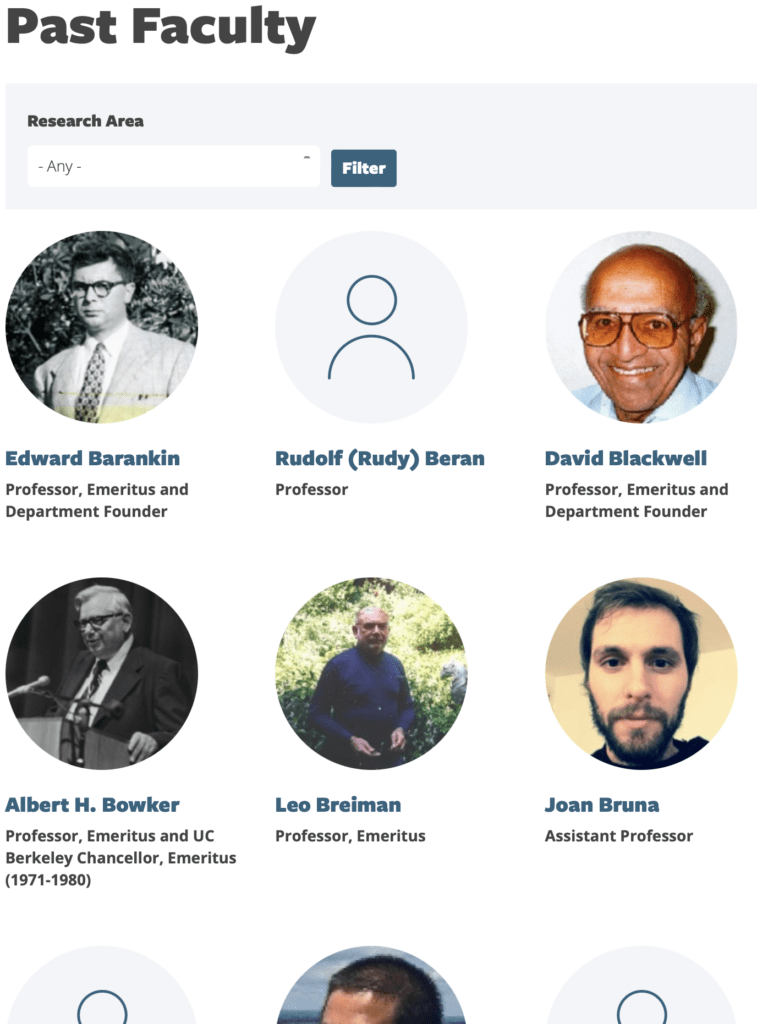
There are 56 people on the list, including me and various other people I know, but not including some others who taught there. I’m not sure how they decided who to include on the page.
Click on the names and you get little webpages, like this:

Or this:

All the links seem to go to webpages, except for these three people:



Clicking on those sends us to this error page:

What do those three dudes have in common? They all were involved in sexual harassment scandals. I guess this treatment on the webpage is some sort of compromise: the harassers don’t get removed from the main page, but they lose their individual pages.
I think it would have been better if women set up their own competing research institutions, funded/etc in parallel to the existing ones.
As it is the men piggybacked on the momentum from the enlightenment, ran many fields into the ground, and are now passing them on to women who will probably be blamed (in the age-old adam and eve kind of way).
Andrew wrote: “What do those three dudes have in common? They all were involved in sexual harassment scandals.”
Sort of tricky that word “involved.” Would it be better, more accurate, less vague to say, “Each of them was accused of sexual harassment”? Before I am charged with engaging in pettifogging, just today this popped up in the news:
https://www.yahoo.com/news/abc-agrees-pay-15-million-011329006.html?fr=yhssrp_catchall
“ABC has settled a defamation lawsuit Donald Trump brought over anchor George Stephanopoulos’ inaccurate on-air description of Trump being civilly liable for sexually abusing and defaming E. Jean Carroll, which Stephanopoulos described as “rape,” The Associated Press reports. The network will pay $15 million, which will go toward Trump’s presidential library as part of the settlement. Stephanopoulos had wrongly stated in March that Trump had been “found liable for rape” and “defaming the victim of that rape” rather than sexual abuse during a live This Week interview.”
One of the big sins in the area of statistics is the confusion between Prob(A|B) and Prob(B|A), the so-called “Transposed Conditional,” and it is too easy to claim what we do not really mean. “$15 million” is chump change to ABC but even for a tenured professor, that is an impressive amount.
If no one else will respond, I guess I will have to note the juxtaposition of Trump and library, as in books read by him:
“The network will pay $15 million, which will go toward Trump’s presidential library as part of the settlement.”
Curious when you wrote this post, as now they seem to be gone from the list: https://statistics.berkeley.edu/people/past/faculty
I googled “Terry Speed” and clicked on this blog post from one of the people who complained (I was curious why someone was calling him a male feminist!): https://liorpachter.wordpress.com/2018/01/17/terry-speed-a-male-feminist/
Weirdly it says he was no longer listed by Berkeley as Professor Emeritus as of June 2018. Maybe they meant a different website.
Jessica:
I’m not sure when it was when I wrote the post. 6 months ago, maybe?
Speed could be both a sexual harasser and active in the feminist movement. Feminism is an intellectual and political stance; sexual harassment is a behavior. Indeed, Speed’s denial that his conduct amounted to harassment (see this news article from 2018) even while it seems he did not dispute the facts (“he walked Barbara home in the evenings and then wanted to hug, despite Barbara’s objection to the hugging. . . . emailed Barbara first thing in the morning, and many times throughout the day . . . emails to Barbara included references to her attractiveness and his interest in physical contact . . . he wrote that he was jealous when she spent time with others, and that he wanted her attention and wished to keep her close to him,” etc.), is consistent with him desiring to preserve his intellectual and political feminism by disassociating his behavior with his principles.
I don’t know that any of the three professors mentioned in that post ever apologized for their behavior.
Hey, it’s a new version of the Linda problem:
Terry is 81 years old, mathematically-inclined and excited by ideas. Intellectually and politically, he is concerned with issues of discrimination and social justice. Terry has formerly been investigated for his sexual harrassment.
Which is more probable?
Terry is a statistics professor.
Terry is a statistics professor and is active in the feminist movement.
Jessica:
Yes, I was indeed referring to Linda there!
Regarding the “social justice” thing: Terry talked a good game, but I had some doubts after he worked for the O. J. Simpson defense team.
I think the OJ Simpson thing was one of those brain freeze things, where it was hard to tell which was the PC side to be on. You see some of this dynamic, with the rape stories, when it’s not really ACC fratboys that are the main offenders, statistically. Or with the media stories on anti-Asian violence (not telling us the race of the attackers, and implying to the NYT/NPR midwits that it must be “this is MAGA country” rednecks).
P.s. What did Ron Goldman say to Nicole Simpson when they met in Heaven? “Here’s your damned suglasses!”
Anon:
It’s hard to take the O. J. trial so seriously now, but when it was happening, I was living in California, and people were talking about it every day. Speed working on the trial was considered iffy behavior at the time. My impression was that he took some pride in working for the bad guys on this case–it fit his self-image as a contrarian. It wasn’t really about being “politically correct,” more just that he liked to think he was his own man and wouldn’t take received opinion for anything. The other incident I remember is when he invited a notorious HIV/AIDS denier to speak in our department seminar. There are so many people you could invite to speak; why pick this guy? Again, I think it was Speed showing pride in being a contrarian. Nowadays with vaccine denial being such a big thing, Speed might take a different position on inviting the guy. It’s not so much fun being a contrarian when you’re suddenly sharing a platform with prominent stupid and dangerous people around the world. A couple years ago I discussed this general issue, which one might call the Edgelord’s Dilemma.
I do think Speed was sincere in his feminism, his anti-death-penalty stance, and his political activism more generally. Life is just complicated, that’s all, and Speed, like all of us, was not merely a set of political views. He also had his personal foibles.
Yeah, I was in Cali too. But it was big nationally, also. Later, in an (over)educated and tame/mild group of people at Wildcat U, it was fascinating how different racial groups reacted to the verdict (dismay or happiness), while literally (and not how millennials say that) huddled over a TV. They were even trying to cover their reactions (as did I) since we all knew how it would look to the other “side”.
It was a very meta thing, but I was sort of amused by the social dynamic and thinking about that more than the result. Again observing the electrocuters, not the electrocuted. Then again, it was easy for me not to get caught up in the fascination. I mean I also could have cared less about Jonbenet! Just get bored with same stuff getting raked over the media.
Good for Terry. I have a contrarian slant myself. If this were a conservative blog, I’d screw with them also. It’s not just trolling, but being an independent thinker, being eclectic. Not just lining up like one more monkey throwing feces at the other tribe. Not saying I don’t have tribal impulses…definitely do. I totally get the impulse to fight the other tribe. But it’s good to have some Bayesian betting scientific detachment also.
I mean, I was never an anti-vaxxer, like the typical Fox News lickspittle. I went ahead and got it because I figured it would help with gigs. Wasn’t afraid of the bug, as an in shape guy….and wasn’t afraid of the vax either. But I also didn’t get into the Covid hype either. There was a lot of tribal social positioning going on, on both sides. Look at the mask wearing. Or dragging surfers out of the water!
Anon
That’s extremely stupid. Contrarianism is the opposite of detachment.
HIV definitely causes aids, and muddying that essential fact has killed large numbers of people. Promoting that denialism is definitely wrong; what can be gained by doing so just because it pisses people off?
Double-plus ungood. Must not listen to wrongspeak. Shun, shun, shun!
Incapable of thinking critically and evaluating crap arguments. Must have factcheckers to police the Internet.
Another guy who cannot read. It is time for the department seminar, of which we get maybe 30 a year, let us invite flat earthers and homeopaths and MLM marketers to sharpen our critical thinking skills.
That’s a MUCH better argument. But it is a DIFFERENT ONE.
Your first was all about the danger of his views and possibly spreading. Like are you also worried that slicktalking flat earthers will convince the physics department?
No it is not a different argument. I asked “what is to be gained”
Somebody, this is a direct quote of what you said,
“HIV definitely causes aids, and muddying that essential fact has killed large numbers of people. Promoting that denialism is definitely wrong; what can be gained by doing so just because it pisses people off?”
Now…why mention the downside of the wrong view and the problem of “muddying” from letting people hear that view? I am quite capable of detecting nutters. And would have much more sympathy for your SECOND comment talking about the waste of valuable seminar time. Than from some doubleplus ungood from hearing the “muddying” and “has killed large numbers of people” wrongspeak.
Anon:
I wrote that Speed did the stupid (in my opinion) contrarian thing of inviting a notorious HIV/AIDS denier to speak in our department seminar, many years ago. You replied, “Good for Terry. I have a contrarian slant myself,” and then when somebody questioned this, you replied, sarcastically, “Double-plus ungood. Must not listen to wrongspeak. Shun, shun, shun! Incapable of thinking critically and evaluating crap arguments. Must have factcheckers to police the Internet.”
I have nothing against sarcasm. My problem with your comment is really the same as my problem with Terry’s decision to invite the HIV crank to speak, which is, Which cranks get to speak? Who is privileged? Regarding HIV and public health, there are lots and lots of offbeat ideas. This particular dude was invited to speak, not because his ideas were interesting or supported by data, but because he was an obnoxious asshole who was really good at getting publicity. Inviting him to speak in the statistics department was just one more benefit (admittedly, a very small benefit) of his ability to get publicity. The point is not just that the guy’s ideas were dangerous (although they were, a little bit, to the extent they diverted resources and attention away from real research and serious scientific argument) but also that Terry, by inviting him to speak, was participating in the science-as-spectacle world which I hate so much.
My point is
1. The person’s opinions are worthless.
2. There are potential downsides.
3. What are the potential upsides?
Even if you think (2) is zero (which it isn’t, lots of professional statisticians believe stupid things about biology), my direct call to action was (3), which you still haven’t actually responded to. Why good for him? What do you actually think is good in this situation?
Again, you didn’t actually read what I asked; nor did you respond to the question. You just reacted to general impressions of keywords in what I wrote. That’s why contrarianism is completely stupid, you’re determining your response entirely by your impression of my emotional reaction.
I wish there were male only departments where guys could be competitive and utterly uncaring about feelings. Female only ones too, where they could arrange them in whatever way pleased them.
Anon:
Not to worry: there’s plenty of space on twitter, 4chan, etc., for this sort of attitude!
I’ve never been on twitter or 4chan, so wouldn’t know. It’s an honestly held belief, but I wonder if you would have had this reaction if I said:
“I wish there were female only departments where women could be supportive and cooperative. Male only ones too, where they could arrange them in whatever way pleased them.”
Anon:
It’s a counterfactual so I can’t really say, but, yeah, I think I would’ve had the same reaction. My reaction to your comment was also sparked by the comment at the beginning of this thread on all-female departments. In any case, I recognize that these are just thought experiments–these single-sex departments are not going to happen. Regarding twitter and 4chan: it’s my impression that these are message boards where people like to post these sorts of edgy thought experiments involving stereotypical male and female characteristics, so that could be a good fit for your comment. You might get lots of feedback there.
I missed that comment at the beginning of the thread. I have no issue with current departments, and no issue with female only colleges. I would just like to make some room for guys to do guy things, in guy ways, without reproach and all the drama.
Or in other words, while most science may benefit from ditching the “competitiveness and the scientist-as-hero narrative” I doubt it’s true 100% of the time. It’s a big world, there’s plenty of room for everyone.
Economics had almost no women tenured in its best departments as late as 2000. Probably later. And yes, that’s the field that made up a fake Nobel Prize.
Whenever you’re feeling down, just remind yourself that at least Marc Hauser never won a Nobel.
I sort of have a dim memory of Edge Foundation from a couple decades ago. Is it still a thing? Or now shunned? I honestly haven’t kept track of it. What I saw at the time, was a combination of some pretty interesting stuff (e.g. Steven Pinker) and some that was more hype-y, silly. Like TED talks maybe. I mean, they’re not ALL crap.
And why the special AG disdain for them?
Curious, I really haven’t tracked them. Like I didn’t know they were “notorious”.
And were you criticizing them for a long time or more recently.
Anon:
The Edge foundation kind of disappeared after the Jeffrey Epstein scandal. Part of the problem was that it was funded by Epstein, but now that he’s dead, he’s not funding anything anymore. The other problem is that fewer people wanted to be associated with it, once the Epstein connections became public. Indeed, I dodged a bullet myself on that one: I was this close to signing a contract with those literary agents to write a book when the scandal came out and I backed out.
I have no “special disdain” for the Edge foundation. Lots of people have disdain for it. The whole pedophile island thing, also the smug “billionaires dinners” . . . there was a lot to hate there. See here and here for lots of creepy background.
My long post on the Edge foundation appeared in 2019. That was when I learned that disgraced primatologist Marc Hauser was part of that group. He had written an article for them that was almost charming in its repulsiveness.
Here’s a post from 2022 that included the following paragraph that’s relevant to this discussion:
Basically, my feeling about Edge Foundation is the same as my feeling about Ted talks and NPR, with Edge having that additional level of smugness, sexism, and criminality.
The “long post on the Edge foundation” link goes to one of the same articles that you linked as creepy background. Did you mean to link something else?
Link fixed; thanks.
During my residency, Dr. Helen Taussig came as a visiting professor. She was a great pioneer, leader, and teacher in pediatric cardiology and gave an inspirational lecture on diagnosis of congenital heart disorders with emphasis on the examination of the patient. She had a hearing disability and could not rely on the stethoscope. After the lecture, she announced that she wanted to address the female residents separately. I was told by a friend XX resident that she told them to fight and never back down. Harvard rejected her application to med school, and she went to Hopkins. This is a mark against Harvard, of course. I feel that meeting her was like meeting Jackie Robinson; I got to meet a great hero of humanity.
On this site yesterday, a commentator created a neologism, “effeminance”, to downgrade some ideas. I don’t get it. Without the female we are nothing.
Wierd. No mention of the rash of women professors falsely “professing” to be native american, er…starting with a Senator….
Anon:
As I’ve said before, if you just want to start political arguments, I recommend you go to some place like twitter or 4chan where these sort of comments will fit in just fine. Regarding the substance or your comment, the book in being discussed is about a particular era of women in science. The fact that there have been some women not in science who did some things you did not like is not particularly relevant to a discussion of that book. You might as well complain that the book doesn’t mention that Joan Crawford was mean to her daughter, or that Helen of Troy was a schemer. In that sense, your comment reminds me of the raven paradox. I enjoy some off-topic comments here when they’re fun and take the conversation in an interesting direction, not so much when they seem to be designed to push political buttons–again, there’s plenty of room on twitter, 4chan, etc, for that.
P.S. Just to be clear, I’m not saying that people should never argue about politics in the comments section. Arguing about politics–arguing about all sorts of things–is a useful way for us to explore our ideas. The problem with your comment is that it is off-topic, is not interesting, and seems designed only to provoke.