Dan Luu asks, Why is bridge declining?:
My partner and I [Luu] started playing bridge recently, and people at the local bridge club. People often comment on how young we are. You’ll find serious competitive players of all ages, but the median age of a casual player is probably in the 60s or 70s. There are a lot of discussions about why this is. The most common reasons I hear are:
1. People who are retired have more time to play games, the reason bridge looks so old is that that’s who has free time.
1.b. Bridge isn’t actually declining, as long as people keep retiring, the population of bridge players isn’t going to decline
2. Kids nowadays don’t have the attention span and play video games instead
3. Bridge takes a really long time to learn
4. Poker has sucked all the air out of the room, at least outside of Asian card games
(1) and (2) seem pretty obviously wrong to me. People my age and younger spend plenty of time playing games, they just choose games that aren’t bridge. As (2) hints at, they often choose video games, but they often choose tabletop games (including other card games) instead. . . . (2) seems easily falsified by the popularity of chess or go, games which take a substantially longer attention span than bridge . . .
I think (3) is a correct reason, but it isn’t sufficient to explain what’s going on. It’s true that bridge has an extremely steep learning curve, much more so than games like chess or go . . . (3) has some explanatory power and is consistent with the card games that are still popular, like poker, not to mention da lao er, da bai fen, tuo la ji, zhao pengyou, etc. (Asian card games which haven’t seen a decline in popularity the way bridge has).
Luu continues:
However, I don’t think (3) is a sufficient explanation. if people really want an easy entry, they could teach spades as an entry into bridge . . . A related comment is that it’s not clear that the initial learning curve to bridge is steeper than for a moderately complex modern board game like Terra Mystica (TM). . . . Modern board games as complex as TM aren’t exactly wildly popular, but they’re not in decline, either. If anything, it’s the opposite . . .
Even if it’s true, (4) is more of a symptom than an explanation.
Then he lands the punch:
There’s one factor that seems obvious to me that I haven’t heard. . . . there’s a stodgy bureaucracy around bridge. . . .
If you look at bidding systems in use today, most casual players in the U.S. use some variation or evolution of a single system. There’s more variety at higher levels, in tournament play, but systems that are considered too strange are either banned or highly discouraged. For example, Forcing Pass systems (where opening with a bid of “pass”, instead of indicating a hand not strong enough to bid, is used to indicate a strong hand) are banned in American (ABCL) tournaments. In tournaments where FP systems aren’t banned, players note that people who run FP are often severely penalized by tournament officials . . . And, because penalties are applied at the discretion of tournament officials, additional penalties can be applied for minor offenses . . .
If you contrast this to younger games like Magic or Netrunner, meta-breaking discoveries are lauded; people are rewarded for thinking about the meta and figuring out how to break it. If you manage to “break” the game in a way that’s not cheating, rules will be updated for the next tournament, but you’ll win the tournament in a way that’s considered to be creative and fair. In Bridge, officials may ban your bidding system for being too innovative in the middle of a tournament . . .
If, in the abstract, you imagine one card game where, decades after someone proposes a new meta, officials still ban it or penalize it as a Highly Unusual Method, and another card game, where people reward players for coming up with creative meta-breaking changes, and then you tell people to guess the relative age distribution of the games (ceteris paribus), I think most people would guess that the more creative game has a younger player base and the more conservative game has an older player base.
You might argue that this bidding system stuff doesn’t matter outside of the highest levels of play, but the cultural impact trickles down to the beginner level. When initially learning bridge, my partner asked “why does the system say to do X?” a couple times, but she quickly learned to not ask that question. . . . If you ask the analogous question when learning Netrunner (why was this deck constructed in this way), people *love* talking about this; part of teaching someone Netrunner is teaching people the reasons behind deckbuilding decisions and helping people learn how to construct better decks.
Much like (3), I don’t think that creativity stifling bureaucracy is a sufficient reason to explain the greying of bridge, but it seems like a plausible contributing factor.
Interesting. But I have another explanation, which I think is much bigger than the (1), (2), (3), and (4) listed by Luu, and that’s just that many pastimes are time-bound in their popularity. Bridge was huge for a roughly fifty-year period during the early part of the twentieth century–for example, Wikipedia says, “The number of people who play contract bridge has declined since its peak in the 1940s, when a survey found it was played in 44% of US households.” At that point, there’s nowhere to go but down.
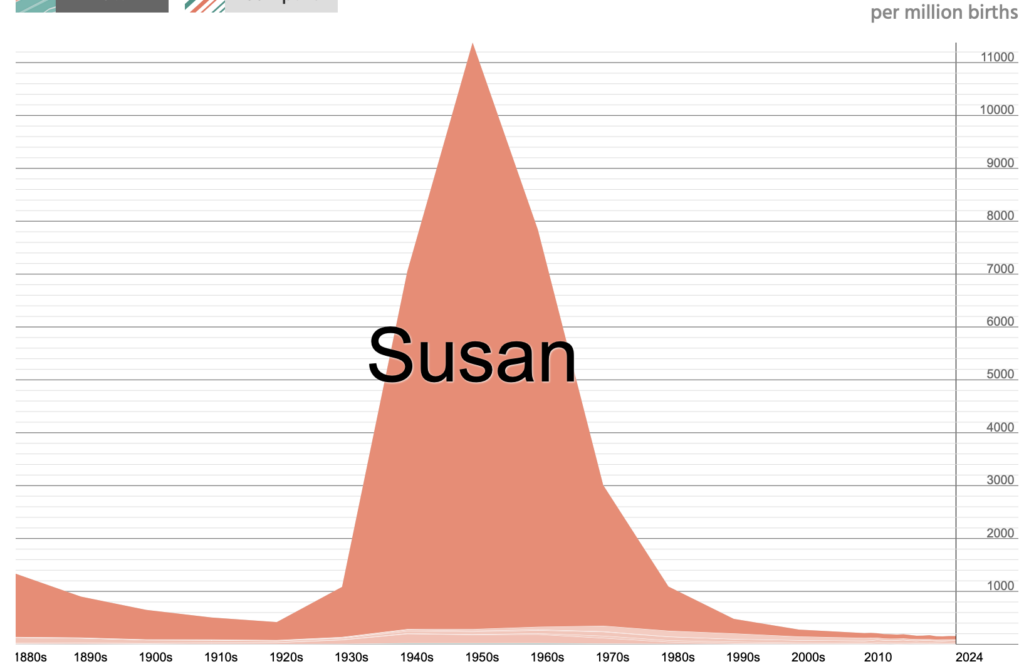
Put it another way. Why don’t they name anyone Susan anymore? See the above graph. At the peak of its popularity, the name Susan was given to more than 1% of babies born in this country. Then Susan became less popular. That makes sense; there are trends. Then Susan became a baby-boomer name, kind of old-fashioned. Now Susan is an old-lady name, and parents aren’t picking it anymore, partly because it sounds like an old-lady name and partly because people choose from a wider variety of names, as illustrated by this graph from chapter 2 of Regression and Other Stories:
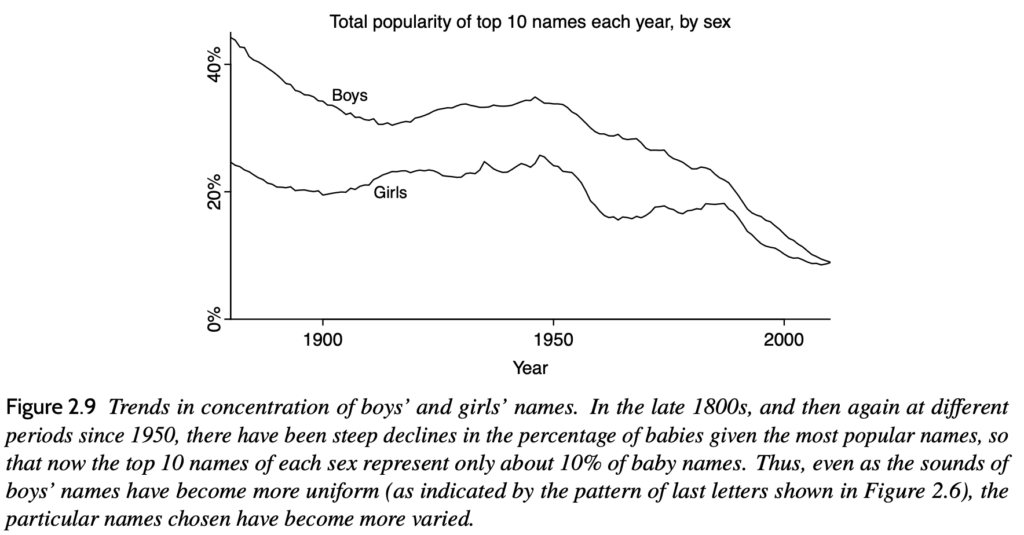
The point is, there’s no need for a Susan-specific explanation of the decline in popularity of “Susan.” It’s just the ebb and flow of popularity, along with a feedback mechanism by which, once a name gets less popular and becomes associated with a specific period in the past, that can drive the popularity down even further. This is something we’ve particularly seen with girls’ names over the years. “Susan” could mount a comeback (as has “Sophie” but not “Bertha,” to consider two names that were popular a couple generations before “Susan”), and there’s something to be said about how these trends can vary–but I think the baseline explanation is just the age thing.
Similarly with bridge, a game that was absolutely huge a hundred years ago, then gradually declined in popularity with competition with other amusements (TV is the usual culprit that’s given for the decline of everything else), then, like “Susan,” it got this generational tinge, so it’s less appealing to the kids–it’s an old-people’s game.
But what about chess and go? They’re a lot older than bridge and are going as strong as ever, or at least they haven’t cratered among the young in the way that bridge has. I could give a couple of answers: chess and go have special properties, they’ve stood the test of time in a way that other games haven’t. I’m not claiming that a popular board game will necessarily go into sharp decline or be associated with old people–similarly with names–; I’m just saying we shouldn’t be surprised when this happens.
The funny thing is, a few weeks ago at a party I was chatting with someone who had been the world champion at one of these modern tabletop card games–it might have even been Netrunner! Whatever game it was, I guess it’s orders of magnitude less popular than bridge, but it did sound like it was most popular among young adults. We’ll see how things look in fifty years.
P.S. If you google *Dan Luu bridge* you’ll also come across this fun post, where Luu writes:
You don’t have to be at a party to see this phenomenon in action, but there’s a curious thing I regularly see at parties in social circles where people value intelligence and cleverness without similarly valuing on-the-ground knowledge or intellectual rigor. People often discuss the standard trendy topics (some recent ones I’ve observed at multiple parties are how to build a competitor to Google search and how to solve the problem of high transit construction costs) and explain why people working in the field today are doing it wrong and then explain how they would do it instead. . . .
Asking people why they think their solutions would solve valuable problems in the field has become a hobby of mine when I’m at parties where this kind of superficial pseudo-technical discussion dominates the party. What I’ve found when I’ve asked for details is that, in areas where I have some knowledge, people generally don’t know what sub-problems need to be solved to solve the problem they’re trying to address, making their solution hopeless. . . .
Since I often attend parties with programmers, this means I often hear programmers retelling their cocktail-party level understanding of another field . . . An example I enjoyed was this Twitter thread where Hillel Wayne discussed how programmers without knowledge of trad engineering often have incorrect ideas about what trad engineering is like . . . Hillel compared the perceptions of people who’d actually worked in multiple fields to pop-programmer perceptions of trad engineering. One of the many examples of this that Hillel gives is when people talk about bridge building, where he notes that programmers say things like
The predictability of a true engineer’s world is an enviable thing. But ours is a world always in flux, where the laws of physics change weekly. If we did not quickly adapt to the unforeseen, the only foreseeable event would be our own destruction.
and
No one thinks about moving the starting or ending point of the bridge midway through construction.
But Hillel interviewed a civil engineer who said that they had to move a bridge! Of course, civil engineers don’t move bridges as frequently as programmers deal with changes in software but, if you talk to actual, working, civil engineers, many civil engineers frequently deal with changing requirements after a job has started that’s not fundamentally different from what programmers have to deal with at their jobs.
Luu continues with this amusing example:
A line I often hear from programmers is that programming is like “having to build a plane while it’s flying”, implicitly making the case that programming is harder than designing and building a plane since people who design and build planes can do so before the plane is flying. But, of course, someone who designs airplanes could just as easily say “gosh, my job would be very easy if I could build planes with 4 9s of uptime and my plane were allowed to crash and kill all of the passengers for 1 minute every week”.
I think you are right about games rising and falling. When I was young, you could still find a pinochle deck (my grandmother used to play it). And before that there was whist.
Another possibility: bridge requires groups of 4 people. Chess only requires 2 (perhaps 1). I think it is rarer to find groups of 4 people that routinely get together now, compared with when I grew up. I notice the same thing with neighbors: it seems like neighborhood friends come mostly in groups of 2. When I was growing up, my entire block (12 houses) routinely got together for various activities. Life has become far more isolated and bridge is sort of the opposite (I guess we can ask whether mah jong, pinocle, etc. are suffering the same fate – one I am familiar with is golf foursomes, but I didn’t play in my youth so I don’t know if they are more or less common than in the past).
Golf can be very expensive, particularly if one has to pay club dues.
But that’s the whole point of golf: to demonstrate you have enough money to do it.
Maybe on the east coast. West coast has lots of community courses, in LA county you can easily play a round of golf for about the same price as going to a movie or buying a paperback book or two.
But how would you account for Uno? I think more people have familiarity with it, even though it requires buying its own deck and it seems to be the dominant card game with four players.
Nice post about the decline (possibly) of bridge. One thing that really impacted it in our area was the pandemic where group gatherings were prohibited for a period of time. Bridge also used to be a couples game that took place after dinner between friends and that disappeared a long time ago. I played through out undergrad in the mid 1960s even at the tournament level in SoCal. Eventually, I had to move on to other things.
My other interest was 3 cushion billiards but today even finding a table in a metro area is extremely hard. It is still popular in Europe and a couple of Asian countries. Straight pool has disappeared as well as the game takes to long and competition has shifted to nine-ball.
Here is a good website for name dropping and name rising:
https://www.babynamestats.com/babynametrends.html
Put in “Liam” and “Deborah” to see a meteoric rise and a complete collapse, respectively.
Kinda cute that a blog entry about the decline of bridge found its way to a discussion of moving a bridge.
By sheer coincidence, I happened to be reading recently about a bridge construction project that’s not too far removed from building a plane while it’s flying. And they seriously call it “launching a bridge”. In Denali National Park, a landslide took out the only road into the park interior a couple of years back. They’re building a bridge over the landslide without any central support and without being able to transport much heavy equipment to the other side of the landslide. The solution is to build the bridge truss framework on the accessible side, then slide it partway across, then slide a mini-bridge the rest of the way to the other side, then use the mini-bridge as a support to slide the main bridge the rest of the way. Remarkable!
https://www.asce.org/publications-and-news/civil-engineering-source/civil-engineering-magazine/issues/magazine-issue/article/2025/03/what-did-engineers-do-when-a-massive-landslide-blocked-a-road-in-denali-national-park
I thought the post was going to be about this:
https://en.m.wikipedia.org/wiki/Francis_Scott_Key_Bridge_collapse
Fascinating example. For other readers who might get lost in some of the explanation, there’s a nice diagram at the bottom.
Bridge wasn’t just widely played, it was widely discussed. If you go back and look at newspapers from most of the 20th century, every one of them had a bridge column, usually next to the comics or TV listings. For a while, international star Omar Sharif (Lawrence of Arabia, Dr. Zhivago) was almost as well known for playing and writing about bridge as he was for his acting. Bridge had a status among games that was — and, as far as I can tell, still is — unique.
My local newspaper (Register-Guard, Eugene, OR) still has a bridge column, next to the comics. (There are no TV listings.) I’ve often wondered how many people read it. I occasionally do, though I know nothing about bridge, just to marvel at how I understand absolutely none of it.
I don’t play bridge either, but for sentimental reasons, I’m glad the columns are still hanging on.
Regarding bridge columns and comics, how about astrology columns? Are they dying off as well? Was any of that predicted in previous astrology columns? This particular blog used to have a fair number of columns devoted to astrology but that seems to have diminished of late. Again, was that foreseen?
I think there’s a sense that astrology is resurgent, but that the action isn’t in newspaper columns (see eg https://www.economist.com/culture/2025/01/15/astrology-is-booming-thanks-to-technology-and-younger-enthusiasts).
Oh, how horrible!
Bridge used to be popular among members of Maths and Statistics departments (maybe it still is?). Roy Kerr, who derived the Kerr metric
https://en.m.wikipedia.org/wiki/Roy_Kerr
Invented a bidding system called the Symmetric Relay System
https://www.pagat.com/docs/SymmetricRelay.pdf
I’m sure there must be other leading bridge players who were/are also math/stat academics.
I’m going to send this post to my 91-year-old mother who still plays bridge professionally and ask her what she thinks. In the meantime, amplifying a few comments above:
(a) Casual bridge games as a way for people to hang out have indeed, I think, died. (Though a SurveyMonkey-based survey that I have no reason to trust disagrees with me — See figure 4: https://www.worldbridge.org/wp-content/uploads/2019/09/ACBL-EF-Survey-September-2019.pdf Duplicate bridge clubs exist, and I think, are still pretty popular, but cater to people who take bridge Very Seriously (as the comments regarding conventions above show). Online Bridge is still very popular despite rampant cheating.
(b) But of course you know the answer, Andrew. You’ve already written about it: Blame Trump. https://sites.stat.columbia.edu/gelman/research/unpublished/notrump_falk_gelman_icml.pdf
As someone who loved the original Netrunner CCG and also was (for a time) the youngest Life Master of Bridge, I enjoyed this post immensely. I agree that searching for intrinsic sources of Bridge’s decline (eg difficulty of learning) can’t quite work since how then would you explain its success in the first half of the 20c? I also think pointing to the rules around competitive bridge (eg conservatism around novel bidding systems) is probably also the wrong direction. Tournament bridge dried up because casual bridge stopped being a thing. And here I think the “it takes 4 people” may have some explanatory power. My sense – and I haven’t seen good data about this! – is that styles of casual hanging out changed quite a lot post WWII (perhaps accelerating in the 1960s).
In any event, I wrote up a long ish set of possibilities here in case anyone is curious:
https://www.reddit.com/r/AskHistorians/s/R0rMM6or9s