If you want to play basketball at the top level, there’s a huge benefit to being tall. Not just tall, but exceptionally tall, outlier-outlier tall. If you’re an American and at least 7 feet tall and the right age, it’s said that there’s a 1-in-7 chance you’ll play in the NBA (but maybe that’s an overestimate; we’re still looking into that one).
Here’s another one for you. If you want to play women’s tennis at the top level, there’s a huge benefit to being ____. Not just ____, but exceptionally ___, outlier-outlier ___.
Take a guess and continue:
The answer to this fill-in-the-bank is “rich.”
Paul Campos reports:
At the moment, five American women are ranked among the top 30 women tennis players in the world, per the current WTA rankings. . . . two of the five women have a billionaire parent.
Whaaaa? OK, I googled *wta women’s tennis ratings*, which takes us to this page:

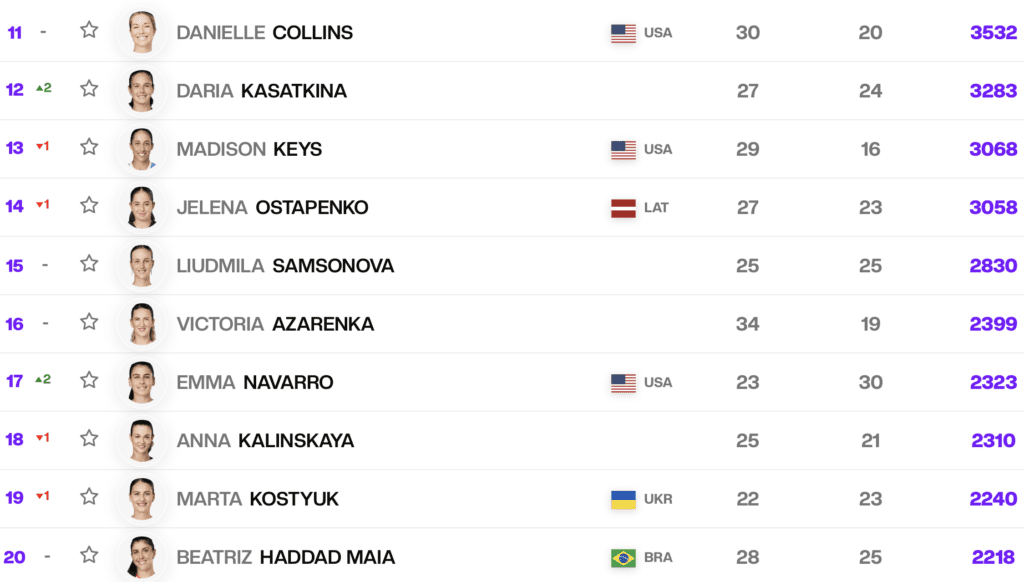
Actually, those 5 Americans are in the top 20, so I don’t know why Campos said “top 30.” Maybe in tennis the top 30 is a thing that people talk about, I dunno.
In any case, yeah, Campos ain’t kidding. Google the five U.S. players above, and indeed two of them are literal children of billionaires. According to wikipedia, one of those billionaires worked for Goldman Sachs and Citigroup before founding his own investment services company; the other worked for Getty Oil before founding his own natural gas drilling company, which he eventually sold to some major oil companies.
The other women in the top 20 are mostly children of top-tier athletes: some pro tennis players, an internationally competitive ping-pong player, badminton, football, basketball, etc. A mix of sports, actually. And then there are the two children of billionaires.
Campos runs the numbers:
The top 30 women tennis players in the world currently range in age from 17 to 34. Using that — unrealistically but we can’t make this too complicated too early in the morning — as a hard cutoff for the possible age range of top 30 in the world women tennis players, that means you have 18 relevant birth years: 1990-2007 (more or less). How many girls were born in America, collectively, in those 18 years? The answer is about 37 million. So if you were a girl born in America between 1990 and 2007 your odds of being one of the top 30 women tennis players in the world in July 2024 are about 7.4 million to one.
He continues:
But let’s toss just one little confounder into this equation: What if your parent happens to be a billionaire? There are currently 756 billionaires in the USA.
If billionaires average one daughter each, and, say, half these daughters are currently between 17 and 34 years old, then that would be 378 tennis-pro-age daughters out there, so the probability that a randomly-selected one of them is a world top 30 tennis player is 2/378, or about 1 in 200. OK, that’s just a rough calculation, but you get the point.
There are several interesting angles here.
1. Meritocracy. Campos writes that “this apparently trivial stat illustrates quite beautifully just how absurd the idea of ‘the meritocracy’ really is.” I wrote about this a few years ago in a post entitled, “Meritocracy won’t happen: the problem’s with the ‘ocracy’.”
The logic goes as follows: Under meritocracy, the people with merit get the spoils; they run the place—that’s the “ocracy” part! One of the goodies you get from merit is the ability to get nice things for your kids, things like fancy cars, houses in good neighborhoods, and . . . successful careers. Like being a top-20 tennis player.
The point is that seeing ultra-rich kids becoming tennis champions is not a sign that our society is not meritocratic (sorry, reader, for the double negative there!). Actually, it’s a strong indicator of meritocracy: these dudes had the merit to succeed in business, and they used their resulting “ocracy” to give their kids what it took to reach the top. If it hadn’t been that, maybe the kids would’ve become world-class musicians, or comedy writers, or artists, or some other field where some combination of connections and training can give you that leg up.
2. Paradigms about fairness in the economy. The 7-footers-in-the-NBA statistic tells a story about economic efficiency. Pro basketball pays so well and gets so much publicity that it sucks some large percentage of all the available talent in the country, at least to the extent that “basketball talent” is associated with extreme height and some minimal level of athleticism. In contrast, the billionaires’-daughters-in-professional-tennis tells a story about economic inefficiency. There’s so much slack in professional women’s tennis that extreme wealth plus high motivation are enough, in themselves, to give someone a solid shot at the top echelon.
You can see why the NBA story would gain traction on the right; see here and followup here, where Tyler Cowen writes, “the NBA shows that it is possible, over time, to do a much better job of both finding and mobilizing talent.” And you can also see how the women’s tennis story fits a narrative on the left; indeed, in his post Campos makes an explicit connection: “taking money from the rich and giving it to everybody else is both the right thing to do — see statistics on women tennis players above, which illustrate just how preposterous the idea is that people “earn” their social privilege — and good politics.” Pick your sport, pick your story.
3. NBA vs. women’s tennis. Bill James wrote about the professionalization of baseball during the past 100+ years, characterized by a greater degree of seriousness at all levels: players starting younger, being paid more, becoming more specialized in their skills, working out during the off-season, being drawn from a wider group of the population, throwing hard and swinging hard on every pitch, and a few other things I can’t quite remember. The modern NBA is pretty much all these things. As for women’s tennis: the players start young and the pay at the top is not bad, but clearly they have far to go on the “being drawn from a wider group of the population” thing.
Taking a group of 400 or so daughters of the super-rich, there’s no reason to expect any stupendous athletic talent, pretty much mo more than you’d expect from 20 years of high school graduates from some random town that graduates 20 women a year. That said, there’s a lot of athletic talent out there in the world, just as there’s a lot of musical talent. If you think of 400 people from your high school, you can probably recall some very talented athletes. Not world’s best, but still awesome, the sort of kids who would be much better than you in any sport they might try, just naturally athletic and motivated to win. For fully-professionalized sports, “awesome in your high school class” won’t do it—minor-league baseball is full of local heroes who couldn’t make it up to the highest levels—but in a “thin” sport such as women’s tennis, a 1-in-400 level of ability seems to be enough.
4. Billionaires vs. millionaires. A baffling aspect of the women’s tennis story is that these women don’t just come from rich families; they come from super-super-rich families.
What’s the mechanism by which a billionaire’s daughter becomes a top-20 tennis player? To start with, it helps for the billionaire to be a sports fan so that he’s motivated to give his daughter all the advantages: private coaching, chartered flights to tournaments, etc. The only thing that’s puzzling me here is that you don’t really need a billion dollars to do all this. A few million should suffice. Meanwhile there are so few billionaires out there. What happened to the ordinary multi-millionaires, those parents who could easily afford private coaching starting at age 0 and all the transportation their kids could possibly need?
I can only speculate here. My guess is that being a billionaire doesn’t just give you the resources to give your child every possible advantage; it also gives you a sense of entitlement. If you’re a normal parent in this country, and your kid shows some ability—and, remember, someone at the 99th percentile of athletic ability really will be impressive—then you’d encourage your kid to play, you might enroll your kid in a sports camp, and if you’re really into sports, you might spring for private coaching, at whatever level matches your income. If you’re wealthy, same thing except that you can afford a membership at the local country club and top coaching. But if you’re really really really wealthy, you think, “Hey, my kid could be a world champion.” Why not? If you’ve personally parlayed your business efforts into ownership of a bank or an oil company or whatever, it could just seem natural that your kid could apply herself and reach the athletic summit. So you’ll push your daughter that much more, or she’ll push herself, having internalized the I’m-a-billionaire-so-I-can-get-everything-I-want attitude.
I dunno. This still doesn’t explain it all to me. I’ve heard enough about rich people in the suburbs and their kids doing 30 hours a week of sports training, that I can only assume there are other rich people in the suburbs whose kids are doing 60 hours a week . . . I guess that if you’re a mere millionaire and you want your daughter to do all this and become a tennis star, it’s still unlikely—but maybe kinda worth it because she’ll still get into Stanford on the tennis team—but if you have an actual billion dollars it’s somehow that much more likely to happen? I remain somewhat baffled.
5. The utility of money. There’s this whole debate in economics about whether money buys happiness. Everyone seems to agree that going from poverty to the middle class is a plus, as is going from the middle class to the upper middle class. After that, there’s some dispute about the marginal value of additional bucks. Leftists like to say that, after a certain point, extra money doesn’t make people happy, so why not redistribute it. Rightists are skeptical about claims of a threshold and point to findings that, even at the high end, money doesn’t just buy you a jetski made of diamonds, it also helps with happiness and life satisfaction. At the same time, right-leaning economists also will often play the populist card and explain why stuffed shirts who buy art or drink expensive wine or go to the symphony or whatever are really being conned. I think the rule is that if the expense is considered high-class, economists will want to puncture the bubble, but if it’s of the man-of-the-people variety (I guess that would include things like fast cars and boats and expensive steaks, but not Van Goghs or vintage wine), they’re inclined to say the money has been well spent.
OK, I drifted there for a moment. What I wanted to say is, this tennis thing is a great example of the continuing utility of money. If you want your daughter to be a top-20 tennis player, there’s something about those extra zeroes at the end of your net worth that makes a difference. 2,000,000,000 really is better than 20,000,000—even though, from an instrumental perspective, it’s hard to see the difference. As noted above, I don’t fully grasp the mechanism, but this is where the data point.
Summary
It’s amazing how much social science we can squeeze out of this one stylized fact. As the saying goes, God is in every leaf of every tree.
If I were going to make up a theory about why billionaires raise more champions than millionaires, it would be that the quality of coaching is more important in tennis than in other sports — that although an ordinarily good coach is all that’s necessary to get a basketball player to express their full potential, in tennis there’s a real difference between what an ordinary good coach can teach you and what one of the top few hundred coaches in the world can teach you, and for some reason it’s easy to identify the best coaches. If the billionaires can systematically buy better coaching for their daughters than the millionaires, that’d do it.
I don’t actually know anything about tennis, so this could be nonsense, but it’d be easy to check for someone who did know the sport.
Lizard:
Sure, but if you’ve got, say $20 million, you could still afford the world’s best coach, no? Or is it not the cost but the connections? To hire the world’s best coach, you don’t just need to know who that coach is, you also need to be able to reach the person?
Although the billionaire could always outbid the millionaire for the same service and is likely to have access to an even broader and deeper network to find that coach.
You could reach exactly the opposite conclusion by noting that college basketball coaches are paid far more than college tennis coaches — therefore, the quality of coaching must be more important in basketball than in tennis.
The problem being that in college coaching, any basketball coach is probably worth far more in terms of dollars generated than any tennis coach. So the measuring stick is the money generated by college basketball vs the money generated by college tennis, not the quality of the coaches or players.
It would be amusing to see coaching stats (pro or college) analogous to player stats cast in terms of dollars, so recast “Wins above Replacement” for players with “dollars above replacement” for coaches.
In college sports, the biggest thing is probably not coaching ability; it’s recruiting.
Andrew, how much is recruiting “skill” if you want to call it that, driven by earnings? That could have two sources: one, a team that generates strong TV revenue will have more money for recruiting; two: teams that are popular and frequently on TV will be more attractive to recruits, since it enhances their career prospects
I still want to see the DAR state for college coaches…
To clarify: I don’t think my argument is good, just that it’s equally bad (i.e. unsupported by data).
Annoyingly, the blog ate my other comment, asking me (again) to verify that I’m a human, in case I handed my laptop to a robot in the 2 minutes since last indicating that I’m a human.
Raghu:
Sorry about that. I’ve asked our sysadmin, and apparently it’s some Columbia-wide thing. In the past the blog was overwhelmed by thousands of spam comments a day.
If you are a millionaire then you can probably give a tennis champion type upbringing to one child but not to multiple children* so then it becomes choosing which child to give their time and money to succeed – and many Dads would rather sit on the side of football field then a tennis court. Billionaires don’t have to choose, they can give their money to every child and outsource the management.
(*Yea, the Williams sisters but they were born so close in age there was probably some economies of scale. They could train together, go to the same tournaments, etc)
The other thing is that the tennis kids are selected for specialised training at 8 or 9 whereas basketball players don’t really start showing how tall they will be until they start going through puberty. So many top level bb players were playing against highly competitive kids until puberty when size entered the equation. It’s costly to find competitive peers for the young tennis kids but not for young basketball players.
I’ve heard that the one in seven 7 footers are/at one point we’re in the NBA stat is a bit of a myth. The NYTimes article you linked doesn’t actually seem to claim it and the Tyler Cowen post links to a dead link, an SI story that google surfaced that claimed it also is a dead link, so it’s hard to find the original at the moment.
But I’ve seen a couple places where someone re-ran the numbers and found a much lower % of American 7 footers in the nba, more on the order of 3%. One the primary issues raised is a measurement issue. Every NBA player has official height listings but those have historically been notoriously unreliable because they would measure the players in shoes which would inflate their height by varying amounts. Also I am not certain exactly what the height measurement process is for the official listings, but I believe they’re submitted by players or teams, not measured independently by the league. Fans have long known that the numbers are often fudged in ways that would benefit players professionally, or just for their self image. And to the extent that players had any influence over it, it would be particularly desirable as a big man to get over the 7 foot threshold.
Michael:
One source for the 1-in-7 claim was the data journalist Seth Stephens-Davidowitz; see here.
I’ve never seen the numerator or denominator of this calculation. As you say, the numerator is subject to error, given the strong motivation of NBA players to exaggerate their heights. The denominator isn’t clear either, as there’s no census of Americans’ heights.
In repeating the 1-in-7 number, I was just assuming that Stephens-Davidowitz had been careful in this calculation and had adjusted for such things, but maybe he didn’t! I’ll ask him.
Let’s just use 8 footers. I don’t know what the denominator is but I believe the numerator is 0.
Dale:
If you want to know the denominator for that one, don’t ask Francis Galton.
If the numerator is 8 footers in the NBA, then yes, the numerator is likely 0. If the numerator is people who are 8 feet tall, then no, such people do exist.
https://en.wikipedia.org/wiki/List_of_tallest_people
Robin:
The number of people who are over X feet tall is the denominator here.
I would like to rewrite this
“If you want to play women’s tennis at the top level, there’s a huge benefit to being ____. Not just ____, but exceptionally ___, outlier-outlier ___. (And what we can learn about social science from this stylized fact.)”
so that it reads this way,
“If you want to blog about statistics at the top level, there’s a huge benefit to being ____. Not just ____, but exceptionally ___, outlier-outlier ___. (And what we can learn about social science from this stylized fact.)”
I invite others to fill in the blanks.
“significant”
We knew Sprayberry High had a really tall guy. But when 7′ 5″ Chuck Nevitt ran out with the rest of the team for pregame warm-ups, I initially thought that a mascot on stilts was running with them. Then he came around a corner and I realized those really were Nevitt’s legs. We lost the game, but not because of Nevitt. He was weak.
He got a scholarship to NC State and went on to a 9-year NBA career in which he was basically a practice player. And now he has his own Wikipedia page. So I dunno about 7 feet, but 7′ 5″ will get you an NBA career if you want it, for sure.
Matt:
Having your own wikipedia page is no big deal. My cousin Bill Jr. has his own wikipedia page too, and all he did was get together with some friends, form a Puerto Rican team, and compete one year in the Winter Olympics. (No, he’s not from Puerto Rico, and, yes, he finished last in the slalom. Which isn’t so embarrassing . . . someone has to finish last, right?)
To have your own Wikipedia page you need to work to appear in one or two pieces of journalism, and put in some time learning and playing the Wikipedia rules game. Lots of PR agencies offer this as a turnkey service although if you are not already in the news you will have to actually talk to the reporter / give the public talk / provide quotes for the press release.
There should be one adjustment to the calculation. The set of billionaires is (I’m guessing) not stable. We should use the superset of all billionaries during the analysis window, not just the most recent count.
Yes, so – if you’re going to use “billionaires” as a category – at the very least you would need to use all people who were billionaires during the period 1990-2007
The “meritocracy” belief goes like this:
Billionaires are just all around better. There why they became billionaires. And their kids become great tennis players, because they inherited those all-around superior genes.
Just ask Trump, he’ll tell you about it.
That’s why faith in our “meritocracy” is effectively unfalsifiable for those who believe in it.
I think it’s more tautology than faith. If you define wealth as a form of success, the wealthy are certainly more successful on average than other people. If you think demonstrated success is a form of merit…
Confused:
I agree that tennis, and also golf, are upper-class in a way that other major sports are not. Still that doesn’t explain the extreme overrepresentation of billionaires’ daughters, compared to daughters of mere millionaires.
Also I don’t think men’s tennis has such an extreme wealth distribution, which corresponds to the men’s version of the sport being a more mature, or competitive, environment, in which raw physical attributes are more important and you can’t get as far from training alone.
Google Taylor Fritz, the top ranked American male. It’s not like he comes from a long line of paupers!
“I think it’s more tautology than faith. ”
I don’t agree with that. Wealth is associated with “success” becasue it’s easy to measure. The same for athletic or other kinds of sport or game success. On the other hand, it’s hard to measure things like political success. Election victories are one way, but it’s extremley difficult to measure political success on a policy basis for obvious reasons.
Beyond that, wealth derived from business or entertainment success is quite clearly a measure of “merit” as measured by the utility of a given company’s or entertainer’s products. Sure, at some level companies become entrenched and entertainers become entrenched icons (classic rockers anyone?) but is anyone ready to say that iPhone suck, but that they keep selling because Apple is an entrenched monopoly? Or that Taylor Swift is only a big seller because her past success drives more air play than she deserves? I don’t think so.
I am absolutely willing to say that iPhones suck. That’s at least partially a subjective opinion, but I’m willing to lay out my reasoning. But I think it is hard to deny that part of why they sell so well, in the US at least (they are a minority of smartphone sales worldwide) is a combination of social cache and the fact that they make it very onerous to exit their ecosystem once you’ve bought into it. They even (whether they would put it this way or not) try to “coax” non-Apple users into their products by making interacting with iPhone users extremely annoying for non-iPhone users and leveraging their (local) market position.
Nkh:
Yeah, no kidding. Many years ago I switched to using Mac laptops—which I think are great, they work much better for me than PCs—and then at some point I started putting all my music on the Apple music app, which they keep changing and making difficult to use. When I want a portable music player, the only real option is my ipod—which they don’t make anymore!—as other music players just don’t really work with the Apple music system. Not a big deal, but, yeah, it’s annoying. It’s not like a record player that can easily switch between 33 1/3 and 45 rpm.
nkh: My view is that all apple products suck. Unfortunately, I’m in the minority as many many people I know love their apple products, including scientists and Microsoft employees.
I think there’s a cultural factor too. Isn’t tennis seen as upper class in a way basketball and football aren’t?
—
What does “merit” in “meritocracy” even mean? I think this is a case where people arguing exactly opposite things can both kind of be right, since they are using the same word to mean different things.
If it means “demonstrated success” then the wealthy obviously have more on average,due to opportunity, training/education, etc etc.
If it means “ability to do X well”, then you would still expect the wealthy to have more, since good education/training/etc do improve ability, and family/social pressure to achieve probably pushes people to develop their abilities more (plus, on the poorest end of the spectrum, detrimental effects of poor nutrition on development).
If it means “inherent talent excluding the effects of education and social/physical environment” then probably not, and certainly not broadly in a way that would carry over from business acumen to athletics (the NBA is what I’d call a narrow example – some people really are inherently taller than others – but height is not an advantage in other fields of life).
If it means “moral worth”…
I don’t think there’s anything about this that demonstrates “the utility of money” in atheletic achievement.
1) A “Meritocracy” is “A system in which advancement is based on individual ability or achievement.” Nothing in this definition implies that “people who have the best raw material at birth” succeed. These women are at the top because they won. They acheived. The have *obtained merit through success*.
2) Success in athletics (or anything) is determined by multiple traits, not just raw physical ability. In athletics, a combination of:
a) physical ability
b) the age at which a player starts (which determines how much time they have to learn relative age of becoming pro)
c) intellegence
d) individual commitment (hard work)
e) coaching quality
f) Other family support
would all be major contributers to success. LeBron is not just big and strong. He’s big and strong and smart and *very* hard working and from the sounds of it also had very strong support from his family. My guess it that most billionaires have most of these characteristics and their children are likely to have them to a high degree as well. I’d also bet that on average billionaires have at least above average athletic ability. Just the same, *all* of these traits – most of which reflect personal choices – come into play in athletic success
3) the most obvious: n = 1, that is one year in which two women in the top 20 are the daughters of billionaires. Most likely, this is really just a temporary statistical outlier.
4) the billionaire cut-off is arbitrary (as Andrew points out). Surely anyone who earns a few hundred grand has the money to provide the necessary coaching for a top tennis player.
5) I looked up the William’s sisters. I couldn’t find any solid info about their parents’ income but they were born in Saginaw and moved to Compton at a young age. That does’t immediately conjure up an image of wealth. It would be interesting to see if they are a statistical anomaly on the opposite tail from today’s wealty billionaire-daughters.
6) tennis is more popular among wealthy people than among poor people – e.g., it’s likely that a greater proportion of wealthy people play tennis than poor poepole. Probably the same with golf, water polo, equestrian sports etc.
7) not quite the flip-side of (6): I don’t know if basketball is equally popular across the income distribution or not, but it’s *much* greater popularity in general means that more coaching talent is avilable everywhere. Another way of thinking about that is that on an absolute basis, because there is more competition at every level, any given basketball coach is probably better than any given tennis coach.
Chipmunk:
4. I agree that “Surely anyone who earns a few hundred grand has the money to provide the necessary coaching for a top tennis player,” but that raises the question of why daughters of billionaires are so overrepresented in this group.
5. Indeed, many top women’s tennis players are not from rich families. Still, we’re talking about 10% of top women’s tennis players coming a tiny tiny percentage of the population. Yes, it’s only 10%, not 100% or even 50%; nonetheless, 10% is still a huge number considering the denominator.
6. I agree that tennis, and also golf, are upper-class in a way that other major sports are not. Still that doesn’t explain the extreme overrepresentation of billionaires’ daughters, compared to daughters of mere millionaires. Also I don’t think men’s tennis has such an extreme wealth distribution, which corresponds to the men’s version of the sport being a more mature, or competitive, environment, in which raw physical attributes are more important and you can’t get as far from training alone.
“Surely anyone who earns a few hundred grand has the money to provide the necessary coaching for a top tennis player”
I’m going to say that this is probably only sort of true. Maybe, if you’re in the right place where you actually have access to top-level coaching and facilities (which is definitely not a given since tennis is pretty space-inefficient) you would be able to afford sufficiently good coaching. But becoming a pro requires a lot of time from a very early age and the odds of success are pretty poor. The opportunity cost is pretty high, then. Time you’re spending probably failing to becoming a tennis pro is time you’ve lost on building other skills you’ll probably need because you will still need to find a job. If you’re a child of a billionaire (or sufficiently rich millionaire) you do not have that concern. That cost doesn’t exist for you.
This may be different elsewhere in the world. Maybe there are higher quality public tennis clubs and better public infrastructure so the “market” for tennis talent is more efficient.
Andrew,
I think you have a weak case – actually I’m surprised you argued it to begin with – but I won’t belabor the point.
But one note regarding size and strength: the top mens players are mostly 6-0 to 6-2 (avg 6-2) and mostly under 200lbs (avg 179). Imagine Djokovic (6-2) or Nadal (6-1) in your mind. Hardly the picture of rippling muscle and power. Nothing like Aaron Judge, LeBron James or for goodness sakes Marshawn.
https://tenniscompanion.org/players/male/height-and-weight/
Chipmunk,
I expect that, like soccer players, they’re mostly very fast and very coordinated. But basically I’m just riffing off a point that Bill James made many years ago, that as a sport changes in certain systematic ways when it becomes more professionalized and it draws from a larger population of potential players.
I agree that the billionaire-daughter tennis players is not much of a mark against meritocracy. I also agree that the interesting angles Andrew noted are interesting. What I’d like to see is the distribution of careers that kids of billionaires have. Are difficult and generally not lucrative jobs like “professional tennis player” — low payoff for most professionals — common? Do many end up leading the family business? (Much less meritocratic.) What about jet-setting international playboy?
Earlier this year, there was 1 child of a billionaire in the top 30. Three years ago, there were zero. If billionaire parents ’cause’ top tennis players, then where are they all? Shouldn’t there be a couple more in the top 100 players? And a bunch more in the top 1000? What about the men? What about in the past?
I think the explanations here are examples of “just-so” storytelling based on a fact that looks far more like a coincidence than a pattern.
Also, tennis is famous for producing top players from non-elite coaches. Nadal made it to the top with his uncle (a soccer player) as his coach. It’s almost unbelievable how many women have their dad as their coach. Tennis certainly skews wealthy — no question. But it would take some serious work to actually show that buying coaching was the key to success.
Lastly, it is highly debatable that tennis is “thin” in talent. Look at the flags on that top 30 list. Compare to American football. Again, tennis skews wealthy in a way that football does not, potentially depriving the sport of some talent pools. But the population of Europe is double the US, and tennis is huge there. Plus S. American and Asia. There is plenty of talent in the tennis world, and there is absolutely no way that merely “awesome in your high school class” cuts it in tennis, no matter how rich your parents are.
>Earlier this year, there was 1 child of a billionaire in the top 30. Three years ago, there were zero. If billionaire parents ’cause’ top tennis players, then where are they all? Shouldn’t there be a couple more in the top 100 players? And a bunch more in the top 1000? What about the men? What about in the past?
I was about to write something to this effect and am glad somebody else brought it up.
Not saying there is nothing here, as some of the points Andrew and others made are reasonable.
But ultimately, we are talking about numerator of 2, so I feel like randomness (e.g. avoiding injury) is probably the biggest factor by far.
Does there need to be a reason why among the <100 people born on November 21st in Donora, Pennsylvania (population of ~5,000), two of them ended up in the baseball Hall of Fame?
There are much fewer billionaires and many more people who are baseball hall of famers, and that still isn’t a coincidence! Ken Griffey Jr’s father was an MLB player and his grandfather was a teammate of Stan Musial. The high school baseball program probably started strong and got even stronger when Stan Musial made it big, and the connections obviously made them attractive to talent scouts
“There are much fewer billionaires and many more people who are baseball hall of famers,”
! Actually, to my surprise, that’s not the case.
2023 US billionaires: 748
2024 total HOF: 346
Data:
Wikipedia’s “List of members of the Baseball Hall of Fame”
Statista chart “Number of billionaires in the United States from 1990 to 2023”
I ditch the links and use titles to prevent moderation. Apologies.
So, if you’re making a comparison of “billionaires” – that is, inflation adjusted – over the entire period since Musial entred MLB, I’d bet there are 100x the number of poeople who have be inflation adjusted billionaires than there are hall of famers. For reference, today’s dollar is worth about 4.5% of the 1941 dollar, so a billion today is equivalent to $46m in 1941. I feel confident that there were at least a population-equivalent number of inflation adjusted billionaires in 1941, on the day Musial played his first MLB game, as there are today.
Dollar data: https://www.in2013dollars.com/us/inflation/1941
You are incorrectly comparing numerators to denominators. The meaningful comparison is, stated in full, “there are fewer billionaires than there are people born in Donora and more hall of famers than top 30 tennis players.”
“Nadal made it to the top with his uncle (a soccer player) as his coach.”
Rafael Nadal’s uncle Toni was his tennis coach (and was a coach before he began working with his nephew). It’s Rafa’s uncle Miguel (Toni’s younger brother) who was the soccer player.
You’re right, my bad. (But, he was not an elite coach sought out by billionaires, he was just a local club coach.)
There was an interesting article about the life of a professional tennis player in the guardian this year: https://www.theguardian.com/sport/article/2024/jun/27/the-loneliness-of-the-low-ranking-tennis-player
My sense from this is that there is likely a massive advantage of coming from money and having strong connections, both because you can afford the best coaches/training etc but also because even getting into the right tournaments seems to be impacted by those connections. I would not be surprised to learn that even breaking in to professional tennis requires either a) generational talent, such that you can rise through the ranks so quickly that you start making enough money to support yourself or b) multiple millions in accessible funding to support this lifestyle for many years to work up the ranks slowly. I’d also note that the money is worse in women’s tennis, so the chance of relying on “a” is probably smaller.
Given those constraints, the overall denominator of potential pro tennis players is much lower. There are around 225k people in the US with more than $30M, which would clearly seem to satisfy “b” above, and 3/112,500 (using the same assumptions about age of daughters above) is still much lower odds than 2/400, but these are rare events and there is still a hard to quantify benefit of having well connected parents that is not accounted for here.
I doubt there’s going to be a satisfying answer to the billionaires v. hundred-millionaires question, but wealth in general is extremely important in population-level sports performance, as demonstrated by international sports. Many sports fail to draw talent from countries with potentially huge talent pools, in many cases because the sport is culturally irrelevant, but in just as many cases if not more because the countries are poor.
You could argue that this is due to the sport-specific developmental advantages that wealth confers on prospects, such as access to high-quality training and coaching from an early age, but to me that feels absolutely dwarfed by selection effects. USMNT discourse is swamped by discussion about how its “programs” obviously stink since we don’t turn out loads of champions league level talent, while those same programs produce the USWNT who smashes everybody it plays. Are the top-down development strategies implemented in countries with notoriously poor institutions like Argentina and Brazil really the reason for their disproportionate success in men’s versus women’s soccer?
What works is having a big talent pool and effectively drawing from that talent pool. (The Olympics is dominated by western Europe, the US, and a middle-income country with 20% of the world’s population.) A good way to draw from the talent pool is for the sport to have incredible cultural significance to the country, but the best way is to be wealthy. Wealth allows people to chase the dream. If professional sports never works out for you, you can still go do something else when you’re 25. In many cases your family will finance your pursuit, and the life you fall back on will still be something typical of a person in a rich country.
And it’s not the can’t-miss prospects we are talking about here. There are plenty of George Weahs who make it coming from absolutely nothing. What wealthy countries have in droves are the late bloomers and career grinders who become world-class players later than the phenoms. Pegula was a pro for around a decade before she cracked the top 100; she slowly ascended over a long period of time. I’m sure it has helped for her to never have to think about giving up the chase, to know that this will be her job until she decides to stop, especially in a sport like tennis where anthropometric and neuromuscular characteristics seem to be less important than other sports (and thus maybe years of training means more). There are sure to be many examples of non-affluent or at least non-ultra-affluent people doing this, but it’s hard to believe that demographic in particular isn’t going to skew wealthy.
Like I said this doesn’t answer the ultra-rich v. merely very-rich question but “what is a billionaire?” and “aren’t we talking about *two* tennis players, one time?” seem to be vague enough questions that this one isn’t too worldview-shattering for me.
Sam:
The USWNT doesn’t smash everybody it plays anymore. Recall the last World Cup!
I think there’s a difference in sports that are mostly based on physical characteristics (such as length) and sports that are more based on experience.
Back in my student days I was into fencing. I was moderately good at it, but, as I only started it in college I’d get horribly outplayed by anyone with more experience than me (including, embarrasingly enough, a tournament where a 70-year old got a perfect win on me without barely moving a muscle…)
The top fencers at that time were old (in their mid 30s) compared to most sports, mostly Eastern European, and selected by the communist regimes in their countries at a very young age (5 yo or so) for elite fencing schools.
You cannot do that if length at age 20 is a very important factor for athletic succes… I’ve seen some very tall 5 year olds who ended up not so tall as an adult.
I suspect tennis is also more experience based, which means tennis lessons at a young age (which only the rich can afford) will produce athletes with more experience at their peak age.
IMO your point about the age at which people start training in a sport – or also playing an instrument – is super important. The age when a person starts training is a huge factor. Aside from building knowledge and experience, they can tune their physical development to the demands of the particular sport over many years.
F. Scott Fitzgerald grew up in Saint Paul, MN and possibly even in my zip code even if it, and I as well, did not exist back then. One of his famous quotations from the novel, “The Great Gatsby” is
“Let me tell you about the very rich. They are different from you and me. They possess and enjoy early, and it does something to them, makes them soft where we are hard, and cynical where we are trustful, in a way that, unless you were born rich, it is very difficult to understand.”
Paul:
Fitzgerald did not grow up in MN. When he lived there it was Minnesota or possibly Minn., not MN.
For details about Fitzgerald in St. Paul
https://www.nytimes.com/2016/05/01/travel/f-scott-fitzgerald-st-paul.html
As to the city itself, recall that Garrison Keillor called it: “Saint Paul, the city that knows when to rest.” Our two most famous recent residents are Tim Walz and Jesse Ventura. Walz’s rise is much in the news these days, but, as you might imagine, Jesse’s ascendancy is far more interesting and convoluted. For you baseball (but not tennis) fans, Jesse’s original pick for Lt. Governor was a baseball player without a vowel. No prizes awarded if you can guess who that was.
Kent Hrbek?
Andrew:
You’re misunderstanding how reference works in language. “MN” is just a sequence of letters that refers to the state of Minnesota. So if he grew up in Minnesota, he grew up in MN. Now you can say, “When he grew up, nobody called Minnesota ‘MN’.”
Suppose I pick up a nickname, say “Spike,” at some point. Now suppose someone introduces me to a friend of theirs and says, “Spike grew up in Detroit.” I think we can all agree that would be true. We could, of course, add, “But he wasn’t called ‘Spike’ then”.
As another example, suppose I say “The president grew up in Pennsylvania.” You can’t contradict this by saying, “He wasn’t president then.”
Bob:
I guess it depends. If you say “Luc Sante was born in 1954,” that will annoy some people. But if you take some historical figure who grew up on a farm in a place that is now part of London, say (I can’t think of an example right now but I’m sure there are many of this sort), I think it would be more natural to say that this person “grew up in what is now part of London” rather than saying the person “grew up in London.”
If you take MN to just be a replacement for “Minnesota,” I agree that if Fitzgerald grew up in Minnesota, then he also grew up in MN. To me, though, I see “MN” as referring to modern Minnesota, not the Minnesota of Fitzgerald’s childhood. But, yeah, my comment was wrong to the extent that it was implying that my phrasing was the correct one.
Language is really tricky with reference. Bertrand Russell wrote a lot about this and basically took my line, and now that I’m reading through this, I realized his later debate with Strawson is related to your point, which is that there’s more to nouns than their referent. In simple cases they’re interchangeable in terms of truthfulness, but sometimes if you look at their implications, connotations, etc. they’ll be different.
I think the Luc(y) Sante example reinforces my point. In 1954, the person currently called “Lucy Sante” was named “Luc Sante”. You’re right people would get upset if you said “Luc Sante was born in 1954” in this case even though that was their name at birth.
There’s an ongoing kerfuffle in the Dungeons and Dragons community over Jennell (formerly Paul) Jacqays and whether bloggers should go back and edit all their old posts to replace “Paul” with “Jennell”. Her Wikipedia page cleverly finesses the problem by just using her surname for all of her early work and then switching to both names for her later work. Again, that’s in line with how Andrew wants to see language used.
I wondered how this worked when it wasn’t gender loaded, so I went to the Duke of Wellington’s Wikipedia page. The Wikipedia uses “Arthur Wellesley” to refer to him before he was made a duke and uses “Wellington” after. That case would be particularly confusing because he wasn’t a duke at the time he was called “Wellesley”, so “Duke of” would be more confusing to refer to the young Wellesley.
“MN” isn’t a one-for-one linguistic replacement for “Minnesota” in that it could mean other things in different contexts. It’s just that you can use them both in the present day to pick out the state of Minnesota, which is where Fitzgerald was born. It’s the same as my being able to use “Professor Gelman” and “Andrew” interchangeably to refer to you despite the words not meaning the same thing. Presumably you wouldn’t like “Professor Gelman did his undergraduate studies at MIT” because you weren’t a professor at the time—I think it’d be true to say that, but agree it could be confusing.
Bob:
It’s fun to think about these examples! I think it’s fine to say that George Orwell was born in 1903 and that Sandra Day O’Connor was born in 1930 or that Queen Elizabeth II was born in 1926.
I wish I had a good case of the “So-and-so grew up in what is now part of City X” because that would a perfect example of the point I was trying to make!
Alfred Hitchcock was born in what is now part of London. Marlene Dietrich was born in what is now part of Berlin.
Carlos,
Thank you! To connect to Bob’s remarks, I guess the point is that “London” is not a stable quantity. London in 1899 is not the same, geographically, as London in 2024. In contrast, the Sandra Day who was born in 1930 is considered the same person as the Sandra Day O’Connor who became famous many years later. To return to the original example: to Bob, MN could refer to the state of Minnesota in 1900 or to the state of Minnesota today, but to me, MN cannot refer to the state of Minnesota in the years before these two-letter abbreviations became commonly used. Indeed, in my childhood, these two-letter abbreviations were obscure postal codes, not used as synonyms for the states.
I forgot to couple Fitzgerald with Philip Roth
“GOODBYE, COLUMBUS,” Philip Roth’s prize-winning novella about a decent, edgy Jewish boy from Newark who falls in love with a rich, tennis-playing Jewish princess from Short Hills, has been made into a very funny, immensely appealing movie of suburban romance.
I don’t see any contradiction between meritocracy and these disparate outcomes, for a different reason than you point out. Even if someone is the better tennis player only because their parent spent a gazillion dollars on it, they’re still the better tennis player. Maybe someone else would have become a better tennis player if they had access to the same thing, but that doesn’t make the tennis non-meritocratic. That hypothetical maybe contradicts the idea of an all-encompassing societal meritocracy, but a true “equality of opportunity” meritocracy is kind a dystopic vision to me.
Imo the millionaires vs billionaires piece is by far the knottiest part of this problem. I’m willing to buy income is associated with generalized traits like fluid intelligence and diligence, and I’m willing to accept that tennis training and equipment are expensive, but neither explain the truly incredible overrepresentation of billionaires.
I’m surprised real estate and efficient capital investment haven’t been mentioned as reasons why tennis is so class associated. A basketball court is multipurpose. So, pretty much all public schools have a basketball court/gymnasium. A tennis court and a swimming pool are single purpose. Even if you have the money to spend privately, you’re a lot less likely to discover a kid’s talent without some kind of publicly funded social environment to try it out.
Agreed. Meritocracy doesn’t mean equal opportunity.
Why call it a meritocracy? Why not just say that people with more money have more privileges that manifest in a variety of ways?
The idea of it being a meritocracy implies that some people don’t have a leg up; that outcomes aren’t based on who has a leg up.
Even if someone is the better tennis player only because their parent spent a gazillion dollars on it, they’re still the better tennis player. Maybe someone else would have become a better tennis player if they had access to the same thing, but that doesn’t make the tennis non-meritocratic.
I mean let’s take another example. Say students of rich kids have better test scores. Because of their better test scores, they go to better schools. Because they go to better schools, they get higher paying jobs.
Say they have better test scores because their parents acquire tutoring services. Is your contention that’s a meritocracy because the rich kids actually do have better test scores?
Would I say what’s a meritocracy? The test? Society? Admissions?
Tennis rankings are about who’s the better player as defined by who’s most likely to win matches. You go up in the rankings by winning matches and the ranking system is very good at assessing who’s likely to win. So I would say the tennis ranking system is meritocratic on the merit of who is the better tennis player. What I’m not saying is that life is fair.
Somebody –
So I would say the tennis ranking system is meritocratic.
OK, so the ranking system per se is meritocratic.
Seems to me kind of an unusual use of the term meritocracy, however. Usually I see that term being used with a border scope, to explicitly describe a system where inherited wealth or privilege doesn’t play a casual role in success.
In the broader scope, the fact that extreme wealth is associated disproportionately with higher rank suggests that inherited privilege plays a role in who winds up ranked higher. That seems contradictory to how the term “meritocracy” is typically used.
I suppose it’s possible that the extremely wealthy could have a vastly disproportionate prevalence of success without inherited wealth playing a role somehow. Seem rather implausible to me. Can you think of anything else that would explain that result where the suggested causal role of extreme wealth would be spurious?
I agree with Joshua, “meritocracy” is usually used in contrast to “aristocracy”.
If you say “tennis is a meritocracy” what I hear is “who your parents are and how much money they have is not an important factor in tennis outcomes”
If you said “tennis is an aristocratic sport” it would mean “to succeed it’s essential to be born to the right people, or at least backed by them in some way.”
Daniel:
Read the linked post. The point of the “ocracy” part of “meritocracy” is not just that people with merit get good jobs, it’s that they run things (“ocracy”). It’s inevitable that many of the people who run things will want to use that power to help out their friends and family. That’s why meritocracy is self-contradicting as an idea.
Andrew said:
“That’s why meritocracy is self-contradicting as an idea.”
That’s bass ackwards Andrew. The meriticracy implies that people with the best skills get the job (on average) and, overall, the US is much better at this than most countries and has been since before it became a country. Compare the US to, say, Mexico. It’s like no comparison.
I don’t see that the big tech magnates are handing over their positions to their kids, do you? AFAIK, not one of the children of these people has made a significant impact in the tech industry or frankly that I know of anywhere.
Of course, Academia, that’s another question! :) We know academia runs in families. And you do see some academic bloggers promoting family…(not you)…but I won’t say who.
I think you’re way off the mark Andrew.
I think the term meritocracy/meritocratic perhaps has a different meaning if it’s applied broadly to a whole country, vs a specific company/field/etc. I think Andrew is right that the -ocracy part makes the broader meaning more accurate, but I think the “ability is rewarded” meaning is out there too.
I think meritocracy is one of those terms too poorly defined to be terribly useful. (“aristocracy” originally meant “government by the best” and was opposed to “oligarchy”, btw…)
Let’s make that N = 1. One of the two billionaires, Ben Navarro, only became a billionaire this year!
https://www.forbes.com/sites/gracechung/2024/04/13/how-most-billionaires-made-their-money/
Maybe the causality works the other way and one way to become billionaire is to have a professional tennis player daughter!
Seems to me that a basic explanation here could just be that children of billionaires play more tennis than children of millionaires. Sure, it would be nice to know the reason why that’s the case, if it is the case, but without that information, it seems to me that speculating about other explanations is kind of a waste of time.
Joshua:
No, that’s not enough. There’s no way they play that much more tennis for the ratios to work out.
OK. Thanks.
Not sure about this. Take a look at the most successful female US tennis players
– Williams sisters NOT WEALTHY BACKGROUND; COACHED BY PARENT
– Chris Evert NOT WEALTHY BACKGROUND; COACHED BY PARENT
– Martina Navratilova GREW UP OUTSIDE USA; NOT WEALTHY BACKGROUND; COACHED BY PARENT
– Billie Jean King NOT WEALTHY BACKGROUND
Though maybe the statement is still true, that it is a benefit to be rich. It’s clear that you don’t need to come from money to succeed in tennis, though, at least historically. A critical factor (it seems to me) is parental support from a young age. That could be by being your coach or by hiring you a coach.
Fwiw:
It’s all about the denominator. 2/20 or even 1/20 is much much much much more than the proportion of billionaires’ children in the population. You don’t need to come from money to succeed in women’s tennis, nor do you need to be 7 feet tall to succeed in basketball. It just gives you a huge huge huge advantage.
I think it is strange to say “it’s all about the denominator.” The denominator can be made as small as you’d like but focusing on the top 50, top 10, top 5, or top ranked player. Suppose we ask about the probability that the top ranked player is the child of a billionaire. In the present case, we are looking at 2 of the top 20 or so, but having 1 of the top 5 is even less likely. It seems to me that if we are interested in the effects of wealth on production of top tennis players then we need a more comprehensive analysis than focusing on any particular denominator. For example, is wealth positively associated with ranking, using all ranked tennis players? Or, more crudely, is the rank positively associated with whether or not the player is from a billionaire family? The choice of denominator seems too indirect a way to address the question.
fwiw –
It’s clear that you don’t need to come from money to succeed in tennis, though, at least historically..
Well, sure.
There are a myriad of ways to group the attributes of top players. One might be: families where parents focus a lot of their attention on their kids and are willing to rearrange their lives to promote their kid’s career as a tennis player.
In that case, extreme wealth isn’t really causal, but just a moderator. And in a sense, it’s arbitrary to pick out that one moderator among the many.
Or for the prescriptivists, myriad ways?
a note that those “prescriptivists” are dead wrong…
https://www.merriam-webster.com/grammar/cmon-of-course-myriad-is-a-noun
if that moderator is virtually universal, it’s not arbitrary to focus on it.
?
Being extremely wealthy isn’t virtually universal.
It may be true that most top tennis players are not from wealthy families, but there definitely seems to be barriers to entry in tennis compared to other professional sports. Parental support from a young age is definitely a huge factor.
Looking at the bios of the tope 20 female tennis players, it is striking how early they started to focus on tennis. They typically started to play tennis when they were between 3 to 7 years old (although I didn’t find the ages they started for all the players), many of them went to specialized tennis academies as children, and all of them turned pro while they were still teenagers.
In comparison, basket ball players like Hakeem Olajuwon, Tim Duncan, and Joel Embiid didn’t start playing basketball seriously until in their teens. Many future NFL, NBA, and MLB players play multiple sports while in their high schools and colleges. Many professional athletes including WNBA and NWSL players have college degrees.
This could be partly because of skill requirements. It is of great advantage to start early in some sports like swimming, gymnastics, and figure skating. You find some young teen phenoms in these sports. But there could also be something structural, too. In tennis, a lot depends on your ranking and it may be important to establish yourself professionally early.
The flip side is that it seems difficult to have a plan B when your dream to become a professional tennis player does not work out. Only two of the top 20 female tennis players graduated from college. (Emma Navarro is one of the two.) You have to constantly play tennis tournaments since you are a teenager and it will be difficult to learn any other skills. If you are in other sports, you are more likely to get a college degree and may also have more time to learn other skills. This is something you don’t need to worry too much if you are from a wealthy family. (There are also cases like Williams and Osakas, where the families were betting on the success of their daughters.)
So, it seems to me that the advantages of being from a wealthy family are that you are more likely to have a chance to learn to play tennis at a very young age, to train at a specialized tennis academy as a child, and can dedicate to play tennis professionally from a young age without worrying about the risk of failure. You probably don’t really need to be a daughter of billionaire to have these conditions, but some of it is just a matter of chance. We also don’t know how wealthy parents of other players are. (The parents of other players include lawyers, for instance.)
I read somewhere a guy was asked if being really good at chess makes you smart. He replied, something like “No, it makes you good at chess at the expense of everything else”.
Also, I didn’t read the whole thread but aren’t you just noticing all these billionaire tennis players just because there are a few of them right now? Plus that is a pretty arbitrary threshold isn’t it?
I’d look at whether this consistent over time. First issue is then “billionaire” would need to be adjusted for inflation. Second is how these rankings were determined, I doubt that is constant over time either. It seems the WTA began in 1973:
https://en.wikipedia.org/wiki/Women's_Tennis_Association
Andrew, all,
I agree that more precise research questions are required. Andrew, you say that I should think about the denominator, but have you thought about the numerator? They both depend on how we formulate our idea of elite.
Looking at the best US female players (e.g. my short list) should we consider the chances of being wealthy and elite to be zero?
More generally, does anyone believe the Williams sisters or their father would be so tenacious and fiercely competitive (besides skilful) if they were from wealthy backgrounds?
At the extreme tails of success, I would posit that wealth could even be a hindrance. Think of the character and sacrifices it takes to be #1. Would a privileged background help?
I think this is much subtler and more involved than the relationship between height and success in basketball.
I came to this thread late and I’m surprised no one has mentione equestrian events, in which successful offspring have come from Bruce Springsteen, Queen Elizabeth, Michael Bloomberg, Bill Gates and Steve Jobs. According to the undortunately often unreliable Business Insider: “In 2018, Gates, Jobs, and Springsteen were all among the top 30 show jumpers in the nation, according to rankings from the US Equestrian Foundation.”
Given the expense of participating in this sport at almost any serious level, this result is less surprising than tennis.
Another thing is that getting paid to play tennis was frowned upon until relatively recently:
https://en.wikipedia.org/wiki/History_of_tennis#Open_Era
Lets say tennis players peak at ~25 years old. Those players in 1970 would now be ~80. About 20 years ago when the current top players were learning to play they were 60.
Further assume the great coaches tend to be retired tennis players. They would retire at, say, 35 then maybe it takes a few years to figure out if they can coach. Say that is around 45. Then they can coach until, maybe, 70.
In that case, the best coaches ~1990-2015 were still from the “amateur era” and may prefer clients with generational wealth for that reason.
In general, what this model predicts is that the proportion of very wealthy top-tennis players has actually been decreasing over time due the transition of the sport from amateur to professional. And as time goes on there will be less bias as more coaches were raised in the professional era.
One question I’m curious about: How does this track in other similar sports? Golf for instance? Or even men’s tennis?
You don’t see this effect in men’s tennis because billionaires are physically attractive and have only daughters.
“OK, I drifted there for a moment. What I wanted to say is, this tennis thing is a great example of the continuing utility of money. ..”
What happened to all your usual skepticism about forking paths and constructing hypotheses to fit the data? Maybe this tennis thing is just a random coincidence. What is your prediction about the number of future top women tennis players with billionaire fathers?
James:
Fair enough. My mental calculation was that 2 out of 400 is such a big number that the underlying rate, in a statistical sense, would still be very high compared to the rate of top women’s tennis players in the general population, or even among multimillionaires. But, yeah, this is just some casual inference (as we say in statistics). This would be a good research project for someone interested in sports and society, to gather and analyze these numbers over time and for different sports.
To answer your last question: my prediction for the future proportion of top-20 women’s tennis players who are daughters of billionaires is between 1/200 and 0. Partial pooling!
Hmm. I watched the Duke/Virginia basketball game yesterday and I was struck by the fact that the player that the announcers regarded as the best on the floor and perhaps the best college player this year—Duke’s Cameron Boozer—came from a wealthy family.
ChatGPT tells me that his father made about $150 million in his early career and currently has a net worth of about $50 million.
How much of Boozer’s success is due to his family wealth and how much is genetic? His father made his fortune by playing 17 seasons in the NBA.