When talking about junk science, or bad research, or fraud, or mixtures of these things (recall Clarke’s Law), we often talk about the role of scientific journals in promoting bad work (with Psychological Science and PNAS being notorious examples), being defensive and slow to admit problems (Lancet, more than once), playing the business-as-usual game (lots of examples), and flat-out refusing to issue corrections even when pointed out to them (lots more examples).
Another problem is propaganda journals. I’m not talking now about medical and public health journals which occasionally play a propagandist role by not looking hard at papers that push a liberal political agenda, nor am I talking about traditional propaganda such as CIA-funded journals or commercial propaganda such as the apparently all-too-common practice of research claims being dictated by pharmaceutical companies, etc. Nor am I talking about so-called predatory journals that exist not to push an agenda, scientific or otherwise, but just to make money by conning authors into paying for publication and conning promotion committees into count those publications. Rather, here I’m talking about entire journals created to push some pseudoscience, with today’s example being vaccine denial.
My first thought when seeing an entire journal devoted to a fake science was annoyance, but that initial reaction is really missing the point. Yes, it’s annoying that there are people out there pushing ESP, ghosts, climate change denial, vaccine denial, evolution denial, etc.—and that’s not even getting into the various noxious forms of historical denial—but I guess the real problem here is not the existence of the journals so much as that there are enough people who are confused—passionately confused—that they go to the trouble of putting together these journals in the first place. Conditional on such people existing, yeah, sure, they should definitely set up journals. It’s a free country! Also, apparently misguided theories sometimes do contain truths, so maybe these journals play a potentially valuable role as safe spaces where true believers can share their theories and maybe turn up something useful for the rest of us, if only by accident.
Anyway, my main point here is not whether these journals should exist, or how many such journals there should be, or whether a journal on a fake science like ESP is better or worse than a journal on some popular but unverifiable religious belief, or whether I’m violating the spirit of St. Feyerabend and being “patronizing” and “punching down” by even suggesting that there are people out there who have M.D.’s or Ph.D.’s after their name but don’t know what they’re doing . . . whatever.
No, my main point is that often in our discussions of published research incompetence or misconduct (again, recall Clarke’s Law), we hope or demand or expect or wish that the journal that published the bad thing will remedy the problem. But when it’s junk science published in a junk journal, there’s no hope! Pretty much the entire reason for these journals is to push an agenda and to provide a place for people who push that agenda to publish their papers, so of course that’s what they do. To expect a journal of fake science to retract a paper because it does poor science would be like . . . oh, I dunno, it would be like the House of Lords expelling some Lord Thistlethwaite type for being too snobby.
How much does this bother me? It depends on the field. Arguably, even the junk science on astrology or ghosts is doing some damage, at least to the extent that it degrades the reputation of science more generally and takes resources away from more worthy projects such as Game of Thrones. Junk science such as the critical positivity ratio or himmicanes is a bit worse, as these are shiny objects that attract not just feature stories but also can fool respected science writers. I’d give a break to cold fusion and speculative cancer cures, at least at first, because they fall in the “big if true” category.
Then there’s vaccine denial, which seems much worse to me, as it’s killed hundreds of thousands of people already. I can’t quite say that the researchers who publish vaccine denial papers are immoral, exactly, as many of them might be sincere in their beliefs—they can’t all be political hacks or irresponsible media hounds, and statistics is hard. But, as we all know, bad deeds can be done by people who don’t understand what they’re doing.
I thought about all this after reading this Retraction Watch article about a university lecturer in New Zealand who published a fatally-flawed paper claiming a negative effect of vaccines in a journal published by a vaccine denial group (who, for better or worse, don’t have access to the same high-quality web design as the Hoover-adjacent Panda organization). What was interesting here is that the lecturer’s employer got involved:
Robert Scragg, the head of the School of Population Health at the University of Auckland, where Thornley is employed, took the unusual step of demanding the retraction of the Thornely and Brock paper.
In an email to the institution, which was posted on Twitter, Scragg wrote that the article — in a “low ranking non-indexed journal” — includes a “major error” and called on them to:
immediately publicly retract their article because of the anxiety it is creating for expectant parents and those planning to have a child.
The authors took the hint and retracted their paper.
It’s hard to know what to think about this. On one hand, I don’t like the idea of research being policed by one’s employer. On the other hand, the author teaches in the epidemiology department, and it’s pretty ridiculous to have an epidemiologist pushing anti-vaccine propaganda (or pushing incompetent anti-vaccine work). Everybody makes mistakes, but mistakes that pseudoscience talking points that are killing people, that’s really bad. Then again, academic freedom. Then again, the head of the school has academic freedom too . . .
Here’s the researcher’s posted self-description:
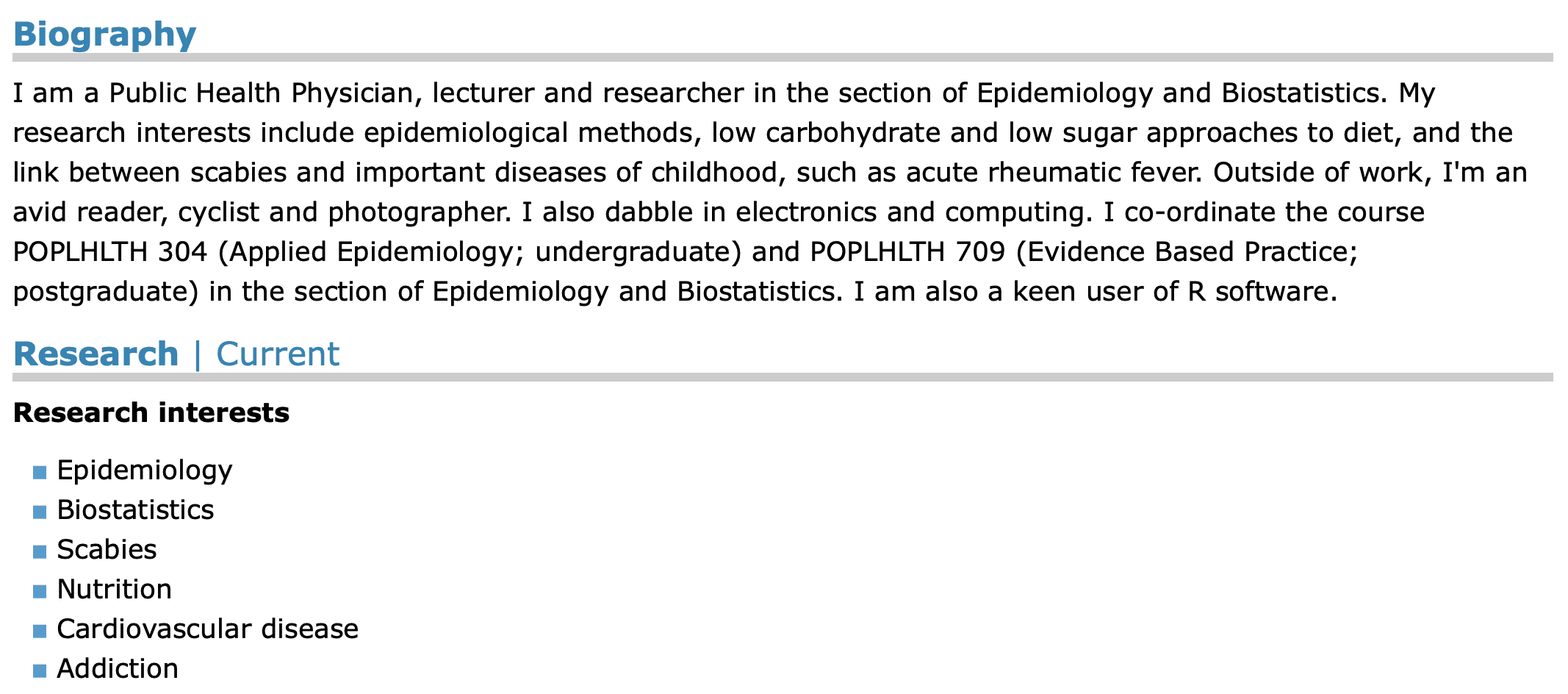
Avid reader, cyclist, teaches applied statistics, uses R . . . hey, he’s practically talking about me! On the differences side, I’m not much of a photographer and I eat tons of carbs and sugar.
Googling this guy led to this news article from 31 August 2020 where he was quoted as saying:
“Looking at the science, I believe an effective vaccine is a very remote possibility for COVID-19,” said Dr Thornley.
“We know that the world record in terms of vaccine development is four years – that’s with mumps, from the Merck company. We know that most of them take 10 years – they need to be carefully evaluated. These early vaccines that are coming out of Russia I’m very sceptical they’ve been really well tested in long-term studies.”
He said discussions with vaccinologists he knows have led him to be sceptical.
“Hanging out for a vaccine is not an option… a fantasy, in my view.”
I guess the next step after saying the vaccine won’t happen is to deny the vaccine’s effectiveness and to make up stories about its hazards. Kind of funny that he coordinates a course on Evidence Based Practice. Maybe the Hoover Institution could hire him to head up a new biostatistics department?
Back in August 2020, scepticism about vaccine development speed was pretty reasonable.
So yeah, it is not about never making a mistakes, but about being able to admit them.
There’s often some element of truth behind many conspiracy theories.
Take the ivermectin conspiracy theory. Is it plausible that big pharma might push expensive therapeutics, and even undermine the widespread use of generics as an alternative? Of course.
Are groupthink and motivated reasoning real? Yup.
Is there a political aspect of the public and media pushback against ivermectin (and ivermectin-promoters)? I’d say yes.
Is there a troubling aspect of large media platforms labeling promotion of Ivermectin as “disinformation?” I think so.
Is it plausible that there’s an army of medical researchers and public health officials to mislead the public about the efficacy of Ivermectin, with indifference to the health and welfare of hundreds of millions? Well, I don’t think so.
Maybe a question of semantics but I wonder if this is about admitting to being wrong, as it seems to me that to admit you were wrong you have to perceive that you were wrong. I think more accurately this is about our ability to admit error – even to go so far as to believe things that are highly implausible because of the flaws in how we investigate our own errors.
Joshua,
Go on over to Science-Based Medicine and you can read all about ivermectin. The short story is that there were some initial studies that claimed ivermectin was effective, but these turned out to be badly flawed, and subsequent studies showed no effect. This didn’t stop people who should have known better from clinging to the initial studies.
John –
I’ve actually been following the ivermectin saga quite closely now for months – including the Health Nerd and the Weinstein/Heyer/Harris/Deigen/Lehmann IDW internacin spin offs. Scott Alexander has a decent review of the literature – which lines up with what I’ve seen – there has been some fairly weak and poorly controlled observational, population-level evidence that there might be some positive effect but there hasn’t been findings through RCTs or empirical research into the pharmacokinetics that support the weak observational evidence. Meanwhile, many people who like to claim a mantle of scientific rigor have exposed a deeply unscientific underbelly in fascinating ways. It’s all very interesting and disturbing at the same time.
Don’t know if you’ve seen this, but this is an interesting, fairly recent development (discussed a bit by Alexander in his review).
https://www.economist.com/graphic-detail/2021/11/18/ivermectin-may-help-covid-19-patients-but-only-those-with-worms
So no direct benefit but it may help reduce the negative effects of cortico-steroid treatment for people with covid who have a lot of worms (which could help explain some of the observational evidence).
Jushua,
The Economist paper is behind a paywall, so I didn’t read it, but for a thoroughly critical view take a look at https://sciencebasedmedicine.org/ivermectin-is-the-new-hydroxychloroquine-take-6-incompetence-and-fraud-everywhere/
John –
Thanks, that’s a good piece. I’m not entirely sure I agee with the conclusion the it’s unethical to run more trials (interesting that he says that view is based on bayesian reasoning), but I think his argument is a cogent one.
FYI, you don’t have to pay to get around the Economist paywall, but as for the whole worm thing, this will help
https://mobile.twitter.com/boulware_dr/status/1345769283444477953
> Is there a troubling aspect of large media platforms labeling promotion of Ivermectin as “disinformation?” I think so.
I don’t. Promoting Ivermectin as an off-label Covid cure is irresponsible and kills people, same as any other miracle cure; it’s responsible to tell your customers that it’s wrong.
We all laughed when Trump was understood as drinking bleach, but people do drink chlorine dioxide (MMS or CDS) and feel that protects them better than a vaccination.
Mendel:
I agree. The ivermectin business is just one thing which by itself would be no big deal, if some people used an unproven treatment in a setting where no good alternative is available. But there is a bigger picture: ivermectin is part of an anti-vaccine movement that is killing hundreds of thousands of people.
Mendel –
I just get a bit uncomfortable when massively powerful monopolistic companies have that level of influence on the public discourse.
But let me be clear – I think the claims of “censorship” are politically expedient self-victimization, and in tthe face of massive mis- and disinformation campaigns and hugely popular conspiracy theories, I don’t really see viable, less sub-optimal alternatives.
Powerful social media companies influence public discourse by creating filter bubbles, and by allowing anyone to publish anything with far less accountability than they’d have in traditional media. I’m very uncomfortable with this; I think it’s harmful because it’s favoring populism and pseudoscience.
I’m also more uncomfortable with keyword-triggered advertising (and tracking) than with keyword-triggered misinformation warnings.
Mendel –
I agee. The combination of siloing with advancements in the art of mis- disinforming is a huge problem. What’s happened with ivermectin is a good illustration of just how much damage is being done. I’m concerned about the implications of the only realistic remedy but I don’t I see any better options.
From the Retractionwatch article:
“The paper recalculated the reported miscarriage rate to only include people who were pregnant in their first or second trimester when they were vaccinated. Doing so increased the miscarriage rate to between 82 and 91 per cent, a shockingly high figure.
Because the study lasted three months, the only way for a person to complete pregnancy in that timeframe is to have a miscarriage (unless they were late in their second trimester).”
This reminds me of what you say when someone wants to know why your project cannot be completed earlier than scheduled, “no matter how many men you put on the job, it still takes nine months to make a baby.”
That number is so insanely, stupidly high, you really question if the researchers are playing with a full deck.
The:
They’re playing with the same deck as the researchers who claim that women were 20 percentage points more likely to support Barack Obama during certain times of the month, or the researchers who claimed that beautiful parents were 36% more likely to have girls, . . .
Days since Hoover reference: 0.
Great post. Accusations of “punching down” should be ignored. The same crowd that supports agitating for change on their pet projects object when it’s their ox being gored — screw them. Agitating for change is just that — agitating. That’s how movements change minds.
Imagine being depraved enough to think the following circa Civil Rights movement: “Wow, these people doing a sit in on this segregated restaurant sure are annoying. They’re punching down! The owner’s got a mortgage, man!” If you firmly believe something, you’ll take slings and arrows. Publishing scientific literature isn’t tiddlywinks.
Your invocation of Clarke’s Law is on point. It does not require you to know the motives and other inner-most thoughts of other researchers when you see shoddy work. Identity or ideology should not shield you from standards (but maybe I’m heterodox for saying that, who knows anymore). Robust disagreement is the point of organized science!
I think there are so few educational platforms that can really dig into the studies and clinical trials which form the bases for many opinions. I understand that there are over 500,000 articles on COVID from nearly all disciplines.
If, as some experts allege, one can yield any research result without resorting to unreliable/inaccurate methodologies, then who is lending oversight to this epistemic environment. We see a lot of mistrust of experts.
Lastly, I was on Amazon last week perusing the Best Seller Book list for Christmas presents. And surprisingly, Robert F. Kennedy Jr.’s book on Dr. Fauci was rated number 1 and then 2. Whoaaaaa!
The anti vaxxers have a large following. Had I not read Paul Offit’s history of the anti-vaccine movement, I would not have ever known about it. That following is from a more affluent/educated class too. They are digging into studies and posting their evaluations of them.
The average reader of this blog does not watch Alex Jones’ Infowars.com but if he/she/it/theyx did, he/she/it/theyx would be bowled over by the number of medical practitioners who have gone public proclaiming that Covid does not exist, the vaccine is what kills you, Fauchi is a war criminal profiting from the vaccine and the Illuminati are alive and well. But, I have left out Soros, Schwab,The Great Reset, Baron Rothschild, The New World Order and Big Mike. If you have no idea what in the world “Big Mike” is, you haven’t been paying attention.
I have been paying attention but I don’t know who Big Mike is. The Google was maybe a little help (Michelle Obama?)
And how could you possible have left off Billy G?
Joshua: I just used Wikipedia to look up Billy G and I am none the wiser after reading the item. Clearly, I need to expand my horizons and devote less time to Infowars.com.
Big Mike is indeed Michelle Obama who is actually male and not female as the Infowars.com followers all know. Dog Whistles are paramount because they act to identify a clan. Note how often right-wing people use as an adjective the word “Democrat” rather than the word “Democratic” as in “Democrat party.”
Recall the extreme active form of the dog whistle used by the antisemitic Posse Comitatus: members would greet each other by cheek slapping so as to make the cheek red. This was done as a form of group identity and purity because it is well known that Jews do not blush.
Bill Gates!
It’s really Satanic Panic level of incredible (magically tens of thousands of people sacrificed to Satan, with nobody noticing tends of thousands of people missing). What’s killing these people, if not COVID? On the flip side, where’s the huge number of those with vaccine harm? (Obliviously there’s some harm, but the numbers they claim don’t match reality).
The good thing about the Internet-is-forever is that the public (assuming journalists, you know, do journalism) can track who these fools are and take their claims as seriously as they warrant (often not at all, but sometimes they can contribute as Andrew points out).
Paul,
Some liberal leaning folks I know do read Infowars.com. I’m beginning to suspect that they get some rush from reading them. It fuels and channels their anger in ways that are such a waste of time, from my perspective.
The other thing some of us have noticed; words like ‘wisdom’ or ‘wise’ are spurned or rejected b/c they are considered archaic concepts. This is pretty odd to me at least.
Moreover, I worry whether the scientific method is in jeopardy after witnessing the trajectory of the pandemic modeling and theorizing.
Closest link between those people and this blog would be the Marginal Revolution comments section. My impression is lots of them are soft conspiracy theorists, the ones who don’t quite think that Michelle Obama is male, etc., but think it’s amusing to do the troll, think that Alex Jones is basically a good guy who fights the good fight. Sort of like the political equivalent of the psychology researchers who can’t quite bring themselves to stand behind himmicanes, critical positivity ratio, etc., but at the same time get angry when people point out how ridiculous these claims are. The political trolls are much worse, but I see a similar general attitude.
“I can’t quite say that the researchers who publish vaccine denial papers are immoral, exactly, as many of them might be sincere in their beliefs”
break the shackles of Kantian ethics then! :)
Of course you can. Their sincerity is irrelevant.
+1.
The parable about shipowner deserves to be copied here
A shipowner was about to send to sea an emigrant ship. He knew that she was old, and not ever-well built at the first; that she had seen many seas and climes, and often had needed repairs. Doubts had been suggested to him that possibly she was not seaworthy. These doubts preyed upon his mind, and made him unhappy; he thought that perhaps he ought to have her thoroughly overhauled and refitted, even though this should put him at great expense. Before the ship sailed, however, he succeeded in overcoming these melancholy reflections. He said to himself that she had gone safely through so many voyages and weathered so many storms that it was idle to suppose she would not come safely home from this trip also. He would put his trust in Providence, which could hardly fail to protect all these unhappy families that were leaving their fatherland to seek for better times elsewhere. He would dismiss from his mind all ungenerous suspicions about the honesty of builders and contractors. In such ways he acquired a sincere and comfortable conviction that his vessel was thoroughly safe and seaworthy; he watched her departure with a light heart, and benevolent wishes for the success of the exiles in their strange new home that was to be; and he got his insurance-money when she went down in mid-ocean and told no tales.
Putzing around this morning, I came across the journal Hormones and Behavior (the official journal of The Society for Behavioral Endocrinology), which publishes articles such as “Acute Inhibition of dopamine beta-hydroxylase attenuates behavioral responses to pups in adult California mice.”
https://www.sciencedirect.com/science/article/abs/pii/S0018506X21001653
I wonder how good their statistical methods are …
Martha,
The phrase, “putzing around” is quite harmless to most but I suggest you avoid using it if a member of the cognoscenti is present.
https://www.waywordradio.org/putz-around/
No need to avoid “putzing around”, Webster has your back:
https://www.merriam-webster.com/dictionary/dick%20around
Mendel says:
“No need to avoid “putzing around”, Webster has your back:”
But, from https://www.thefreedictionary.com/putzing
1. Slang A fool; an idiot.
2. Vulgar Slang A penis.
intr.v. putzed, putz·ing, putz·es Slang
To behave in an idle manner; putter.
Discretion is the better part of valor and neither Merriam nor Webster can be trusted for this word.
My theory is “putzing around” is actually from a combination of “futzing” and “puttering” neither of which is penile. It doesn’t derive from the same place as the Yiddish word Putz.
This was just posted online a few minutes ago, even though it has yesterday’s date
https://www.theguardian.com/us-news/2021/nov/23/florida-doctors-covid-coronavirus-bruce-boros
“Seven doctors contract Covid after attending Florida anti-vaccine summit”
From the article
———————————————-
Doctors tested positive or developed symptoms ‘within days’ of conference at which alternative treatments were discussed”
“I have been on ivermectin for 16 months, my wife and I,” Dr Bruce Boros told the audience at the event held at the World Equestrian Center in Ocala, adding: “I have never felt healthier in my life.”
The 71-year-old cardiologist and staunch anti-vaccine advocate contracted Covid-19 two days later, according to the head event organizer, Dr John Littell.
Littell, an Ocala family physician, also told the Daily Beast six other doctors among 800 to 900 participants at the event also tested positive or developed Covid-19 symptoms “within days of the conference”.
———————————————————————————————————
Sort of ironic that so much of the medical advice we see in print ends with, “speak with your doctor” when so many have kookie medicinal ideas. Perhaps we should postpone that annual checkup which we are repeatably urged to have. Might be better off talking to a used-car dealer.
It is important to have a good doctor. If your doctor isn’t that good, it is better to do your own research. A medical degree is not the same as a science degree (not that a degree is a guarantee, but it tells you something).
I’m not sure you can make a clear distinction between peer reviewed journals and propaganda journals. After all, many academic fields could be described as clubs of people that have decided to ignore some serious methodological issues.
For example whole sub-fields of psychology just ignore questions about the measurability and ontological status of psychological phenomena (“constructs”) purportedly measured with questionnaires and test. There are many areas of social science public health where extremely dubious samples are routinely used and there are many communities of researchers that believe digging through observational data looking for p<0.05 is a valid form of science.
Likewise, it seems to me that some conclusions are usually easier to get though peer review than others.
I don't think it would be possible to evict a discipline like astrology from science today. After all astrologers could have their own peer reviewed journals (some high impact!), get grants, graduate PhD students and meet all the other criteria for academic productivity.
Would peer reviewed astrology journals not be "propaganda journals" of sorts? And what would make them different from e.g. mainstream personality psychology or p<0.05-type public health research?
You’re writing as if astrological journals didn’t exist. For example, “Correlation accepts articles reporting empirical research in astrology, review articles, and those discussing methodological, conceptual and philosophical issues relating to astrology.”
A defining part of science is communication. If you produce a medical (anti-vax) journal that simply ignores the prevailing wisdom of the field, you’ve positioned yourself outside of that field. Any journal for “alternative medicine” is not a medical journal if no working medical researcher actually reads it.
(I say “working” because belief in weird theories often correlates with age.)
I’m interested to see there exists at least one dedicated astrology jounral.
I’ve run into it previously in the Journal for Scientific Exploration.
Following has lists of articles (and links to PDFs) over many years:
https://web.archive.org/web/20150318030748/https://www.scientificexploration.org/journal/articles.html
My favoriate article used to be “Unexplained Weight Gain Transients at the Moment of Death” (dead sheep), but then it was surpassed by an astrology study on 500 Parisian puppies:
https://web.archive.org/web/20150424120723/https://www.scientificexploration.org/journal/jse_21_2_braesch.pdf
Weirdly, an article in this journal (a review of a Michael Crichton thriller) was used in 2005 to support an attack on the climate “hockey stick.”
Quote: ” it’s annoying that there are people out there pushing ESP, ghosts, climate change denial, vaccine denial, evolution denial, etc.”
Putting so-called “climate change denial” together with obvious pseudo-science disqualifies this paper otherwise interesting. See e.g. article of 16 influential scientists from 2012 Wall Street Journal “No Need to Panic About Global Warming”.
This method of associating one opinion with other absurd opinions based on an alleged common group representing both opinions is a classic eristic technique demonstrating a lack of objectivism.
If 16 top scientists in 2012 is not enough we may also add Freeman Dyson or two Nobel laureates: James Peeble or Ivar Giaever. Putting together anty-evolution and climate change results in drop of the reputation of all the legitimate science – sad story. But should we be surprised if top medical journal Lancet retracts a paper about the ineffectiveness of cheap mass-produced masks against the pandemia?
Zbig:
Arthur Conan Doyle and Alan Turing were pretty smart guys too, and they were hard-core believers in ghosts and ESP, respectively.
But I take your point that the term “denial” isn’t quite right here. To call people deniers can be taken to imply that they are holding a position they know is false. Rather than “people pushing climate change denial, vaccine denial, evolution denial, etc.”, we could say, “people who do not accept the evidence in favor of climate change, vaccine effectiveness, evolution, etc.” The complicating factor is that some of the people who take this position actually don’t accept the evidence or reasoning, while others are actual deniers—I’m thinking here of the people who take vaccines but try to convince others not to, or in the past there were the cigarette company executives who had seen the smoking-cancer evidence and were hiding it—and then there are some people in the middle, who want to believe something so they look away from the evidence. And then there are people like the Freakonomics team who say they think climate change is an important problem but, for some cultural/political reasons will occasionally promote contrarian claims on the topic. So it’s complicated.
But, hey, you might think belief in ghosts is “absurd”—so do I!—but tens of millions of Americans would disagree with you on that! I’m sure that more than 16 top scientists are in that group. They just don’t have the political pull to get a Wall Street Journal column, that’s all.
Dear Andrew
I think that there is one missing factor in your analysis. The vaccine issue in general, covid-19, and ‘urgency’ of climate change are all hijacked by big politics which is not the case of ghosts or ESP.
This is another reason to avoid such generalizations like the one you made.
When it comes to ‘climate crisis’ as it is recently called by mainstream media there is an obvious uncertainty element in it. Media and politically motivated activists do not like to consider these milder additional points of view:
a) climate change is real but not danger
b) climate change is real and danger but it is impossible to fix
c) climate change is real but not urgent
etc.
Taking into account the bayesian approach in the stochastic analyses of urgency and credibility of climate change models will indeed lead to very poor support of climate change urgency. And the bayesian approach proved to be very successful in many other hot issues.
In the book “Bayesian Statistics The Fun Way” by Will Kurt there is a beautiful example with respect to the vaccine issue. There is a certain serious illness which happens every year for 2 people per 100 000 of population. After swine flu, it was observed that among all vaccinated people the frequency of this rare, dangerous illness increased to 3 per 100 000. Let the public at large read this result and soon you will obtain a headline that vaccination increases by 50% this rare and dangerous illness. In my opinion, for these reasons statistics should by taught in primary schools as early as possible.
Zbig –
> Taking into account the bayesian approach in the stochastic analyses of urgency and credibility of climate change models will indeed lead to very poor support of climate change urgency.
Can you explain that a bit more?
The models of global, Earth climate are heavily based on stochastic approaches, various random assumptions multiplied by modern massive data collections. The Bayesian approach makes it possible to combine stochastic analyses with also stochastic models – making it possible to asses credibility of final results.
The book by Will Kurt “Bayesian Statistics The Fun Way” easily explains these not easy, Bayesian approaches.
I’m afraid I still can’t understand better from that explanation.
In what way are you saying a Bayesian approach will lead to poor support of climate change urgency.
In the very least, I think you’re wrong that the models are based on “random assumptions.” I’m hoping you can do more than refer me to Kurt’s book. As near as I can tell, your explanation runs afoul of a basic principle where it can reasonably be argued that with more uncertainty, the urgency of addressing climate change increases.
Zbig:
You write that the vaccine issue is “hijacked by big politics.” Sure, but that’s only in the past year. As of a year or so ago, anti-vaccine attitudes represented a fringe position (much more fringe than belief in ghosts!) with close to zero political support. I don’t know what it would take for ghosts and ESP to become mass political issues, but I think it’s possible if some powerful political operators thought it would benefit them.
Andrew –
> I don’t know what it would take for ghosts and ESP to become mass political issues,…
Interestingly, UFO’s have, to some degree anyway, crossed over from fringe belief to something of a politicized issue in the last year or so.
Coincidentally, an example just popped up into my Twitter feed:
https://twitter.com/RepTimBurchett/status/1466139425029730321?s=20
Joshua:
I think UFO’s were always a mass belief, like ghosts and ESP, but only recently has it been embraced by so much of the political and media establishment. I don’t see much of a partisan connection yet, but I guess that could change, just as it did with vaccines.
You don’t really need to “believe” in UFOs, a UFO is an “unidentified flying object” and there are tons of those legitimately. Like the “jet pack guy” near LAX.
https://www.youtube.com/watch?v=eq05ZQmxcLA
Now, the idea that they’re aliens… yeah that requires belief because there’s nothing data-wise which would suggest either way really.
Andrew –
> I don’t see much of a partisan connection yet, but I guess that could change, just as it did with vaccines.
Maybe. My general sense is that it has been covered a lot more on Fox and other media sources – particularly Tucker? And I’m willing to estimate it’s been a topic among politicians on the right more than on the left.
But…yeah…it doesn’t really feel like it’s partisan. Updated polling would be interesting to see. This is from June:
https://www.deseret.com/2021/6/4/22451984/is-there-a-conservative-position-on-ufos-donald-trump-barack-obama-aliens
It would be interesting to see if there’s a notable change. If so, it could be a good window into understanding how issues intersect with politics.
I agree with you about this.
Yet that earlier problem with anty-vaccine movements derives directly from the public at large reading scientific papers (now on the Internet) and poorly understanding basic rules of statistics.
Again I think that statistics should be taught in schools as early as possible to avoid stupid conclusions in such cases.
Such stories like about president Roosevelt being terrified about the news that half of Americans have intelligence below average are good examples that knowledge of statistics is a basic need for democratic societies.
This blog is often about PhD’s doing that.
Andrew wrote:
> To call people deniers can be taken to imply that they are holding a position they know is false.
That’s deceit, not just denial. Denial is the refusal to acknowledge overwhelming evidence or logical argument. This can be caused by sincerely held beliefs that conflict with it.
If you redefine denial to mean deceit, you make it more difficult to talk about denial.
Mendel:
I guess these are fuzzy categories, where on one extreme you have flat-out liars (such as the cigarette executives) or the equivalent (such as the 100+ congressional representatives who endorsed transparently ridiculous election-fraud claims); on the other extreme are people who are genuinely persuaded by contrary evidence (the evidence does not appear overwhelming to them, but you can’t really say that they’re refusing to acknowledge overwhelming evidence); and somewhere in the middle are people who are politically or otherwise motivated to troll (as with the Freakonomics authors) or to not look hard at the evidence (as with some of the covid deniers). Denial doesn’t have to involve deceit, exactly, except that it can involve people deceiving themselves, or being willing participants in being deceived. To put it another way: I think that active deceit is typically an important part of the ecosystem of denial, or beliefs-contradicted-by-overwhelming-evidence more generally. Some people deceive, others believe deceptive claims because they want to believe, etc.
Most of the “ecosystem of denial” works on a system akin to brainwashing where the importance of contrary information or logic is simply downrated in the denier’s mind. They’re no longer acting rationally in their denial.
Some denial groups have been compared to cults in that respect, both by observers and by former members.
Andrew –
> But I take your point that the term “denial” isn’t quite right here. To call people deniers can be taken to imply that they are holding a position they know is false.
Not necessarily that they “know” it is false. Typically “denial” suggests some kind of unconscious mechanism of defensiveness.
But yes, the problem with using “denier” or “denial” is that it rests on some kind of objective determination of “truth” (dismissing uncertainty), or an ability to mind-probe.
Probably best to avoid altogether. It’s just not necessary.