The data thug quotes from: an April 2023 post from the EVP of Research at Wiley:
In September 2022, Wiley identified and immediately alerted the industry to paper mill activity we found operating at scale. Specifically, we found fraudulent outside editors that had subverted our processes and workflows, leading to a proliferation of bad content. This scheme hit Hindawi’s Special Issues program hard.
For those who are unfamiliar with academic publishing: Wiley is a long-established firm.
Back when I was a student, Wiley was perhaps considered the #1 publisher within statistics. They published Feller’s classic books on probability, Cochran’s classics on design of experiments and survey sampling, and many other standard texts.
In recent decades, as with other academic publishers, they’ve branched out into other publishing-related businesses, for example, Hindawi, which has a habit of filling your inbox with spam about dodgy journals. From Wikipdia: “In 2023 and after over 7000 article retractions in Hindawi journals related to the publication of articles originating from paper mills, Wiley announced that it will cease using the Hindawi brand and will integrate Hindawi’s 200 remaining journals into its main portfolio. The Wiley CEO who initiated the Hindawi acquisition stepped down in the wake of those announcements.”
To those of us of a certain age, seeing Wiley and Hindawi in the same sentence is disturbing in itself, a sign of what the world of publishing has come to. Not that publishing has ever been pure—just for example, back in the 1960s and 70s, legitimate publishers released fake-science books such as Chariots of the Gods, The Bermuda Triangle, and The Jupiter Effect—; still, it was sad to see the once-respected Wiley name dragged so low.
You can hire James Heathers for less than $3.7 million
Heathers points out that, because Wiley is a public company, certain of its business records are required to be public, and he found this:
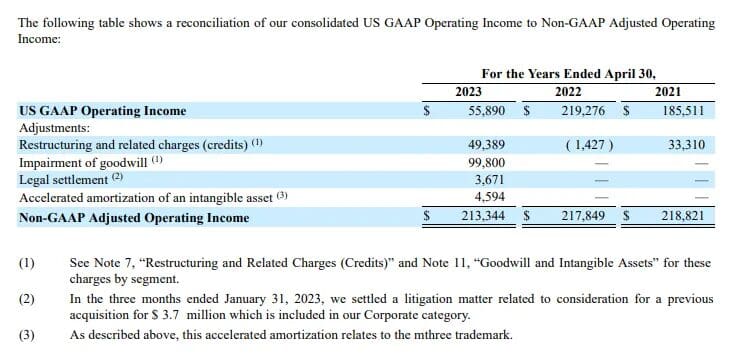
Heathers explains:
‘Legal settlement’ is exactly what it sounds like, and the footnote description is ‘a litigation matter related to consideration for a previous acquisition’.
The shorthand is: their own shareholders sued them. They said they were going to, and did. . . .
This is not uncommon . . . Any large public company in business for long enough has seen a suit or two like this. . . . Generally, they settle. . . . this is noticeably more expensive than running a full-scale proactive research integrity program.
And here’s the kicker:
For 3.7M, you could have the world. I [Heathers] am quite confident in saying: I could run that as the operating budget of a fraud mitigation unit for multiple years, and drop the amount of nonsense by . . . maybe two-thirds, three-quarters? within that time.
All right, then!
This is not new to Wiley
Just one thing. This is not new. Wiley’s been in the lucrative science-fraud business for awhile. Recall this story from 2011, “Wiley Wegman chutzpah update: Now you too can buy a selection of garbled Wikipedia articles, for a mere $1400-$2800 per year!”
But, yeah, the Hindawi business sounds a lot worse. When Wiley was conned by a formerly respected academic into republishing Wikipedia content and charging money for it, that was just a one-time breach in editorial standards. The Hindawi story seems like something else entirely. On the other hand, when it comes to fraudulent publishing, they had some track record.
Adversarial journalism
Heathers writes:
There absolutely IS adversarial journalism in academia/research/science/etc. Science Magazine, Undark, Vox, etc. have all published great pieces on this.
Ahhhh, Undark Magazine . . . that brings up memories. A few years ago, Undark published a terrible article, misrepresenting a scientific story in which I’d been involved. That was adversarial journalism in the worst sense, in that the journalists were coming in with an agenda and using it to distort and slam anyone who disagreed with it. See here for more on that story.
I’m not saying you shouldn’t trust anything in Undark just cos they ran that one bad article, any more than I’d un-recommend the books by Cochran just cos they were published by Wiley. I just thought it was funny that Heathers mentioned Undark in particular, given that my only experience with that magazine was so unpleasant.
Those publishers (Doubleday, Econ-Verlag, Putnam, Bantam) weren’t/aren’t scientific publishers and their criteria for publishing a book (mostly, will it sell well?) are quite different from those of scientific publishers. I don’t have a huge problem with the likes of Chariots of the Gods or “The Great Evolution Mystery” by Rattray-Taylor or other bunkum airport bookshop pop sci books. No doubt there are examples of crude dishonesty, but some of the authors of these books were simply either seriously misguided or slightly mad! You know scientific rigour isn’t guaranteed but you might hope for an exciting read esp if you’re a teenager. That’s not to say that some pop-sci books aren’t excellent.
So I don’t think mixing together Wiley in the same paragraph as these efforts is really justified; it makes it seem as if Wiley is publishing bunkum pop-sci.
Anyway, this stuff still goes on. A “legitimate” publisher published Michio Kaku’s bunkum “Quantum Supremacy”, it sold well and got lots of good review scores on bookseller sites. So different criteria cf scientific publishing.
That 3.7 million is almost irrelevant in the context of a 300 million acquisition which was clearly not a good one.
From what I understood back then and hopefully remember correctly: The hefty price was mainly justified for Hinawi’s editorial IT system that Wiley wanted to acquire. What they clearly miscalculated was the cost of a reputation hot in a reputation driven business