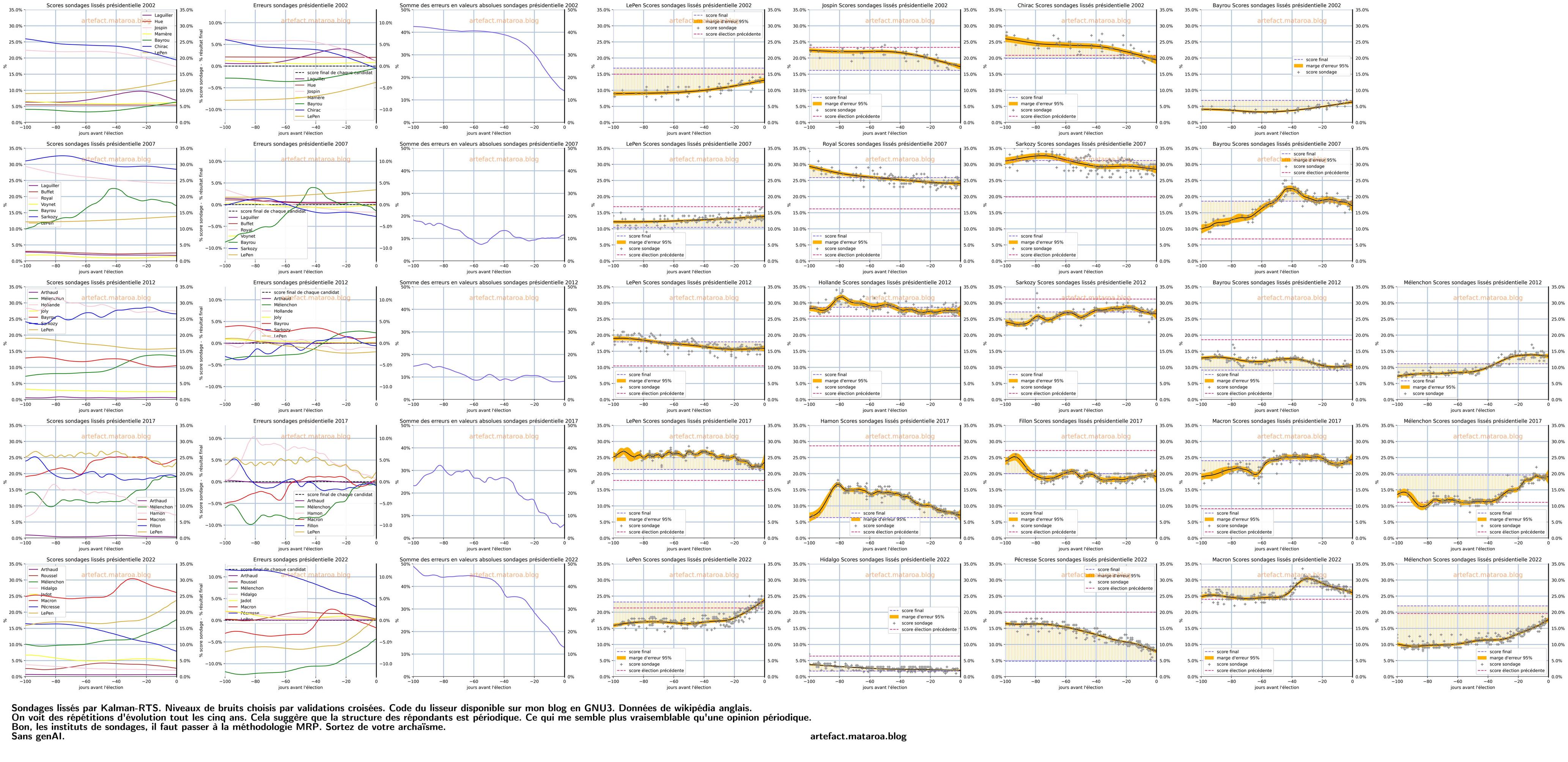
An anonymous statistics student from France sends in the above plots (click twice to see big versions) and writes:
I’m trying to push French pollsters to start doing MRP.
I made a poll agregator and applied it to the last 100 days of the last five french presidential elections.
I did some smoothing using an algorithm from a paper of Aki Vehtari. It is Kalman-RTS with cross-validated levels of noises.
I tested it on some simulated data to confirm it is fitting properly.
I put the data and the code on my blog.
What I shared as “the data” is the smoothed result. I fitted it on the wikipedia pages of the french polls.
On the plots, the same parties (with changed names or fusions) are on the same position horizontally to allow comparisons.
I see some periodic movements in opinion that I think may be coming from a periodic non-response.
Also, the movements seem far too large to me. I can believe 10% increase for a candidate in five years, but not in less than 100 days.The French polling industry is in profound need of reform. A fun fact: They allow themselves to change the final result by plus or minus one point based on the feelings of the person in charge of the poll. They call that the “pifomètre” or nosemeter. I heard about this in an interview with sociologist Hugo Touzet on his book, “Produire l’Opinion: Une Enquête Sur Le Travail Des Sondeurs.” I trust his descriptions of their methods since he has interviewed their workers.
I think MRP would allow the pollsters to do predictions for the legislative elections and municipal elections, which have been largely ignored because they are too difficult and expensive with quota sampling.
I know next to nothing about French polling, but, yeah, I do think they should be using Mister P (multilevel regression and poststratification; MRP).
P.S. Here’s a fun cranky post from this student.