As regular readers know, our posts are usually on a 6-month lag, but this one is so important I had to share it with you right away.
Paul Alper points us to an online video promoting something called Lotto Champ, which describes itself as “a cutting-edge tool designed to help lottery players make more informed choices. By analyzing data and patterns, LottoChamp offers personalized number suggestions, providing a smarter approach to playing. It takes the guesswork out of the lottery experience, enabling a more confident and strategic play.” It provides “tailored sets of numbers” and costs a mere $197.
As a statistician, this claim of effectiveness surprised me. Most obviously, if the lottery is run well, the numbers are random so there’s no way to predict them, and even if there’s some flaw in the randomization, the vig of the lottery is huge that it’s highly implausible that any edge would be enough to make you money in expectation. The next obvious point is that the lottery numbers are the same for everyone, so the concept of a “personalized number suggestion” makes no sense.
And, yeah, yeah, I know what you’re gonna say: if it’s the powerball then at least you can avoid commonly picked numbers (hint: avoid numbers between 1 and 31) so that, if you do win, you’re less likely to split the prize. I was still under the impression that it was still a losing bet, and that it would be bad news bad news if you’re such an addict that you’d even consider spending $197 on this. And, again, I thought that “tailored sets of numbers” made no sense.
But what do I know? I’m just a simple country statistician, I’m no lottery expert. The real experts are on the internet.
So I googled *Lotto Champ* to see what came up, and I saw some things like this:

and this:
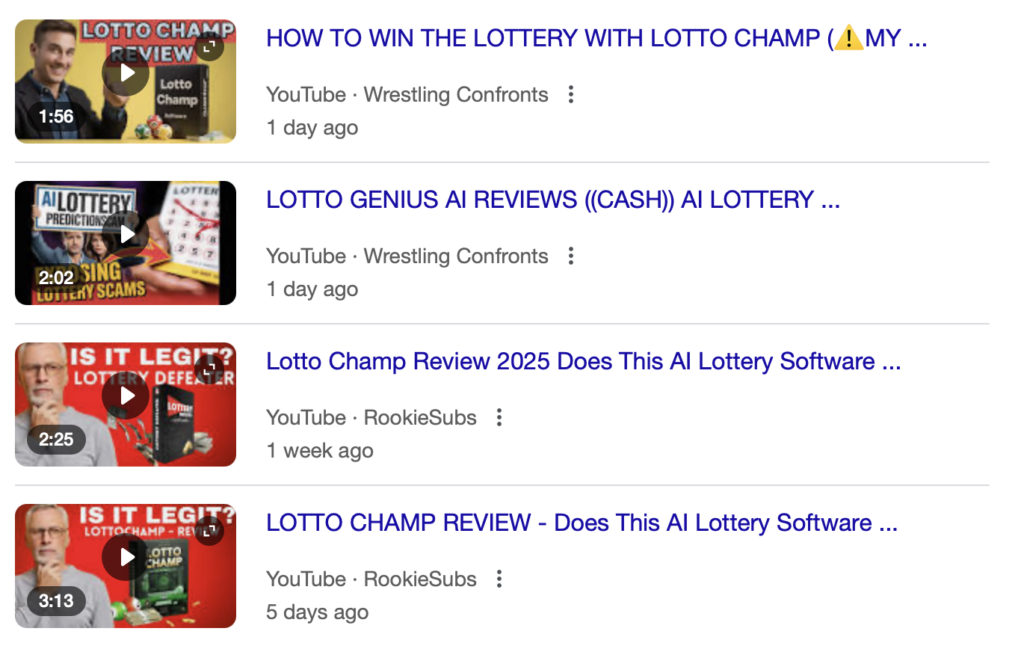
OK, so some ads and some reviews. The reviews are unusual in that they use advertising promotional language and are full of links to the site, encouraging you to buy. I guess these reviewers are really excited about the product! There’s no way that these could be fake reviews, inserted just to suck customers in. Doing such a thing would be immoral, and there’s no reason to think that someone selling lottery tips for $197 would be immoral. On the contrary, they’re trying to help people!
Then this:
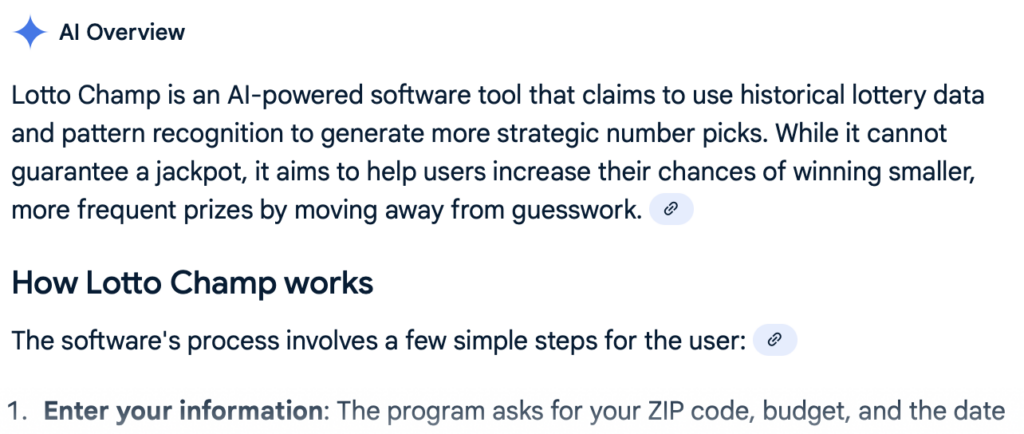
Hey, thanks, Google, for providing this valuable information!
Ahhh, but scroll down on the page and you’ll find some warnings:
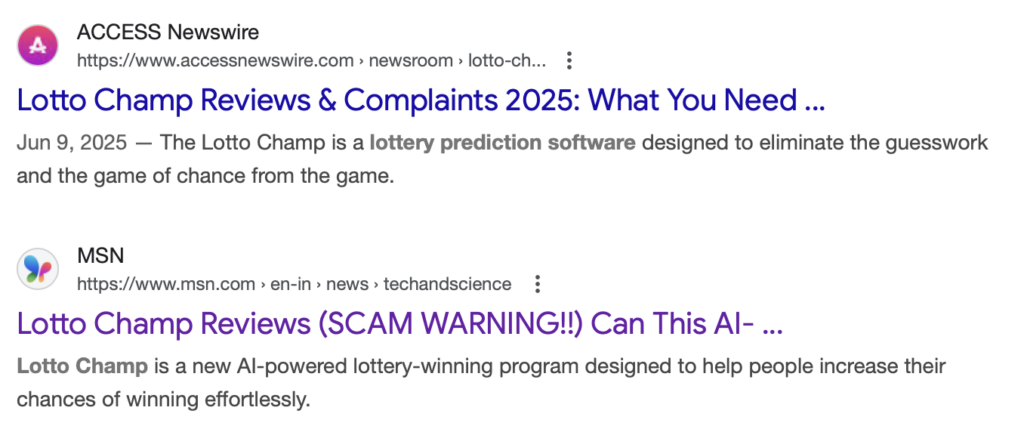
Now I’m concerned. I’ll first click on the site from “ACCESS newswire.” This seems like a legitimate source, and here’s what they say:
Lotto Champ Reviews & Complaints 2025: What You Need to Know Before Buying This AI Software
AUSTIN, TX / ACCESS Newswire / June 9, 2025 / Lottery games are always considered a game of chance that cannot be rigged. But have you considered the fact that since it is a game made by humans, it will have a set pattern that can be cracked? Well, this realization was what led to the creation of the Lotto Champ lottery prediction tool. This is an AI-powered software built to eliminate the guesswork from the lottery games.
Whew! For a moment there I was concerned that this lottery numbers thing might be a scam. It’s a relief to learn from this independent news source that it will “eliminate the guesswork from the lottery games.” huh? Sounds like a great deal–my only question is why they only charge $197 for this wonderful innovation? My guess is that the people at Lotto Champ are just very nice, and they want ordinary people to be able to make money too. The news story continues:
The basis of the program is that it is powered by artificial intelligence tools that have access to a huge collection of publicly available data on the lottery games of the country. This huge dataset that has historical winning patterns, ongoing lottery games, and future games will help the AI choose the best game with the biggest winning odds and payouts for the customer.
Wow–cool!
The article continues:
Understanding how the Lotto Champ software works is simple. Before getting deep into that . . .
The article goes on for a few zillion more paragraphs without ever “getting into that.” I guess the authors of the review were so excited that they forgot to put in their simple-yet-deep explanation of how it works. But, don’t worry, I’m already convinced that it works. And for only $197, I don’t need to know how it works, I can just live off the steady stream of money it will provide me:
The main aim of this Lotto Champ review was to present a comprehensive analysis of this new lottery prediction tool that has garnered all the attention. The lottery game is one of the most sought-after and celebrated games in the gambling world. People bet their chances on the belief that they are lucky and will get a bigger win.
Even though this is the basis of the lottery game, this lottery prediction tool is introduced for players who want to make their wins more consistent and get a stable income from this game.
It’s good that the Lotto Champ system really works. Because if it didn’t–if lottery numbers really were indistinguishable from random and unpredictable in any useful way, then it would just be evil to feed the deluded fantasies of gambling addicts. It would have the potential to ruin people’s lives. But we don’t have to worry about that.
Oh, and what about the other link above? It’s from www.msn.com and it’s entitled, “Lotto Champ Reviews (SCAM WARNING!!).” SCAM Warning . . . that’s pretty scary? And msn.com is a legitimate news site. From wikipedia:
MSN is a web portal and related collection of Internet services and apps provided by Microsoft. The main home page provides news, weather, sports, finance and other content curated from hundreds of different sources that Microsoft has partnered with.
OK, you may not be the biggest fan of Word and Excel, but Microsoft is a mainstream institution, and it doesn’t seem unreasonable that they’d have a webpage warning you off some internet scam.
So I better click on the link and go to msn.com to see the full story, whose full title is “Lotto Champ Reviews (SCAM WARNING!!) Can This AI-Powered Software Help To Win Lottery Multiple Times?” Here’s what msn.com reports:
Lotto Champ is an advanced AI-powered software that is specifically developed to increase the chances of winning lotteries. It provides a more strategic approach and leverages AI-powered technology to generate numbers that have a higher probability of winning.
It analyses past lottery results based on data-driven insights and tends to predict the best possible combinations. It optimizes your selections and enhances your odds compared to traditional random choices. Lotto Champ provides an intelligent analysis of the historical data and takes the guesswork out of the equation.
Hey, thanks, Bill Gates! I was worried that Lotto Champ was a scam. I’m glad you cleared this up. Now that a reputable source has confirmed that it’s cool, I can confidently send them my $197.
It’s a good thing that Lotto Champ is providing a legitimate and valuable service, otherwise Microsoft would be promoting a scam on its own branded website (no, this article is not labeled as an advertisement, and its url begins with innocuous root, https://www.msn.com/en-in/news/techandscience/).
But now I’m still kind of concerned so I google “lotto champ scam,” which reveals a pile of videos and text links saying how wonderful it all is.
These Lotto Champ people must have done an awesome job at search engine optimization. Good for them! They’re providing a valuable service for a mere $197. It’s the least they can do to spread the work on the internet, especially to those skeptics who might naively think that a lottery-promotion system is a scam.
And good job, Google! You’re not just promoting a wonderful scheme to win the lottery, I guess you also made some money selling slots on your search pages. I guess that’s why your motto is “Don’t be evil”: you’re helping people and making money at the same time! What could be moral than that.
On the other hand, if you’re a potential customer who’s lucky enough to google “Is Lotto Champ a scam,” the first link is this no-holds-barred youtube video by Jordan Liles shooting them down. What a party pooper! C’mon, Jordan Liles, you’re just jealous of all those people who live a comfortable life playing the lottery–and for a mere $197 investment! You can make all the videos you want; I don’t care.
I also came across a review titled “Lotto Champ Reviews (EXPOSED)” at morningstar.com. Hey, Morningstar’s a reputable company too! So I was scared about the exposé. But, not to worry, click through and read the article and it’s all about how great the system is. It even includes links so you can go buy it directly! Good for you, Morningstar! Like Google, you’re helping the ordinary Joe and you’re also taking sweet sweet advertising dollars. Again, I breathe a sigh of relief that Lotto Champ really does what it says. Otherwise mighty Morningstar would be enabling gambling addiction.
As with the other cases, the Morningstar review is not labeled as an advertisement. Indeed, it’s in the “Market News – Accesswire” section of their website. Market News from Morningstar . . . that sounds pretty legit!
Google also provides an “AI overview” informing us that Lotto Champ is “Backed by data: The software uses AI to analyze decades of past draw data to identify patterns and trends. This gives users a strategic approach instead of relying on luck or superstition.” Bafflingly, the AI review also says “The software cannot alter the fundamental randomness of a lottery drawing, and the ultimate outcome still depends on chance.”
That sounds like a contradiction to me! First it says it does not rely on luck, then it says the outcome depends on chance. Hey, that’s the Markov model for ya.
So, yeah, thanks Google!
And some other sites popped up associated with Apple and Yahoo, two more recognizable brand names have positive reviews (including helpful links to where you can spend your $197) on their webpages.
Before seeing all these entirely neutral third-party reviews, I was suspicious of the idea of an AI that could pick personal lottery numbers for you. But given that Google, Apple, Yahoo, Morningstar, and Microsoft all endorse it, I’m convinced.
Also, if Lotto Champ were really a scam, I’m sure the government would’ve already cracked down on them, just as they’ve already prosecuted cryptocurrency frauds, promoters of dangerous anti-vax misinformation, the mayor from some city, I can’t remember where, who was allegedly taking bribes from a middle eastern government, etc. One thing we know about the U.S. government is that they have no tolerance for crime and corruption.
In better times I’d say the government should crack down on this. Not just the lottery crap but the corruption of Google, Apple, Yahoo, Morningstar, MSN, etc etc, which are either actively promoting it or else are passively letting themselves be manipulated.
Selling lottery numbers is already a scam. But setting up a network of fake reviews with the implicit complicity of some of the world’s richest corporations, that takes it to the next level of evil.
I’m sure the internet is full of such things. I just hadn’t been aware.
In the meantime, remember that Reputation is a two-way street. If I were foolish enough to believe that Lotto Champ is a scam, I don’t think I’d ever trust anything on msn.com or Morningstar Market News or whatever. Or Yahoo, either, but I actually hadn’t been aware that Yahoo still exists. Fortunately, I have full trust in Lotto Champ, msn.com, and Morningstar. Lotto Champ deserves my $197, and Google, Microsoft, and Morningstar deserve every dollar that is given to them to run these valuable and informative reviews, and Google is wise to run its server farms 24/7 and burn up whatever remaining coal we have in the world in order to produce these very helpful AI overviews.
What I’d really like is for some rich guys to buy Reddit, Stack Overflow, and Wikipedia and convert them to sites that are as useful as those provided by Google, Microsoft, and Morningstar.
P.S. The above post is not intended to provide any financial advice. Spend any $197 at your own risk. Remember that $197 can be converted into 137 Jamaican beef patties, 1/85 of a conference featuring Gray Davis, Grover Norquist, and a rabbi, or 2 1/2 dinners of a soggy burger, sad-looking fries, and a quart of airport whisky. Spend your money wisely, kids!
https://www.reddit.com/r/ChatGPT/comments/1nmverc/agi_achieved/
This post about scams is as good a place as any to point people to Jonny’s analysis of the Claude Code leak. Anthropic accidentally leaked their source code to their coding chatbot. The chatbot they have been advertising is extensively written using the chatbot…
https://neuromatch.social/@jonny/116324676116121930
(Jonny is a grad student or postdoc not sure which, at UCLA where he works on neuroscience and open science technology by actually hand writing code)
The take home message, Claude is like 500k lines of code of the worst spaghetti dogshit copypasta reimplement everything 23 separate times each with its own bug, whenever you need some function dont call the one you already have write out a nearly identical one with a different name and a different set of bugs and call that, recompress images through a series of 13 separate compression schemes… spaghetti bullshit
surely the people on the internet spending a trillion dollars to promote this stuff have societies best interests at heart and we should repeatedly pull this machines lever to see if the spinning wheels will give us a jackpot over and over… I’m sure it’ll all work out well in the end and noone would ever decide to say schedule air traffic control based on one of these spaghetti piles and then have the entire country’s airlines shut down essentially permanently when someone in the Chinese military injects a remote triggered intentional physical airplane-crash inducing bug.
As someone who has been using it almost every day for about 9 months.
1) This is obvious from using it and checking the github issues (which is also run by the bot)
2) It is amazing software, the most amazing I have ever used by far in my life.
For 99% of projects no one cares about the craftmanship.
@Andrew
The government may crack down on lotto champ, but it will be only to release their own version. Thats what happens with the most profitable scams (eg, ponzi schemes, lotteries).
Noone cares about debuggability of your private whatchacallit, but people care a lot about the debuggability of operating system kernels, hardware drivers, the embedded code in your cars antilock brakes, your banks transaction management, the filesystem itself, database management systems, scientific analysis being used for policy recommendations, the power grid, water treatment plant feedback control, numerical algorithm libraries, cryptography, file format conversion, financial hedging strategies used by pension funds… etc etc etc
So yeah, lots of us are worried that kool-aid drinkers will expose the rest of us to risks associated with their enthusiasm involving those kinds of important processes.
Yeah, AI-generated code superficially “works” until you have to think about efficiency, security, reliability, and maintainability.
Debuggability for a bot is different for than a human. Trying to shoehorn the bot into a human workflow will give you a bad experience.
Instead its all about logs and integration tests. Not just logs for your software, but what the bot has done as well. You should be able to go back and discover exactly when any bug was introduced and why in a few minutes. Eg, “seance” any old ancestor session.
Its a totally different way of working. That said you still should try to limit the spaghetti code, the importance of this is just dramatically lower.
I’m kind of in between Daniel and Anoneuoid on this, but closer to what I think is Anonueoid’s position.
There is no way to debug humans’ operating systems either, not even my own. We rely on drivers, pilots, police- and fire-men, and many others to make life-or-death decisions all the time, and many people could screw things up badly for any of us by incompetence or malfeasance. Every car has a black-box decision-making algorithm that controls how it is driven, in the form of a human brain that does whatever it does. For this kind of thing, maybe we should take the stance that the proof of the pudding is in the eating: if computer models, however opaque, can drive ten billion miles with fewer accidents than human drivers, can’t we conclude that the computer models are acceptable or perhaps highly desirable? Do we need to understand them? I don’t always trust or even understand my own brain’s split-second decision-making, so it seems a bit nutty to impose the requirement that cars must be driven by entities whose decision-making algorithm can be proven bug-free. That’s not the way we have ever done it before!
That said, I am much more comfortable if a system is made up of subsystems that can be independently tested, at least: can the car-driving program use its sensors to identify other cars reliably? Can it estimate their distances, relative speeds, and directions of travel with reasonable accuracy? Can it predict its own stopping distance and maneuverability with reasonable accuracy? And so on. We can do that with our brains, I think it’s reasonable to require this of any alternative system.
Phil:
This all makes sense. It reminds me of the idea we’ve discussed before, that a probability isn’t just a number; it’s part of a network of conditional statements.
“A software of which nobody has any idea how it works doesn’t need debugging anyway”
Oh my
There is still lots of debugging, just a new workflow that takes advantage of the bot’s capabilities.
To clarify, I am talking about using the bot to write deterministic software. Not using it to receive input from the user and return results itself (although that is also going to increasingly work as “glue” between various deterministic modules as well).
Lol. Is it important to not take your source code, which most likely cannot be legally copyrighted by latest legal precedent, and leak it to the public internet?
The truth is that the AI spaghetti code is also less debuggable by the AI agents. As someone who works in big tech, the truth is that the consumer frontend code being good basically has not mattered for a very long time.
1. Computers are super fast. If your program is 10x less performant than it would have been 10 years ago but computers are 9x faster, you probably won’t notice.
2. The frontend compute is distributed across computers that each user owns, and which sit mostly idle. Why bother optimizing it. If your application were say, bundled with an entire copy of chromium so you can use the javascript engine instead of rewriting your website, and used a gb of RAM for basic text messaging with a memory leak that bloats it to 4 gb before restarting every hour — who actually cares? You’re not paying for it, that’s their problem.
3. Users have low expectations. It used to be the received wisdom that your website had to have constant uptime or users would go somewhere else and users had to be babied or they wouldn’t figure things out. Now the expectation is that your app is so addictive that users will put up with all kinds of annoying shit, or else your users are locked in by an enterprise contract and their opinion doesn’t matter. If your app is broken or has some confusing UI, the user will figure it out; quit out and restart it or google for a fix and clear their cache and cookies or open it in incognito or something.
This really comes down to the economics of software. People almost never pay for quality software. Software is a tool to get at the thing you really want. Even more than physical tools; a cook might show their friends a nice knife and run their finger along the blade. A trucker will pat the hood of their 18-wheeler and say “now that’s a lot of engine. She’s a workhorse that one.” Sublime text is a masterpiece, but you’re really out there if you call your friends over to show off opening a 25 mb text file in 0.01 seconds.
People will pay for access to content consumption (or token consumption), either directly with fees or indirectly for ads. Or businesses will pay for quality software. All the talent these days is in backend stuff–multitenant, highly scalable, highly available whatevers, complex simulations and machine learning. And also video games, the only software people will actually pay for.
On the subject of the software quality of Claude Code:
First of all, obviously they’d rather not have published their source code publicly. We don’t have any way of knowing how it happened, but I do think agentic coding probably played a role in that major mishap, whatever they say publicly.
But as to whether or not Claude Code is “bad”, the whole package is obviously amazing, but most of that is the model. The part that runs on your computer, the “harness” doesn’t matter that much, and there are other harnesses that are about as good or better. In the ways that the frontend Claude Code is meaningfully bad, why would Anthropic care? Is there an Oauth token authentication bug that locks it up and requires an arcane set of steps to fix? Your primary audience is software engineers, they’ll figure it out and pass it around. Does the harness just retry JSON formatting in a loop until it passes syntax validation, instead of efficient guided generation*? Why would anthropic care, every token you spend is NRR for them. Why would they hire a specialist to make any of that better when they could hire someone to increase average tokens generated per GPU-hour by 1%?
As I started typing, this really went places I didn’t expect. I guess it triggered some kind of feeling in me. As somebody who plays tech support for their parents, I don’t love this trend. I also think people really do undervalue quality software, and that bothers me a bit.
*https://arxiv.org/abs/2307.09702
I think this is an elaborate prank, based on today’s date
Anon:
No, the site appears to be real, and given all the effort they seem to have put into fake links pointing to it, I’m guessing that the evil people behind it are making money.
Some time ago in a previous life, I must have sent this to Andrew, but today is the first of April, so anything goes, which would make for a good title of a Broadway musical, except that it is already been taken as of November 21, 1934.
“April first” is the new hit Broadway musical that let’s the audience think about their own choices and actions. It’s more than a musical, it’s an invitation to think about what really matters.
The opening scene shows April, a woman in her 40s, drinking tea with her brother Ben at her brother’s new home where he lives with his wife Tina and their two children. Ben tells about moving into their new home, and how much work they have done at their new home, and that they now only have to paint the hallway ceiling.
Scene:
April: I can paint the ceiling!
Ben & Tina: [both laugh out loud]
April: What’s so funny?
Ben: Uhm, it’s April first, you’re joking right!?
April: Ow, I didn’t know it was April fool’s day. I’m sorry, but I haven been traveling for work the last weeks. I don’t even know what day of the week it is.
Ben: Yeah, you told us. That’s why you couldn’t come to my birthday party 6 weeks ago when Jim was coming over as well. It would have been nice for you to see your other brother there. How long has it been?
April: Uhm, 2 years I think. I spoke to him on the phone last month though. It’s just that I have been busy with the company. But hold on, why would you immediately think I was joking when I said I could help paint? It’s a normal thing to propose I would think.
Ben: Uhm, for others perhaps but not for you April. I mean, you haven’t asked whether you could help out when we told you we were moving 5 months ago. Why now?
April: Well, I don’t know. I am just thinking about stuff lately and wondering what’s important. I thought it might be a good thing to spend some more time with you and Tina and Jason and Kelly. I was thinking about calling Jim on Saturday, to see whether I could come visit him.
Ben: I’m not sure if that’s a good idea now April. He was very disappointed that you forgot he had his birthday a few days before you called him last month. I think he thinks you mostly care about yourself. He called me the day after you called him and he said to me: “It’s always April, April, April. She never thinks about anyone else but herself. It’s April first!”
April: [flustered look on her face at first, dejected look a little later]
That’s the opening scene of “April first”, a story about a woman being confronted with all the times she could have been there for someone, but chose to be somewhere else. April first is the day April decides it isn’t “April first” from now on.
Tickets on sale now.
>…the lottery numbers are the same for everyone, so the concept of a “personalized number suggestion” makes no sense.
Not so! If Lotto Champ recommends a certain set of numbers to its first customer, then the recommendation to the second customer should be personalized in the sense that it should not recommend the same set of numbers. The more customers Lotto Champ gets, the more personalized the recommendations (should) become.
> And it’s endorsed by Google, Apple, Yahoo, Morningstar, and Microsoft!
Is it?
> “ACCESS newswire.” This seems like a legitimate source, and here’s what they say:
At the end it also says: SOURCE: Lotto Champ. It’s not hard to see that it is just a marketing tool, you can publish whatever you want to publish for a fee.
> the Morningstar review is […] in the “Market News – Accesswire” section of their website.
Unsurprisingly the “Market News – Accesswire” section is just reproducing content from ACCESS newswire. I don’t see the document you refer to but there is a more recent one, ending with the “SOURCE: Lotto Champ” mention (and a link to the ACCESS newswire original).
I can’t find the MSN India thing you quote but I assume it may also come from ACCESS newswire or a similar marketing service. I don’t know what Yahoo “endorsement” you write about either but there are similar pages that start with a “This is a paid press release. Contact the press release distributor directly with any inquiries.” box.
Google will just search for things, and will find the things that are out there (including your declaration of full trust in Lotto Champ but apparently it can recognise the sarcasm). If you ask if there are holes in Bayesian statistics it will repeat some points from you but that’s not really an endorsement, is it?
I guess that for Apple the issue is not that they are regurgitating third-party content like news aggregators and Google do but that they have some app called “Lotto Champ” in their store. To the extend that they are “endorsing” something I suspect that it’s in fact a different “Lotto Champ”. Is Amazon is also “endorsing” Nazism by selling “Mein Kampf”?
> What I’d really like is for some rich guys to buy Reddit, Stack Overflow,
I’m not sure if you’re aware that Reddit is a $25bn company listed on the stock exchange and that you can also find Lotto Champ reviews there. Stack Exchange parent is also a $100bn listed company, by the way.