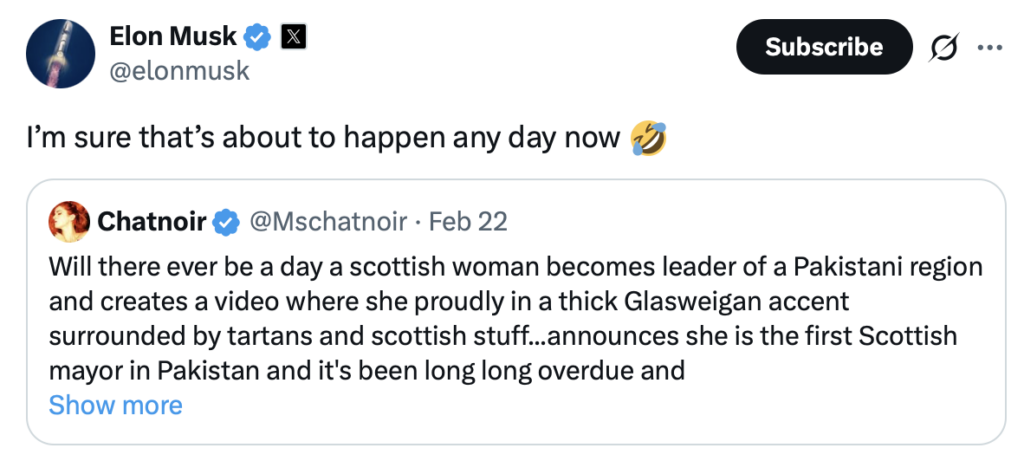
I go onto Twitter and Bluesky every morning to post the link to the new day’s blog post. When I go on Bluesky, I know what to expect: it shows me a list of my recent posts. Twitter does something different: it gives me some general-interest feed, some mix of home improvement videos, celebrities, politics, and whatever has recently liked by Elon Musk. The above post came up this morning.
Usually I find such posts annoying, but this one was convenient because it overlaps with some of what we’re covering next week in our course, Rationalizing the World: The Hopes and Disappointments of American Social Science, 1900 to the Present:
Week 6: Democracy and totalitarianism
The new challenge of the 1940s was the cold war: fascism was defeated, but communism remained and was stronger than ever. The ideological struggles of the twentieth century led scholars to study different forms of modern government and how they have developed in the United States and elsewhere. We consider the connections between various forms of democratic and authoritarian government and their connections to domestic politics and colonialism.
In particular, we have several readings related to “herrenvolk democracy,” which is the term used for countries such as apartheid South Africa and the U.S. south that had democratic governance but with the vote restricted to members of the ruling ethnic group. We compare this practice to universal democracies, completely non-democratic systems, and colonial systems such as the former French Algeria, the territories controlled by Israel, American Indians in U.S. territory, and various past restrictions on suffrage based on property ownership and sex.
I can’t be sure, but I think that in the above post, Musk is expressing support for a sort of politics of ethnic separation, where Pakistan is populated by ethnically Pakistani people with Pakistani accents and wearing Pakistani clothing and Scotland is populated by ethnically Scottish people with Scottish accents and wearing Scottish clothing.
It’s easy to poke holes in this sort of thing–for one thing, “Pakistani” is itself a relatively new nationality; for another, there are ethnic divisions even among national groups; for another, Musk himself lives in the U.S. but he’s from South Africa–I guess this is OK by him because he now dresses like an American, and his South African accent is not too thick, but then of course it raises the question of how his nationality principle would work in a multiethnic country such as the United States or South Africa which have many languages, accents, and clothing styes. At this point perhaps his reply would be that the U.S. and South Africa would be better off if they were not multiethnic, but it’s not clear what could be done about that. It’s not like you could split the countries into separate, homogenous bits: all sorts of people live in all these places. Beyond all this is the history of colonization, in particular including Musk’s example of Pakistan and Scotland: as the saying goes, “We are here because you were there.”
OK, fine. A political slogan doesn’t have to be logically coherent: it just needs an emotional appeal coupled with some connection to a current political dispute–in this case, Musk wants people to vote for anti-immigrant parties in the U.S. and the U.K. I think he’s holding Pakistan as a sort of ideal, in the sense there are not a lot of people of European descent living there, so they don’t currently have to worry about ethnic outsiders holding political office.
But let’s step back and think about this in terms of political theory. Herrenvolk democracy isn’t on the table in the U.S. or even in South Africa. So what would Musk’s ideal be here, beyond his goal of not letting more people enter the country who he would consider suitable in their politics, ethnicity, language, and clothing? Maybe some system of separate ethnic voting, where different groups vote for their own political leaders, and then these leaders of the different group negotiate in some sort of cabinet? I think they had this system in Lebanon for many years, also Belgium is divided up in this way.
The point here is that we can think of herrenvolk democracy not just as a historical throwback (or, in the case of Israel, as a sort of living fossil) but rather as a response to political conditions, an available solution to a problem perceived by some powerful people.
In this course, I’m trying to help students see social and political events, and social science theories, in their historical contexts, and this is a good example. To someone in Musk’s position, straight-up democracy is unacceptable, but he recognizes that any system needs some form of legitimacy, and that’s leading him in this direction, of centering legitimacy in ethnicity. His South African background is part of the story, but given how many countries have herrenvolk traditions, you could just as well say the same thing if his background were English, or French, or American, or all sort of other nationalities.
Again, I’m not saying that Musk is wrong, or that he’s right, to be upset that Scotland has enough ethnic diversity to support the election of politicians who don’t dress the way he likes. People are free to be upset about whatever they want. It’s more that this is an example of the sort of elite panic that can motivate social science theory as well as policy.
Charles Richard Swayne, born in Dublin was Resident Commissioner of the Gilbert and Ellice Islands (Micronesia). Uganda was under the British Regent from 1890-1960. Pakistan itself was under British rule for a century. Not really understanding anyone’s point in today’s essay. Maybe I need to read it again.
Yeah, pretty sure there was at least one (probably several) British equivalents of mayor/governor in modern-day Pakistan between 1800-1950. As usual. Musk has said something that almost sounds sensible unless you know basic history.
You have Musk’s post badly wrong. He’s mocking the inherent contradiction of the left’s demand for proportional representation, as well as its direct contradiction with the basic freedom to choose one’s one representation.
Minority groups and their supporters in the majority group (The Left) tell us that majority and minority groups are exactly alike in all abilities and potentials, so any statistical differences in life outcomes or representation in any category are due to unfair (almost always racial) discrimination. On the other hand, the left tells us that minority groups are so different they need special rules to force proportional representation, because without proportional rules their special exactly alike unique voice can’t be heard. On the one hand, the minority has the same needs and desires as the majority. On the other, the majority can’t possibly understand the needs and desires of the minority – thus the minority must have the right to specific representation.
The upshot is that their are no cultural differences between groups that should influence outcomes in any way in any category, but minority groups still need protection from “cultural appropriation” because majority groups use cultural appropriation to steal the exact sameness of minority groups and exploit it for a profit. But weirdly majority groups don’t seem that worried about minority groups “culturally appropriating” cancer treatments, Chevelles or North Face jackets; but minority groups are very upset about the unique culture that provides these things, even if there is no such thing as a unique culture.
IMO you’re a bit messed up on this issue. It’s inappropriate to deny a racial group the right to vote. But the right to vote doesn’t imply a right to proportional representation in government any more than the right to an education implies a right to proportional representation among Physics faculty or the right to play sports implies a right to proportional representation in the NBA.
Why should, say, the Christian majority be denied the right to elect Muslim representatives if they so desire, just because that could be disproportional? “Proportionality” rules are designed to protect the established elite in any minority community – a protection racket that’s further advanced by various forms of welfare being channeled through that elite. In effect, these minority elites are tools of the majority and further the discriminatory aims of that majority – as our friend Gavin recently so eloquently highlighted.
Puzzles:
I take Musk’s position that Pakistan should be populated and run by Pakistanis, Scotland should be populated and run by Scots, etc. I have a feeling that the percentage of Pakistanis who are of immediate Scottish descent is low enough that there won’t be political support for a strongly Scots-identified candidate there. Scotland doesn’t have many people of Pakistani descent, but it’s politically connected to England, also of course there’s the colonial history of Pakistan, so there’s more of a logic to there being strongly Pakistani-identified politicians in Scotland. So, in a literal sense, Musk’s implication that this won’t likely happen soon in Pakistan seems reasonable.
The issue is more that he is also implying that what is happening in Scotland is a bad thing. In my post, I’m not arguing that Musk should or should not have that political view; I’m just situating it within the political context of herrenvolk democracy. You write, “It’s inappropriate to deny a racial group the right to vote,” and that’s fine, it’s your view, but not everyone agrees with you on that issue. That’s kind of the point of herrenvolk democracy, that there are powerful people who think the vote should be restricted a dominant ethnic group. You frame this as majority vs. minority, but in herrenvolk South Africa, and in many places in the herrenvolk U.S. south, the whites were in the minority.
I see from a quick google that the former first minister of Scotland was of Pakistani descent. In his official portrait he appears to be wearing a business suit, which I guess is neither traditional Pakistani nor traditional Scots garb. In any case, it appears that he was elected to office by winning more votes than his opponent, then he lost his position as first minister as a result of an intra-party vote. I don’t think anyone was deprived of the right to vote for who they wanted, except in the usual–and, I agree, often problematic–sense that voters only usually get to choose among the major-party candidates offered to them.
There’s also some stuff in your comment about physics, basketball, and something called Chevelles. This doesn’t seem so relevant to our discussion of herrenvolk democracy but I guess it demonstrates the point that there are connections between politics and lifestyle that can be hard to parse. The bit about the thick Glaswegian accent and tartans can be related in some way to Victorian-era photos of British colonialists standing around in uncomfortable British-style clothing in various warm-weather locations.
I think you have some valid points in there somewhere, but it is hard to find them due to what seems like an overbearing and highly opinionated view of “The Left” that you seem compelled to declare. Insisting on proportional representation in anything can easily lead to absurd outcomes. I think when “The Left” focuses on proportionality, it is as a symptom of past and present treatment of groups not in the majority. The shortcomings and contradictions embodied in proportionality are not evidence that discrimination does not exist. Insisting on proportionality may indeed be a poor way to deal with the problem, but denying its existence doesn’t deal with it either. Insisting that anything that aligns with proportionality (any time of affirmative action, for example) be abandoned is a denial that discrimination matters. I’d rather see you acknowledge the problem, and then explain why some responses to it are bad and what alternatives would be better. I don’t see any of that in your comment.
Puzzles:
You wrote: “But the right to vote doesn’t imply a right to proportional representation in government any more than the right to an education implies a right to proportional representation…”
It does. The purpose of (some forms of) gerrymandering is to distort proportional representation. That is, everyone has a right to vote but only some have the right to be represented. Also, because gerrymandering in the US is geometric, it’s difficult to quantify what is proportional and what is not. Mathematical tools such as the seats-vote curve and the efficiency gap have been developed to quantify what is proportional and what is not.
Why has this been done? Because democracies that don’t have proportional representation, such as Singapore, are essentially authoritarian states (https://pacificaffairs.ubc.ca/perspectives/gerrymandering-and-its-effects-in-singapores-2025-general-elections/), where gerrymandering is used to insure that voting isn’t proportional.
“the inherent contradiction of the left’s demand for proportional representation, as well as its direct contradiction with the basic freedom to choose one’s one representation.”
Why is the election of a person of Pakistani descent to a political office in the UK a contradiction for the left? Sadiq Khan for example was elected as Mayor of London by winning 57% of the vote. Where do you see a contradiction between leftist commitments?
Maybe your misunderstanding is that you think Khan (for example) was elected *as a person of Pakistani descent*. He was elected as a candidate of the labour Party who simply happens to be of Pakistani descent.
As I point out below, Musk is simply trolling in order to propagate resentment against immigrants with foreign sounding names (while being an immigrant himself). There isn’t anything coherent to be interpreted into this silly post.
There was almost an ethnic Italian prime minister of India, Sonia Gandhi! (She was the party president of the biggest party for a while.) I’m going to be less polite than you and say that Musk is clearly just racist and ignorant, and amplifying others’ racism.
There’s also an ethnic French Bollywood actress who grew up in India and speaks several Indian languages fluently. Most Indians consider her as Indian for this reason. Skin tone doesn’t matter, except to racists (regardless of what country the racists may be from).
https://en.wikipedia.org/wiki/Sonia_Gandhi
https://en.wikipedia.org/wiki/Kalki_Koechlin
I think Musk is claiming that liberal democrats are being played for suckers or that Muslims are hypocrites. Scotland had a Pakistani prime minister; he is laughing at the idea that the reverse will ever occur.
This is (to my ear) a moderately effective argument for stoking anti-Muslim, anti-liberal sentiment, because it plays on the fact that people hate being taken advantage of as well as anti-Muslim prejudice. The tacit question is “why should we (liberals) give equal political rights to Pakistanis, when they will never reciprocate”.
Eric:
Your description sounds like an accurate description of Musk’s perspective. What’s interesting to me from the political theory perspective is what someone with those views thinks should be done about the problem, given that there are already people of Pakistani descent with political power in Britain. If you want Scotland for the ethnic Scots, or for ethnic Britons, or for Christians, or for white people, or whatever, one way to get that is through herrenvolk democracy.
I guess I see your point, though. To the extent that Musk’s goal is not political representation but rather the gain of some political advantage through public opinion, it makes sense for him to be complaining about something (the presence of people of Pakistani descent in the Scottish political system) that he can’t do anything about: if played carefully, this can serve as an unending source of political grievance.
“Scotland had a Pakistani prime minister;”
I’m sure you are aware of it, but the person in question (https://en.wikipedia.org/wiki/Humza_Yousaf) is a British citizen born in Glasgow who happens to be of Pakistani descent. It’s important to avoid carelessly reproduce right wing talking points.
It’s discombobulating to me to separate this specifically into a political representation lens. The well that Musk is drawing from is “homogeneous societies are more harmonious” e.g. nordic countries w.r.t. crime rate/happiness/etc
While this idea is appealing (to me) it gets drastically misconstrued into “all white countries have better outcomes” when in my mind it ought to be “pakistani immigrants can also become excellent citizens of scotland, regardless of race/ethnicity/culture”
What I mean to say is I believe Musk and his ilk are using every lever possible to divide and fear monger, and focusing specifically on political representation gives them more nuance than they should be credited for.
The current mayor of New York is a Muslim; as is the current mayor of London. They achieved their positions through peaceful conventional political processes. That’s ok with me. Others have pointed out that representatives of the British crown ruled for a time in Pakistan. These representatives were not chosen by the people of Pakistan. Will there ever be a Glasweigan woman with high office in Pakistan? I would not rule that out. After all, Benizar Bhutto, a woman, became the prime minister of Pakistan despite what we think about the role of women in the Muslim world. Right now it is quite unlikely that a woman could be elected in the USA, but I have not given up hope. I’d say that a Glasweigan woman getting a regional political office is probably as likely as a female POTUS. The important Ranger or Celtic issue has to be resolved first.
Ranger v Celtic solution: Hearts.
Those of you who have no idea what I’m talking about, just move along.
just an fyi, browser extentions like “Control Panel for Twitter” can hide the algorithmic “For you” (which contain all those craps) and restore the chronological “Following” timeline as default, along with many other UI and timeline features.
Prejudice may well be forever. Old Ben Franklin viewed German immigrants to the U.S. in a way hard to imagine today, today being well after WWII ended in 1945:
https://www.youtube.com/watch?v=nw1YXaAU1iA
Notice that he referred to Germans as “swarthy” !
I think we can rise above it. Musk seems to be living in the 1700s (or earlier).
I don’t think it’s right to say that Musk’s post indicates that he’s an advocate for apartheid, herrenvolk democracy, or ethnic separation. His response to the idea of a Scottish mayor in Pakistan is not “God forbid” or “hope not,” but instead is a sarcastic implication that it would never happen. (“I’m sure that’s about to happen any day now” is a prediction with no particular valence, and the laughing emoji seems to indicate that it’s a joke, so he doesn’t believe it’s going to happen any day now.) You work in statistics and you are also interested in predictions, including predictions of who will win different elections. If, as part of your election prediction work, you made a prediction that “I believe that it’s unlikely that there will soon be a Scottish mayor in Pakistan,” and someone replied by saying “gosh I didn’t know you were an advocate for apartheid,” would you believe that they were acting in good faith? Do you think this is a good faith reading of Musk’s intentions?
My own interpretation of the motivation or values behind Musk’s post is that he’s laughing about the asymmetry between Western and non-Western societies/cultures. Western societies like Scotland (he thinks) have openness to immigration to the point of electing relatively non-assimilated immigrants to important offices. Non-western societies (he thinks) don’t tend to have that level of openness (hence a Scottish mayor in Pakistan isn’t going to “happen any day now”). Moreover, non-Western immigrants tend to flaunt their non-assimilation even when they’re elected to office, and this non-assimilation is sometimes covered positively in the press. Such flaunting of non-assimilation is unlikely (Musk thinks) to be accepted and celebrated in non-Western societies. I think all of that interpretation can be justified by the post (it’s about assimilation, not apartheid), but I believe that going straight from the social media post to saying that Musk wishes for apartheid is not a good faith leap.
Padang:
I agree that Musk’s post does not indicate an endorsement of herrenvolk democracy or these other things. What I do think is that he views it as a bad thing that a major political office in Scotland is held by a person of Pakistani descent who speaks with a Pakistani accent and wears traditional Pakistani clothing.
You write, “Western societies like Scotland (he thinks) have openness to immigration to the point of electing relatively non-assimilated immigrants to important offices.” I don’t think that Musk views that as a good thing! (Except to the extent that he and his non-American friends are allowed to live here, but I’d guess that he’d argue that this is different because he and his friends are assimilated.) One reason I think this about Musk’s views is that he’s written other things on the topic.
Now, just because someone believes that Scotland’s openness to immigration is a bad thing, that doesn’t imply that this person wants apartheid or herrenvolk democracy or whatever. The challenge is to think about what it would take to get to what I take as Musk’s desired situation, in which Scotland’s elected officials were all ethnic Scots, or whatever would be close enough to that under his judgment. My guess is that Musk has not thought it through, or else as noted earlier in the comment thread he might think it sufficient to complain about the problem without having a solution, which could be effective if the goal is to stir up political resentment.
Thanks for your reply. I think there are some rhetorical leaps in your argument that are not justified. Consider an example: what if I post that it’s absurd that my sister keeps marrying losers. Then someone writes a blog post about “what it would take to get to what I take as Padang’s desired situation, in which his sister only married men who he approved of.” They write about the history of authoritarianism and marriage restriction laws including anti-gay marriage and anti-miscegenation laws, and write that something like those must be the solution I prefer. Well no, I just want my sister to choose better on her own! If someone wrote that blog post, I would feel they were stretching to make me look guilty by association in a dishonest way. Well just like my disapproval of my sister’s choices doesn’t mean I have any brief with marriage restriction laws, maybe Musk doesn’t want herrenvolk democracy or anything like it, he just thinks Scottish voters should make different choices.
I think this type of stretching to push guilt by association is part of what makes our political culture unhealthy today. I probably shouldn’t spend my free time defending Musk, because I’m not a fan of his, and I am a fan of you Prof. Gelman. But I don’t like the situation we seem to have where little statements from people we dislike are taken as proof that they’re only a couple of steps from running a gulag or that they implicitly favor a situation that’s only achievable through apartheid. I know you hate Twitter and I thought that type of culture was why. If you refute and discredit Musk, I hope you can do it by playing fair, not through unjustified rhetorical leaps and guilt by association.
Your exchange with Andrew made me go back to read the original post that Musk approved of – though I only read what is posted above (I refuse to access social media). The plain meaning to me is that Musk is offended by what he sees as a difference between Western (Scotland in this case) and Middle Eastern (Pakistan in this case) societies. Western societies are willing to elect a clearly non-Western person whereas that would not be tolerated in Pakistan. Given Musk’s many views about immigrants and race, I don’t see much ambiguity about what he is saying. Whether he approves of apartheid or not is a bit of a stretch here, especially without a clear definition of what is meant by apartheid. So, I’ll agree that it isn’t productive to infer specific views to Musk as a result of this one post, or even as a result of his other stated views. But I think there is plenty of evidence that this is merely another Musk comment against immigrants that he sees as less worthy. He is clearly expressing a preference for Scots over Pakistanis, and that matches his many statements about immigrants in a number of countries. It is not simply that he wishes Scots would make different choices – his support for the AfD, for example, is not irrelevant to the present discussion.
Whether Musk is racist or not may be a misreading of his views (and racism is yet another term that is not clearly defined, nor is it a binary phenomenon). His views may reflect his views about free speech, AI, unions, or any number of issues that lead him to support far-right politics. But his support of a comment distinguishing between politics and people in Scotland and those in Pakistan should be viewed in the context of his other views, not in isolation. Your comment sounds to me like you think that post should be viewed totally on its own. Just as it can be dangerous to stretch “by association” as you say, it is also dangerous to ignore people’s past views and actions.
Padang:
My post is much more about herrenvolk democracy much more than it is about Musk. The Musk thing happened to come up and it was a good example to help connect the general topic to current events.
The point I’m making is that, instead of thinking of a system such as herrenvolk democracy as some sort of weird political artifact, it can be helpful to think of it as a response to certain elite concerns.
I’m not trying to “refute and discredit Musk”; as I wrote in an above comment, he can feel free to be amused or annoyed at whatever he wants to be amused or annoyed by. I don’t consider any part of my post to be a refutation or a discrediting. What I’m doing is exploring the logic of some political ideas. Musk chose to put his posts in the feed so that I keep seeing them, which is his decision as he owns the platform, and I’m just making use of this to illustrate a point from a class I’m teaching.
Regarding the specifics: you write, “maybe Musk doesn’t want herrenvolk democracy or anything like it, he just thinks Scottish voters should make different choices.” Indeed, that could be. The point of my post is not to say herrenvolk democracy is one way that this sort of thing–preferential election of candidates from the favored ethnic group–can be achieved. That doesn’t mean that Musk would want to do that, or that he’s “only a couple of steps” from that or whatever. In his post, he expressed his amusement and irritation at a political system. I think it’s very reasonable of me, as a teacher, to take the offhand statement of a public figure in order to illustrate a point, and that should not be taken to mean that I’m trying to establish “guilt.”
Padang —
We can all offer different readings of what Musk intended in this one tweet. But the broader context matters. Musk has a long, consistent pattern of posting material that:
(1) is interpreted by explicit racists as an endorsement of their worldview,
(2) is interpreted negatively by many others who see him as endorsing racism, xenophobia, or nativist politics, and
(3) is interpreted by his fans as a way to mock people with the “woke brain virus” for supposedly over‑reading neutral observations.
This pattern has been visible for years, and Musk is fully aware of it. He could easily add clarifying language if he wanted to avoid any of these predictable interpretations. He chooses not to. That choice is part of what Musk is communicating.
Let’s look beyond one post in isolation. He repeatedly uses a rhetorical style that relies on ambiguity and plausible deniability to sustain engagement along a consistent pattern. When someone with a massive platform consistently communicates this way, it becomes reasonable to analyze the political implications of the pattern rather than treating each post individually.
Along those lines, I don’t think your analogy tracks. If you had spent years making jokes that were reliably celebrated by people who advocate marriage‑restriction laws, and you repeatedly declined to clarify your stance when asked, then people would reasonably start analyzing the pattern rather than the literal content of each individual joke.
The post’s author and Musk may both have a lot of opinions about herrenvolk democracy, etc., but most of the discussion here presumes a more comprehensive worldview than I think is on display.
The most important bit of the original post is not the hypothetical outcome of the Pakistani election but the woke reaction to it: “…first Scottish mayor in Pakistan and it’s been long long overdue and….” When a non-white person attains a position of power in a majority-white society it’s commonly celebrated (often hyperbolically) by the left as a milestone, and a common reaction from the right is “imagine if the situation were reversed,” which is meant to call out what they see as the inherent hypocrisy of that celebration.
At the more extreme end, this kind of thinking feeds into Great Replacement paranoia, and fanning the flames of white nationalism is on-brand for Musk.
***
FYI, the full text of the original post is
“Will there ever be a day a scottish woman becomes leader of a Pakistani region and creates a video where she proudly in a thick Glasweigan accent surrounded by tartans and scottish stuff…announces she is the first Scottish mayor in Pakistan and it’s been long long overdue and she will overcome the tyranny of Pakistan only ever electing Pakistanis to represent them
?
why is the opposite happening here not considered as absurd?”
https://x.com/Mschatnoir/status/2025500204644868510
Thanks for posting the link to the complete post – I wrote my comment above before seeing that. I agree with you that it is probably wrong to read too much into what worldviews Musk specifically holds based on this post, even in conjunction with his track record. He dislikes wokeism clearly, though what that term embodies in his mind is not clear to me. I really am not interested in knowing Musk’s views in detail anyway. I find the post distasteful and Musk’s apparent support of it distasteful. As you say, “At the more extreme end, this kind of thinking feeds into Great Replacement paranoia, and fanning the flames of white nationalism is on-brand for Musk.” That’s enough for me, whether or not this extends to Musk supporting apartheid or any particular version of democracy.
The idea of comparing one of the poorest countries in the world (per capita GDP $1,710 (160th)) with one of the richest (per capita GDP £40,339 (around 30 times larger)), forgetting that said richest ruled said poorest until 1947 or so, and then making some sort of gotcha political comparison seems pretty stupid and obnoxious.
I think Musk is saying that the election of an ethnic Pakistani in Scotland is hailed as a triumph of diversity and multiculturalism, but the reverse would not be true in Pakistan. A partial explanation is that an ethnic Scot would be seen as a member of the former colonial power and therefore an example of cultural hegemony
On the question what Musk might have in mind, given as you say that “it raises the question of how his nationality principle would work in a multiethnic country such as the United States or South Africa which have many languages, accents, and clothing styes”: I think there’s a fantasy of the US in which “most people” and “most regions” are ethnically and culturally homogeneous, with some fringe groups on the coasts and in big cities. Geographically, it might be the Midwest or the South or everything between the coasts. Culturally, it might either be Protestant, or Protestantism exclusive of “mainline” churches, or Christian generally, or Evangelical in particular. But also with a preference for, say, Twain over Dickens. And the same “conservative” social values one would have expected among non-elites 125 years ago. Very affluent white people of Musk’s type seem to view those people as having “the same” culture as the more educated white Christian sort, and think it’s their duty to defend them from those who seem “obviously” not part of the echt American culture.
The very low probability that Musk has any contact with people who were in fact brought up in a pretty genuine American culture makes this even more difficult. I suspect the difficulty of resolving those contradictions makes Herrenvolk democracy seem like a reasonable way to make things work out logically, somehow, as dominating “others” and their supposedly “foreign” beliefs feels preferable to them than recognizing their idea of what’s “normal” had all along been inaccurate.
J:
Yes, I think that herrenvolk democracy is sometimes thought of as a next-best-alternative to complete ethnic separation. The idea is that different ethnic groups have their own countries, and it you happen to be in a country where you don’t belong, then you should consider yourself a guest and be happy with whatever non-voting privileges you get.
From that perspective, the problem is with those ungrateful immigrants who come to a country where they don’t belong, then refuse to assimilate, then get citizenship and vote for politicians who represent their interests. But, as discussed in the above post and comments, this take isn’t so realistic (except as a complaint that can stir up ethnic resentment), given what’s going on in real-world countries. The U.S. does not actually have an overwhelming white Protestant minority, Scotland really does have prominent people of Pakistani descent, Pakistan is the product of colonialism, etc etc. Also there are lots of people of mixed ethnicity. So I think herrenvolk democracy has major problems, as we’re just not in that idealized situation in which people are ethnically separated by country. It does exist, though, as it represents some attempt for some powerful people to address political challenges that they see.
Yes, and it gets hairier as you go into the details. Maybe we could have ethnic enclaves for minority groups and immigrants, but how would that work? Would they be prohibited from mixing and mingling with the natives, on pain of some kind of penalty? Would they be educated along native lines or in their “own” schools? And the definition of “Protestant” in the US has to deal with the history of religious upheavals, revivals, and transformations of the forms of religion they or their answers brought from Europe. That’s all on top of the obvious issues around Native, Black, and Spanish (pre-annexation of California and the West) populations.
The idea of picking one of these and calling it “the real America” seems unworkable.
There was in fact an Irish (not Scottish but hopefully close enough) woman who became a Pakistani citizen and then became a Pakistani MP in 1970, but lost her seat in 1977 due to a rigged election. Her name was Jennifer Musa. She married a Pakistani man, learned to speak the local languages, and was buried in her husband’s family’s ancestral graveyard. She was hugely popular.
https://en.wikipedia.org/wiki/Jennifer_Musa
https://www.dib.ie/biography/musa-jennifer-mummy-jennifer-jehanzeba-qazi-musa-a9646
Wins the thread. Hilariously.
Nah, this only counts if she had a thick Irish accent and was wearing traditional Irish costume, kinda like the Pogues or whatever.
She moved to Pakistan when she was 30, so she probably did have a thick Irish accent. I think it’s nitpicking to ask that she was wearing Irish costume, though. Most Pakistani-Scottish don’t wear traditional Pakistani clothes. Though there are tens of thousands or Irish in Pakistan, so some of them surely do wear it.
There’s also a town nicknamed “Little Britain” with mostly British people in it. Maybe they wear traditional British clothes there. Maybe it has a British mayor! Though I haven’t heard of British MPs from there.
https://en.wikipedia.org/wiki/European_Pakistanis
I came here to say something similar. Light skinned Euro-Americans are honestly pretty popular globally.
https://en.wikipedia.org/wiki/Marutei_Tsurunen
https://en.wikipedia.org/wiki/Hsiao_Bi-khim
“light skinned Euro-Americans are honestly pretty popular globally.”
Not in Japan any more. The LDP’s policy of making Japan a “tourist superpower” has resulted in horrific over-tourism*, and the Japanese no longer find foreigners amusing**. Another LDP policy, encouraging foreign manual labor (which is actually economically necessary, since Japan’s population is falling and there’s a shrinking supply of native labor willing to do hard work for minimum wage), resulted in enclaves of ethnically uniform foreigners, and although in real life the number of actual complaints isn’t increasing (despite a doubling of the number of foreigners in, e.g. Saitama Prefecture), various right-wing politicians are claiming that “people are concerned”.
Hilariously, everything the far right in Japan is complaining about and using as cudgels to beat their lefty opponents over the head are things the LDP (the right-wing party that’s controlled Japan for 67 of the last 70 years) is responsible for.
*: It really is horrific. The major tourist spots are places that the Japanese would like to visit occassionaly also, and it is, for example, simply not reasonable to even think about visiting Kyoto.
**: My SO is one of seven kids, five of whom are women, and two of those married Americans. My brother in-law in-law lives in the US, and doesn’t nerd out Japanese much, so his Japanese is pretty clunky. But he’s in town, so the two of us go out doing touristy things, and since he’s into practicing said rusty Japanese, I let him do the talking, and despite the rust and clunk, the locals seemed to be happy to not have to deal with a non-Japanese speaking tourist. In Japan, if someone says “Your Japanese is really good”, it means “Your Japanese is terrible, but thanks for at least trying.” I was in line at the local bodega (convenience store) buying a full cart of stuff and had some bills to pay, and an older (than I, even) Japanese bloke with like 2 things was in line behind me, so I told him to go ahead of me. He was somewhat flustered, couldn’t think of anything much to say, blurted out a “Your Japanese is really good.” and then realized that it’s not much of a complement and got even more flustered, and muttered “You sound like you’ve been in Japan a long long time”, which was a compliment.
David –
“simply not reasonable to even think about visiting Kyoto.”
I’m not sure what that means.
“I’m not sure what that means.”
Sorry.
It means that there are such a ridiculous number of tourists in Kyoto, that visiting there is an unpleasant experience.
The Japan Times reports inbound tourists to Japan topped 40 million in 2025 (with a government target of 60 million by 2030. That’s a lot of folks.
https://www.japantimes.co.jp/news/2026/01/20/japan/japan-foreign-visitor-number-record-high/
Speaking of crazy, unlike the Boston Marathon (which has really strict entry requirements), the Tokyo Marathon is a come one, come all festival with 38,500 runners this year (oops: not quite come one come all: it’s seriously oversubscribed with entry by lottery). It was a nice day, and everyone had a great time. You did have to declare a (reasonable for you) target time, and starters were grouped by said time. We breifly watched at a midpoint and then near the finish as the 4-hour time blokes came by. Most runners were pumping their fists as they approached the finish. One bloke was limping and massaging his leg muscles, but put on a “frack the pain” expression and loped off to the finish line. A few folks collapsed, including one guy we saw just before the finish. Lots of forreigners running. Walking around the area around the finnish, folks with their big “Tokyo Marathon 2026” towel around their shoulders were chatting with friends, most in languages I couldn’t even recognize.
Whatever. They seemed to have a really really really large number of volunteers and they did a great job of it.
When my friends and I ran the Boston Marathon back in college, we didn’t register or get numbers or anything like that. We just took the bus to Hopkinton and then waited until the official runners had all passed the starting line and then followed them. But maybe they don’t let people do that anymore.
“I think he’s holding Pakistan as a sort of ideal, in the sense there are not a lot of people of European descent living there, so they don’t currently have to worry about ethnic outsiders holding political office.”
Musk isn’t espousing some sort of political theory, or anything even resembling a coherent view. The only point of his post is to preach resentment against immigration, especially of Muslims. His gotcha is “look how unfair it is that somebody with a Pakistani background can win political office in Scotland but there are no Scottish background politicians in Pakistan”.
I don’t know who the post refers to. The Mayor of London, Sadiq Khan, has a Pakistani background. Hamza Yousaf, former Scottish First Minister, has a Pakistani background. There is a sizable Pakistani background immigrant community in the UK because of its history of colonialism, and some members of that community have become politicians and got elected (by British voters, obviously). Musk has no coherent comment about that, he simply thinks resentment is the appropriate response to politicians with foreign sounding names. It’s that simple.
Oh and regarding Pakistan: of course it’s a multiethnic multilingual society, far more diverse than any Western country. Westerners will always have a hard time grasping this.