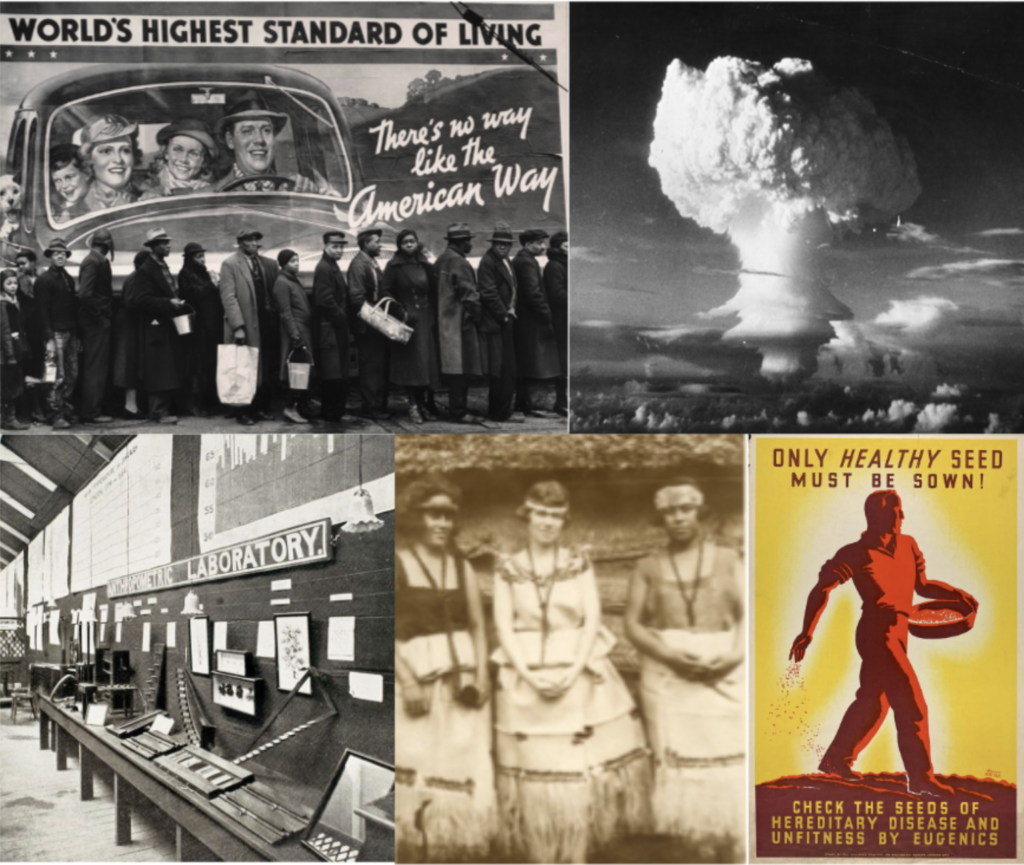
I’m really excited about this class, which is open to undergraduate and graduate students. Unlike all the courses I’ve offered in the past, this is a straight-up political science class, not a methods class. It will be based on readings and discussions from a wide range of social sciences.
This course will cover the development of modern social science and its relation to American history and culture. The different strands of the course are indicated by its title, where “rationalizing” refers both to attempts to understand society through rational means and to the role of social science in providing a justification or rationale for existing social structures.
Quantitative thinking and social science have become increasingly prominent in our society. But modern discussions of the political relevance of social science do not always account for the ups and downs of particular ideas. For example, Freudianism was huge in mid-century, both within psychology and in the culture at large, but has faded for both intellectual and economic reasons. The Keynesian revolution dominated economics from the 1930s through the 1960s but then was contested by later paradigms in response to the stagflation of the following decade. Trends in criminal justice policy have followed ideas from anthropology, psychology, and economics, and political theories of international relations have affected and been informed by developments in foreign policy. This course provides students with an opportunity to learn about these and other examples of the development and influence of theories in social science, and to form a larger connection between intellectual, social, and political history.
It is common for students to learn about just one or maybe two social sciences and not to see the way that different social sciences fit together intellectually and how they compete for influence. There’s a tendency to think of any field of study as being a static set of truths as laid out in textbooks or else a steady march of progress. In contrast, this course presents a series of booms and crashes: unsustainable enthusiasms for new ideas followed by disillusionment and controversies that are often never fully resolved. Through readings, class discussion and activities, and final projects, students should learn to see social science as a process that proceeds both internally and with reference to society.
By the end of the course, students should gain a broad understanding of the development of modern social science and its connection to American politics and society. They will read different sides of academic disputes involving figures from Margaret Mead to Milton Friedman and will gain a historically informed sense of how social science has been influenced by and has influenced culture and policy. The course should thus have value both for its methodological and historical content.
syllabus
P.S. Here’s the current updated draft of the syllabus. It has tons of reading. I’ll be extracting around one chapter per book on the syllabus, and then I’ll have to set up some sort of system so that not every student will be required to do all the readings each week.
Looks wonderful Andrew! Will the slides be available at some point? I’d love to read them?
Sylvain:
There will be no slides. I do hope to write an article and a book about it, though.
Quote from above: “There’s a tendency to think of any field of study as being a static set of truths as laid out in textbooks or else a steady march of progress. In contrast, this course presents a series of booms and crashes: unsustainable enthusiasms for new ideas followed by disillusionment and controversies that are often never fully resolved. ”
Interesting (and possibly useful and important)!
This all reminds me of several papers I came across over the last decade or so which I think have helped me to put certain things into perspective, and to become more aware of the possibility that progress might be hard to measure or assess (or perhaps even define). I hope it’s okay to share some of these papers, which may be relevant and interesting concerning the (content of the) course.
For instance, seven years ago or so I was reading some things concerning the so-called “replication crisis” for a manuscript I was writing at the time, and came across some papers which provided information that crises have been around for much longer. That was new for me, especially in light of all the very enthusiastic people and papers and talking about “the replication crisis” at the time. I think it would have been useful for me to be(-come) a bit more aware of things like that happening in the past, just for some perspective and things like that, at an earlier stage.
For instance, Lewin (1977) writes: “This paper examines the crisis in social psychology in the light of attempts to solve the same problems fifty years ago. The fundamental question is, are the phenomena of social psychology lawful?” (p. 159). And Sturm & Mülberger (2012) write: “This special issue is devoted to the analysis of discussions of the crisis in psychology that took place from the 1890s through to the mid-1970s.” (p. 425)
Another interesting, but for me pretty difficult to read due to the language/words used, paper was Koch (1981) where the following can be read in the conclusion section which I thought about after reading about the new class/course:
“I have been inviting a psychology that might show the imprint of a capacity to accept the inevitable ambiguity and mystery of our situation. The false hubris that has been our way of containing our existential anguish in a terrifying age has led us to prefer easy yet grandiose pseudo-knowledge to the hard and spare fruit that is knowledge. To admit intellectual finitude, and to
accept with courage our antinomal condition, is to go a long way toward curing our characteristic epistemopathies. To attain such an attitude is to be free.” (p. 269).
And finally, if I remember correctly someone on here commented something that referred to a certain paper that made clear that memory or language process-related research may not have made much progress in the last (50 or even more) years or so. If I remember it was something like that, and this was mentioned on here about 6 months ago (?) would be my best guess. Anyway, such papers might be very important and useful for students to be(-come) aware of, if only to at least make them more aware of the possibility that things may not progress that clearly or optimally, or that it might be hard to measure progress, etc.
References:
Koch, S. (1981). The nature and limits of psychological knowledge: Lessons of a century qua “science”. American Psychologist, 36, 257-269
Lewin, M. A. (1977). Kurt Lewin’s view of social psychology: The crisis of 1977 and the crisis of 1927. Personality and Social Psychology Bulletin, 3, 159-172
Sturm, T. & Mülberger, A. (2012). Crisis discussions in psychology – New historical and philosophical perspectives. Studies in History and Philosophy of Biological and Biomedical Sciences, 43, 425-433
Its so irritating when people do this. We should think to ourselves, “its just some person like me that wrote some words and drew some pictures.”
Textbooks in particular need to be simplified, so are almost always in disagreement with the actual literature/evidence on this or that seemingly unimportant but actually foundational point.
Sounds interesting – wish I could take it! One of my favorite classes in undergrad was my American Studies course, tracing manias from the witch trials to the satanic panic. It’s very fun to trace these types of threads through history.
It falls ever so slightly outside your timeframe, but I hope you’ll talk about Ida B. Wells’s analysis of lynching in The Red Record (1895), and the scientific method applied to the study of injustice thereafter. It’s a powerful thread with more meaningful wins than any other domain of social science.
Andrew–
I saw the multiple meanings of rationalize, but not the same two you invoke. I, too, took it to mean “to understand society through rational means”; but the other meaning I thought of was ‘to reorganize according to rational principles’. This latter meaning is pretty much the opposite of ‘justifying existing social structures’; it represents the impulse to change society so as to make it better using rational principles. I think the latter impulse of societal reform has been a major theme in at least post-World War II social science, (for example in education, public health, and economic security).
Gregory:
Ahh–good point! I’ll add that third meaning.
“Analysing Rationalizing the World: The Hopes and Disappointments of American Social Science from 1900 to the Present”?
(The professor/course/students do the “analysing” of the “rationalizing the world” by others/other things?)
This may also fit with what comes after the colon. The part after the colon “The hopes and disappointments of american social science from 1900 to the present” may fit nicely with the “analysing” of the “rationalizing the world” (?).
Some basic familiarity with the works of Durkheim and Weber (no idea how they are read in English) might be a start. Knowledge of the Humboldts might also be of help. And, please (your favourite deity here), no slides.
An interesting book about the German historical tradition and progressivism/radicalism in the US is Atlantic Crossings: Social Politics in a Progressive Age by Daniel Rodgers. All these folks who went to Germany in the late 19th c. to study “scientific” approaches to reform, then came back and promoted public health, housing, welfare systems, etc. It mostly predates Andrew’s time focus, but its impetus lasts well into it.
And of course Trust in Numbers: The Pursuit of Objectivity in Science and Public Life by Ted Porter. I didn’t agree with everything he said, but the overall story is important.
Thank you for the Rodgers reference – meanwhile, back at the ranch, I keep looking at the British Social Attitudes surveys; gotta keep on the ground I’m familiar with ;-) As for Porter – thanks for the reference – the publication date is significant, in my humble opinion.
This sounds like a great class! Could you post the syllabus? We need to encourage more of this stuff.
It’s especially interesting to read this on the day that the Supreme Court is revealing its intent to overturn Humphrey’s Executor, which is really repealing the Progressive vision of government by expertise. Reports I’m seeing indicate the majority will try to craft its ruling to carve out the Fed, because in this one case they want to preserve independence. I guess economic expertise is different from every other kind.
Are you surveying the debate between Lipmann and Dewey over democracy and/or rationalization?
Picking up on your comment, I’ll ask a question here that someone may be able to answer. How can the Court decide the President can fire these Commissioners at will without declaring the acts creating these agencies unconstitutional? Didn’t Congress establish these agencies specifically to have multiple commissioners with bipartisan representation and terms that exceed those of the Administration? There would be no purpose to such provisions if they intended the President to fire without cause (especially when they also included the phrase that it needed to be for cause). So, it seems to me that the acts creating these agencies must be unconstitutional if the Court sides with the Administration here.
Also, my perception is that Jackson is the only careful thinker on the Court now. She asked the right questions – about why these agencies were created in the first place and why in this way. Now I know that many conservatives don’t believe we should have these agencies – and I think perhaps more should have such a structure if the rationale is that these are areas requiring technical expertise and decisions should not be done and redone too easily – I think that logic might apply to many areas (environmental protection, education, etc.) that have single appointed officials. In any case, Congress treated some of these areas differently than the others, and did that intentionally (back to my original question).
Another argument that came up that seem warped to me: what limits the powers of these quasi-independent commissions? Plenty, I think. Congress holds the purse and has the ability to pass laws to override or reverse agency decisions. The President also has similar abilities through executive orders, although these may be more questionable legally. I know that some people view these constraints as ineffective and view these agencies as out of control – much the way I may view the Executive Branch as out of control since Congress fails to constrain its actions. But that is the way the system is designed – why only complain about failure to do oversight of quasi-independent agencies, but not about failure of Congress to constrain the Executive Branch (just pointing out what I see as one more hypocritical position).
Clarence Thomas’ position is exactly yours (swallow that!). He thinks that severability is bonkers, exactly because the provisions of who could fire whom was doubtless an important part of the underlying negotiations that got the bill passed that set up the agency in the first place. He would force Congress to go back and make the agency constitutionally valid.
Yeah, it’s hard to swallow me being in agreement with Clarence. But if he says what you state, then I agree. If the firing without cause is legal, then the agency creation is not legal. Contrapositive: if the agency creation is legal, then the firing without cause is not. But the Court is somehow avoiding having to rule on whether the agencies are constitutional or not – bonkers is right.
Peter:
I posted the current draft of the syllabus as a P.S. above. Regarding your specific question: I’m not sure, I’ll have to read some of this stuff during the next month!
Whoa, that’s a lot of material! I’ve only given it a quick skim, but two thoughts:
1. Don’t leave out Dewey. I would use a portion of Robert Westbrook’s John Dewey and American Democracy. His idea of “intelligent action” (very Progressive) as an antidote to fascism is worth reviewing. It echoes a lot in current debates.
2. About the attack on Keynesianism in the 70s. Stagflation was a red herring; Solow and Tobin (among others?) were always clear on the persistence of expectations and the instability of the Philips Curve. From what I understand, the counterattack from Chicago was a conjoining of conservative hostility to activist macro policy and the rational choice revolution that was coming on board at that time. Rat choice was initially based on very simple assumptions — limited interaction among agents, restrictions on expectations — and was predesigned to support more libertarian conclusions. Later versions of rational choice generated Keynesian-type multiple equilibria or at least macro-level suboptimality and so activist macro came back with lots more window dressing. Sometimes a limited or crippled “rationalism” is the enemy of rational thought.
In the ’70s we had the debate between napkin economics and Keynes'(1936) Chapter XII. The napkins won out, and since then it’s been diapers all around.
Neat, I took history/intellectual history with Bannister as an undergrad.
I think that you have a lot of 1950s material in week 2, but almost all of that was really post-world war ii critique, it’s the emergence of the concept of post-industrial, not the industrial. (Meaning, Mills, Whyte, Jacobs etc). Week 2 in terms of time period has so much possibility. But it doesn’t seem like the decades are what is really the organizing principle.
Elin:
The organizing principle of the decades is that for each decade there is a social science that was big at that time, and then in the corresponding week of the class we cover a century’s worth of developments in that area. So the readings for decade X are not things that were written in decade X, they’re the readings corresponding to the social science that is the subject of that week’s discussion and that was a big deal in that decade. Also I want to give them a snipped of popular history or fiction or film from each decade to give them some sense of that period in American social and political history. . . .
At this point I’m kinda wishing I had another year to prepare the course. But really there’s no way forward except to jump in.
Absolutely jump in.
So is sociology the theme for week 2?
I think you should add the Sutherland White Collar Crime ASR piece, which is short but so representative.
Also maybe something by Veblen because he underlies so much of everything else.
The theme for Week 2 is the study of modern industrial society, so, I guess, yes, this is mostly sociology.
Quote from above: “At this point I’m kinda wishing I had another year to prepare the course. But really there’s no way forward except to jump in.’
I am not sure how to interpret the above sentence, but when reading it I was reminded of the recent blog post (dated december 7th 2025) about the life of the artist, in which you write the following:
“My main goal is not to create unique works of art (even though, yes, I try to make each article and book and even blog post as beautiful and perfect as I can) but rather to advance our understanding.”
In light of that quote, I thought that perhaps if your students who properly take the course will have a better understanding of (some of the) things you intend for them to have a better understanding of (I hope I phrased that correctly), the course at this point in time perhaps doesn’t have to be as beautiful and perfect as you could possibly make it if you had, let’s say, many more years to prepare the course.
I feel like week 12 is very unbalanced (and a bit repetitive). I think you either need the Inequality by Design or if you want something more popular at least Mismeasure of Man or Not in Our Genes.
Thanks. And I’ll have to pare the readings in any case, so that should help with the repetition.
Chomsky is authoritative on public opinion. Don’t know if he merits inclusion in the syllabus.
For Rational Choice…Guillermina “Willie” Jasso is one of the few exceptional value-neutral sociologists. She edited a (Summer1997) Special Issue of ‘The American Sociologist’ on ‘The Place of Rational Choice in Sociology: Perspectives from Six Architects of Modern American Sociology’. Your students may find this interesting.
Chomsky needs to be included in any IR or history syllabus, at least. He has amazing amounts of evidence for his claims. I don’t see him in the syllabus, though.
Well done. It’s a labor of love to put together a whole new course.
I agree with Peter Dorman’s sentiment: “Whoa, that’s a lot of material!” Will you use AI to generate your chapter summaries? Some suggestions:
* You might want to think about basing your lecture on the next week’s readings so your students can incorporate your views (pro or con) on the material.
* To help your unfortunate students, you might want to point them to Chapter 1: Dissecting a Text and Chapter 2: Critiquing a Text in “Grad School Essential: A Crash Course in Scholarly Skills” by Zachary Shore. It will save them oodles of time, much hair, and loads of embarrassment (I’m thinking of Elliott Gould’s dissertation defense in “Getting Straight”).
I hope you post your thoughts at the end of the course.
Restore a deleted “grin” after my chapter summaries comment!
Vladimir:
The above-linked syllabus is the first draft. I’m trying to get more focused on the readings before the semester begins.
Minor point regarding the syllabus. You may have confused David Axelrod (the Democratic political consultant) and Robert Axelrod (the political scientist) under your Week 7 readings.
Also, I wish I could take this class from you!