A few years ago we had a post on the lack of clear evidence on the long-term effects of children on being whacked by their parents. This is sometimes called “corporal punishment” but I think that term is too mild, because from the kid’s perspective what’s relevant is not the “punishment” part (to a kid, the adult world is full of ever-changing rules, so you can be punished for pretty much anything if the adult in power decides to do so) but the bit about being hit by someone who is taking care of you and is possibly supposed to love you. It’s also sometimes called “physical abuse,” which to me seems like an accurate term but which I will avoid because the term “abuse” when applied to children brings to mind sexual abuse which is not what I’m talking about here. So I’ll stick with “whacking” which I think conveys the pain of being hit, if not the feeling of betrayal.
Back in that earlier post, I questioned some journalists who reported certain pro-whacking research (“The research, by Calvin College psychology professor Marjorie Gunnoe, found that kids smacked before age 6 grew up to be more successful . . . ‘The claims that are made for not spanking children fail to hold up. I think of spanking as a dangerous tool, but then there are times when there is a job big enough for a dangerous tool. You don’t use it for all your jobs.'”). Nothing wrong with citing this work, but then it would make sense to also cite the research pointing in the other direction.
And this goes both ways. John “not Towering Inferno” Williams writes:
My step-son is visiting, along with his wife and two boys, aged 4 and 6, and I’ve retreated upstairs to my study. My step-son and wife are following what seems to be the current norm for parenting, which involves trying to reason with or distract misbehaving children, rather than setting limits and teaching them that breaching the limits has consequences. The boys, being bright, realize that they can get away with all kinds of misbehavior, and take full advantage of this.
Now, I was raised by pretty permissive parents: my father spanked me only once, and my mother never did. However, behaving badly got me or my sibs put “out of the living room” for five minutes for the first offense, longer for subsequent ones, and this was enforced. I don’t recall that we ever resisted this, probably because on an unspoken threat of corporal punishment if we did, but in any case, some semblance of order was maintained.
Anyway, the noise from downstairs got me wondering where the current fashion for child rearing came from, so I started poking around on the web, and came across sites such as that of the Center for Parenting Education, where I found “The Case Against Corporal Punishment,” which among other things says that:
Children who are hit as toddlers have a lower IQ than children who are not spanked.
According to Murray Straus, a professor at the University of New Hampshire and Director of the Family Research Lab there, children who were spanked or slapped averaged a five-point drop in IQ.
The strongest link between corporal punishment and IQ occurs when parents continue to hit their children into their teen years. Yet, “even small amounts of spanking make a difference,” according to Straus. (Glenn).
This seems last implausible, so I looked up “Murray Straus corporal punishment IQ” on Google Scholar and found: Corporal Punishment by Mothers and Development of Children’s Cognitive Ability: A Longitudinal Study of Two Nationally Representative Age Cohorts 2009. Murray A. Straus & Mallie J. Paschall; here is the abstract:
This study tested the hypothesis that the use of corporal punishment (CP), such as slapping a child’s hand or “spanking,” is associated with restricted development of cognitive ability. Cognitive ability was measured at the start of the study and 4 years later for 806 children age 2–4 and 704 children age 5–9 in the National Longitudinal Study of Youth. The analyses controlled for 10 parenting and demographic variables. Children of mothers in both cohorts who used little or no CP at Time 1 gained cognitive ability faster than children who were not spanked. The more CP experienced, the more they fell behind children who were not spanked.
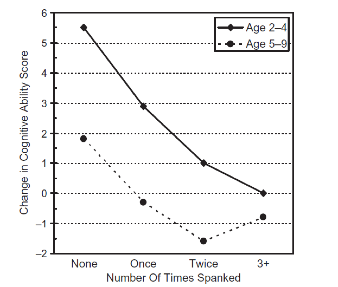
So, it is an exploratory study is looking at existing data; with lots of forking paths and measurement issues (just what is a spanking?); the main result is shown in Figure 1, with no error bars, and an unexplained benefit from very frequent spankings for older kids.
Figure 1. The more spanking, the lower the child’s cognitive ability score four years later.
From the text, we learn that the data are really for the previous week, but, not to worry.
CP was measured during two 1-week assessment periods in order to identify children who experienced as close to no-CP as possible with this data. The fact that a score of zero identifies children who were not spanked in either of the 2 sample weeks over a 2-year time span makes it plausible to consider the zero group as children for whom CP was extremely rare or in some cases nonexistent. Nevertheless, in the light of the extremely high intervention rates needed to properly supervise toddlers (once every 6–10 minutes; Lee & Bates, 1985; Minton, Kagan, & Levine, 1971; Power & Chapieski, 1986), there were innumerable opportunities for the mothers to use CP as one of the disciplinary tactics and, as another national survey found, 94% of parents use CP with toddlers (Straus & Stewart, 1999). Thus, the CP scale used for this study does not eliminate the possibility that the children in the zero category experienced CP on rare occasions.
Google Scholar also lists a 2009 talk, explaining that the decrease in corporal punishment explains the recent increase in IQ scores: DIFFERENCES IN CORPORAL PUNISHMENT BY PARENTS IN 32 NATIONS AND ITS RELATION TO NATIONAL DIFFERENCES IN IQ*; here is the abstract:
A previous study found that spanking by parents of two nationally representative age cohorts of children found that the more spanking at the start of the study, the more the child fell behind in development of cognitive ability when tested again four years later. There is also evidence of a world-wide decrease in use of corporal punishment (CP) by parents and of a world-wide increase in IQ. The combination of these three sets of research results suggested the hypothesis that the decrease in use of CP is part of the explanation for increase IQ in many nations. A preliminary test of this hypothesis was tested using data on CP experienced by 17,404 university students in 32 nations and data on national average IQ scores. The results show that the higher the percent of parents who used CP, the lower the national average IQ. These results provide additional evidence on the harmful side-effects of CP. Because the historic decrease in use of CP is accelerating, these results also suggest future gains in national IQ.
Murry seems to be a big gun in the anti-corporal punishment world, so I looked up some more of his stuff, such as
Murray Straus 2010 PREVALENCE, SOCIETAL CAUSES, AND TRENDS IN CORPORAL PUNISHMENT BY PARENTS IN WORLD PERSPECTIVE
This starts with:
This article looks at corporal punishment by parents from several angles–from its links to familial behavior patterns to global variations in its use. First, it describes the prevalence of spanking and other legal forms of corporal punishment (CP) around the world. Second, it presents and illustrates a theoretical model arguing that an important part of the causes of CP are to be found in the nature of society. Third, it presents some of the evidence that a world-wide reduction in the use of CP is taking place. Fourth, it suggests changes in society that may be producing the decrease. The bulk of the research leads to the conclusion that CP has harmful side effects, and that conclusion is an underlying assumption of this article.
At least he is forthright about assuming his conclusion. Anyway, farther down:
How often parents use CP is critically important because many of the adverse effects on children are in the form of a “dose response”–that is, the more frequent the CP, the greater the probability of the adverse side effect. This is illustrated by studies of the relation of CP to depression,8 antisocial and cognitive ability.10 The dose-response pattern is also the basis for the erroneous claim that, when rarely used, spanking is harmless.11
Going to 11 in the references gets to a couple of comments on other articles.
11. See generally Diana Baumrind, Robert E. Larzelere & Philip A. Cowan, Ordinary Physical Punishment: Is It Harmful? Comment on Gershoff (2002), 128 PSYCHOL. BULL. 580 (2002); Robert E. Larzelere, Response to Oosterhuis: Empirically Justified Uses of Spanking: Toward a Discriminating View of Corporal Punishment, 21 J. PSYCHOL. & THEOLOGY 142, 146 (1993).
The main thing I learn from all this is that Straus thinks ever hitting kids is bad, but I don’t see a lot of evidence that “even small amounts of spanking make a difference.” Certainly corporal punishment can be overdone–when I was young, many decades ago, I had friends whose father whipped them badly with his belt, and that was indeed bad. I don’t doubt that even much less than that is bad–I hit my own kid only once, when he didn’t come away from the waves on a dangerous beach when I told him to–but I don’t see evidence that an occasional swat on the bum is going to hurt a kid. I’ve spent only a couple of hours looking into this, so maybe there really is good evidence on that hitting kids is always bad, but it smells a lot more like ideology than science.
I think it’s fair to say that the research results on the effects of parents whacking children are not so clear, and that’s kind of inevitable given the observational nature of the data, the difficulty of recall, reporting errors, etc.
Parenting can be tough. Whether you think it’s ok to handle your frustrations with the job by occasionally whacking your kids until they cry, that’s your call. Unfortunately, your kids don’t have much of a say in it, at least not until they’re big enough to fight back.
I don’t think any of the studies under discussion considered the immediate effects of whacking, balancing out the parent’s stress release and feeling of satisfaction in exercising power with the child’s pain and feelings of betrayal.
It’s kind of funny (in the interesting, not the ha-ha sense) to consider only the long-term effects, and none of the intermediate effects, of an immediately violent action that’s pretty much being taken for the purpose of giving immediate satisfaction to the perpetrator.
If you ever decide to read the book “Shepherding a Child’s Heart”, by Tedd Tripp, it will inform you that there is another option on the table which appears to be totally ignored by most researchers: there is a way to use corporal punishment in ways that are NOT revenge, that do not make kids feel betrayed, and are, quite simply, not abuse. To me, the presence, though probably rare, of this kind of corporal punishment would seem important if politicians are getting too big for their britches and trying to muscle in on legitimate parenting as they tend to do all too often. It’s a confounding variable to the entire research program. I totally agree with you that the research appears to be inconclusive: perhaps this is a reason why.
Adrian Keister wrote:
“corporal punishment in ways that are NOT […] abuse.”
Wikipedia: “A corporal punishment or a physical punishment is a punishment which is intended to cause physical pain to a person.”
Wikipedia again: “Physical abuse is any intentional act causing injury or trauma to another person or animal by way of bodily contact.”
When making a claim such as yours, you really need to think of ways to mince the words, because the words are your enemies, and a little mincing makes them less effective.
He used his words accurately.
Sure, he used his words accurately, so accurately that they directly contradicted each other, which rendered his statement meaningless.
What difference does it make if the parent is NOT doing the whacking in revenge? The only thing that matters is what is going through the kid’s head. And as Andrew pointed out, the kid is likely unclear about why he got whacked and how to avoid it in the future since the criteria seem arbitrary.
The one time my father spanked me was because some other neighborhood kids enticed me to sit on the hood of someone’s car. I was already terrified of my father’s temper and would never do anything to cross him, so absolutely nothing changed in terms of my discipline except a new and vague sense that bad things could randomly happen at any time. In hindsight, I think his fury was triggered by a sort of swim lanes kind of thing in which us kids encroached upon a car, which is adult turf. Or something like that.
No, kids nearly always understand why they are being spanked.
You seem to have some unresolved issues from your children. If you want to learn about spanking, read a book, or talk to any of the millions of parents who use it in a constructive way.
Roger:
I expect that kids generally understand that they’re being whacked because (a) their parents are feeling frustration and this is an easy way for them (the parents) to discharge that frustration, and (b) their parents can get away with it. But I’m sure that different kids have different takes on the matter, and it also depends on the age of the kid, how hard the kid is being hit, whether the parent is drunk or sober, all sorts of things. It can be tough being a kid, living in a household where big people have control over you and sometimes hit you hard, just because they feel like it. You have to develop a “theory of mind,” as the philosophers say, and try your best to avoid being in the wrong place at the wrong time.
Your responses are baffling to me. I have never even heard of kids with such experiences.
Roger wrote:
“Your responses are baffling to me. I have never even heard of kids with such experiences.”
Except my first-hand testimonial above…right? Or maybe you just assume I made it up.
Let’s flip this around. You could only have such a strong opinion on this if you personally experienced the opposite. After all, you can’t really know what is going on in some other kid’s head, even your own kids. So please describe the times that you were spanked as a child and exactly how those events shepherded your soul to a better place.
Matt, your story is that your father once spanked you for sitting on the hood of another car. I accept that at face value and do not have any opinion about it. But nowhere do you say that your father was using the violence to discharge his own aggression, or that he was using you as a prop to calm himself, or that he betrayed you, or that he was spanking to relieve his own frustration.
Roger wrote:
“But nowhere do you say that your father was using the violence to discharge his own aggression, or that he was using you as a prop to calm himself, or that he betrayed you, or that he was spanking to relieve his own frustration.”
Wow, that is a perfect encapsulation of why I think my father spanked me. All those things. What else would it be? All he had to do was explain to me why I needed to stay away from other people’s cars, and I would have done it. I was not a mischievous child. He never told me why what I did was wrong or how to avoid getting spanked in the future.
And if you are trying to fit your good parenting model to my father, all I can say is you never met my father!
“What else would it be?” Are you kidding? This is a blog on Statistical Modeling, Causal Inference, and Social Science. Readers here should be able to think of about ten more likely explanations.
Your story doesn’t even make any sense. Your father told you that you were being spanked for sitting on someone’s car. And he apparently did tell you how to avoid getting spanked, because you never got spanked again.
This particular thread has reached what Phil calls “garbage time.” It’s particularly ridiculous here, because Roger is getting into an argument with Matt about . . . Matt’s dad!
Sorry, Roger, but I gotta assume that Matt knows his dad better than you do. Just give it up.
I don’t necessarily agree with the OP but I don’t see anything wrong with what was written. Physical pain != injury or trauma.
There should be a better way to discuss what is the appropriate way to discipline children, and people in general.
Do you think that taking away toys from a child is mental abuse? Or, another way: is there any form of punishment for children that is not “abuse”?
All of the arguments against spanking also apply to taking toys away, or any other form of parental discipline.
From reading a little about the book it seems absolutely abhorrent to me, starting with the premise that humans are not born morally neutral and our sinful nature must be dealt with through violence. Can you expand on what “option” this is, where corporal punishment is not abuse?
**Warning: ill attempt at humour to cope with an otherwise distasteful topic**
Perhaps I have watched too many gangster movies — OK, I have — but I primarily associate the word ‘whacking’ with murder. Let me quote from a hypothetical research proposal to study the effects of ‘whacking’:
‘If a parent successfully whacks their child in the mobster sense, we hypothesise that their IQ will drop to 0, even after the first instance (a highly significant effect!). However, the exact magnitude is unknown. More research is required, so please fund our randomised controlled trial (RCT). In addition to the usual funding, we will require some off-the-books funds to bribe the IRB, a legal fund for the participating families and plane tickets to a country without an extradition treaty.’
Raphael:
From Merriam-Webster, the first definition of “whack” is “to strike with a smart or resounding blow.”
I think the use of “whack” in gangster slang is an ironic adaptation of that use.
I wrote some lyrics to a possible song about physical abuse and revenge as some sort of combination of some things Johnny Cash might sing or write about and a recent song by HARDY titled “Wait in the truck”. I used the word “whack” in those lyrics to indicate someone getting hit with something. Also, the revenge part of the lyrics and story involves a gunman, so in fact it’s about “whacking” in the other way as well I now realize. Anyway, I would love to post the lyrics here as it is also one of the last things I haven’t yet posted here concerning my lyric-writing, but I don’t know if that’s appropriate.
I wrote the lyrics with the idea of a singer like Johnny Cash singing it, with a certain talking-singing approach and with a certain music to it. Just like Johny Cash’s song “One piece at a time” is about stealing, but it doesn’t “feel” that heavy, possibly due to the style of music and singing and the humor aspect. The lyrics I wrote might also tie in to some story-telling blog posts on here, and with A.I. writing and/or poetry. More specifically, what A.I. is capable of concerning writing a coherent story with certain nuances and details to it. I estimate A. I. is not capable of writing lyrics I wrote in this light, but I am not sure.
It was me
(Verse)
In a flash I saw the light of the moon,
reflected in whatever was in his hands
After I made the mistake of speaking too soon,
and just before another one of his rants
I blamed the whiskey, and the good Lord,
for the things he did, and all of this mess
But I wasn’t the only one who scored,
as he was blaming me, and continued to transgress
(Chorus)
I am not sure what I had done,
if I was good or bad, right or wrong
The angel on the one, and the devil on the other shoulder,
seemed to either fade away, or merge as I grew older
All I knew is that I didn’t want to be
in any way like him, so I thought it was me
(Verse)
In a flash I saw the buckle in the air,
after which I briefly closed my eyes
I couldn’t watch her get hit sitting in her chair,
at least not the first whack, before the cries
I blamed myself, and the Devil,
for the things he did, and all of this mess
Maybe one day things would be more level,
so I could finally make it stop, and alleviate her stress
(Chorus)
I am not sure what I had done,
if I was good or bad, right or wrong
The angel on the one, and the devil on the other shoulder,
seemed to either fade away, or merge as I grew older
All I knew is that I didn’t want to be
in any way like him, so I wished it was me
(Verse)
In a flash I saw the side of my face,
reflected in the mirror as I passed by
After I walked up the darkened staircase,
and just before watching him die
I couldn’t blame the whiskey, the Devil, nor the Lord
As I was sober, and conscious of what I had done
In his final moments he wasn’t even floored
because he knew why, and saw the gunman: his own son
(Chorus)
I am not sure what I had done,
if I was good or bad, right or wrong
The angel on the one, and the devil on the other shoulder,
seemed to either fade away, or merge as I grew older
All I knew is that I didn’t want to be
in any way like him, so I decided it was me
(Bridge)
Now, I could have run,
or made it seem like a break-in
But I still had the gun,
and in the rear-view mirror I saw a grin
If I would have blamed something or other,
I would also break a promise to my mother
You see, I told her I would never become,
like the man that gave her her son
In a certain way I could also see,
that I was now finally free
The time behind bars would probably be,
less than the time he had taken from me
So I decided then and there,
to just drive to the station and declare
that I had been the one who made the mess,
and to state that I would fully confess
So, I said my prayer and took my key,
and walked through the doors and said it was me
I simply told them what I had done,
and that he shouldn’t have laid his hands on my own son
(Chorus)
I am not sure what I had done,
if I was good or bad, right or wrong
The angel on the one, and the devil on the other shoulder,
seemed to either fade away, or merge as I grew older
All I knew is that I didn’t want to be
in any way like him, so I said it was me
FWIW my immediate reaction from the title that it was going to be about some mob family assassination stuff.
It’s similar to mobster slang where “a hit” means a murder, not a blow. Thus a “hitman” is a killer for hire, not a someone who has been slapped.
There’s good joke from that in the movie “Analyze This”, “A comedy about a psychiatrist whose number-one patient is an insecure mob boss.”
Dr. Ben Sobel: You know what I do when I’m angry? I hit a pillow. Just hit the pillow, see how you feel.
[Vitti pulls out a gun and empties the magazine into a pillow]
Boss Paul Vitti: There’s your fuckin’ pillow.
Dr. Ben Sobel: Feel better?
Boss Paul Vitti: Yeah, I do.
I doubt that any of the spanking studies have the necessary controls.
A lot of behaviors are heritable. So violent nonconforming parents have violent nonconforming kids. Genes may lead the parents to spank, and for the kids to have bad outcomes, but with no causality.
Maybe the parents do not even believe in spanking, but the kid is naturally so badly behaved that the parents spanks. That is, the bad behavior in the kid leads to the spanking and to the later bad outcome.
There are ethnic differences in spanking attitudes.
Parents have to discipline their kids somehow. Unless the study compares spanking to other discipline methods, it is useless.
Thus far, no mention about what gender was likely to be spanked compared to the other. Is it taken for granted that boys are more likely to be spanked? And harder? Or, is it understood that gender is irrelevant to the discussion?
And race as well!
“… of an immediately violent action that’s pretty much being taken for the purpose of giving immediate satisfaction to the perpetrator.”
I don’t think that corporal punishment is necessarily administered for the purpose of giving immediate satisfaction to the perpetrator. Perhaps it is in many, most, or even nearly all cases–I don’t know. But I recall one occasion when I obstructed my father’s view while he was driving down a highway. (This was before the seat belt era–things like that don’t happen when car occupants are appropriately restrained.) My father pulled the car to the side of the road and immediately spanked me.
My father was a person with a very calm temperament and no violent tendencies. I doubt very much he took any pleasure in hitting me then. I also remember him saying at the time, very calmly, that he was doing this because my misbehavior was extremely dangerous, potentially fatal to both of us, and that he felt he had to impress upon me the how serious it was in a way that I would never forget. It was one of only two times he ever struck me. The other, I’m told, was also occasioned by doing something life-threatening (this time, to myself only), although that instance took place at an age when I was too young to remember it now.
Having a world model is really helpful. I agree with their conclusions entirely from a practical standpoint but none of these studies pass the smell test. Spanking a child a few times will not affect their IQ. Short of abuse, it’s just silly. However the expected punishment of children is culturally mediated. So in a culture where hitting kids is an expected form of punishment it will be less harmful to your children than in a culture where it’s unthinkable. I think this is the world our parents lived in. The worst behaved children react terribly to corporal punishment, which is ironic because they are ones who need it most. There is good evidence it doesn’t work well on these kids. if your kid reacts positively to this form of punishment it’s actually a great signal they’d respond well to other punishment. Kids who get hit often tend to be assholes, and there is large within family variation on hitting. Also different punishments work well at different ages. Maybe spanking works okay between 5-10, but it gets weird older, and it’s incomprehensible younger. If you’ve had 3 or 4 kids, and one of them has behavior problems, you can test all the theories. If hitting a kid caused IQ issues having siblings would cause them as well, it doesn’t. Motivated, embarrassing fake studies.
Gen:
I disagree with your statement that spanking a child is “silly.” I don’t think it’s silly for the parents, who are typically furious and are using the violence to discharge aggression, basically using somebody else’s body as a prop to calm themselves down, and I don’t think it’s silly for the child, who gets pain, betrayal, and the feeling of being dominated by someone more powerful.
You know that saying, “This hurts me more than it hurts you?” I wish that every parent who is going to strike a child would instead decide to punch the nearest wall, really hard, then show the kid their bloody hand and say, “See what you made me do?” Then the parent gets to discharge that feeling of fury and the kid doesn’t get hurt. Win/win.
I read GenX as saying “it’s just silly” that spanking a child nonabusively a few times would affect their IQ.
Andrew,
When I hit my kid I wasn’t furious, I was scared as well furious, and I didn’t think I got pleasure from it; I was trying to get his attention about staying the hell away from the waves.
I hit a wall once long ago when my girlfriend of the time said something that set me off. It was a sheetrock wall, but I hit a stud and broke a bone. Weeks later, when my hand was in a cast, I gave a hitchhiker a ride, and was talking openly to him in the way that people sometimes do with strangers. His straight-faced advice was that if you have to hit something, hit an interior door, which are solid only at the edges.
Polls indicate that a large majority of parents believe that spanking is a necessary part of child rearing. So no, they are not “using somebody else’s body as a prop to calm themselves down” or anything like that. They simply practicing a well-accepted method of child discipline.
Roger:
I don’t get what you’re saying. Just cos a majority of parents whack their kids, that doesn’t mean they’re not using somebody else’s body as a prop to calm themselves down. This is just something that a large majority of parents do, because they can, and nobody can stop them.
> I wish that every parent who is going to strike a child would instead decide to punch the nearest wall, really hard, then show the kid their bloody hand and say, “See what you made me do?”
Is this not.. mental abuse of children?
Dan:
Yes, such behavior would be characterized as mental abuse, and I don’t think it’s a good thing! I still think it’s better than physical abuse, first because it doesn’t hurt so much and second because it causes enough pain to the parents that perhaps it would dissuade them from doing it so often. But I’m no expert in this area; this is my speculation. Please don’t take the above comment as a recommendation from me to punch a wall. I think that punching a wall is preferable to punching a kid, but I think both these things are bad ideas, even setting aside any potential long-term effects as were discussed in the above-linked paper.
Based on nothing but my prejudice, I have a non-monotonic model of corporal punishment: i.e., violence on children.
1. It “works,” in the sense that it leaves a very strong impression on a kid.
2. It is less effective the more often it is used.
3. The possibility of corporal punishment backstops other forms of parental discipline.
4. Its harms are cumulative.
This implies two things:
1. There is some optimal frequency of corporal punishment: maybe a few times in a childhood.
2. It should only be used when it is very very important to make a very very strong impression.
Things change. The word “silly” has been mentioned a few times today. Its meaning down through the centuries is well-tracked, partly because today’s meaning is quite different from the earlier ones:
https://talesoftimesforgotten.com/2016/11/28/the-facinating-evolution-of-the-word-silly/
“The word changed its meaning again and came to mean ‘noble’, ‘righteous’, ‘brave,’ or ‘virtuous’.”
But then was then for Shakespeare’s Juliet, a silly girl.
I don’t have children so I don’t have a dog in this fight…or a child, obviously.
Andrew, I do think you’re missing something that a few other commenters are trying to convey. Let me try it another way.
Imagine a parent thinks that whacking their child is the most effective way to get them to do something or to stop doing something. When I say “most effective” I mean some combination of immediacy and permanence (I.e. this isn’t just going to change their current behavior, it’s going to change what they do in the future). If such a parent thinks a behavior is sufficiently important, they might whack their kid even if they (the parent) are not angry or frustrated at all.
You’ve repeatedly suggested that the only reason people whack their children is for the parents to relieve their own frustration. You have parents in these comments telling you that’s not true. Do you think they’re lying? That was a rhetorical question; obviously you think they’re lying. I think you should seriously consider the possibility that they’re not lying.
I’m not saying it is or isn’t ok to give one’s kid a whack in certain circumstances, just that I don’t think your assertions about the motivation behind it are correct in all cases. Maybe – you- can only imagine whacking your kid if you were extremely frustrated, but that doesn’t mean that’s true if everyone!
Phil:
I don’t think that relieving frustration is the only reason that parents hit kids. I think that relieving frustration is one of the benefits that parents get from hitting kids. Everyone has their own experiences.
I want to qualify what’s below. When we look at the kinds of ways parents hurt children with intention, physically is often the swiftest and potentially most likely to lead to some sort of abusive situation. Avoiding doing so for the simple reason that any other kind of correction requires at least a moment of sober thought ought to be enough for most parents to avoid it.
Revenge, frustration, anger, etc. are not reasons to hurt a child in any way at all. The focus by anti-abuse advocates on spanking ignores the many horrible ways that you can punish a child including withdrawing affection, isolation, refusing to talk to them, restricting food, impoverishing their environment, etc. Focusing on the act of correction ignores the reason and administration of the correction. Children can tell when you are getting your satisfaction from any one of a number of abusive things you can do. And I think everyone would agree that if someone is getting satisfaction from hurting their child it’s abuse no matter how you do it.
On the other hand, a clearly laid out set of rules with structured set of consequences that are adhered to by the parent is not abuse unless the rule set and consequences themselves are unreasonable and cruel. That is true even if that rule set involves some sort of corporal punishment. What’s more harmful? A planned and expected swat on the behind for failing to follow an important safety rule like hold onto the parent’s coat in a parking lot or immediately withdrawing any kind of affection for the 10 minute drive home after said incident? Which do you think the child would select? In most cases there are escalations of discipline (e.g. removing a cell phone from a teenager) where the child would gladly trade some sort of physical discipline. Many a child would prefer a quick spanking to a drawn out time out or withdrawal of affection for an extended period.
Children need enforced boundaries to flourish. They have to know what they are and there has to be consequences for exceeding them. If we’re going to have a discussion about it let’s not confuse discipline, abuse, the nature of a consequence, and the reason for it.
The research also suggests that yelling is almost as bad or even just as bad for kids as spanking. Parents don’t feel good about yelling at their kids, but they end up doing it because of an escalation, either in kids’ volume or in potential severity. Sometimes yelling seems effective because the kids stop a dangerous behavior after the lower-volume attempts didn’t work. The gentle parenting assertion is that a more effective parent who is not at the end of their tether could find a better strategy to avoid yelling, but it’s truly hard to know due to selection effects. Maybe the yelling is itself damaging to kids, or maybe kids who get yelled at have ineffective parents who lack adequate parenting skills to find a good strategy, or maybe the yelling shows kids that their grown-ups have no self-control, or maybe no better strategy exists for those particular kids.
The hypothetical “super nanny” scenario where another adult takes over parenting to teach parents better strategies involves a change that itself surprises kids; maybe the super nanny’s tactics are not any different than what the parents would do, but the new adult gets their attention due to the novelty.
An episode of the Canadian comedy Kim’s Convenience shows ineffective gentle parenting with a young child who is rampaging in a convenience store, an actually dangerous situation with heavy things that could fall onto the kid and glass that could break, not to mention the damage to the store. The store owner flicked the kid with a finger, and that shocked the kid out of his rampage (https://kimsconvenience.fandom.com/wiki/Rude_Kid). Did the physical punishment of the finger flick hurt the kid, or was it the intervention of a new grown-up, or was it actually a more effective intervention with a kid who has lost control and might hurt themselves? I never tried finger flicking, but it might show greater self-control than if I yelled to get kids’ attention.
I have so much to do, and now this… I thought for a second that with the conflicting evidence and our tendency to like to believe what we believe, there will be no chance to sway anybody here. But I couldn’t chase the thought out of my head and then I thought that maybe there is an argument to bring to the whackers (for simplicity I segregate the world into two groups and even if you have never whacked a child but you think it’s ok to t do so, you’re a whacker). My argument relies on no statistic or research, just common sense. If you think that whacking is ok, that a bit of pain and sadness due to the administration of CP now is a small price to pay for the benefits to be reaped in the long run, tell me then, where do you draw the line? When do you decide that a domestic regimen of discipline has crossed over into abuse? I think that this is a pretty strong argument because I don’t think it’s possible to draw this line. At least it’s not possible for society to have an enforceable line unless it’s drawn at zero.
SWIM (someone who isn’t me) lived through this hell and his story was enough to convince me that the price is too high to pay to admit responsible whacking as a sound form of parenting when the parents have options. Im not going to elaborate more on SWIM’s accounts except to say that he can go on and on describing the reign of terror he was raised in. It’s like he can recall each one of these incidents, and nothing else. The trauma he was left with cannot be overstated. There is nothing worst than your home being your source of trauma. We have laws protecting children against sexual abuse; allowing CP is leaving the door upon for the possibility of physical abuse which easily morphs into psychological trauma. Put yourself in the place of the children. The next time you administer an appropriate dose of responsible parenting whacking, be aware that there are hundreds of children currently being tormented by parents who also think thye are dong the responsible thing.
I have a colleague whose research on corporal punishment found it’s not the “whacking” but the hostility of the whacker that is impactful. Anyhow, I was told the corporal punishment mafia (i.e. reviewers) rejected that kind of result because it may condone dispassionate whacking – at least, that is what I recall as the takeaway.
Interesting. Thank you. Seems self evident that this would be the case – aren’t emotional scars always deeper than any physical pain? Was the researcher not able to publish the work?