I wrote about imputation in July dreaming that we could solve practitioners’ condundrums in the comment section (like happened here, thank you Gaurav !). But this is how statistics (and life) has been for me, I keep circling around the same questions.

Let:
- Z = observed covariate
- X = unobserved covariate
- Y = outcome
We want to model E[Y | Z, X].
D’Agostino McGowan et al. (2024) look at continuous Y and linear models for E[Y|X,Z]. Sisk et al. (2023) look at binary Y and logistic models for E[Y|X,Z]. Both consider:
- deterministic imputations
- with Y: Xhat = E[X | Z, Y]
- without Y: Xhat = E[X | Z]
- random imputations
- with Y: X ~ p(x | z, y)
- without Y: X ~ p(x | z)
To understand this, let’s look at a simple example: forgetting Z, using all linear models.
We want the slope from a regression of Y on X: Cov(Y,X)/V(X)
The imputation model is a regression of X on Y: X = a + bY + e
Using the correct X = a + bY + e gets:
Cov(Y, a + bY + e)/V(a + bY + e) = bV(Y) / (b^2 V(Y) + V(e))
Using Xhat = a + bY as a deterministic imputation forgetting e gets a slope that is too big:
Cov(Y, a + bY)/V(a + bY) = bV(Y) / (b^2 V(Y))
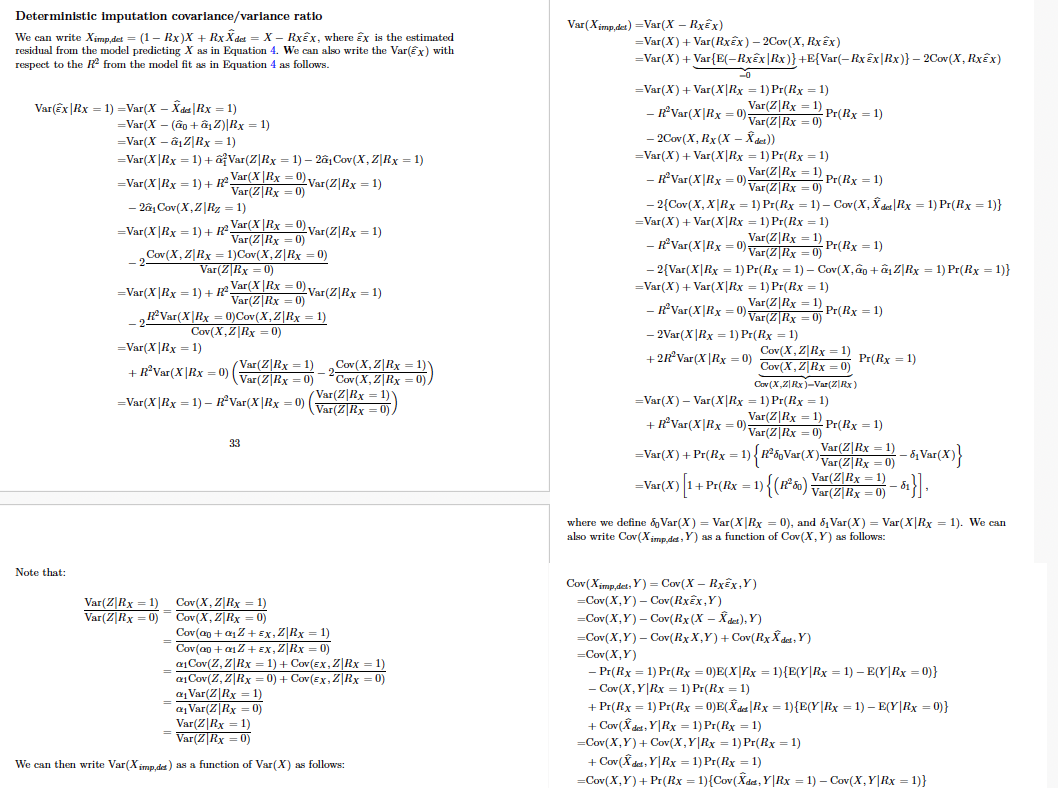
D’Agostino McGowan et al. (2024) have appendices doing long calculations to show versions of this phenomenon:
Now remember we are a team of practitioners, and different teammates have different “Y” variables. So deterministic imputation has to respect everyone’s Ys, excluding them from the imputation models. Is this an argument in favor of random imputation ? This way the team can condition fully (see the MICE algorithm, for example). Thoughts ?