Nathan Heller writes:
I first visited the Harvard.edu home page as a callow West Coast high-school student more than twenty years ago. Back then, it had links to basic topics: “Academics,” “Admissions,” “Campus Life.” There was a virtual tour and low-resolution QuickTime videos. In the lead reel, I remember, Seamus Heaney, Harvard’s Nobel laureate in literature, read a poem as a choir sang “Shenandoah.” . . . the Web site was my portal to an unfamiliar world.
Harvard.edu now has a different mood. When I looked recently, the top item was a guide to following New Year’s resolutions. Below that was a module advertising Harvard’s free branded online courses (“Building Personal Resilience,” “Backyard Meteorology”), with a link to many others–some free, some purchasable for a few thousand dollars. Next came a module with mindfulness instructions (“1. Sit, 2. Focus, 3. Expand, 4. Embrace”); another was called “Read an Engaging Book” (“Revisit anything Agatha Christie wrote. She is more brilliant than you remember. I’m immersed in the Body in the Library”). Nowhere on the home page was there any information about the academic institution.
“Backyard Meteorology”? I was curious so I went over to harvard.edu. This takes me to https://www.harvard.edu, and what I see is a long scrolling page:
Innovations from Harvard.
For nearly 400 years, the Harvard community has made important contributions to scientific, scholarly, and humanitarian progress.
The innovations listed are:
First things first:
1954. The first organ transplant
2023. The first logical quantum processor
1908. The first M.B.A. degreeLeading the way in learning:
Sesame Street
Reading braille
Multiple intelligencesMedical Breakthroughs:
1961. Defibrillator
1968. Oral rehydration therapy
1991. Functional MRI
2025. Gene-editing medicine
2016. Portable surgery
1854. A baking revolution at HarvardAthletic advancements:
The forward pass
The golf tee
The catcher’s maskAn innovation hub . . .
Bringing education to everyone . . .
Technological marvels . . .
Robot revolution . . .
Great moments in global relations . . .
Important innovators . . .
A wonderful way with words . . .
Bringing the past to life . . .
Advancing art and architecture . . .
Latest news and innovations
Nothing on the Gospel of Jesus’s Wife, but, hey, there’s not room for everything!
Seriously, though, Harvard’s home page didn’t have any of the silly things mentioned by Heller. I went back using the internet archive to versions of harvard.edu from earlier in this year, and they had different things on different days . . . ummmm, here it is, from 7 Jan 2025:
A guide to keeping your resolution
Free courses on Building Personal Resilience and Backyard Meteorology
Try a mindfulness exercise today
Read an engaging book
. . .
I don’t see anything on Agatha Christie on that page, but if you click through on the first link in the “Read an engaging book” section, it takes you to a list of book recommendations from Harvard Business School, which gives recommendations from several faculty members. There are lots of recommendations there, and it’s kind of unfair to pick out the Christie.
From this exercise I learned that Harvard changes its homepage often.
Maybe they could follow this example from the University of Oregon.
What about Columbia’s homepage?
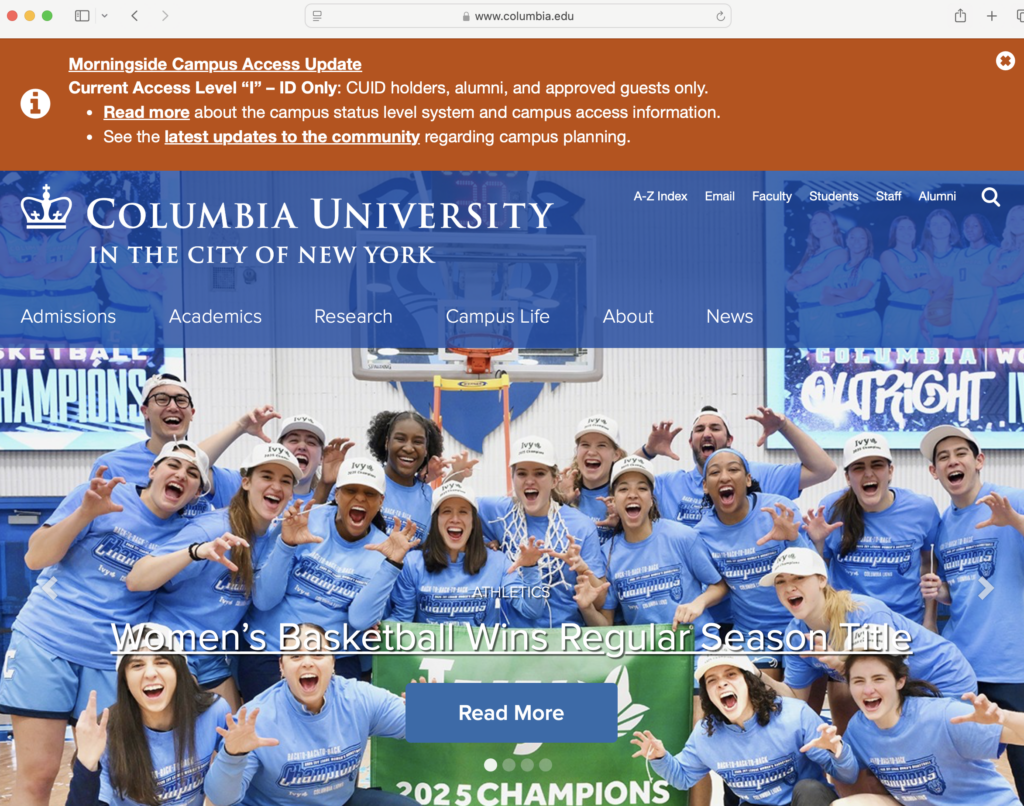
Congrats to the basketball team.
This blog post is missing one crucial element. What did you learn about backyard meteorology?😉
https://pll.harvard.edu/course/backyard-meteorology-science-weather
“Learn to forecast the weather just by looking out your window.”
so you don’t actually need a backyard
you need to be quick tho – the course starts today (Aug 15th; 108,480 learners enrolled)
“You don’t need a weatherman to know which way the wind blows…..”
“How to avoid being struck by lightning”
If there’s one thing I dislike about universities is their possible steering and nudging and directing and all that stuff.
What if I want to struck by lightning dear Harvard, have your ever thought about that! Perhaps a more neutral way of stating things might be better. Please do better Harvard.
“How to bring agency to your encounter with lightning”
If there isn’t a small group of people with different skin tones (or whatever the most appropriate word to use is according to the most recent guidelines presented by certain people who apparently think about that sort of stuff and think they know why and how and think they have the right to say something about it) sitting on a grass and smiling while holding or reading a book is it really a university website?
And don’t forget a mention of the latest research by the university’s current “super stars” with, of course, some dramatic possible major implications and perhaps a message like “more research and/or funding is needed” at the end to make sure to attempt to at least keep the money machine running.
I’m reminded now by a paper I came across a few years ago and thought was interesting: “The University lost: The meaning of the University” by McFarlane, D. A. (2013). Or maybe that’s a bit too much. Perhaps it’s better to stick to commenting on universities home pages…
(I’m gonna turn up the sound on my speakers because Electric Six “Danger! High Voltage” just started playing and I like the song a lot! Up next “Kickstart My Heart” by Motley Crue!!)
Anon:
I agree that the picture of “a small group of people with different skin tones sitting on grass and smiling while holding or reading a book” is a silly cliché. That said, it would be worse for them to feature a small group of people with identical skin tones! That would be kind of creepy.
“That said, it would be worse for them to feature a small group of people with identical skin tones! That would be kind of creepy.”
Not necessarily I reason. It depends on a lot of things. For instance, does the picture want to represent a realistic scenario, or does the picture want to represent a fair representation of the people sitting on the grass at that specific university, etc. etc. etc.
Some images of university home pages in universities in countries like Indonesia, or Japan, or China, or Zimbabwe, or Korea might have different pictures in that sense on their home pages for those kinds of reasons.
Anon:
I thought we were talking about U.S. universities here. (I guess that’s my U.S.-centrism.) Whenever I’ve walked through the campus of any U.S. university, I see a mix of people with different skin tones. I guess you’re right that things could be different in other countries.
“Whenever I’ve walked through the campus of any U.S. university, I see a mix of people with different skin tones. I guess you’re right that things could be different in other countries.”
Perhaps it’s a good thing to be(-come) aware of certain things, such as the possibility that one can be (heavily?) influenced by being, or having been, at a specific (kind of?) university. Maybe some people at certain (kinds of?) universities might say things like “please do better” (or whatever the most appropriate words to use are according to the most recent guidelines presented by certain people who apparently think about that sort of stuff and think they know why and how and think they have the right to say something about it) in situations like a person showing a possibly narrow view of things. But I’m not sure.
Regardless, that’s not me. I generally think it’s best not to use such words or sentences like “please do better”. I’m gonna listen to AC/DC “Thunderstruck” now because of the Harvard course mentioned here and the topic of avoiding being struck by lightning that was a topic in that course if I understood things correctly. Nice job on that Harvard!
And I would like to thank you for your reply, and provide a link to the following “Honest College Ad”:
https://www.youtube.com/watch?v=hbsdlSpA2GU
Anon:
1. The post and all other comments were about U.S. universities so I don’t think it’s unreasonable that I applied with that in mind.
2. You say, “I generally think it’s best not to use such words or sentences like ‘please do better.'” Fair enough; that’s your preference. But the only person in this discussion who used the phrase “please do better” was you, in an earlier comment! So you appear to be engaged in a spirited debate with . . . yourself.
1) It’s certainly not unreasonable in my view and reasoning to reason from the perspective of one’s own experience or part of the world or however you want to phrase this. If you look, and think, carefully about my (attempt at) the joke about the people sitting on the grass you might reason the “joke” only works because I reason from a particular part of the world and experience, and I assume (a lot) of the readers share this or else my “joke’ doesn’t work.
2) “So you appear to be engaged in a spirited debate with . . . yourself.”. This sometimes happens on this blog, sometimes you are even involved in it. In those now familiar cases to me it seems that you misinterpret something I write (for certain particular reasons possibly) and comment in a way that I don’t know how to react to. In this specific case here now, I will only state that I don’t think I said anything about you saying something like “doing better”, which is the only way in which your comment would make sense to me if I should have said that. But you can possibly re-read what I exactly wrote, and how, and in which context, etc. etc. etc.
Anyway, I will be leaving now because this is sort of the moment in the discussion where you have said to me that I should go to twitter or X or 4chan or whatever, to which I then state that I don’t do social media, which then has even caused someone else to then tell me I am stupid or something like that, and that’s all a bit weird and not very useful to and for me.
It’s all good, no worries.
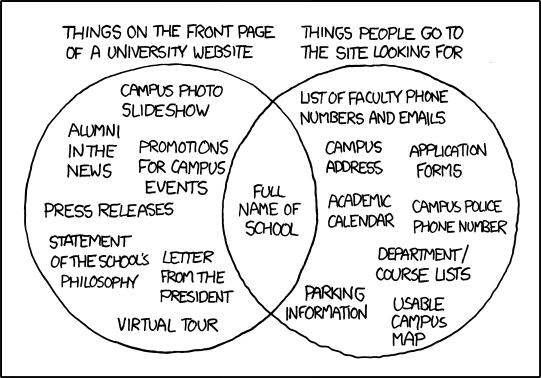
That venn diagram perfectly sums up my experience navigating my college’s website. Thanks for the laugh!
Your university (Columbia) helpfully notes right at the top that it’s “in the City of New York.” (I’m not being sarcastic; that is actually useful and probably not universally known.) And, it has a link near the bottom to a story on research on “Robots that Grow by Consuming Other Robots,” which is a cool enough title to also raise my opinion of Columbia’s home page crafting skills.
It’s so hard to find university addresses on some sites, including the city, so yes this is great. There are also other Columbias out there.
Overall, the Columbia home page has links to most things I’d look for.
Andrew mentions obliquely, the “Gospel of Jesus’s Wife” and my advice to one and all is to read Ariel Saber’s, “Veritas: A Harvard Professor, A Con Man and the Gospel of Jesus’s Wife.” I liked it so much that immediately after I finished reading it, I started reading it again. I wrote a review for a British journal, and from what appears below, you can see how wildly wrong my 2021 prediction has turned out:
https://srheblog.com/2021/01/15/bayes-keynes-king-and-fritz-fake-news-and-academics-with-fixed-ideas/
“Currently, because of the mob raid on the United States Capitol, Republican legislators are in a Bayesian quandary as to if, when and how to leave the Trump ship. The new data really aren’t all that different from the old data but after a while, as they say, enough is enough, especially when fascist-type behavior is captured on video immediately after deep-south Georgia elected two Democrats to the United States Senate. I am tempted to repeat my favorite quotation from a TV program of my youth:
‘You can fool some of the people all of the time, and all of the people some of the time—and them’s pretty good odds.’”
For any readers who are following this deeply in the comment thread, here’s my review of Sabar’s excellent book on the Gospel of Jesus’s Wife.
A school’s motto is an absolute must on a uni home page, in my view.
But then you are left with the problem of deciding, as with LLMs, does the school actually (a) have beliefs, and (b) in particular, actually believe it’s motto. Yale’s motto was written in Hebrew during the period Yale refused to admit Jewish students. Did Yale, in any sense, “believe” its motto?
It seems Columbia in particular doesn’t have any beliefs. Harvard looked like it did for a while, but that may have changed (making it’s motto (“Was Ist Das”) seem rather precient). MIT’s motto (“Mind Your Hands”), though, is appropriate for a school overly dense of male nerds. (The present author being guilty as charged.)