We recently had a discussion about useless insights from social science, and commenter Adam pointed to an article on “10 evolutionary insights” from the pandemic that I thought was kinda speculative. As I put it:
All its claims seem to me to be stretching credulity. The whole thing reminds me of an article I read in Omni magazine many years ago, featuring a bunch of what they called “partly-baked ideas.” The one I remember was to take some plant such as a Venus flytrap that opens and closes its leaves once per day, keep it in an inside environment with lighting control, and gradually decrease the period of night and day from 24 hours to 23 hours to 22 hours to shorter and shorter, until eventually the light is flickering on and off multiple times a second and the leaves are flapping so fast that the plant elevates off the ground. Clever, but I don’t think it’ll happen. That’s how I felt about the ideas in that PNAS article.
This got me curious about that article from Omni, so I did some googling, and . . . I found it! Here it is:
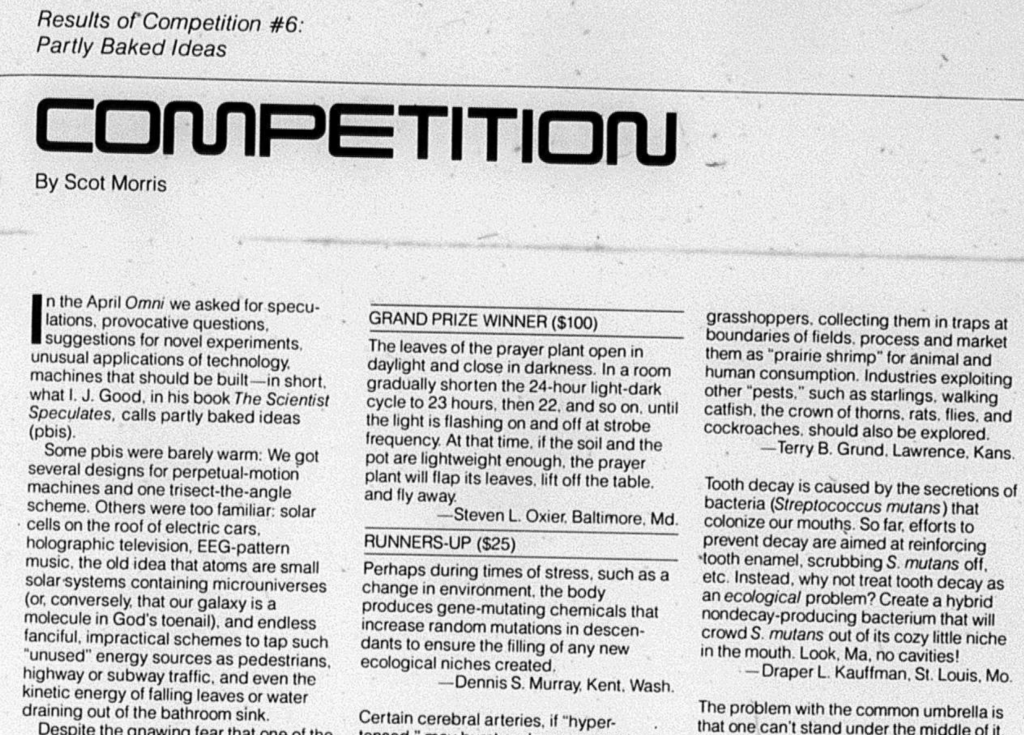
There it is–the grand prize winner, so vivid that I remembered it almost exactly, over 45 years after I came across it one day in the school library.
But here’s something new: The term “partly baked ideas” derives from I. J. (originally Isidore Jacob, later changed to Irving John) Good, the mathematician who worked with Turing applying Bayesian inference to crack the Enigma code in WW2 and then wrote two statistics books and a zillion articles, perhaps now most famous for his tongue-in-cheek article about 46656 varieties of Bayesians, but that’s kind of unfair because it seems that, in addition to helping to build the algorithm to crack that code, Good also invented a whole bunch of Bayesian statistics from scratch along with a precursor to the fast Fourier transform. He was kind of Tukeyesque in his combination of breadth and depth. This article of his from 1964, “Speculations concerning the first ultraintelligent machine,” is pretty impressive! I’d always thought of Good as having had a kind of disappointing career: it seemed that in his articles he kept reliving the glory of the war years. But, checking the dates and the bio, that’s not quite right: he was born in 1916, so, sure, he did his most intense work in his twenties, but then he worked in military intelligence for awhile after that, so we’re not going to hear what he did during that period, and he published his second book in 1965. It’s the usual pattern for mathematicians to slow down after 40, so, all in all, he kept things going for quite awhile. Also, with all those short articles . . . he was a proto-blogger! I kind of wonder what would’ve happened to me in a world without the internet. Maybe I’d be writing a new book every year. It’s hard to find the right balance between the different strands of my work, and I guess it seems to me that, after the age of fifty, Good did too much of one thing and not enough of everything else. His choice, of course! I’m evaluating his career in a theoretical or aesthetic sense, in the same way that I wish that John Updike had written more short stories and fewer novels after he turned 50, or that David Sedaris had pivoted toward telling other people’s interesting stories rather than continuing to mine the dead seams of his own life and extracting smaller and smaller nuggets. All these people are (or were) free to do what they thought they could do best for them, in the same way that I might sit and read a novel rather than complete one of my important (I think) but unfinished research projects.
Getting back to that “partly baked ideas” thing, I went to the library and checked out the 1962 book, “The Scientist Speculates: An Anthology of Partly-Baked Ideas,” edited by Good, along with Alan James Mayne and John Maynard Smith. Good himself wrote many of the articles; other authors you might have heard of include George Pólya, J. E. Littlewood (expressing the belief that the Riemann hypothesis is false!), Bruno de Finetti, Arthur Koestler, Michael Polanyi, Colin Cherry, Cyril Burt (oh, sorry, “Sir” Cyril Burt), Wassily Leontief (who recommends “effective, somewhat ruthless, overall co-ordination . . . not only all operations within a single plant, but also the relationship between plants within an industry and of all industries within a national economy as a whole,” which I guess is consistent with his perhaps Sputnik-influenced claim that “The motive drive and the co-ordinating devices used by the Russians seem to be so much more effective than those built into our system that in the post-war economic race the East has been gaining rapidly on the West”), Arthur C. Clarke, Isaac Asimov, Roger Penrose’s dad, Lloyd Shapley’s dad, David Bohm, Eugene Wigner, and Marvin Minsky. An impressive list of authors, even given that they mostly restricted themselves to getting contributions from dudes (with the exception of Gertrude Schmeidler and maybe some of the many authors who are listed as Anon or only with first initials). In a bit of charming British understatement, the book does not feature mini-biographies of the authors at the end of the articles or the end of the volume.
Seeing Minsky’s name on that list reminded me of Jeffrey Epstein’s Edge Foundation, which had some of that same vibe of Great Men sharing their Big Ideas. I have to say that Good et al. carried it off a lot better in 1962 than the Epsteins did in the 2000s (see here and here).
The book was ok, not quite as fun to read as you might hope, but it had some readable bits. I pretty much agreed with Colin Cherry in his article where he attributed road rage to the frustrated desire of drivers in traffic to communicate with each other. I think the only thing he missed was that, when you drive, you can do all the road rage you want and it doesn’t tire you out, so you keep raging more in an escalating spiral of annoyance. In contrast, if you’re biking and you’re feeling frustrated, you can just pedal harder, which is exhausting, creating a useful feedback loop by which you become too tired to be angry.
The most striking thing about the book, though, is that it has a long section–20 different articles!–on ESP. It leads with a disclaimer by Good (“[Claims of ESP] will be generally accepted if they become readily repeatable by other experimenters. Since that has not yet happened I am including this chapter with some trepidation. But if there is anything at all in parascience it is very important to science and to men”), but, still, it seems to me to be a sign of its times that there is a chapter on ESP but nothing on ghosts, gods, angels, space aliens, or other popular supernatural or science-fictional beliefs. I’m reminded in some way of Stephen Pinker’s list of “taboo” subjects, which left me wondering what were his criteria for putting a topic on that list.
More on the ESP thing in a future post.
Wait, that last idea, about tooth decay, is totally a thing now!
https://www.astralcodexten.com/p/defying-cavity-lantern-bioworks-faq
And not just that one! Stress-induced mutagenesis and its evolutionary origins is also a serious research topic, if still controversial. And if you click through to look at the whole scan, there’s also one about how people reporting dreaming in black and white might be the result of black and white photography and another one on rear cameras for cars! Plus one on warning lights for deaf drivers that I think people are still working on.
There is a difference between “partly baked” and outright fabrication. Cyril Burt was so enthralled by and committed to the notion that nature is so much more important (roughly a consistent 4 to 1, regardless of sample size) than nurture, that he fabricated not only the data, but as well, his assistants, Miss Howard and Miss Conway (known to the cognoscenti as “The Ladies”). The defenders of Burt point to his failing marriage and Meniere’s disease.
Your opinion of Good is reminiscent of Lindley’s (from “A Conversation with Dennis Lindley”). Lindley said:
If I look back at what I said, it is often rude. I was ashamed when I looked back at one of the discussions of Jack Good’s paper. Good is someone whom I, and perhaps Savage, misunderstood and underestimated. He did not get his ideas across to us. We should have paid much more respect to what he was saying because he was way in advance of us in many ways. That is one of my regrets, but I did have the opportunity of repairing this by writing an overview of his work in 1990 (Good’s Work in Probability, Statistics, and The Philosophy of Science). Looking back, I think many of us were unappreciative of Good. I don’t know whether his explanations weren’t clear or whether we did not take the effort, but the message did not get across, whereas we did understand Jeffreys.”
I believe the discussion Lindley is referring to is from Good’s paper “A Bayesian Significance Test for Multinomial Distributions” from 1967. Lindley wrote:
It has been said of the Bayesian formulation of statistical problems that it makes them trivial: another writer said that Bayesian statistics is dull, and I have heard comments to the effect that a lecture course based on Bayesian ideas is not as intellectually stimulating as the orthodox course. I agree with these sentiments but feel that these are merits rather than disadvantages. A feature common to most important advances in science is that they make what was previously complicated simple. For example, the introduction of the Arabic system of place value for numbers, instead of the Roman system of letters, made arithmetic straightforward and dull: and I feel sure that a lecture course using the Roman method would have some features that might be confused with intellectual stimulation. Bayesian statistics is trivial when applied to some problems that can only be solved with great difficulty by orthodox methods: the point is that it can be applied successfully to problems where the orthodox method fails. But there may be those who regret the simplicity introduced by posterior probabilities and yearn for the complexities of the usual approach. To these I would commend a study of tonight’s paper: there they will find, within the Bayesian approach, intellectual stimulation and complication in abundance. I had thought we were dealing with a simple problem, but Dr. Good makes it appear that this is not so. I disagree with him.
Good replied:
One of the most interesting of Freud’s ideas was that of unconscious psychological resistance. Professor Lindley’s contribution to the discussion is interesting. He is reminiscent of Fisher at his best when he uses the expression “intellectually stimulating” to mean “unnecessarily complicated”… In conclusion, I must apologize for being “intellectually stimulating”, express a hope that some of the complications will have other applications, and thank the discussants for a rumbustious evening.
Lindley fails to mention that he also made up for his rudeness by writing an introduction to Good’s remarkable 1952 paper “Rational Decisions” when it appeared in the book “Breakthroughs in Statistics Volume I: Foundations and Basic Theory” published in 1992.
Lindley wrote:
British statistics in 1951 was dominated by the ideas of Fisher and Neyman-Pearson. The decision-making ideas of Wald (1950), by then becoming popular
in the United States, were just being noted by theoreticians but never became a significant force. Savage (1954) had yet to appear and even the name
of de Finetti was virtually unknown. The work of Jeffreys (1939) lay largely unread. In September of that year, the Royal Statistical Society held a conference in Cambridge. An account of it is given in J. Roy. Statist. Soc., Ser. A, 115, 568. At the time, I was a demonstrator, a title suggesting, but not actually
implying, practicality, at the university, attended the meetings, and even gave a paper. Regrettably, I have no memory of them, only of the Masonic Hall in
which they were held. Into this environment came I.J. Good with this extraordinary paper that is totally outside the Fisherian mold and a precursor of
subsequent, Bayesian developments, The Cambridge audience could have had a foretaste in Good’s (1950) book, but the paper is devoted to rational
action, whereas the book was more concerned with rational thinking. I regrettably found the book’s heterodoxy unimpressive and was presumably equally
unappreciative of the talk. How wrong that attitude was! Good, extremely succinctly, describes an all-embracing philosophy of statistics and mentions
several applications. Important ideas are scattered throughout and often only receive brief mention despite their importance. Many of them are original and
even those that are not are treated in a highly original way that shows them in a new light.
For me, one problem with Good’s writing is that after he worked on these very complicated top-secret applications, he didn’t seem to do much direct applied statistics work at all. Or, at least, his papers all seem to be some mix of mathematics and toy applications. Toy examples are great, and I use them all the time–eight schools, anyone??–but I get a lot out of working on real applications too, in all their messy details. Also, I think that through my applied work I am able to better explore and explain my methods. There is this weird thing with Good where it seems like he was writing the same theoretical paper 1000 times. It was a good paper, and each retelling is interesting in its own way, but . . . it would be kinda like if all I did was write papers like this and this, but never papers like this and this.
I agree with your criticisms (e.g., nonexistent applied work, few examples, redundant summaries of his philosophy), which are nicely expressed by Jim Berger in his 1985 review of Good Thinking:
Reading papers of Good, especially philosophical ones, is both easy and hard. It is easy because Good writes clearly and is often quite funny (intentionally);
but it is hard because the ratio of ideas to examples is large, because there are frequent side trips, and because Good has a penchant for naming
things “optimally,” even if the names conflict with standard names. (An example is the frequent use of “initial probability” and “final probability” instead of “prior probability” and “posterior probability.”)
In the same review, Jim Berger elegantly summarizes my positive feelings towards Good’s work:
Good firmly believes that the dominant statistical philosophy will become the pragmatic, flexible Bayesian philosophy he espouses. I agree (see Berger
1984), and I further believe that Good will be recognized as the founder of this philosophy. This is not to say that Good was first in developing the
individual components of the philosophy, that more fundamental (in some sense) developments (such as deFinetti’s) are not valuable and informative,
that the methodological Bayesian contributions of such individuals as Jeffreys will not have immense practical impact, or that other Bayesians have not had
as great an impact on overall Bayesian development. But in terms of tying together the philosophical threads and finding the correct balance between
idealism and pragmatism, I find myself in greatest accord with Good.
Berger’s development of Robust Bayesian Analysis was based on the Good’s idea that subjective probabilities are imprecise, and therefore interval-valued. He credits Good for this in his 1990 paper “Robust Bayesian Analysis: Sensitivity to the Prior”. Berger maintains that robust Bayesian analysis is the “fundamentally correct way to think about statistical inference” to this day, as stated in an interview with Wagenmakers on the JASP website in 2017.
Regarding IJ Good, I recently finished “Good Thinking” and found it to be insightful, witty, and powerful. I enjoyed his dry sense of humor and prolific one-liners.
Wow, I used to love the Omni magazine. What happened to it?
Thanks Andrew for this post!
You mention prominently the same Good publication that I cite most often, his 1971 TAS letter “46656 Varieties of Bayesians” which was reprinted in his 1983 anthology Good Thinking and is posted at fitelson.org.
Among his sequels was this piece,
Good, I. J.(1980) C74. Terminology for various kinds of Bayesian methods, Journal of Statistical Computation and Simulation, 11: 3, 309-313.
I always thought it a shame that (apparently) no one followed the 1971 letter with a piece on the varieties of frequentists, with a competition to see which statistical phylum had the most species. I once thought Bayesians would win easily because they have all the extra classification dimensions for priors. But Good’s 1987 TAS letter disabused me of that notion by revealing how each Bayesian method could be topped by a frequentist empirical-Bayes method, which could then be topped by a Bayesian empirical Bayes method, and so on without bound:
Good, I.J. (1987). Hierarchical Bayesian and empirical Bayesian methods (letter). The American Statistician 41: 92.
– I would guess pure-likelihood methods could enter into this interleaving via Lee and Nelder’s h-likelihood theory.
Any particular reason the comments are closed on the post about Pinker’s list (which, BTW, looks to me like yet another example of someone who talks about X constantly, complaining that he’s “not allowed” to talk about X).
Joshua:
The blog software automatically closes comments after some amount of time (1 years?, 2 years?, I’m not sure) because those very old posts get very few legitimate comments but they do attract the occasional spam. Just for you, I went to that old post and enabled comments, so if you have anything you want to say there, fire away!
Andrew, “ghosts, gods, angels, space aliens” is a list where one (the last) is not like the others – there’s a different between “not from this village, not from this region, not from this continent … maybe there’s not from this planet?” which is physically imaginable, as opposed to the purely supernatural. For ESP, decades ago it was bigger as a cultural factor. However, nowadays, it’s been more thoroughly debunked overall after decades of fraud and bad data. I think stage magicians (e.g. The Amazing Randi) did reasonably well in educating scientists about all the scammers in the field.
I see a big distinction in these “partly-baked ideas” between logical reductio-ad-absurdem jokes like having a plant flap and fly away, and stuff which is merely speculative, such as having benign bacteria out-compete harmful bacteria. Note on the second page, one writer basically proposed menstrual-cycle tracking apps on smartwatches, all of which now exist.
Seth:
I disagree. Spacecraft-piloting aliens may sound more scientific and less supernatural than ghosts, but I think that’s just because science fiction happens to be more recent than ghost stories. It is possible to clothe ghosts in the language of modern science fiction, in the same way that is possible to describe space aliens in a more fantastical, non-modern mode. Similarly with gods and angels–yes, they’re supernatural, in the same way that green-eyed men from planet X are supernatural, and they’re also potentially science-fictional products of “force fields” and the “collective unconsciousness” in the same way that space aliens use “warp drives” and “cryogenics” and other such fictional elaborations of reality.
Regarding ESP, I agree that decades of debunking had their effect. The interesting thing to me is that people took it seriously for so long. Ironically enough, one group that was not fooled was the psychologists! Take a look at the third paragraph of the History section of the wikipedia article on extrasensory perception.
Andrew, I’d argue there’s a qualitative difference between “more advanced technology” and “concept that may not even be coherent when considered in detail”. What IS a ghost? How does it hear and see? How does it speak? Does it need to sleep or eat or excrete? Is it material or immaterial? What does it even look like?
In contrast, surely you’d agree it’s reasonable to think intelligent life *could* exist on other planets. Then the issue is if it’s possible that there’s space travel far in advance of what we know about. But that isn’t a supernatural idea. Imagine trying to explain how supersonic airplanes work to a remote jungle tribesman who has never even seen a wheel.
Of course one can be playful with language. The Internet is a portal to a demon-infested hellscape, where one collects the necessary spell components and learns proper incantations for astral projection, but an unwary novice without proper psychic defenses may suffer severe soul-damage. But this is just poetic language (I think … I hope). SF stories don’t go into details, because they’re stories. Some of the very first SF stories did a lot of technological exposition, and it wasn’t popular (he wrote, employing the world-spanning network built onelectromagnetism and semiconductor effects).
Seth:
I don’t see any qualitative difference between, “An angel is a person who, though mechanisms currently unknown, can appear to some people and speak to them while being invisible to others,” and “A space alien is a person who, through mechanisms currently unknown, can fly a small metal spacecraft hundreds of light years and land on earth.” Warp drives are typically described in language that sounds a lot like science (that’s one reason they call it science fiction), whereas angels are typically described in language that sounds a lot like old legends, but I don’t see the difficulty in describing warp drives in legend-like language or describing angels in science-like language.
Somewhere, though, I agree that there is a border. There is speculative science that could really happen (like a new adaptation scheme for Stan), and speculative science that could happen but might be impossible (like a general algorithm in Stan that will work for all funnel problems), and speculative science that’s just made up (angels, warp drives) that could maybe be possible even though there is no existing theory to support it. I’m putting ghosts and ufo’s as space aliens in the same general category as examples of beliefs that, if there were good theory or good empirical evidence, I could believe, but for which there has never been either.
Andrew, your definition of “angel” seems to neglect everything people associate with the word. Usually it has a core meaning as an agent of Judeo-Christian God – which immediately brings up questions like what if you don’t believe in that version of God in the first place, and what does God need with a starship, err, agents, anyway? (I haven’t even gotten into the fun “biblically accurate” angels idea). I’d say the whole God-framework itself is qualitatively different from the speculation that there could be great technological advances from now, in the same way that we now are so far advanced from centuries ago.
To be clear, I don’t think there’s any actual evidence of space aliens visiting Earth, not the least because I’m a firm believer in both Murphy’s Law and littering. But I don’t understand why you find the speculation so unreasonable. What’s objectionable about that specific analogy reasoning? We explored more of our planet as technology vastly improved, in the future we (or others!) may explore other planets. Any sort of argument that we can’t even discuss anything involving technology unknown to us now without describing how that technology works in detail, seems to me almost a logical paradox, or at least, stiflingly restrictive.
This is not to deride exploring why certain topics grip the culture at times. Thus, for example, if our civilization begins to explore beyond our planet (“Space Race!”), to national fascination, it’s a pretty obvious idea that popular culture might be gripped by the implications, and well-educated people would speculate about it. And that might fade later as the topic fades from being current, or just becomes relatively exhausted in that so much has already been said. However, this all doesn’t seem to me improper or deplorable in any way.
ESP seemed weirder before everyone was transmitting their ideas silently and invisibly through the air all day, every day.
Like humanoid robots communicating with each other over wifi would definitely appear to be using ESP.
The real question is why no organism on earth ever evolved to do this. Also keep in mind highly compressed/encrypted signals look just like “background noise” and there are many different possible “channels”.
If you used the same NHST methods to test if bluetooth existed without knowing about frequencies, passwords, signal attenuation and so on would it yield similar results? I think it would.
Anon:
Actually, as I discuss in my upcoming post on the topic, I think it goes in the other direction. I think that one reason all these mid-twentieth-century physicists fell for the ESP hoax is that they’d learned from quantum mechanics that there is such a thing as spooky-action-at-a-distance. They had a vague sense that if subatomic particles could have quantum entanglement, then so could people. In the same way that, in the 1950s, people had a sense that if we could launch rockets into space, then creatures on other planets could send spacecraft to earth. In some very vague, reasoning-by-analogy way, it could seem possible. It all just breaks down or becomes impossibly vague when you try to specify mechanisms or evidence.
That spooky entanglement stuff is pretty much a popular myth itself, ie read Bell’s (famous for the “Bell tests” used to check for entanglement) Bertlmann’s socks paper:
https://hal.science/jpa-00220688/document
The actual “quantum correlations” are much more subtle. Its explained in equation 9 of that paper:
Which is simply describing the three polarizer paradox: https://sciencedemonstrations.fas.harvard.edu/presentations/malus-law
And indeed the quantum mechanics prediction is just Malus’ law from the reign of Napoleon. It seems weird if you think polarizers block light, but makes sense when you think about how they actually work.
So I don’t see much hope for that mechanism.
But really, how is there not a single organism communicating with others via EM radiation appearing invisible to us (and our equipment)? Seems more likely to be a problem with the tests rather than absence of the phenomenon. Yes, this all implies “ESP doesn’t exist” looks exactly like “ESP is so ubiquitous we think it is background noise”.
Anon:
Regarding spooky entanglement, I’m just talking about something as simple as the two-slit experiment. The nodes that you get when you leave both slits open: they’re spooky to me!
Regarding your speculations about ESP: sure, all things are possible. It just happens that it all just breaks down or becomes impossibly vague when you try to specify mechanisms or evidence. It’s the same thing with unicorns or Bigfoot or whatever. It’s not that these things could not be true in some imaginary world, it’s just that the theoretical justifications are vague and the evidence keeps crumbling whenever anyone gets too close to it. To me, the interesting question about ESP, as with ghosts, unicorns, angels, space aliens, and the rest are not whether they could possibly exist but rather how and why they became popular beliefs among some well-educated people.
I guess I’ll end it at “And bluetooth, if you don’t know details about how it works”.
If the method also excludes things we know do exist, that is a problem with the method. Afaict this is the case for these ESP tests.
Andrew, I wouldn’t call the interference patterns “spooky entanglement”. The wave patterns say “there’s a wave”. But that’s already true for stuff like water or earthquakes which aren’t spooky.
Entanglement says that you can prepare particles A and B and perform experiments where particle B is affected by stuff you do to particle A in a way that is nonlocal. It can’t be described by “Bertlemann’s socks” analogies. If you adjust some apparatus near particle A in a way that the adjustment can’t be seen by particle B yet (ie. is too far away and light hasn’t arrived at B) then particle B still gets affected by the way that adjustment affected particle A.
It’s this nonlocality that Einstein called “spooky action at a distance”.
Note that you can’t send signals with it, since you can’t force A to do any particular thing, and hence also can’t force B to do what you want either.
Daniel:
It’s spooky to me because it’s one damn electron interfering with itself!
There are tons of organisms that do that. Bees see at the UV spectrum which is invisible to us. Eels and rays sense electromagnetic fields lower than we see.
The assumption making it seem weird is that the universe works like a markov chain with no memory. Instead think of it like a boat leaving a wake, then traveling through that same wake. The wake is the boat “interfering with itself”. The electron is vibrating and constantly creating “wakes” that propagate from itself.
That is the whole non-markovian dynamics simulated by the walking droplet phenomenon. It looks exactly like de Broiglie’s original pilot wave model (the first ever proposed to explain QM “weirdness”):
https://thales.mit.edu/bush/index.php/4801-2/
I’ve found for every CRAZY, WEIRD, MIND-BENDING modern physics interpretation you can find alternatives from the original people who came up with it that make sense.
Good was a fascinating character. I recommend “A conversation with IJ Good” by DL Banks 1996, available from Project Euclid and elsewhere.
Speaking of Good I’m reminded that he was supposed to be the model for Martin Gardner’s Irving Joshua Matrix in Mathematical Games.
Also, I’m reminded of a general science book from the 1970s, called The Encyclopedia of Ignorance. Mainly people in Great Britain, but a quick glance at the TOC shows Wheeler, Bondi and Penrose contributing articles in physics. I have to find it now and reread it to see if it holds up after 50 years.
Time to find my copy of Good Thinking as well.