On 1 Feb 2025, Dale Lehman wrote:
If you are inclined, I think this is worth blogging about sooner rather than later:
A list of government web pages that went dark Friday | AP NewsAnd, if you do, please do use my name! Many of the data sources are ones I have used and contain potentially important information. Regardless of the Trump view of what is good or bad, I don’t think it is justified to remove data because it mentions topics he finds unacceptable. The data is not biased nor does it promote any specific ideology. Of course, it can get used that way, but that is different than the data itself promoting an ideology. And, I have little sympathy for the bureaucrats at these agencies that have yielded to pressure from the administration – I appreciated the dangers for them, but there comes a time to stand up against injustices. If we can’t track things like sexual identify and suicidal thoughts, such issues do not disappear. Whether an analysis is viewed as promoting an ideology should be separate from whether the data is available or not. Lack of distinction between data availability and the use of that data is a dangerous precedent that should upset anybody concerned with data analysis. Of course, any action is but a weak and ineffective protest, but my sense of helplessness is endangering my health. Can’t we at least take a stand?
I agree. For nearly 40 years I’ve been annoyed at government employees not sharing their–our!–data, and it’s even more disturbing when the reason is ideological.
After reading Lehman’s email, I clicked on the link and the missing websites seemed to be online again, so whatever glitch it was, I guess was fixed. Or maybe someone fixed things in response to the news story?
I noted to Lehman, who responded:
Interesting that they are back. Of course, there is now this: USDA ordered to scrub climate change from websites
A bit different – not an executive order, not definitive, but plenty worrying.
He added:
I just checked the Census bureau site. It is back up, but when I tried to access some data on race and ethnicity, I got this:
As with so much of this, it is a moving target. The USDA story I just sent to you claims that a spreadsheet listing all references to climate change (and details) is required for all USDA document/websites. That should certainly improve government efficiency. I’m sure many of the sites and much of the data will be restored – but it is also likely to be sanitized according to the Trump vision of the world. It is hard to blog about a moving target, but I am not reassured.

Then on 3 Feb:
Update:
Here is the now present link to the YRBSS site on cdc.gov:
And here is where it currently leads:
The CDC website does say that it is being revised to comply with the Executive Order. But by what stretch of the imagination is historically collected survey data in potential violation of an order to remove all materials that promote a particular ideology? What bureaucrat feels it is necessary to check such things?


I was curious so I checked the YRBSS today (22 Feb) and found this:
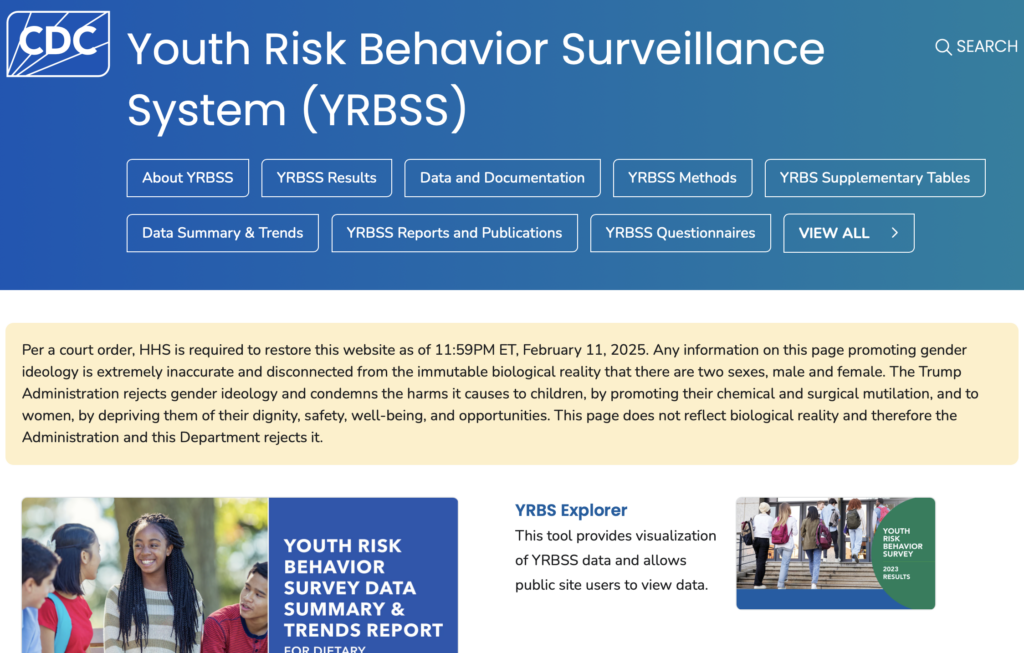
This is absolutely nuts. Real Soviet-era crap. Trofim Lysenko would be proud. Because of that court order, I guess, the Youth Risk Behavior Survey Data Summary & Trends Report is still available online. Here’s the table of contents:
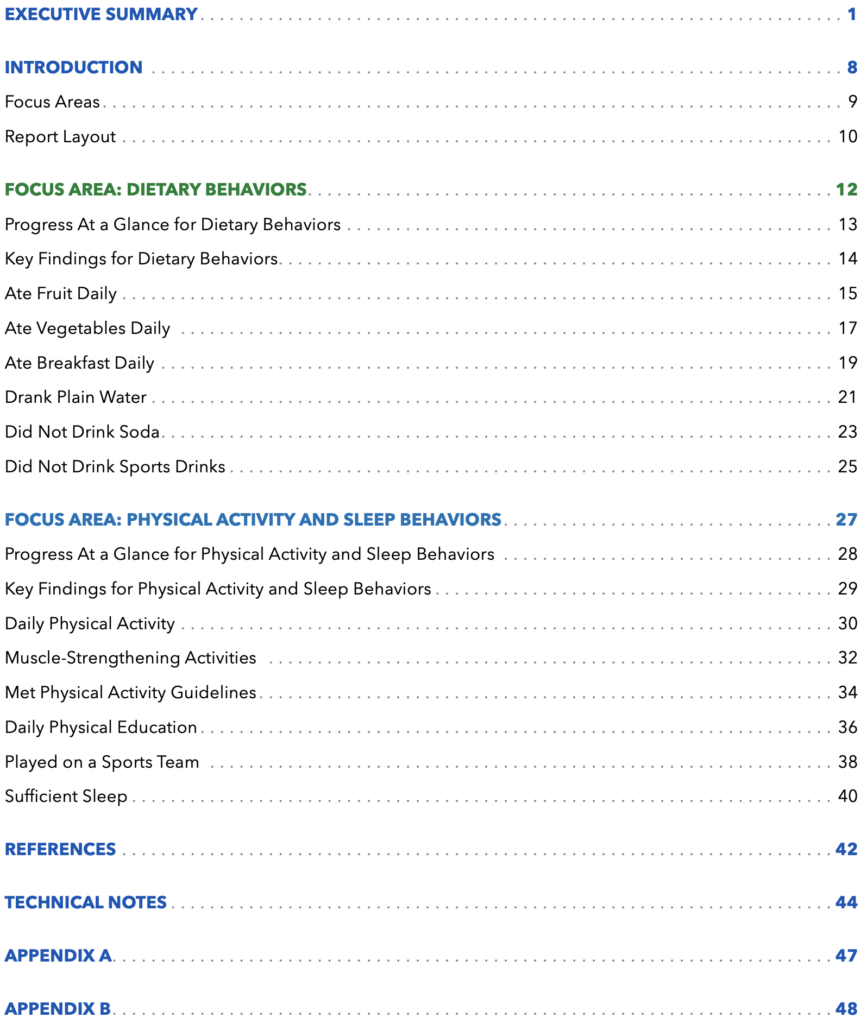
Seems reasonable to me. But not to the commissars. I guess they’re bothered by transgender people . . . I searched the document for *trans* and here’s what came up:
During 2023, the national YRBS included a question asking students if they identify as transgender. The national YRBS also included a question asking students how they describe their sexual identity. In this report, sexual and gender identity are represented in two categories:
1. Cisgender and heterosexual. This group includes students who answered that they (1) are not transgender and (2) describe themselves as heterosexual (straight).
2. LGBTQ+. This group includes students who answered that they (1) are transgender or are not sure if they are transgender or (2) describe themselves as lesbian, gay, bisexual, questioning, or some other way.
As seen with other health behaviors, students who identify as lesbian, gay, bisexual, transgender, questioning, or another non-heterosexual identity (LGBTQ+) experienced disparities in healthy dietary, physical activity, and sleep behaviors compared to their cisgender and heterosexual peers.
There was also something on trans-fat and saturated fat, and a citation of a paper, “Transforming Evidence Into Action: A Commentary on School-Based Physical Activity and Nutrition Intervention Research.”
To say, “This page does not reflect biological reality and therefore the Administration and this Department rejects it” . . . that’s just ridiculous. Health surveys ask about lots of questions. They’ll ask about attitudes, beliefs, religious affiliation, all sorts of things that are not biological.
I agree with Lehman when he writes, “Whether an analysis is viewed as promoting an ideology should be separate from whether the data is available or not. Lack of distinction between data availability and the use of that data is a dangerous precedent that should upset anybody concerned with data analysis.”
Lehman’s next update came on 4 Feb:
None of the CDC datasets are available today. Page not found and the main page just indicates that the site is being reviewed to make sure it complies with Trump’s executive order. I would maintain that the existing datasets automatically comply with the order – the data itself does not promote any ideology. The way the data is used could, in theory, fail to comply, but not the data itself. Also, somebody had to make the decision to pull access to that data while it is being reviewed – who are these people? Is it their interpretation of the order or were they ordered to make everything unavailable until it is reviewed? The lack of due process, lack of explanation and detail is simply another way of telling us that we are irrelevant and powerless. I feel like an Orc in Lord of the Rings, just waiting to hear what Mordor says.
I’m sure this will all get sorted out eventually, perhaps even soon. But who is involved in deciding what is consistent with the Executive Order? Are they accountable to anybody other than Trump? Where are the 3 branches of government that you say we have? I only see one.
I get what Lehman is saying on the orc thing–I feel that way too. In answer to his last question: we do have three branches of government, but the legislative and judicial branches haven’t been doing much. I guess the judicial branch did move that webpage online, so that’s something, but it doesn’t seem that all the laws are being faithfully executed.
On 22 Feb, Lehman added this:
Once gain the issue concerns openness and transparency. Musk has claimed that DOGE is completely transparent: “When asked what mechanisms were in place to guarantee accountability and transparency as DOGE ransacks the federal government, Musk replied that “we post our actions to the DOGE handle on X, and on the DOGE website” — clearly referring to the official government URL, DOGE.gov.”
That is from a report. It was dated Feb 12 and I don’t believe applies any longer since the DOGE website is quite there. What I see on that website is a detailed listing of all transactions as well as what are called “Savings.” You can click on any particular transaction and see a pdf of the contract. What I can’t find anywhere on that site is an explanation of how the “savings” were determined. I haven’t gone to the X site to see if it is explained there (though I doubt it) as I don’t like or bother with X or its predecessor, Twitter.
I don’t like twitter either! But I go there every day to post the links to the new blog posts. Recently when I go there I get a lot of Alex Jones videos: doesn’t he owe some kids 50 billion dollars or something?
Lehman continues:
Without any explanation of where the savings come from, this is not transparency in my mind. In a statistical analysis, it is akin to posting the data with some analysis columns, but no explanation of how those columns were created. If I have to guess, I think they did something like I was able to do from the US budget data. For example, when I downloaded all of the US AID transactions I was able to search for any that contained the words “diversity, equity, or inclusion.” Given what Trump and Musk have said, I suppose they consider these “waste” and perhaps eliminating such transactions can then be called “savings.” There are many issues here. Calling DEI “waste, “inefficiency,” and/or “fraud” is a serious misuse of these terms. Fraud is a legal matter and requires much more than an ethical or political disagreement. Waste and inefficiency suggest somebody did a bad job – while it may be true, it requires more than a disagreement with the last administration’s policies, at least in my mind.
But the more serious matter is that DOGE has not provided any explanation of where these savings come from – what exactly is being saved and why? Claiming complete transparency renders the term meaningless – it is just a list of numbers without the explanation behind them. Let me know if you see an explanation somewhere, but my feeling is that it is hidden, not transparent. Similarly, the listings of Real Estate show “saved” for specific properties of specific sizes. I suppose DOGE has determined that these facilities are not needed – but again what criteria were they using. I can “save” a lot of money if I don’t need to explain what I am doing. And, am I completely transparent if I simply provide a list of what I did?
He continues:
Here is an addendum as I think I figured out to read the forms on the DOGE website. For example, here is one savings of $103,398 on a contract of $127,398.
https://www.fpds.gov/common/jsp/LaunchWebPage.jsp?command=execute&requestid=239910218&version=1.5
The link is the pdf form linked to the DOGE website. I had thought these were the original contract forms, but they are apparently DOGE forms. This particular one shows that on Feb 10, 2025 it was entered. There is a field for “Reason for Modification” and it says “Terminate for Convenience (Complete or Partial) here: https://www.fpds.gov/common/jsp/LaunchWebPage.jsp?command=execute&requestid=239910952&version=1.5. I haven’t nearly checked all, but that appears to be a very common “reason.” And the DOGE website showing all these transactions is titled “Wall of Receipts: A transparent account of DOGE’s findings and actions.” Here is what the website says:
To me, this is a continuation of the denigration of the idea of reasons or explanations – the antithesis of scientific reasoning. As much as I disagree with many of the actions of the current administration (though far from all), it is the methodology that disturbs me the most. I can tolerate the fact that Trump one the election and is going to do many things I dislike (some intensely). But when facts and reasons are no longer necessary, then there is nothing left for me, except golf.

Unfortunately the two links just above no longer seem to work. I’m thinking that the government should have an official policy to archive all links forever, just as there is a policy (or used to be a policy?) that all government communications be done through official channels such as .gov emails.
I’ve not looked at the government websites in detail; I’m just forwarding the items that Lehman sent me. With all the scary things going on in the world (most of which cannot be reasonably blamed on Trump–or on the Democrats either, for that matter), missing or garbled government statistics have to be one of the least of our concerns. What’s frustrating here is that this is the government not doing its job, for what seem to be ideological reasons or some sort of political gamesmanship.
The Lysenko analogy seems apt to me. I don’t know Lysenko’s motivations, whether they were pure careerism or whether he had some communist ideology mixed in, but he successfully used political ideology as a tool in bureaucratic infighting. I don’t think that anyone in the current government is playing the role of Lysenko, or Stalin; rather, it seems that political ideology is being used as a tool for people to get what they want, and a lack of enforcement of rules is allowing our government to be used as a playground for these manipulations.
None of this is new–the government hired Brian Wansink and Cass Sunstein, after all, indeed I think Wansink served under both Democratic and Republican administrations–but now it seems to be happening all over.
The NY Times’ Upshot finds that Musk’s accounting is dodgy: “DOGE’s Only Public Ledger Is Riddled With Mistakes”
https://www.nytimes.com/2025/02/21/upshot/doge-musk-trump-errors.html?searchResultPosition=1
The Times report is good (it’s nice to see the news media doing something useful, even if I don’t like much of what the Times does). I’d highlight one thing they found to make a point: the cite a $5.4 million claimed savings by DOGE for a contract: “Diversity, Equity, Inclusion and Accessibility Professional Support Services.” This one of those “savings” given the reason “terminate for convenience” (or something like that). The Times found a number of issues with the claimed amount, but I want to raise a different issue that concerns me even more.
We all know that Musk, Trump, and many MAGA believers hate “DEI.” I’d have much more respect for them if they simply said: “We won the election; we have the presidency, control of Congress, and ultimately the courts. So, we have the power to eliminate any spending that has anything to do with DEI. If you don’t like it, then you need to regain some power from one or more of those branches of government.”
That reason I can understand. I may not like the decisions, but it is a reality that they have the power to do these things (at least thus far). But the apparent reasoning that DEI is either “waste,” “fraud,” or “inefficiency” really bothers me. First of all, fraud is a legal determination and no such evidence has been provided. Inefficiency in this case must apply to the goal, not the means, since there was no evidence collected or supplied about the means being used. The objection seems to be that it is a waste to produce any reports having anything to do with DEI. They seem to believe that – but they provide nothing other than the label. I want to see substance about what this contract actually entailed – why was it originated, what kind of work was performed, what was achieved? In the absence of any of these things, it is simply a power play. And I can respect a power play if they would just admit that is what they are doing. It is the veneer of some moral or ethical legitimacy that bothers me. It is the absence of evidence or reasons that bothers me. It is the fact that many people appear to not be bothered by these absences that bothers me. Bullies do what they can – they bully. I don’t like it, but they do so because they can. But their attempts to pretend that it represents some higher purpose for which no evidence needs to be provided is dangerous. It lacks compassion or respect, and undermines their responsibility.
For the final links that did not work, it may have something to do with those pages being drilled down. You can try the top level savings page: https://www.doge.gov/savings and then drill down on particular “savings” to see pdfs where there is a field for modification reason.
“With all the scary things going on in the world (most of which cannot be reasonably blamed on Trump–or on the Democrats either, for that matter)” The things that scare me most are the increased threat of nuclear, war, pandemic H5N1, surging authoritarianism, and losing ground in dealing rationally with climate change. Which of these don’t involve Trump? Sure, Trump didn’t create H5N1, for example, but he is keeping health agencies from responding appropriately.
It took a couple weeks but The Guardian finally called it.
https://www.theguardian.com/us-news/2025/feb/17/trump-musk-government-cost-cutting-coup
I’ve decided to stop eating. I’ve benefited as a result from savings and cutting waste.
Anyway, for those who don’t like the NYT, you can check out the Wall Street Journal. Paywalled, but this is the bottom line:
DOGE claims to have saved $55 billion.
WSJ is able to find $2.6 billion over a multiyear period.
Only 2% of savings are related to DEI. The rest is stuff like a clinical test for a a drug to help with Alzheimer’s.
https://www.wsj.com/politics/policy/elon-musk-doge-federal-savings-claims-783b9507
Here’s a Twitter post with some screen grabs:
https://x.com/RichardHanania/status/1893482229159891269
Includes discussion of the claim of savings from a Fauci exhibit that was already paid for.
Like I’m sure everyone else in this neck of the net, I think the world needs more and better data, not data combed for ideological nonconformities. But it’s important to understand what we’re up against. Musk and his comrades are deeply anti-rational as the rest of us understand it. They despise empirical tests of or qualifications to their a priori beliefs. Please read Marc Andreessen’s “techno-optimist manifesto”. They are sure we are at the start of a new chapter in human history that will be written by AI, one that will solve all worldly problems provided the evil hand of government, and the prudential, protective mindset behind it, is withdrawn (or cut off). It’s crazy stuff, but they’ve been fairly clear in proclaiming it.
How do you argue against an anti-rationalist, anti-empiricist cult? How do you make a case? We’re used to honing our methods to address the criticism of people who broadly share our epistemological priors, but this is a whole new ballgame.
“How do you argue against an anti-rationalist, anti-empiricist cult? ” The best way I know is with a whole lot of people out in the streets. I don’t know who the 5051 people are, but they have gotten it started. If there isn’t a demo planned for March 4 near you, host one.
Peter:
You write, “Musk and his comrades are deeply anti-rational as the rest of us understand it.”
Is Musk “anti-rational”? It’s an interesting question.
1. I strongly doubt Musk himself would consider himself anti-rational. His fortune comes from advanced technology that was developed only with huge amounts of rational effort, and the techno-optimism to which he and his associates subscribe is assuming the development of much more technology, which again would have to be developed by rational means. Hypothetical developments of new methods of carbon capture, new vaccines, etc., would involve lots of rational and empirical work.
2. Even moving away from technology and toward political issues, I’d associate Musk’s positions with rationalism. I’m particularly thinking here of what is sometimes called “scientific racism” or “race science,” a framework of thinking about people and societies in terms of races. Racism is far from the only rationality-based framework–and, for sure, it involves a lot of irrationalism too–but ideas of wanting less immigration and more white babies can be seen as rational consequences of some racist assumptions.
Similarly, you refer to the idea that private business “will solve all worldly problems provided the evil hand of government, and the prudential, protective mindset behind it, is withdrawn (or cut off).” That’s a rational and empirically-derived view! It’s a view that could well be completely wrong–as the saying goes, the laws of physics don’t care about dollars and cents, and it doesn’t matter how large your pile of wampum is, if we run out of fresh water etc.–but it’s a view that is derived from rational arguments of economic theory and from empirical observations about the failures of command economies.
3. On the other hand, Musk seems to have followed Alex Jones and Donald Trump into what could be called a post-truth zone. For awhile now, Musk has been actively promoting misinformation, also he’s allying himself with Nazis, and, yeah, the Nazis used technology too but they had very much an anti-rational ideology.
In some sense, none of this is new. Daniel Bell wrote The Cultural Contradictions of Capitalism which was highlighted the juxtaposition between modernism in business practices and conservative social ideology. One can attempt to resolve such contradictions–for example, modern race science often is attached with a version of gender essentialism that is cloaked in the terminology of science (if sometimes crudely, as in the work of Satoshi Kanazawa that was touted by the Freakonomics team)–but I think the seams still show. We can see similar incoherence on the left, which at least since the time of the French Revolution has favored some mix of rationality and passion.
My guess is that Musk and others like him see themselves as being entirely rational, with even their apparently irrational actions, such as promotion of false claims about politics and business, being justified as politically necessary expedients. Or, to put it another way, they see the public sphere as a game where the goal is to win money and political power; from that perspective, promoting lies on social media or making impossible claims about hyperloops is equivalent to running a bluff in a poker game.
From my perspective, yeah, I’m with you on this: I think lying is bad and I think it degrades public discourse when people abandon rational argument. It bothers me when Elon Musk or Alex Jones or Donald Trump does it, in the same way that I’m bothered by those academic bigshots who misrepresent their research, do crap scholarship, and then promote each other. Even people who should know better, like Steven Pinker, do it. But when Musk et al. do it, it’s a lot worse: these guys have a lot more power at their disposal. Just like when JFK talked about the nonexistent “missile gap”: that may have caused a lot of damage.
Above I talked about “scientific racism,” which to my mind is an unstable mix of rationality and irrationality, both politically (an alliance of technology executives and anti-rational political movements) and intellectually (the use of rational methods to back up traditional beliefs).
I see something similar in various areas of bad science, for example the mind-body healing work that Nick Brown and I have criticized, which also is a town-and-gown mix of trust-your-gut-and-live-healthy irrationalists and celebrity academics.
I’m not sure what to say about all this, but it bothers me, and I think it’s too much of a simplification to label these as “anti-rationalist, anti-empiricist cults.” I think they are a combination of rational and irrational views.
The impression I have is that Musk is following a method used by venture capital when it takes over a business: make lots of cuts and then fix what turns out to be essential. In that context, you can measure the success or failure of the method in terms of money, but with government it seems not so simple. If it isn’t, then using that method doesn’t seem rational, even if Musk thinks it is.
John –
. In that context, you can measure the success or failure of the method in terms of money,…
Twitter is worth probably around $30 billion less now than what he paid for it. But you could argue his purchase was a success because owning Twitter empowers him with tremendous amounts of influence. Money isn’t the (only) measure of success or failure there.
Of course Musk thinks of himself as rational. As do we all.
But thinking you know what he believes seems fruitless to me. The guy has changed his political orientation, and his accompanying stated beliefs, by 180 degrees o just a few years.
It’s like asking what Vance or Graham or Cruz or Gabbard or RFKJrbelieve about Trump, when over a few years they’ve all gone from explicitly stating he was basically Hitler to stating he has basically has been placed on this Earth to save America from the devil (I.e., Dems and libs).
We know they all WANT to acrue power and influence and will day whatever they need to say to achieve that goal.
Does Musk believe it when he says that Dems had a plan to being on immigrants so they could lock up their votes and eliminate any future elections?
Does Musk think it’s the “actual truth” that Jews have waged a long-standing compaign to foment “dialectical hatred” against white people by flooding Western countries with “hordes of minorities?”
Asking what Musk believes or whether his beliefs are rational is like asking those ame questions of Trump. It’s part of their whole con, to get people speculating about what they believe or whether they’re rational – because they know can rely on unfalsifiability to say you’re lying about what they believe: “You’re obviously a triggered lib of you say I’m a racist or an antisemite, because I never said I hate black or Jewish people.”
Joshua:
I wasn’t thinking so much about what Musk or Jones or Trump personally believe, so much as their stated ideologies. Musk’s stated ideology seems to me to be a mix of rationality (technology will save the world) and irrationality (repeated willingness to pass along false statements). Various people try to square this circle in different ways, for example some scholars have argued that religion is a good thing for stupid people to believe as it keeps them from creating trouble. This news article discusses some of these issues.
Andrew –
For sure when you start looking around, these guys seem to believe some, well, interesting stuff.
Apparently quite a few members of the PayPal Mafia want to build a Utopia where they ascend the ladder of “biological hierarchy” to their rightful place as demigods. All of a sudden Trump’s interest in Greenland and Panama looks a little less unexplainable.
https://x.com/jennycohn1/status/1877052010559844478
Praxis is a Thiel-backed “network state” project that aims to build its own “nation”
https://www.nytimes.com/2023/12/12/style/praxis-city-dryden-brown.html
My impression of Musk is that his technical intuitions are really really bad. He removed LIDAR from Teslas making Tesla self-driving one of the worst in the industry, the Boring Company idea is inanely stupid, he wants to do AI, but he’s twice done monster press conferences/tech releases with robots that were painfully stupidly faked, the Neuralink stuff is an obvious (but, IMHO, probably bad at present) idea that he bought, Space X is a company he bought (and hasn’t messed up yet, but putting people on Mars is seriously stupid), Tesla is a company he bought (and just had a recall of over 300,000 defective vehicles), the Tesla mini-truck is a disaster* (the “the windows are strong enough to withstand rocks” demo that failed (the window broke) at the press release should have been a clue to everyone what an idiot he is). Etc. etc. etc. etc. etc. etc. etc.
So far, his only good idea that I can see was that he insisted that the PayPal predecessor he was involved in (and forced out of(???)) actually do payments.
*: Not all of this is Musk’s fault: the problem of EV batteries being a horrific fire hazard is nasty. But the Tesla problem of doors not being able to be opened when the electrical system is out makes them death traps (has this been fixed???).
As I understand it current Tesla’s have front doors that are immune to power outage but your children in the back seat will burn to death unless they’ve read some manual involving pulling up the floorboards and using a screwdriver or some such bullshit.
@David in Tokyo:
I am not sure where you are getting your information from, but every publication I have read so far puts Tesla cars in the top bracket of self-driving vehicles. Also, his xAI company has just released Grok-3, which is a top performing LLM according to the chatbot arena (not an entirely uncontroversial source, but I believe their numbers are not pulled out of thin air, but are at least backed up with some substance). While I currently see no direct benefit from putting people on Mars other than ‘for the glory’, there will probably be trickle-down benefits from such an endeavour. Not all technologies are developed with a clear purpose in mind. On the other hand, I may be even more sceptical than you about the Neuralink stuff. I am horrified by Mr Musk, but given the information I have I do not think his business ventures are largely houses of cards.
Oh come on, Raphael. Tesla’s FSD is a scam. They tell you not to use it unsupervised, which is not Full Self Driving! They blame the driver for not intervening when FSD causes accidents. Waymo, meanwhile, has been running actual autonomous taxi service without a human driver and has an excellent safety record. Can’t make money on it but that’s another matter.
Daniel: That’s not a problem, since your kids are already dead from preventable diseases.
anon e mouse: Thanks for doing my homework. There are lots of reviews out there that point that out, and that when things go wrong, they go wrong really really fast. Also, apparently you need a hardware upgrade to actually run the latest version in (certain? some? all?) Teslas.
As I’ve said before, “self driving” doesn’t fix the problem that the private car is a seriously bad idea in a plethora of ways (my favorite being that adding new roads/increasing road capacity induces demand of about 130% of that new capacity, ROFL). Also, “self driving” is seriously hilarious from the standpoint of the car-hater: cars are so wonderful and so fun, until you actually use them and find out that driving’s a pain. Driving is so much of a pain that there’s monster demand for self-driving so we can use our cell phones again. (Not that an increased likelihood of dying has ever been an impediment to cell phone usage. See: Darwin Awards.)
But the bottom line remains: Musk is a sci-fi addled technnical incompetent.
How do you argue against an anti-rationalist, anti-empiricist cult?
It has become more obvious and more important in these days of social media to realise that the most useful goal in a debate is not to convince the person or campaign you are debating against, but to convince the audience. Calm rationality therefore should work at least as well when your opponent is unreasonable as when they are reasonable. Admittedly, one problem with Musk is that the public may presuppose that the government is not an ideally efficient organisation, and that DEI posts do not pay for themselves by increasing the efficiency with which organisations select the best person for the job. Musk also claims to have found politically directed waste, and quotes like “tossing gold bars off the titanic.”
I would genuinely applaud a left leaning organisation which set out to sell the idea of expanding the area of government influence by demonstrating how government could increase its efficiency and competence to an extent that would justify this expansion, just as I applaud the news that the leader of the Scottish Labour party is talking about creating a Scottish version of DOGE.
Why should they give us the data when all we want to do is find fault with it?
Sorry, that was an inside joke.
What has struck me about this is the scope of effort it would/will take to deconvolute all this:
1. Cancelled contracts wind up in court, where well-compensated industry lawyers eat government lawyer’s faces. The money is typically impounded, maybe for years.
2. The study of older people getting social security conducted in 2015 suggested that fraud mitigation in social security was a net negative revenue producer. In any event, Elon’s boys will not be the ones trying to figure out what happened to Verna Ledbetter of East Hayfork, Mississippi between her last utility payment in 2010 and her final social security payment two years later!
3. The weekly updates from employees requested by Elon went to hundreds of thousands of workers with security clearances and other sorts of limitations on communication with outsiders. If you have a security clearance, everything you write as part of your job is considered “CUI,” Controlled Unclassified Information. Sending a CUI e-mail to a foreign national would generally earn the sender a visit from the local spooks.
4. Elon’s “Fork in the Road” was really nothing more than a spanner in the works for most government agencies. There simply is no place in federal law for a “direct-funded” – meaning paid for directly by a sponsor such as a Navy Captain who oversees Naval Air ops or whatever – employee to be sent home and shifted to “admin” funding for no mission-related reason. That is both a violation of the law and a violation of the agreement made between the Captain and the agency. Because of that, at the agency where I used to work the employees were called into meeting rooms and verbally told “forget about it, you are not getting this.”
OK, that is too much already.
About those weekly updates: Given the number of (non-security) employees mandated to write them, they will not be read by humans but some sort of AI application. Presumably this machine reader will be entrusted with identifying malingerers and miscreants so they can be discharged. I guess if you think that AI is already a super-human instrument with world-changing capabilities, this makes a lot of sense.
Peter:
Interesting point. I guess I should append something to my long comment above to say that, just as extreme skepticism is a form of credulity, unwarranted trust in rationality is a form of irrationality.
And I believe most of the “savings” DOGE has identified were also identified by AI applications. It makes sense that Musk would have such belief in AI – he is building businesses around the capabilities and I happen to believe his view is that 90% of what the government does is unnecessary or undesirable and that AI can do whatever we need government for. But that makes is doubly (triply?) ironic that he declared that ballots cannot be trusted to a machine (for example, https://www.msn.com/en-us/news/technology/elon-musk-calls-for-paper-ballots-and-in-person-voting-at-pennsylvania-town-hall/ar-AA1sEiqp).
His belief in AI is so strong that he doesn’t trust it to read ballots.
“I happen to believe his view is that 90% of what the government does is unnecessary or undesirable and that AI can do whatever we need government for. ”
You keep saying this, but it’s competely, 100% dead wrong. The government is there to provide services people need. Health insurance (hint: poor people (that is: everyone who isn’t grossly filthy rich) can’t afford it so the government has to subsidize it (get over this: no one else is going to do this)), Warren’s CFPB actually returned over 60 BILLION dollars to ripped-off consumers at a tiny cost of a few million. National parks and protecting natural resources for future generations. Assuring that Tesla’s mfg. sites aren’t poisoning their neighbors. Research funding/support. US universities are going to start closing down since “90% of the government is unnecessary”. Science and medicine are really hard, and it’d be nice if reality-based folks were monitoring US health, but that’s going away. Friggin’ tuberculosis is back, polio’s coming back, and you think 90% of what the gov. does is problematic. Do you have kids or grandkids? Even if you want the MMR vaccine for them, it’s not going to be available. Ditto for you for shingles, etc. etc. etc.
Really. There’s NOTHING you can name that isn’t actually completely necessary to get us through the next few decades without people dying decades earlier than necessary, going into medical debt bankruptcy, etc. etc. etc.
More generally the government regulations that Republicans hate so much are pretty much all safety regulations of one form or another, to prevent companies from killing their employees (job safety) or releasing dangerous chemicals. Or cheating their customers (CFPB). These make life better for the vast majority of people, and a bit harder for a very small number. The latter being represented well by the Republican Party.
If I sound irritated with this, it’s because I am.
David
Read the quoted text a little more carefully. Dale thinks that MUSK thinks that govt is 90% useless.
That’s NOT Dale’s position.
(Replying to Daniel L.)
“That’s NOT Dale’s position.”
That’d be nice, and I’d owe him an apology. But rereading the post, I don’t see it.
Dale’s clearly one of the smarter blokes here, so it’s a reasonable bet that I’m off the wall. I hope that’s the case.
Quoting the relevant bit
“I happen to believe his [MUSKS] view is that 90% of… ”
The “his view” means “musks view”
Or perhaps the issue is that you glossed over the word “is”
“I happen to believe his view that…” Would be Dale agreeing to Musks view being correct.
compared to what he actually said which is
“I happen to believe his view IS that…”
Dale stating what he believes Musk thinks.
Sorry. I spaced out. I’ll try to read more carefully.
Just to clarify – indeed I was saying what I think Musk believes, not what I believe. But since you raise those points, I will say that while I find government necessary for most or all of the things you list, that is not the same thing as saying that the policies are efficient. I do think much of what government does is poorly designed and could be done more effectively and/or more cheaply. For the most part I think this is not due to stupidity or malfeasance but due to the nature of democratic processes themselves. Almost any goal can be more efficiently reached by an autocracy than by the messy business of democracy – it more a matter of the goals that are the problem. Autocrats don’t generally chose the same goals as result from democratic processes.
So, to be more concrete and specific. Health care is an area where I believe government is necessary if we are to have compassion and achieve anything resembling universal availability of care regardless of income. I believe in such a goal and in fact I would like to see more government involvement than less. But that is not saying that current government policies are all necessary or desirable. Too much medicare spending goes for the last 2 years of life – it is wasteful. But it is also the result of having people involved in determining these policies – eliminating that care would only happen if some non-democratic process were used to force it on people (I don’t really know this to be true, but it is hard for me to envision a realistic scenario where a large portion of the population were to agree to not provide this care).
When government pays for health care, people will use more of it – that is, I think, not subject to debate. Some of that care will be “unnecessary” and/or “inefficient” – I think that is also not controversial (though probably which care is debatable). We could eliminate the waste by doing away with Medicare, akin to what DOGE is doing with many things. It is not that all the spending is necessary or efficient – it is that Medicare exists for a reason, and that reason does not disappear if you shut down Medicare (or even parts of it). All of the government policies that many people find potentially wasteful – foreign aid, DEI, environmental protection, zoning, the CFPB, Dept of Ed, etc. were created to address real problems. That does not mean the existing policies are necessary or efficient. What it does mean is that there is a real problem, and if you don’t like the current policies then you should find something better. The chainsaw approach totally fails to acknowledge that the problems exist. And the policies regarding data and research aim to redefine the world and rewrite history so that the problems disappear.
David, your list of government activities is something I totally agree with – I believe we need government to address many things. That is different from saying that the existing policies are efficient. Some people might claim (I know this because I was trained as a neoclassical economist and it was taught to me) that the inefficiencies are so large that it would improve things to do away with the government involvement entirely (project 2025 seems to be a clear statement of that belief). I don’t believe that, but it is not entirely without merit. But I believe that even the worst policies were designed to address some real problem, a problem that does not disappear if the government agency were to disappear.
And, yes, I do think Musk believes that AI can more efficiently 90% of what is needed – partly by denying much of the need to begin with, and then by overestimating what AI can deliver.
Dale your reference to the role of government in access to healthcare provides an example that encapsulates the issues around public/corporate contributions to health, wellbeing and economic growth. It also relates to the point about what is and isn’t “rational” and what “rational” means.
Since about the late 1970’s/early 80’s US life expectancies rose pretty much in line with other “Western” countries, with per capita spending on health broadly similar too. Since then US health spending has mushroomed and at the same time improvements in life US expectancies have diminished to the point that life expectancies have decreased in the last decade or so, and are quite a bit lower than in comparable economies. [ e.g. see: https://ourworldindata.org/us-life-expectancy-low ].
That seems largely due structural/societal issues in the US that degrades life expectancies even as advances are made in understanding and treating disease (the latter is increasingly difficult), and IMO the loss of “control” of the medico-legal-pharma sector that treats the US citizens as a resource that can be milked in pursuit of profit. From the point of view of pharma, this is perfectly “rational” since that’s largely the point – to increase profit. From a social scientific POV it would be “rational” to make strong investments in improving nutrition and refocussing on preventative medicine, to structure insurance systems so that basic quality treatments were accessible to everyone, and to regulate pharma, for example, so that the horrors whereby insulin (discovered around 100 years ago and relatively easy to produce) wasn’t priced at a level that resulted in deaths of individuals trying to ration the limited amount they were able to afford (insulin in the US costs around 7 times more than in other countries – a vial that costs $2-4 to produce is sold at $250) – perfectly “rational” where the aim is to extract profit and support a hugely bloated medical insurance system.
A problem (also IMO) is the “private good/efficient – public bad/inefficient” dichotomy that is supported in a way that makes it very difficult for individuals to be properly informed to make appropriate choices. Things are only going to get worse in that regard in the short term. Much of the underlying technologies that support the pharma and tech industries were developed either in the public sphere or with public funding (e.g. DARPA; NIH) but there is little recognition of this. I expect you know of the work of Mariana Mazzucato who has written convincingly about this (also IMO). Her thesis might not be to everyone’s tastes but the role of public funding of research should be more reliably and honestly portrayed. If the tech-bro’s are successful in trashing this it may turn out badly for them down the line.
Here’s one concern I have. There are so many legal cases that the Supreme Court will be put in a position where they can both provide the administration with victories while showing some restraints on the executive branch. I don’t think they really want to give Trump a completely clear win, but I do think they are inclined to agree with much of his exercise of raw power. But they can pick and choose amongst the many cases, deciding each on particular narrow legal grounds, leaving a confusing mess as to what the President can and cannot do. In the meanwhile much damage will be done and we won’t end up with any clarity regarding the balance of power between the Executive and Judicial branches. That leaves the legislative branch as the only way to clearly to “deconvolute” (I don’t know if that is a real word, but I like it) things. That does not look promising.
Here is (are) some supplementary data regarding its (their) alteration and interpretation as seen through the eyes of others:
https://www.washingtonpost.com/dc-md-va/2025/02/22/proud-boys-tarrio-oath-keepers-cpac-jan-6-dc/
Freed Proud Boys and J6ers take D.C. by storm: ‘Our house!’
“Now pardoned by Trump, some convicted for their role in the Jan. 6 Capitol riot are networking at CPAC, appearing on podcasts and openly mulling government jobs or running for elected office.
February 22, 2025 at 4:30 p.m. EST Yesterday at 4:30 p.m. EST”
Not specifically mentioned was the famous (New Mexico) founder of “Cowboys for Trump”, Couy Griffen, a noted nonbeliever in Bayesian revision:
“My vote to remain a no isn’t based on any evidence, it’s not based on any facts, it’s only based on my gut feeling and my own intuition, and that’s all I need,”
Brian Wansink had a 14-ish month sabbatical from November 2007 until the end of the GW Bush administration in January 2009. His ostensibly job was to draft the US nutrition guidelines for the next decade, and IIRC it fell to Michelle Obama to present those, but otherwise I don’t think I ever saw evidence of him working with Democrats. Amusingly, however, one or two commentators used that presentation of his report by the First Lady as evidence that he was “just another corrupt good-for-nothing leftist liberal academic”, bla bla. Somewhere in my files I still have the receipts for the donations of a couple of thousand dollars that both he and his wife made to Mike Huckabee’s 2008 campaign.
Gregory C. Mayer Whoa, the “sharp-as-a-tack” NYT makes a claim!!! The nations most reputble leftwing disinfirmation company. I take it for granted that it’s true.
Dale: you’re free to build your own website and mount a political campaign for any political issue you like, climate change BS included. You can make any claim you want! All you have to do is fund it yourself. But you demand to live in a country where other people buy what you want. Right? :) Please, when you find one where that’s your right, let me know.
Andrew: “Above I talked about “scientific racism,” which to my mind is an unstable mix of rationality and irrationality” How ’bout unscientific “antiracism” like the type you practice? EG, blatantly ignoring the readily available data that quite simply explains the differences in income, crime, employment and weatlh among “race” (self declared) in the united states: Teen pregnancy, single parenthood, education, and zip code? You’re “scientific racism” schtick is BS, not science. If you’re so concerned about racism why aren’t you out in Chicago teaching basic math in grade school?? Get out of the tower and confront the real world. You really really really need it.
Anon:
Just to go through this quickly:
1. You seem to be quoting Mayer as saying the NYT is “sharp-as-a-tack,” but actually this is a phrase that you have introduced to the discussion. He provided a link to a news story, he never said anything about sharp as a tack.
2. You say that Dale is free to build his own website. That’s true of all of you! I assume Dale and you and the others are participating in comments here because you’d like to be involved in some intellectual discussion, which is great. In the meantime, nowhere did Dale demand or even ask “to live in a country where other people buy what he wants.” That line is coming from you. If you want to disagree with other commenters, fine, then disagree with what they actually say, not with something they never said.
3. If you disagree with something specific that I’ve written, feel free to explain it in comments. In the meantime, please save the personal attacks for twitter or 4chan or whatever is your platform of choice for online abuse. You have no idea what I or anyone else here “really really really need.”
Hard for me to imagine a worse example of this phenomenon than this:
WASHINGTON — The Department of Justice has shut down the National Law Enforcement Accountability Database, a federal misconduct tracking system that was intended to prevent officers with disciplinary records from being rehired by other agencies, the Washington Post reported.
The database, created in 2022 under an executive order by former President Joe Biden, tracked misconduct among nearly 150,000 federal law enforcement officers and agents, according to the report. It was operational for just over a year, with all 90 executive branch agencies contributing disciplinary records dating back to 2017.
https://www.police1.com/federal-law-enforcement/national-law-enforcement-accountability-database-which-tracked-federal-officer-misconduct-deleted
Joshua:
This relates to discussion elsewhere on this thread of incoherence in the ideology shared by Musk/Jones/Trump/etc. The other day, Musk wrote “Some people just love doing crime” and endorsed the statement, “The root cause of crime is criminals,” which is a kind of anti-rationalist statement (compare, for example, with the focus of Freakonomics on behaviors being caused by incentives, and also is in conflict with the recent pardon and dropped prosecution of corrupt politicians Rod Blagojevich and Eric Adams.
Andrew –
I don’t take anything he says as an indication of what he believes. He justified the emails to federal workers – demanding that they respond with a just if achievements – by saying there are many workers who aren’t even checking email, so a lack of response would sniff out fraud. Obviously, he could have just sent an email that said “Hey, respond to this” rather than one that threatens termination.
If you take what he says at face value, then you’d think he’s just checking to see if there are people fraudulently getting government checks for no work. But then his emails would be “irrational” in the else of counterproductive relative to a more efficient precess (causing workers to be anxious and distracted). But if his goal is to own libs and to please government-haters, then his emails become “rational.”
From a bottom-line standpoint, firing 80? % of Twitter employees was irrational, as the company is worth far less than it was when he did that. He could justify it on cutting waste, a seemingly rational move (the app runs less well than it did, but it does still run), but the point of cutting waste and fraud would presumably be to improve the net value of the company. But what if that wasn’t really his rationale? What if his rationales were to attract attention, prove a point, own the libs, create or support an image as a ruthlessly inspired CEO, etc. Then his actions seem rational.
I think to know if the ideology is incoherent, you have to know his real rationale – and we can only guess at that. And that’s what these guys bank on: they bank on the reality that their supporters will assume one set of rationales (and thus their actions would appear coherent) and that their detractors will assume another set of rationales (and thus their actions would appear irrational). This works for them if they think that dynamic works to their advantage. If the proximal goal is to own the libs, as a tactic to help achieve an overall objective of acruing power, it works for them. Trump has ridden this strategy to the Whitehouse twice.
Anti-rationalism is effectively a brand for them.
> From a bottom-line standpoint, firing 80? % of Twitter employees was irrational, as the company is worth far less than it was when he did that.
This is below your level. The company is worth less because advertisers boycotted it. They were afraid of brand damage, but the link between “firing 80%” and “brand damage” is very tenuous – you could also link the boycott to Musk’s political positions, the new free speech policy or the unbanning of various users. When he fired all those people, the overall expectation of critics was that the Twitter site itself will not stay up, and the decision has, in hindsight, clearly paid off handsomely (the site is up and a big operational expense is down). You’re looking at something that isn’t even clearly a mistake; don’t call it “irrational”.
Anonymous
I agree that Musk’s actions with Twitter/X are perfectly rational – they are in line with his values. In financial terms, they were not good. The value of the company has thus far declined a lot. You blame this on the loss of advertising revenues, but that is in large part in reaction to his policies so he bear responsibility. Eliminating 80% of the workforce was achieved largely by eliminating the moderation functions that he despised. As you say, that is not irrational, it is consistent with his values.
Whether the same can be said about ridding the US government of many of its employees is a different matter. On one hand, getting rid of scientists who study thing like climate change may be perfectly consistent with Musk/Trump values, and as such, are not irrational. On the other hand, if the most productive people leave (because they can find better employment) and only the least productive stay, then it is an irrational way to improve government efficiency. If one result is that more classified information gets sold to adversaries to make up for the horrible working conditions, then that would seem to be irrational. I think it will be difficult to evaluate the rationality of these decisions. But I think it is much easier to evaluate the morality, compassion, dignity (lack thereof), and democratic nature (lack thereof) of the process.
Buying twitter was the big mistake. It was already not profitable before Elon Musk bought it, and advertisers were already starting to jump ship since it was known in large corps that it had the lowest incremental ROAS of all major advertising channels. There’s also no doubting it was a mistake; Elon Musk was legally compelled to buy it, he publicly did not want to.
Whether or not firing the people was a mistake depends on whether or not Musk wants to try and rectify that mistake and make twitter a true, profitable big tech company with a 50 billion dollar market cap. Advertisers aren’t “boycotting” twitter, they were already jumping ship because it wasn’t profitable. Losing all the customer success managers, CRM, and sales people just means the advertisers had even more reason to jump ship. Losing trust, safety, and moderation makes prestige brands jump ship even more. Losing all bot protection is a complete non-starter. With as many bots as there are on twitter now, nobody’s paying cents per billable action. With an ad based revenue model, the lack of due diligence on bots is actually legally actionable. If Elon Musk wanted to make the twitter purchase a good purchase, short of some kind of abuse of executive power, he’d need the lions share of the people he fired, plus some cost savings and also probably some major changes to site structure to make the unit economics more attractive to advertisers.
If you give up on that and just want twitter to fail as little as possible, what Elon Musk did isn’t so stupid. The cloud exit was just the right decision; the cloud economics just don’t make sense for a business as mature and as large as twitter. If you just want to make > $0, and you can make your site lean, businesses like 4chan do just fine financially without prestige advertisers. It’ll just never be truly “big tech”, which is fine.
From a technical perspective, Twitter does kind of suck now compared to something like instagram. The other day I tried to create an account and it tried to ask me 30 captcha questions. The bot problem is extremely out of control. There are regularly strange UI changes that make basic functionality silently inaccessible. It also doesn’t properly delete accounts; it tells me my personal identification is still linked to an existing if I try to sign up for a new one, but I also can’t sign in with it or the old username. And something is off about the CDN–it flickers on and off semi-frequently.
The bridging algorithm for community notes is very good, though all those people are gone now
https://arxiv.org/pdf/2210.15723
The interesting thing is that despite the whole thing being very janky and annoying to interact with, people keep using it, even people who hate it and complain about it. Social media is very addictive, and network effects are powerful.
Anonymous –
They were afraid of brand damage, but the link between “firing 80%” and “brand damage” is very tenuous – you could also link the boycott to Musk’s political positions, the new free speech policy or the unbanning of various users.
Sure, the huge drop in market value isn’t exclusively a function of firing all those employees – but neither is it completely independent, as both Dale and “somebody” speak to. Firing all those employees has directly contributed to the loss in revenue, because employees who had existing relationships with advertisers, and who helped to maintain a brand value that attracted more advertisers (respectively) were cut back drastically. Certainly the increased profile of nutbars and bots and porn, directly attributable to business decisions that were in turn directly associated with firing people, is a significant factor. I wouldn’t doubt that decreased functionality is also a factor.
somebody –
I will say that I recently used Grok, and to my surprise is was much better than the other free chatbots I’ve used previously. It was much more solid in it’s “reasoning,” it at least seemed to use real world evidence to substantiated expressed opinions in what felt like real time in reaction to input i gave, and it was willing to actually stake out opinions rather than constant wishy-washy, both-sides waffle. Interestingly, it was willing to be very critical of Musk. I queried it regarding specific misinformation from RFK Jr., and it actually explicitly referenced research contrary to his claims, and successfully pointed out how Bobby cherry-picked and directly contradicted even the references he game. And when I linked that kind of nonsense to Musk and Trump, it willingly riffed and elaborated on the ways their approach is connected to and reflected Bobby’s This was after, as claimed by many on Twitter, Grok was given explicit instructions to dismiss and criticism of Trump and Musk as being sources of “misinformation.”
Dale –
On the other hand, if the most productive people leave (because they can find better employment) and only the least productive stay, then it is an irrational way to improve government efficiency.
I think it’s a pretty big leap to conclude that Musk actually wants to improve government efficiency. I mean he might, and certainly that’s what he claims – but do we really know that he wants to make more efficient, the systems that would put a check on his ability to get government contracts? Do we know that he wants to make more efficient, the systems that would investigate and perhaps prosecute fraud in his businesses and those of other people in his circle? There are a ton of areas where we could question the logic of, and evidence available regarding, an actual focus on improving government efficiency.
If we accept what he says, then we could conclude that policies that filter out the more productive employees would be ir- or anti-rational. But what if his values are actually to make our government a better mechanism for him to accrue power, and shape government a better vehicle for him to push his ideological agenda? Then he might be filtering out any employees that might obstruct that goal, and leave behind only those who will help advance that goal. In that case, then it’s basically irrelevant whether the more productive people (in terms of non-ideologically based efficiency) leave and what’s relevant is whether the more productive people (in terms of ideologically-based efficiency) stay.
Joshua
I was not even aware of Grok so I tried it. I asked about the legality of the DOGE requirement for federal employees to submit 5 items of their work in the past week. I received a very thorough and even-handed analysis of the potential legal problems with the request as well as potential ways around these (with enumerated problems with all of these). Then I asked, putting aside legal questions, about the likely impacts assuming the courts don’t intervene. I received a very thoughtful (I know David hates attributing “thought” to an AI, and I’ll agree with him – but I don’t have time to think of the better way to word this) description of the many ways in which damage will occur – morale, productivity, selection problems, etc. I have to say that I prefer this AI to Musk. I didn’t think to ask Grok whether Musk really seeks to improve government efficiency, but that might be an interesting query.
Dale –
As it happens, I was just on a walk and listened to the latest Ezra Kelin podcast that was on related topics. Here’s an excerpt:
See, but I don’t think they’re cutting back the government. I think they are trying to take control of it.
I’ve heard this A.I. thing from a couple of people. I am open to the idea that one thing Elon Musk wants to do is bring A.I. into the federal government. But I am not super open to the idea that that’s what DOGE is doing now.
Efficiency for what? A.I. for what? Every A.I. system has some kind of value function or prompt you have to be giving it. The question of the prompt is really the important question.
Yes, you could, in theory, unleash A.I. on the entire range of Treasury payment data. But what are you trying to get it to find? If you’re trying to get it to find fraud, fine. How is “fraud” defined?
Not that anything is particularly meaningful because Ezra says it – but certainly these are relevant questions.
On a related note (apologies if someone already brought this up.
https://talkingpointsmemo.com/edblog/why-prams-got-shuttered
“Yesterday I broke the news that the CDC has indefinitely shuttered the Pregnancy Risk Assessment Monitoring System (PRAMS), a comprehensive federal data collection program “designed to identify groups of women and infants at high risk for health problems, to monitor changes in health status, and to measure progress towards goals in improving the health of mothers and infants,” which has been in operation since 1988. CDC ordered a halt to collection of 2024 data effective January 31st of this year and put the entire 2025 program on indefinite hold.”
And from Axios:
https://www.axios.com/2025/02/23/federal-government-cuts-drain-technical-expertise
Cuts drain federal government of technical expertise
Just to be descriptive, without endorsing it in any way, I think the issue in this instance is a viewpoint that there’s no “use-mention” distinction. It’s somewhat analogous to the stance on racial slurs where they can never be uttered even in descriptive ways, e.g. a law professor can’t say to a class something like “This historical legal case is about whether the word [actual slur] qualified as First Amendment protected speech or not”. I suspect here, “a question asking students if they identify as transgender” is treated similarly conceptually.
I’m not sure I understand your point. Asking students whether they identify as transgender could be debated legitimately for future surveys. I would clearly support asking that, but I can see arguments that say otherwise (though I don’t find them convincing). But I think erasing such information that had already been collected is a different matter. It is part of the factual record. The racial slur you refer to has been used in the past and I think it is wrong to pretend otherwise – even if you think it should not be permitted in the future. Are you talking about past or future questions about “transgender” or do you not think these are different issues?
Doesn’t seem it would take much effort to put all the data into a torrent.
Why wasn’t this being done to begin with?
Perhaps you are right. I’m not sure how to do that so I’ll claim ignorance, but I can’t say why others haven’t been doing that. What I will admit is that I never thought I would be in this position – where historical record was being removed. I always expected to see different values embraced by other people, but I was naive in my belief that the government – our government – would be erasing and/or rewriting history. As I said, I was naive.
Yea, usually the gov plays more sophisticated games with avoiding the collection of inconvenient data to begin with.
Or, if that fails, massaging it to the point of uselessness.
If that still fails, then it gets put in the most confusing and inconvenient format they can find.
It is true there usually seems to be something preventing just removing it though. I am not sure if thats what is happening here yet either.
Anoneuoid
I hope this doesn’t get to be a lengthy digression that tries Andrew’s patience, but I think there is something in your reaction that is worth addressing. I am not naive enough to trust my government – but I think you are exhibiting an unhealthy conspiracy type belief that the government is always engaging in disinformation. Government is not a single entity – it is comprised of many organizations and people, often with competing interests. That is part of why it is so often inefficient. I don’t think government data or reports should be accepted blindly as “truth” nor do I think they should be automatically labeled as useless. It is somewhere in between, and that is part of why it is hard to analyze it.
I, like you, don’t yet know whether history is being erased or rewritten. As things change daily, some things reappear, some change, and some aren’t there. The US AID website currently only shows a statement to employees about their impending doom. None of the data or reports produced by US AID are available or even listed. Perhaps they will reappear, but I think it is fair to label this as an attempt to erase even if it is subsequently restored.
Another (of the many ironies) is the current Administration treatment regarding data involving things such as sexual identity. The current restored YRBSS website contains the following declaratory box:
“Per a court order, HHS is required to restore this website as of 11:59PM ET, February 11, 2025. Any information on this page promoting gender ideology is extremely inaccurate and disconnected from the immutable biological reality that there are two sexes, male and female. The Trump Administration rejects gender ideology and condemns the harms it causes to children, by promoting their chemical and surgical mutilation, and to women, by depriving them of their dignity, safety, well-being, and opportunities. This page does not reflect biological reality and therefore the Administration and this Department rejects it.”
I see this disclaimer on a number of government sites currently. Ironically, this has the same effect on me that you cite: “Or, if that fails, massaging it to the point of uselessness.” The irony is that I feel this way about the “woke” practices regarding preferred pronouns and other similar practices (I’d add examples like the side effect statements for prescription drugs, safety warnings on lawnmowers, required airline instructions about how to buckle your seatbelts, etc.). As many of these practices illustrate, it can be argued that they represent waste and they could be dispensed with with little or no cost. I imagine that can be argued with, but I’m prepared to say most of these things have ceased to be useful. But I know that they were adopted for a reason – and that reason remains valid. People who don’t self-identify as male or female suffer greatly; people take medicines that actually harm them without understanding the side effects; people have electric lawnmowers whose batteries explode; people are hurt or killed in air crashes when their seatbelts are not properly engaged, etc. When our policies cease to be effective, they should be changed. But simple elimination is not the appropriate response, in my opinion.
USAIDs sister agency, USIA, was effectively shut down in 1999 by merging it into the State Department and hamstringing the projects with endless red tape. Now we got to see all the (previously banned in the US) propaganda videos on youtube.
I’d guess something like that will happen.
Doesn’t look like a torrent, but here is one archive:
https://lil.law.harvard.edu/blog/2025/02/06/announcing-data-gov-archive/
“But I know they were adopted for a reason…” I write from the perspective as someone who works in the public service, but in Canada so, perhaps, my experiences aren’t entirely analogous to the US federal employees being sacked. However, what I fail to see is an appreciation that much of government work is rooted in legislation; the work is only “waste” if you think the legislation is “waste.” Unfortunately, because legislation is developed to address the needs of multiple stakeholders and perspectives, it naturally pleases no one.
I work in endangered species research and management where one side rails against rare species halting development and the other rails against the fact that most species surveys are poorly designed and executed. However, the legislation is there and government has to fulfill the requirements laid out in law. Government has to read those surveys or evaluate how developments mitigate habitat loss. You cut government employees and the work just piles up, but it doesn’t disappear. You have someone who evaluated birds now having to evaluate birds and reptiles and mammals and efficiency goes down, morale goes down, stress goes up, and little gets done. You certainly don’t have the time or energy to devise new and better ways of accomplishing your tasks. You’re just trying to stay afloat.
Dale: You’re still thinking in “use-mention” terms. The opposite idea is that taboo material shouldn’t be around, no matter what the context or history. Imagine if the survey was something like “Have you every called anyone [slur1] ? [slur2] ? [slur3] ? … Have you said the following but not meaning to insult a person: [slur1] ? [slur2] ? [slur3] ? …”. Without defending the viewpoint, I could grasp why someone would complain that everything associated should be removed. Suppose it was a survey of explicit sexual acts, that might be a better comparison.
I don’t find your examples at all compelling. Many phrases and activities may now be considered bad or wrong that were once either accepted or routine. I think that history is important to know. Having a record of it and using it anew seem like different things to me. Take your last example – suppose we have a survey of explicit sexual acts. Given our society’s many views (and often contradictions) regarding sex, it might be sensible to discuss and possibly control access to that information (e.g. limiting access for minors). But erasing the data because we now find this information bad just seems like a bad idea – and especially without a deliberative process regarding potential damages that would result from having access to that information. Instead, what we are observing is an order from the king with no discussion other than the justification that he was elected so he can do anything he wants. As I said before – I’d be happier if he would just state that he can do this because he has the power and not provide purported reasons. Then we would know exactly where our political system stands.
Andrew, to your thought “I’m thinking that the government should have an official policy to archive all links forever, just as there is a policy (or used to be a policy?) that all government communications be done through official channels such as .gov emails.”:
there is a rule that all government records must be maintained on some defined schedule (https://www.doi.gov/ocio/policy-mgmt-support/information-and-records-management/records). So all the underlying data that has disappeared from various websites should still exist. Whether government records are made available to the public is a different story, of course. Websites could also be a record if they are the original source of some piece of government information but my guess is that would rarely be the case.
Continuing on the theme of government data, this just came out: Trump and his administration are considering changing the way GDP is measured – to exclude government spending. While I’m unsure what they mean, there was this dangerous statement:
“If the government buys a tank, that’s GDP,” Lutnick said Sunday. “But paying 1,000 people to think about buying a tank is not GDP. That is wasted inefficiency, wasted money. And cutting that, while it shows in GDP, we’re going to get rid of that.”
This seems ominous to me – it sounds like picking and choosing what parts of economic activity you want to include, making such measures meaningless. I’d even say worse than the manipulated data from the Chinese government. For those of you that believe government measures of the economy are largely worthless (Daniel?), I somewhat agree. But changing what we’ve been measuring consistently for a long time – and doing it based on someone’s judgement about what should and should not count, is destructive of whatever sense we can make about economic conditions.
Dale:
That’s nuts. What if a private company pays 1000 people to think about buying a tank?
Maybe it depends on whether they think about buying Tesla tanks or some other brand?
Lutnick has a degree in economics and ran a highly successful investment firm for several decades. It seems likely that he understands the fundamentals of GDP:
“You know that governments historically have messed with GDP,” Lutnick said on Fox News Channel’s “Sunday Morning Futures.” “They count government spending as part of GDP. So I’m going to separate those two and make it transparent.”
He’s not throwing away or hiding government GDP! Hilarious. If you can add, you’re safe.
The point is to make the government contribution to GDP readily apparent, and the point of that, and of much of what is going on in the Trump administration, is to return the economy to private businesses and individuals so they can choose what they want to buy with their money, rather than having choices made for them by people who take no responsibility for the outcome of their choices.
As Thomas Sowell said:
“It is hard to imagine a more stupid or more dangerous way of making decisions than by putting those decisions in the hands of people who pay no price for being wrong.”
Comically, however, the Hamas-AP then follows up with
“Doing so could potentially complicate or distort a fundamental measure of the U.S. economy’s health.”
Or maybe make it more clear??? :)) No doubt, Hamas-AP has a vested interest in less clear data, particularly with respect to the government spending that it relies on. Thus our writer is following this entry in the Hamas-AP style guide: “Throw shade on Trump, any Trump officials or supporters, or anyone who seeks the well being of the Americans at the expense of the UN-NGO Parasite Complex, at every opportunity”
He continues:
“GDP reports already include extensive details on government spending, offering a level of transparency for economists.”
But not for the general public. Hamas-AP wouldn’t want them to know things like that. Like John Kerry, they believe Democracy goes too far when it exposes the UN-NGO Parasite Complex and thus allows people to actually know what’s going on and – God forbid! – vote on that basis!!
https://apnews.com/article/trump-gdp-economy-government-spending-lutnick-7414ba1bd441bd4bf64620bfd66923b2
Oh, just for fun, one more Sowellism:
“I have never understood why it is “greed” to want to keep the money you have earned but not greed to want to take somebody else’s money.”
Sowell and Kash Patel should have a drink together and commiserate. It’s only cool to be the first “X color” person to do anything if you’re an incompetent left wing tool who brown-nosed your way up with the loudest slogan chanting and most meaningless word salad. If you’re competent, knowledgable and worked hard to achieve your position, you’re a bad example for the left.
Anon:
“Hamas-AP”?? Please save this sort of crap for twitter or 4chan. It’s good to see economic arguments, and the Sowell quotes are fine too; let’s just cut out the made-up stuff and the empty politics. The internet has too much of that as it is, and I don’t want it here.
Regarding the content of your comment: It’s possible that Lutnick said some reasonable things (such as doing accounting that separates government spending) and some unreasonable things (such as the idea that buying a tank is part of GDP but paying people to think about buying a tank is not). Also, the government is already keeping statistics on government spending, and this is available to the general public, no?
I’m with you that there might be good reasons to change the headline numbers, or maybe not. I don’t see how changing the headline numbers will add transparency. Maybe the new plan will report both sets of numbers.
It’s still hard for me to picture how they can seriously consider putting “buying a tank” into GDP but not “paying people to think about buying a tank.” This seems to be an opportunity for creative accounting. If it’s all done transparently then, as you can say, anyone who can add and subtract can recover everything. But I’m concerned that it won’t be done transparently. To borrow Sowell’s words, I wouldn’t want Lutnick etc. to obscure the numbers in a way that would make it difficult for them to pay the price for being wrong.
Regarding the content of Anonymous’ post (and ignoring the absurd rhetoric), sure breaking down categories of GDP but still reporting them all is not quite changing the way it is measured. But even the suggestion that we should only count what a current administration believes is “true” or “proper” GDP activities is a dangerous slippery slope. I can play that game as well – let’s not count ATVs or video games because I view these as unhealthy activities. In the present case, let’s have an alternative measure that makes Musk’s cuts look like they don’t adversely affect economic activity. Leaving it to critics to then recalculate their preferred measure is akin to the difficulties of publishing corrections to previously published data analyses – the “official” record becomes the default and given undue validity.
Lutnick’s proposal is nothing more than politicizing the reporting of economic data. They are weaponizing every branch of government, why should economic data (and all other data) be different? It’s not that GDP accounting is perfect, but it is not an improvement to impose one particular belief system on what is being measured and reported. We’ve had criticisms of GDP for not including measurement of external costs or unmarketed activities (like housework) for decades now. Those criticisms are based on sound economics, yet we haven’t changed the way GDP is measured and reported. Now, we are suddenly going to impose some Musk/Trump/Anonymous beliefs in what constitutes waste.
Dale:
I think you have something there. Lutnick’s proposal to politicize economic data (or, to be more precise, taking something that was somewhat political and making it more political) creates a setting where everything is negotiated, adding a transaction cost–social and economic friction. I feel the same way about other recent political developments such as the continuous promotion of lies and misleading statements on social media, or the pardoning or dropping of prosecutions against crooked businessmen and politicians such as Rod Blagojevich and Eric Adams. There’s a feeling of having to wade through a sea of crap, with every step needing to be negotiated.
For a much more trivial example, a couple years ago a colleague and I were discussing whether to use the word Latino or Latinx for the ethnic group that was formerly called Hispanic. We agreed that it was a lose-lose scenario: we say Latino and we get mobbed by the language politicizers, or we say Latinx and we look like politically-correct dorks. My colleague decided to use Latine, which creates its own problems but maybe pisses off people less. The point here is that (a) there was no safe language choice, no way to avoid getting tangled in politics, and (b) it was a waste of time and effort. I recognize that people have good reasons for opposing, or supporting, the use of new terms such as Latinx–I’m not saying they shouldn’t get political on me–; it’s just that, as I said, everything becomes a negotiation.
The economic statistics example you’re talking about is much worse, in that it involves numbers and policies, not just the choice of words, but t gives the same general feeling of being trapped in molasses. And, again, there are no easy answers, in that the Trump administration, like the promoters of the term Latinx, argue that things were already political (with the Trump administration arguing that standard economic statistics have implicit statist assumptions, and the Latinx promoters arguing that previous terms such as Hispanic and Latino promoted a traditionalist social model), so I can see why they’re wanting to do what they’re doing, even though from my perspective they’re increasing politicization in a way that degrades the social world, even if there are arguments in favor of their particular views.
There is an additional point: regardless of the merits of arguments for reforming the reporting of economic data, there is an issue of the process for making changes. We’ve been measuring GDP for 100 years in one way – a proposal to change should be deliberated carefully and openly. We’ve heard too many promises of “transparency” already to naively believe that, of course, no changes will be made without public input. I have little faith in that, nor do I have faith that the official reporting might change under Lutnick’s proposal, but recalculating to the former method only requires “If you can add, you’re safe.” One major change after another is being made without anything resembling an open process. Lutnick may have economic degrees, but I am pretty confident that if the proposed changes were open to professional economic input (try not to choke on that characterization, which I realize to some is an oxymoron) there would be significant pushback. The more likely proposal might be to continue reporting GDP the same way, but provide an alternative DOGE type report for those that need help with their subtraction.
I think this is no different than all the conspiracies about how the unemployment numbers are “rigged” to hurt Trump unless he likes the numbers in which case they’re an indication that the economy under Trump was the best ever at any time anywhere on the planet. Also reminds me of when Trump said that we should do less covid testing because when you do more testing you find more cases.
I’m continuing this thread because the story is not over. Due to a court order, some websites have been restored – in particular the CDC website and the linked pages about the Youth Behavioral Risk survey (albeit with that disclaimer that the restoration was court-ordered but is not accurate and against the “immutable” facts that there are two genders). But I then dug deeper looking for information titled “Supporting LGBTQ+ Youth” (https://www.cdc.gov/healthy-youth/?CDC_AAref_Val=https://www.cdc.gov/healthyyouth/mental-health-action-guide/index.html). But when I click on it, I get “The page you’re looking for was not found.” Like so much that is going on, things appear and disappear, court orders are followed and not followed, and there are no clear avenues through which to influence anything.
I continue to be bewildered by the fact that the fans of this administration don’t seem to care about process at all. Even if you believe Trump’s goals and “facts” are correct, there is simply no need to accomplish these things in such a cruel, disrespectful, and dangerous way. I am thinking mostly about government “fraud, waste, and abuse.” Trump could have simply announced a 90 day review period, put everyone on notice, turned Musk et al loose on their AI review, and told people the clock was ticking. Nothing needed to be dismantled immediately, nobody needed to be disparaged, none of the havoc was necessary for a legitimate review of government programs and spending. I can only wonder what the real agenda is when the course they chose was the opposite of a sensible and thoughtful process. Maybe my imagination is too limited, but it seems to me that the only purpose was to be divisive and to attack the dignity and competence of Trump’s enemies. No more weaponization indeed.
“I can only wonder what the real agenda is when the course they chose was the opposite of a sensible and thoughtful process.”
I suppose you are being rhetorical here and understand quite well what the real agenda is. But it’s late, my sister in-law is coming in to Tokyo on a flight landing at 00:30 AM and we’re waiting for her cab to get here, so here goes.
The Republican agenda is pretty clear: destroy the government so the oligarchs can run free: Ayn Rand’s “philosophy” in its most pure form. Republicans have always had a deep, visceral hatred of anything that even hints of helping anyone not already insanely rich. They opposed Social Security, Medicare, ACA from the start. Sure, they lie and insist they won’t cut Social Security. But you need to be NYT level dumb to believe that lie.
This is Project 2025* in action. You were told they’d do it, and they’re doing it. It was funny when Rick Perry couldn’t remember the third government agency he wanted to dismantle, but dismantling the government is what the Republicans want to do. And always have. Rick Perry was a joke, but he wasn’t joking.
(Now, dismantling the government is really really stupid. But the Republicans really believe in Ayn Rand. And now they’re in power.)
As Paul Krugman explains, we’re all trapped inside a burning Tesla.
https://paulkrugman.substack.com/p/america-is-trapped-in-a-burning-tesla
*: Project 2025’s take on health insurance is hilarious: The ACA is bad because it forces people to all buy the same insurance coverage. We’re going to fix that and allow everyone to buy exactly the health insurance coverage each person thinks is right for them. With no subsidies and no protections against fraudulent insurers. Like I said: “we don’t help anyone not already insanely rich”.
More rewriting of history: https://apnews.com/article/dei-purge-images-pentagon-diversity-women-black-8efcfaec909954f4a24bad0d49c78074. This one is particularly interesting because it also shows how DOGE is coming up with its cuts and probably the worst way to use AI. The notable example is removal of the photo of the Enola Gay bomber (that delivered the atom bomb to Japan) because the word “gay” was involved. Just like the US AID cuts, DOGE is simply searching for any of the forbidden words in contracts and cancelling those. I’m all for using AI to assist with searching through multitudes of documents and then applying human judgement to investigate further. Instead, they are using keyword search to replace human judgement. I guess this reflects Musk’s view of computer/human relationships. It also illustrates how not to use AI. Now it isn’t too hard to realize these kind of errors if you rely on AI this way, but it reveals that these people really don’t care – in fact, I think they relish in the idea that they can “save” billions of dollars just by a few computer searches.
It should be remembered that Trump has managed to bankrupt MULTIPLE casinos. That takes serious talent and hard work! Very difficult!
Here’s a somewhat misplaced update: https://ohss.dhs.gov/topics/immigration/immigration-enforcement/monthly-tables. I wanted to avoid Andrew’s lengthy posting lag (if he were to blog about this), although given the story his usual lag would still be shorter than the government lag shown on the linked website. It was in today’s AP. According to the official website, as of January 2025 the monthly reports should show data through about 3 months prior due to processing times for the data. However, the last data available is for November 2024 – before Trump took office. The only “explanation” offered is the statement “This monthly report is delayed while it is under review.” Given that the Administration has absolutely zero credibility (and I mean ZERO), essentially immigration data is not available. But this hasn’t prevented constant statements from Administration officials about immigration enforcement. Who needs data when the President can “feel it in his bones” (to cite his latest statement about when the war will end – I actually wrote when the “law” will end – an appropriate slip on my part).