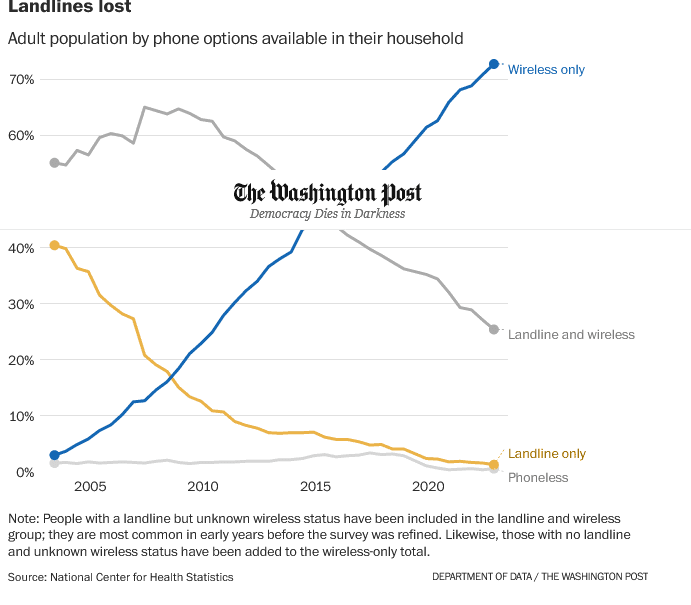
Paul Alper points to this news article, “Barely a quarter of Americans still have landlines. Who are they?”, by Andrew Van Dam, my new favorite newspaper columnist. Van Dam writes:
Only 2 percent of U.S. adults use only landlines. Another 3 percent mostly rely on landlines and 1 percent don’t have phones at all. The largest group of holdouts, of course, are folks 65 and older. That’s the only demographic for which households with landlines still outnumber wireless-only households. . . . about 73 percent of American adults lived in a household without a landline at the end of last year — a figure that has tripled since 2010.
Here’s some statistics:
“People who have cut the cord” — abandoning landlines to rely only on wireless — “are generally more likely to engage in risky behaviors,” Blumberg told us. “They’re more likely to binge drink, more likely to smoke and more likely to go without health insurance.” That’s true even when researchers control for age, sex, race, ethnicity and income.
OK, they should say “adjust for,” not “control for,” but I get the idea.
The article continues:
Until recently, we weren’t sure that data even existed. But it turns out we were looking in the wrong place. Phone usage is tracked in the National Health Interview Survey, of all things, the same source we used in previous columns to measure the use of glasses and hearing aids by our fellow Americans.
The changes have indeed been dramatic. There is considerable FCC data as well. Nationwide, there are (as of June 2022) 367 million cell phone subscriptions (more than the population), 68 million landline via internet (VoIP connections), and 27 million traditional landline subscriptions. 32% of households have some kind of wired connection. Traditional landline service remains most common in rural areas of the country (15-20% of households in those states).
Even more dramatic has been the change in how phones are used (they are cameras first, messaging devices second, and phones a distant third). I’ve been a consultant in this industry for 30 years and remember when we researched telephone calling patterns (geographic and timing) and the hot regulatory issues concerned pricing: local vs long distance. If you are young enough, you may not even know there was such a thing as long-distance and that prices varied by time of day and where you called. Despite these monumental changes, the US still funds universal service policies (including low-income subsidies) via a tax on interstate telecommunications services. While this applies to both wireline and wireless services, the contribution base has been declining – most consumer use of web-based services avoids the tax while interstate telephone calls on traditional networks are fully exposed to the tax. As a result, this tax has gone from 17% in 2017 to 35% currently.
Bottom line: while the way we use telephone services has changed massively and rapidly, regulation has lagged far behind. Thousands of pages of regulatory proceedings (probably millions) have been focused on long-distance vs local telephone services, while the market has revealed that there was never really a difference from the point of view of consumers.
My favorite evidence of the changes: when you shop for a smartphone, it is hard to find anything that addresses the call quality. Virtually everything talks about the camera and a few other apps.
Hey! You called???
I’m landline only. And don’t engage in risky behaviors. I match their prototypical landliner!
But that’s weird: since everyone’s cut the cord, and there’s almost no one with a cord, that means that the whole population engages in more risky behaviors than we did before the cell phone. I doubt that…
Anyway, when I’m out of the house, I’m playing music, playing Go, photographing Tokyo back streets. I really don’t want to be bothered. So I’ve never gotten around to getting a cell phone.
I have two “landlines” (included in the FTTH package; so I guess they’re virtual landlines, though) and no cell phone.
NTT (Japan’s phone company) is giving me the hard sell on upgraded FTTH (an extra dollar or two a month); they claim it’ll be 10 Gbps. I’ve had faster internet than pretty much anyone in the US for the last 10 years, and they’re asking “is your internet too slow?” ROFL. (Just ran a test: 350 Mbps upload, 450 Mbps download; but there aren’t any servers that can actually spit out bits that fast. It was that fast 10 years ago, and I expected it to get slower as the branch line to my neighborhood got more use, but that hasn’t happened.)
I infer that what’s really happening is that they’re modernizing their equipment, and need to get people off the old service.
>But that’s weird: since everyone’s cut the cord, and there’s almost no one with a cord, that means that the whole population engages in more risky behaviors than we did before the cell phone. I doubt that…
It’s probably less that the population changed, but rather that continuing to use a landline is a choice now that sets that subpopulation apart. I imagine the results would be quite different if you could compare the landline using population from a decade or two ago to the current landline population.
My biggest problem with cell phones is the slight lag that causes both parties to keep interrupting each other. It’s very annoying. I noticed this the very first time I had a conversation on my then-new cell phone. Landlines must have a lag, too, but it’s short and not noticeable unless you’re calling someone on the other side of the earth.
The article overlooked one of the joys of a landline receiver. Namely, loudly hanging up on a robocall from India after pressing a multitude of buttons simultaneously. While this does nothing to stop the influx of robocalls, it does keep one from binge drinking.
And, when it comes to phoning, here is the link to the hilarious Nichols and May sketch from the good old days (Bell Telephone monopoly) of the landline phoning from a pay phone:
https://www.youtube.com/watch?v=_Q9f7x5TA50
Current phone calls dealing with any organization’s “customer (dis)service” are nowhere near so humorous.
I’m part of the 2%, for several reasons. One is that we don’t get cell service where we live, so my wife’s cell works only over our wifi; if I have to be in the house to use the phone, I’d rather use one that has better sound quality. The second is that I see too many people staring at their phones and ignoring the world around them. Using them for cameras does seem really useful, however, especially when you are doing repairs.
Cell phone camera quality has been seriously amazing for an age now. I still insist on using a real camera, but it’s really only advantagous in certain edge cases.
Inversely I don’t see how people can put up with the horrible sound quality.
I do find the everyone has their nose in their phone phenomenon freaky, but I keep telling myself that that’s because I’m in a fascinating and crazy foreign country and (despite living here since before most of you whipersnappers were born (not really, just since 1986)) still find watching the locals and their strangenesses* fascinating. I’m sure if I were still in Boston/Cambridge I’d not find just walking down the street half as fun.
*: Why a duck?: https://pbase.com/davidjl/image/174002007
But one thing I also admit is nice about cell phones is maps. I took my real camera out for a walk today with a paper map of a part of Tokyo I’d never been to, had a nice two hour walk, got quite a few nice shots, but got completely and hopelessly lost.
Andrew –
> OK, they should say “adjust for,” not “control for,”..
Why?
Because it’s not an RCT? Because they aren’t actually controlling behavior (thus to say “control for” isn’t accurate)?
Joshua:
I prefer to say “adjust for” because it’s a statistical adjustment. I would restrict the term “control for” to when something is actually being controlled.
Yeah, OK – I read the link given (duh).
I might argue that they are ostensibly “controlling” the biasing effect of a confounder, but I get your point for the sake of accuracy, even if with the ubiquity of the term reducing it’s usage would be an uphill battle.
Joshua:
From a strict linguistics point of view, anything people say is fine if it becomes common usage, and one could argue that the phrase “control for” is common usage for statistical adjustment. I don’t expect to change the world on this one. What I do think is that the effort to change the world here can have value: even if people don’t switch to my preferred terminology, if they at least consider it or hear about the controversy, they might reflect upon the real-world differences between controlling a variable in some way, and adjusting for it.
In biology, the phrase “statistical control” (vs. “experimental control”) is, at least sometimes, used. As an example, the frequency of a frog’s call can be used to identify the species, but call frequency is also strongly affected by temperature. So, when recording frogs at a breeding site, you would measure the temperature as well, and use the temperature data when analyzing for the presence or abundance of particular species. You’re “controlling” for temperature not by manipulating the temperatures, but including it as a covariate. I wouldn’t say I was “adjusting” the frogs’ call frequencies to account for the temperature.
But, as you say, the meaning of a word or phrase depends on how it is used. (Fortunately, usage changes slowly– else words wouldn’t be useful for keeping records!)
It would be perfectly reasonable to say “adjust the abundance estimate for temperature”. And that’s what you’re doing, you’re not adjusting the call frequency, which is why your phrasing ““adjusting” the frogs’ call frequencies to account for the temperature.” makes no sense.
Daniel:
This reminds me of my advice to students when doing data analysis, which is to never edit the data file directly. If there are data problems, program the fixes in your R or Python code or whatever.
Andrew: absolutely. Start with whatever you get raw from the source… and then program the changes. Even if that means creating a data file with the “edits” and then loading that file and then merging the two. That could be an easier way to express the changes you want to make, but then at least you can check that file into your version control and it becomes essentially “part of the source code”.
I have a landline and a little flip (not smart) cell phone. When I moved here Verizon gave me a number ending in 6969 which gets me harassing calls in the afternoons after school lets out, plus the usual junk calls, so I got in the habit of leaving it disconnected except when I want to order a pizza or something. But then my relatives here who like to text couldn’t reach me until I got the flip phone. I use the landline number for all my online accounts so I don’t get many junk calls or texts on the flip phone. Except from Verizon.
Actually the first reason I got the flip phone was because the landline stopped working. All the phone booths that were here when I moved are gone so I had to borrow the counterman’s phone at the gas station to call Verizon, and the customer service guy said I had to walk around my apartment with him on the line, checking stuff, before he would send a repair technician. But I couldn’t take the borrowed phone back to my apartment, so I spent $50 on the flip phone. When the repair lady came there was nothing wrong inside the apartment, it was the outside connection.
The flip phone plus the landline are still cheaper than a smartphone, and I would much rather use a laptop PC for online stuff and hobby work. It is a pain to reply to texts with the flip phone though (tapping the 7-PQRS key four times for S, if I’m lucky).
I have to admit, it is fun seeing videos of my young nephews and nieces on smartphones, though.
When I go to my parents the landline rings all day, all telemarketers. I unplug the phone and they miss nothing.
No one that I want to talk to ever calls me without texting or emailing first to arrange it. (I’m 58.)
That is essentially my system as well. Whoever is answering these phone surveys continues to mystify me.
Also, check out this documentary:
https://en.wikipedia.org/wiki/Telemarketers_(TV_series)
In the end, former telemarketers attempt going to congress and get the run-around. Also, the telemarketers are getting replaced by chatbots trained on their own voices and responses.
How do you reach people without phones when conducting a survey? Would assume those same people are in geographically remote locations too.
Internet panels.
It’s my impression that most contributors to this topic are unaware of the cell phone difficulties during natural disaters that have an impact on electrical power. In Northern California as a consequence of both the Loma Prieta earthquake in 1989 and, more recently, of large fires, the usual electrical grid was knocked ot of service to large geographic areas. Cell phone towers depending on that grid were useless and, as a result cell phones could not be used as a result. Landline phones were operable ijn most affected locations during these disasters, since they rely on a separate electrical grid. I have had first-hand experience with this. I think this issue should receive much more attention than in has. Also sorts of modern services that rely on cell phone communication to operate, including emergency services can be affected by this.
Or just from congestion.
When the 2011 earthquake hit Japan, the power stayed on just fine (everywhere except the places where everything was trashed, which was a lot of places), but everyone tried to call. And couldn’t. (The local shaking in Tokyo was almost 2 orders of magnitude stronger (yes, the Japanese actually do measure local seismic intensity so, unusually, I’m not exaggerating; it was just shy of FIVE as oppposed to a tad over THREE for Mr. second best.) than anything I’ve experienced before or since, even though the epicenter was a long way away.) Tokyo was majorly disrupted, and like, oh, half the population of the area, 19 million people or so, couldn’t get home. (The extended metropolitan area is home to 38 million folks, and the local trains claim to provide 38 million individual rides a day, i.e. (something shy of) half the population goes somewhere and back by train every day.) The trains are really good, so a lot of people work a long way from home. I was home, but my SO/CEO was out swimming (“Funny, the pool water is sloshing around.”) and it took her 5 hours to walk home.
Richard:
Recently they came into our building and redid all the phone lines so that they run on normal power, which is annoying! On the plus side, we haven’t had any blackouts for many years.
“It’s my impression that most contributors to this topic are unaware of the cell phone difficulties during natural disaters that have an impact on electrical power.”
If the electrical grid goes down: the preppers will use Baofengs to communicate, the techies will use Starlink, and the outdoor types will use InReach.