In our statistical communication class today, we were talking about writing. At some point a student asked why it was that journal articles are all written in the same way. I said, No, actually there are many different ways to write a scientific journal article. Superficially these articles all look the same: title, abstract, introduction, methods, results, discussion, or some version of that, but if you look in detail you’ll see that you have lots of flexibility in how to do this (with the exception of papers in medical journals such as JAMA which indeed have a pretty rigid format).
The next step was to demonstrate the point by going to a recent scientific article. I asked the students to pick a journal. Someone suggested NBER. So I googled NBER and went to its home page:
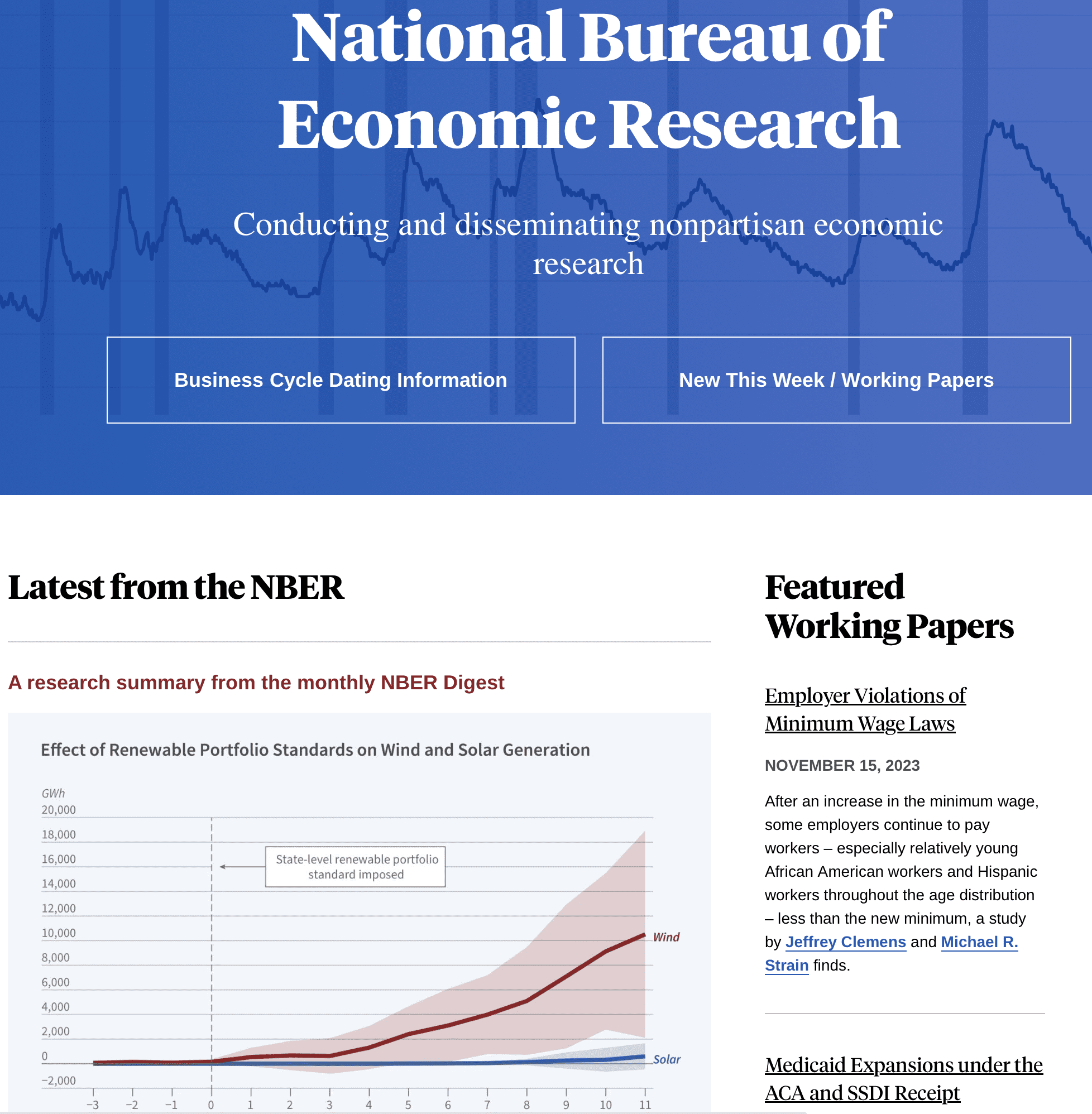
I then clicked on the most recent research paper, which was listed on the main page as “Employer Violations of Minimum Wage Laws.” Click on the link and you get this more dramatically-titled article:
Does Wage Theft Vary by Demographic Group? Evidence from Minimum Wage Increases
with this abstract:
Using Current Population Survey data, we assess whether and to what extent the burden of wage theft — wage payments below the statutory minimum wage — falls disproportionately on various demographic groups following minimum wage increases. For most racial and ethnic groups at most ages we find that underpayment rises similarly as a fraction of realized wage gains in the wake of minimum wage increases. We also present evidence that the burden of underpayment falls disproportionately on relatively young African American workers and that underpayment increases more for Hispanic workers among the full working-age population.
We actually never got to the full article (but feel free to click on the link and read it yourself). There was enough in the title and abstract to sustain a class discussion.
Before going on . . .
In class we discussed the title and abstract of the above article and considered how it could be improved. This does not mean we think the article, or its title, or its abstract, is bad. Just about everything can be improved! Criticism is an important step in the process of improvement.
The title
“Does Wage Theft Vary by Demographic Group? Evidence from Minimum Wage Increases” . . . that’s not bad! “Wage Theft” in the first sentence is dramatic—it grabs our attention right away. And the second sentence is good too: it foregrounds “Evidence” and it also tells you where the identification is coming from. So, good job. We’ll talk later about how we might be able to do even better, but I like what they’ve got so far.
Just two things.
First, the answer to the question, “Does X vary with Y?”, is always Yes. At least, in social science it’s always Yes. There are no true zeroes. So it would be better to change that first sentence to something like, “How Does Wage Theft Vary by Demographic Group?”
The second thing is the term “wage theft.” I took that as a left-wing signifier, the same way in which the use of a loaded term such as “pro-choice” or “pro-life” conveys the speaker’s position on abortion. So I took the use of that phrase in the title as a signal that the article is taking a position on the political/economic left. But then I googled the first author, and . . . he’s an “Adjunct Senior Fellow at the Hoover Institution.” Not that everyone at Hoover is right-wing, but it’s not a place I associate with the left, either. So I’ll move on and not worry about this issue.
The point here is not that I’m trying to monitor the ideology of economics papers. This is a post on how to write a scholarly paper! My point is that the title conveys information, both directly and indirectly. The term “wage theft” in the title conveys that the topic of the paper will be morally serious—they’re talking about “theft,” not just some technical violations of a law—; also it has this political connotation. When titling your papers, be aware of the direct and indirect messages you’re conveying.
The abstract
As I said, I liked the title of the paper—it’s punchy and clear. The abstract is another story. I read it and then realized I hadn’t absorbed any of its content, so I read it again, and it was still confusing. It’s not “word salad”—there’s content in that abstract—; it’s just put together in a way that I found hard to follow. The students in the class had the same impression, and indeed they were kinda relieved that I too found it confusing.
How to rewrite? The best approach would be to go into the main paper, maybe start with our tactic of forming an abstract by taking the first sentence of each of the first five paragraphs. But here we’ll keep it simple and just go with the information right there in the current abstract. Our goal is to rewrite in a way that makes it less exhausting to read.
Our strategy: First take the abstract apart, then put it back together.
I went to the blackboard and listed the information that was in the abstract:
– CPS data
– Definition of wage theft
– What happens after minimum wage increase
– Working-age population
– African American, Hispanic, White
Now, how to put this all together? My first thought was to just start with the definition of wage theft, but then I checked online and learned that the phrase used in the abstract, “wage payments below the statutory minimum wage,” is not the definition of wage theft; it’s actually just one of several kinds of wage theft. So that wasn’t going to work. Then there’s the bit from the abstract, “falls disproportionately on various demographic groups”—that’s pretty useless, as what we want to know is where this disproportionate burden falls, and by how much.
Putting it all together
We discussed some more—it took surprisingly long, maybe 20 minutes of class time to work through all these issues—and then I came up with this new title/abstract:
Wage theft! Evidence from minimum wage increases
Using Current Population Survey data from [years] in periods following minimum wage increase, we look at the proportion of workers being paid less than the statutory minimum, comparing different age groups and ethnic groups. This proportion was highest in ** age and ** ethnic groups.
OK, how is this different from the original?
1. The three key points of the paper are “wage theft,” “evidence,” and “minimum wage increases,” so that’s now what’s in the title.
2. It’s good to know that the data came from the Current Population Survey. We also want to know when this was all happening, so we added the years to the abstract. Also we made the correction of changing the tense in the abstract from the present to the past, because the study is all based on past data.
3. The killer phrase, “wage theft,” is already in the title, so we don’t need it in the abstract. That helps, because then we can use the authors’ clear and descriptive phrase, “the proportion of workers being paid less than the statutory minimum,” without having to misleadingly imply that this is the definition of wage theft, and without having to lugubriously state that it’s a kind of wage theft. That was so easy!
4. We just say we’re comparing different age and ethnic groups and then report the results. This to me is much cleaner than the original abstract which shared this information in three long sentences, with quite a bit of repetition.
5. We have the ** in the last sentence because I’m not quite clear from the abstract what are the take-home points. The version we created is short enough that we could add more numbers to that last sentence, or break it up into two crisp sentences, for example, one sentence about age groups and one about ethnic groups.
In any case, I think this new version is much more readable. It’s a structure much better suited to conveying, not just the general vibe of the paper (wage theft, inequality, minority groups) but the specific findings.
Lessons for rewriters
Just about every writer is a rewriter. So these lessons are important.
We were able to improve the title and abstract, but it wasn’t easy, nor was it algorithmic—that is, there was no simple set of steps to follow. We gave ourselves the relatively simple task of rewriting without the burden of subject-matter knowledge, and it still took a half hour of work.
After looking over some writing advice, it’s tempting to think that rewriting is mostly a matter of a few clean steps: replacing the passive with the active voice, removing empty words and phrases such as “quite” and “Note that,” checking for grammar, keeping sentences short, etc. In this case, no. In this case, we needed to dig in a bit and gain some conceptual understanding to figure out what to say.
The outcome, though, is positive. You can do this too, for your own papers!
Nice example. I have to say, from my experience, this abstract is pretty standard economics writing. Sure there are better abstracts, but also worse ones. This is run of the mill. The suggested improvements are much better. The question is: why is such poor writing practiced in economics (I’m not saying it is worse in economics – I’ll leave it to others to weigh in on that)? Too many economics papers are written so indirectly as to require multiple readings to decipher what is being said. In this particular case, I think the leap from the idea of wage theft and how different groups are impacted to the evidence from minimum wage increases is the key step. Once my brain is thinking about wage theft and minimum wages, the discussion about increases in minimum wages seems like a 90 degree turn. Why is evidence from increases in minimum wages the appropriate way to think about wage theft?
I’m not saying it isn’t – it is not hard to see the connection. But it does strike me as a break in my understanding what is written. There are minimum wages at federal, state, and local levels. There is cross sectional data to look at. There are changes in minimum wages that this paper is using as evidence. But time series changes and cross sectional comparisons are different things. Why should wage theft arise or increase when minimum wages are raised as compared with wage theft that is already present?
The problem for me is that the abstract makes it seem like it is natural to use this evidence to investigate the issue of differential effects of wage theft. It may indeed be good evidence to use, but it isn’t immediately obvious. This kind of indirect writing style makes it difficult to read papers like this, at least for me. It requires a sort of suspension of disbelief rather than clearly telling a story. I consider that poor writing but it is fairly standard in economics. Is it just sloppiness? Somehow I doubt it is just poor writing skills and/or carelessness. Given how prevalent such writing is, I suspect it is modeled behavior. And, for me, it is worse when I try to read journals from many other fields.
Dale:
I agree; I don’t think that abstract is particularly bad. Indeed, there are probably abstracts from many of my own published papers that have similar problems. I think it’s just hard to write clearly, in large part because it’s not always clear what is the message we are sending. This is related to the points made by Orwell in his classic essay, Politics and the English Language.
I agree with you Dale. My perspective is that titles like this stem from the fact that to have an empirical economics paper published in a good journal you need to both meet the identification conditions writing about a topic people care about at the moment. Given the general data limitations, there just aren’t many opportunities to clearly meet both of these requirements. You have next to no chance being published without the former, but at the same time the wheels of academia have to keep turning and papers must be written. As a result we reach the current equilibrium, where authors find data/natural experiments that are robust enough to satisfy the identification requirements, then use certain sections of the paper (typically the title, introduction, conclusion, and sometimes the discussion/policy implications) to tie the paper to the topic/question they’re actually interested in. In general there is much more leeway in these sections, and you can make use of words like “may”, “might”, “possibly”, “hints at”, etc. to safely make dramatic claims. This is all made worse by certain phrases that hold a lot of rhetorical power while being technically true (evidence for, data-driven, etc.).
This isn’t to say that the paper highlighted in this post is guilty of all of this, I haven’t read it so I can’t say. There was an Economics paper mentioned on this blog a few months ago that had a lot of the things I mentioned above in it. I can’t remember it exactly but I have a vague notion that it had something to do with trees or with green-space. Also most of what I’ve mentioned applies to Microeconomics, I’m not as familiar with Macroeconomics. Though every Macroeconomics prof I had in Grad School insisted that Macroeconomists focus on telling a story, so perhaps they’re just more honest.
I agree that this looks like any other economics paper. There are unspoken conventions that people obviously follow. Since everyone is having fun with ChatGPT these days, I had a quick go. I’ll then give you the titles of all articles in the current edition of Quarterly Journal of Economics, a top journal in the field.
====
Prompt: I’ve noticed that many peer-reviewed economics articles follow similar conventions in the title of the paper. For instance, “Statement X: Evidence from Y” seems like a generic template. Can you provide a few common conventions like this?
====
Response: Certainly! While not all economics articles follow a specific template, there are some common conventions and structures that researchers often use in their paper titles. Here are a few examples:
“The Impact of X on Y: A [Methodological Approach]”
Example: “The Impact of Monetary Policy on Economic Growth: A Time Series Analysis”
“[Concept/Phenomenon] in [Economic Sector/Country]: An Empirical Analysis”
Example: “Inflation in Emerging Markets: An Empirical Analysis of its Determinants”
“Essays on [Theme/Topic] in [Economic Field/Area]”
Example: “Essays on Income Inequality in the Labor Market”
“Understanding [Economic Phenomenon]: A [Methodological Approach]”
Example: “Understanding Exchange Rate Movements: A Structural VAR Analysis”
“The Role of [Variable] in [Economic Process/Outcome]: Evidence from [Region/Country]”
Example: “The Role of Education in Economic Development: Evidence from Sub-Saharan Africa”
“A [Method] Analysis of [Economic Phenomenon] in [Country/Region]”
Example: “A Panel Data Analysis of Fiscal Policy in European Countries”
“Exploring the Dynamics of [Economic Concept]: A [Method] Approach”
Example: “Exploring the Dynamics of Entrepreneurship: A Bayesian Econometric Approach”
“The Relationship between [Variable 1] and [Variable 2]: Evidence from [Data/Time Period]”
Example: “The Relationship between Trade and Economic Growth: Evidence from 20th Century Data”
“Causal Links between [Variable 1] and [Variable 2]: A [Method] Analysis”
Example: “Causal Links between Inflation and Unemployment: A Granger Causality Analysis”
“An Empirical Investigation of [Economic Hypothesis/Model]”
Example: “An Empirical Investigation of the Phillips Curve in a Global Context”
These are just examples, and actual titles may vary based on the specific focus of the research. Researchers often tailor their titles to reflect the unique contributions and findings of their studies.
====
Here are the current QJE articles:
Cognitive Uncertainty
Gender Differences in Job Search and the Earnings Gap: Evidence from the Field and Lab
A Fiscal Theory of Persistent Inflation
Children’s Indirect Exposure to the U.S. Justice System: Evidence from Longitudinal Links Between Survey and Administrative Data
What We Teach about Race and Gender: Representation in Images and Text of Children’s Books
Labor Market Dynamics and Development
A Quantity-Driven Theory of Term Premia and Exchange Rates
Buyers’ Sourcing Strategies and Suppliers’ Markups in Bangladeshi Garments
Search Frictions and Efficiency in Decentralized Transport Markets
The Damages and Distortions from Discrimination in the Rental Housing Market
Economic Consequences of Kinship: Evidence from U.S. Bans on Cousin Marriage
Seeing What Is Representative
Why can’t people put numbers in abstracts? I want to know effect size! Just an increase vs 10% increase makes a huge difference
Rahul:
People often do put numbers in abstracts. The trouble is, often these numbers are big overestimates of the underlying quantities of interest; see here, for example.
Good advice! However, I guess there are a lot of differences between disciplines.
Regarding titles, for instance, you have almost 100% “scientific” titles in life sciences. At some point, there was a debate within computer science about titles, some people arguing that the information security community had a bad and ugly habit of using these “killer phrases” in their titles. Granted, a punchline in a title may be perceived as a spin or, worse, a clickbait like in media.
So given your previous ideas (https://statmodeling.stat.columbia.edu/2017/02/02/im-thinking-using-titles-next-97-blog-posts/), why not start a title with “Safety in Numbers”, “Danger Sign”, “Riddle Me This”, or maybe even “All Fools in a Circle”?
I might change your final suggested title to “Wage Theft? Evidence from minimum wage increases”
imho, this engages the reader’s mind. Is the author a bit to the left and going to reveal the corporate crime? Or is it a writer more to the right scoffing at the suggestion.
I wouldn’t entirely strip a title of ‘scientific’ bent.
Unfortunately, some rewrites of a title are absolutely terrible. Let me give you the classic example of a rewritten title which is so criminally bad that only a committee could have come up with it.
I am referring to Hemingway’s “The Sun Also Rises.” As in its epigraph from Ecclesiastes, “The sun rises and the sun sets and a new generation is born.” However, in England, the title was changed to the unevocative, “Fiesta,” thus,losing any evocation of Biblical repetition and inevitability.
I may be missing your point but it seems that “Fiesta” was the original title. After considering multiple alternatives it was the author who rewrote it. Maybe it was a committee who decided to recover that “terrible” working title for the English edition though.
Carlos Ungil: Your wrote, “‘Fiesta’ was the original title.” Please point to where this information exists inasmuch as I had never heard of that sequence. Even if it is the (absolutely) original title in America, then indeed, a second look with presumably other eyes–you attribute the change to Hemingway himself– made for a great improvement.
And, not just because as https://www.britannica.com/topic/The-Sun-Also-Rises
puts it
“The title obliquely references Jake’s injury and what no longer rises because of it.”
https://www.newyorker.com/books/page-turner/hemingways-hidden-metafictions
Ernest Hemingway’s “The Sun Also Rises” was almost called something else. Early title contenders were “Fiesta: A Novel” (as the book was subsequently known in England), “Two Lie Together,” and even “For in much wisdom is much grief and he that increases knowledge increases sorrow”—a line that, like the winning candidate, comes from Ecclesiastes, and that, it is safe to assume, Hemingway might have abridged further if he’d used it. The evidence for these alternatives comes from early notes and manuscripts, which are included in a new edition of the novel, published this month.
[From the “introduction” in that edition: “… once Hemingway switched to notebooks, the working title penned on the cover of each was Fiesta: A Novel. In the unpublished foreword he considers The Lost Generation: A Novel, …” Apparently an appendix gives more details but Amazon’s preview doesn’t get me that far.]
Carlos,
Thanks for the New Yorker link which was truly interesting and pertinent to the topic at hand.
One of the worst (in the sense of being wrong and not terribly honest) is:
“Why Most Published Research Findings Are False”
… although one can understand why an attention-seeker might have chosen it. Astonished that reviewers/editors allowed it.
Presumably because it was John Ioannidis that wrote it. Being a bigwig does give you a certain kind of immunity from editors.
I actually agree with lots of that article though as a student in health meta-research.
Robin,
Ioannidis wasn’t such a bigwig back then! I think it’s just a really good title. Journals like attention, just as authors do. Yes, the title is not quite accurate, but it gets the point across, and I don’t think it’s so bad as poetic license.
There’s a lot to like in this advice. FWIW I tripped over “evidence from minimum wage increases” every time, because there’s tension between two readings (that the amount of evidence is increasing and that the evidence is increasing something that we perhaps lost when the headline was truncated), neither of which are correct.
At the very least it could be “evidence from minimum-wage increases,” and I might consider the slightly longer (but clearer) “evidence from increases in the minimum wage.”
Andrew it’s great that you’re tearing apart abstracts and rethinking and rewriting them in class! Excellent classroom discussion topic.
But beyond that: WOW!! Where’s the abstract? This isn’t an abstract at all. It’s promotional copy.
from The Writing Center at UW Madison [link below] on abstracts:
4. your research and/or analytical methods
5. your main findings, results, or arguments
6. the significance or implications of your findings or arguments.
None of this is in this press release. (4) should include the specific type of model (5) should include the headline numbers and errors (e.g., something like “20±3% of Group X workers lose 5±3% of their wages”). This “abstract” doesn’t have any results!!!!! It offers only *the researchers’ claims about the results*. We don’t care about that. I don’t want to read their paper all the way through to find out they’re noise mining. Put the numbers in the abstract.
Andrew I disagree most strongly that researchers should spend their time ginning up catchy titles with politically fraught phrases like “wage theft”. I would not say the phrase is out of bounds – the paper might really be about wage theft! – but it should be presented as a research paper not a press release – that is, the title should reflect **the context and numerical outcomes** not the catchy conclusion flogged by the authors to power their next grant proposal.
https://writing.wisc.edu/handbook/assignments/writing-an-abstract-for-your-research-paper/
This is kind of hype writing for attention is fundamental reason why US “science” is trending steadily toward garbage.
To be fair, “wage theft” is the term that lawyers and policy-makers use to describe the underpayment of wages. It is splashy and eye-catching, but it is also the most standard, accurate, and succinct way to describe the practice being studied. The fact that it is unfamiliar to academics in fields other than law raises an interesting question: should you use accurate/standard terms when they are not widely known to your readership? I don’t know the answer, but it may be worth a discussion.
I didn’t know that until recently even though I study contracting in economics! But I married an employment lawyer so now I get to learn all these new (to me) terms.
Ed:
My favorite econ term is “earnings” for “money that you make” as is it kind of implies that people earn all the money they make.