David Weakliem, who should have a regular column at the New York Times (David Brooks and Paul Krugman could use the occasional break, no?), writes:
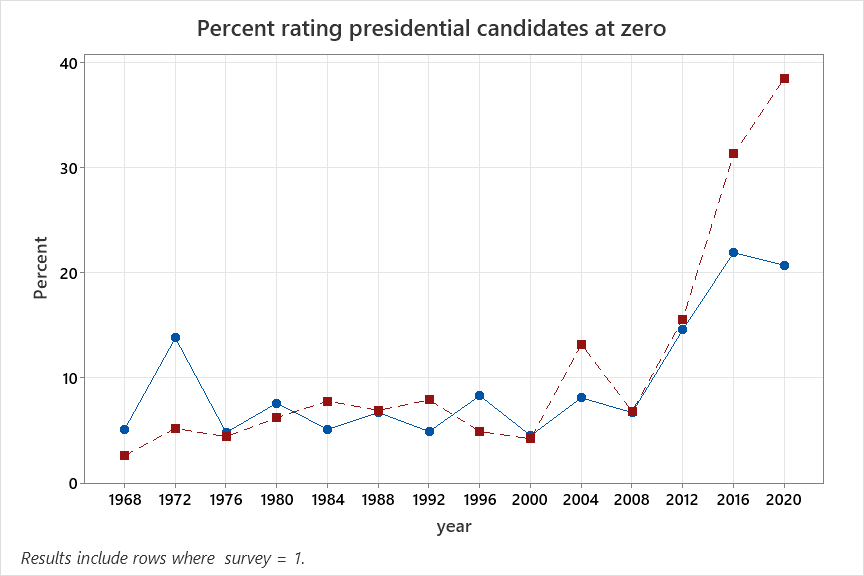
A couple of months ago, some people were saying that Donald Trump’s favorability ratings rose every time he was indicted. . . . Closer examination has shown that this isn’t true, that his favorability ratings actually declined slightly after the indictments. But at the time, it occurred to me that the degree of favorability might be more subject to change—shifting from “strongly favorable” to “somewhat favorable” is easier than shifting from favorable to unfavorable—and that the degree of favorability will matter in the race for the nomination. On searching, I [Weakliem] found there aren’t many questions that ask for degree of favorability, and that breakdowns by party weren’t available for most of them. However, the search wasn’t useless, because it reminded me of the American National Election Studies “feeling thermometers” for presidential candidates, which ask people to rate the candidates on a scale of zero to 100. Here is the percent rating the major party candidates at zero:
With the exception of George McGovern in 1972, everyone was below 10% until 2004, when 13% rated GW Bush at zero. In 2008, things were back to normal, with both Obama and McCain at around 7%, but starting in 2012, zero ratings increased sharply.
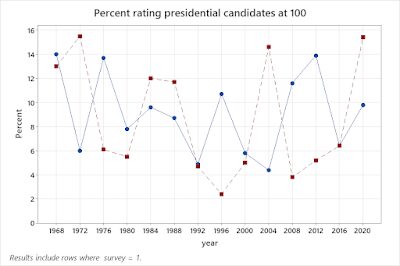
The next figure shows the percent rating each candidate at 100.
There is a lot of variation from one election to the next, but no trend. In 2016, 6.4% rated Trump at 100, which is a little lower than average (and the same as Hillary Clinton). He rose to 15.4% in 2020, which is the second highest ever, just behind Richard Nixon in 1972. But several others have been close, most recently Obama in 2012 and Bush in 2004, and it’s not unusual for presidents to have a large increase in their first term (GW Bush, Clinton, and Reagan had similar gains).
Weakliem concludes:
That is, Trump doesn’t seem to have an exceptionally large number of enthusiastic supporters among the public . . . I think his continued strength in the party is mostly the result of Republican elites’ reluctance to challenge him, which is a mixture of genuine support and exaggerated ideas about his strength among Republican voters.
This is interesting in that it goes against the usual story which is that Republican elites keep trying to get rid of Trump, but Republican voters won’t let them. I think the resolution here is that many Republican elites presumably can’t stand Trump and are trying to get rid of him behind the scenes, but publicly they continue to offer him strong support. Without the support of Republican elites, I think that Trump would have a lot less support among Republican voters. But even a Trump with less support could still do a lot of damage to the party, a point that Palko made back in 2015. This has been the political dynamic for years, all the way since the beginning of Trump’s presidency: He needed, and needs, the support of the Republican elites to have a chance of being competitive in any two-party election or to do anything at all as president; the Republican elites needed, and need, Trump to stay on their side. The implicit bargain was, and is, that the Republican elites support Trump electorally and he support Republican elites on policies that are important to them. The January 6 insurrection fell into the electoral-support category.
Thinking about this from a political science perspective, what’s relevant is that, even though we’re talking about elections and public opinion, you can’t fully understand the situation by only looking at elections and public opinion. You also have to consider some basic game theory or internal politics.
Weakliem also links to a post from 2016 where he asks, “does Trump have an unusually enthusiastic ‘base’?” and, after looking at some poll data, concludes that no, he doesn’t. Rather, Weakliem writes, “what is rising is not enthusiastic support for one’s own side, but strong dislike or fear of the other side.”
This seems consistent with what we know about partisan polarization in this country. The desire for a strong leader comes with the idea that this is what is necessary to stop the other side.
What seems clear to me from the two graphs is that Trump has both an unusually strong base and an unusually strong opposition – not surprising, since it matches the polarization his name seems to bring about. The fact that both extremes are a minority of voters (to the extent that these polls reveal that accurately) does not change the fact that there is a sizable fraction in both extremes. I think the relevant question is why the extremes have so much influence now? Is it “game theory or internal politics” that accounts for that?
The 2020 numbers appear to show slightly over 50% rated Trump at either 0 or 100. Moderate politics and moderate opinion seem to be rapidly disappearing from society – unfortunate for those of us that actually believe in moderation.
Dale –
> …I think the relevant question is why the extremes have so much influence now…
Are you saying this is a trend? I think there’s data that we’ve become more polarized (not necessarily overall, but when viewed across party ID), but what is the evidence that the extremes have become more influential?
The evidence is what is happening in Congress now. And, one look at the likely Presidential candidates for 2024 seems to suggest that these extremes are more influential than in the past. Also, I can’t help but see a parallel in the Israel – Palestine situation. A large and vocal segment of the world population appear to blame everything on either the Israelis or Hamas – moderate views that see injustice on both sides seem to have no place (although I believe there is a large segment of the population that hold such moderate views). Do we now live in a world where only extreme views matter? I haven’t seen many moderate candidates or policies lately – although I’ll accept the possibility that I just don’t hear about them. It might be that the media are unduly influenced by extreme views, whereas their actual influence is not so great. But it sure doesn’t feel like that (I think that is the age-old question of whether the media leads or lags public opinion, to which I’d say “both”).
Dale –
> I haven’t seen many moderate candidates or policies lately…
I struggle with how to reconcile measuring this with how it all feels. For example, the New Deal would seem so radical in the current context that I can’t imagine it ever getting through.
As another example, it’s not clear to me that the US is more polarized than it was during the Vietnam War era with hardhats versus the hippies, or that the extremes have less influence than during that era or the period of the civil rights movement. Surely you remember that the “silent majority” was being marginalized by the vocal extremes.
Ezra Klein presents the argument that there’s not less polarization overall, but that we’re more divided along party lines (less diversity within parties) which gives the appearance of more polarization overall. I think that Biden isn’t particularly more “extreme” within the Democratic Party spectrum than previous Dem candidates, but his administration is seen as extremely radical by nearly 1/2 the country.
I just don’t know how to put this all together and I haven’t seen clear and comprehensive data to do so.
I should say:
Surely you remember the widespread perception that the “silent majority” was being marginalized by the vocal extremes.
Joshua
I just don’t know. I can’t imagine seeing any further amendments to the Constitution, despite feeling that they are sorely needed. I just think the amount of bipartisan support is unattainable. I haven’t given up hope that some kind of bipartisan solution can emerge for the Speaker stalemate, though I’m not very optimistic. You are correct to remind me of examples from the not so distant past (e.g. the Vietnam era). On the other hand, before Trump, I can’t think of any President that I would consider giving a 0 or 100 rating to, despite some fairly hard to tolerate ones. I consider Biden somewhat moderate, but it is notable that no real opposition has emerged to his candidacy and I have a hard time envisioning a moderate successor. Republican moderates seem to have become an oxymoron. It is hard for me to separate the effects of my own aging, media influence, and seemingly changing political and social discourse. But as Blackthorne below observes, the graphs do suggest a strong Republican base for Trump and the opposition in the first graph is clear. Is this a unique Trump effect or is it the new normal?
Dale,
I would highly suggest taking a look at Opting Out of Congress: Partisan Polarization and the Decline of Moderate Candidates by Danielle M. Thomsen. It provides some pretty compelling arguments about the declining number of moderates in the political pipeline.
Essentially, moderates are less likely to run in a polarized atmosphere. Their approach to politics/negotiation/bipartisanship is believed to lead to little policy success. Moderates know there will be intense pressure to toe the party line. If they defect, they are less likely to get important committee assignments, campaign support, etc.
Dale –
I hear you on all of that.
I was fairly young for Reagan, but I remember a whole lot of people (in my social circles) thinking he was a depressingly dangerous extremist. Is it really different than how people see Trump or does it just somehow feel that way?
The disgust for Bush was so intense that the notion of a Bush Derangement Syndrome became part of the parlance. The levels of hatred for Obama felt off the charts, and certainly seemed to me to be widely out of sync with his level of extremeness.
> It is hard for me to separate the effects of my own aging, media influence, and seemingly changing political and social discourse.
I keep asking myself these questions and I’m not finding clear answers.
Dale –
Re polarization, this poll result seems surprisingly not polarized to me. Hard for me to think of very many issues where there’s this much agreement across party lines:
https://twitter.com/DataProgress/status/1715379996913475588
With the caveat that skepticism about polling is warranted…perhaps most interesting is closeness of the result with GOP and Dems. In a sense, that comparison might be less affected by biases in the polling:
Dale,
I agree with your assessment that Trump has an unusually strong base and opposition, but I don’t agree that being strongly opposed to Trump is extreme except in terms of where you are in a distribution. After all, the guy has already been found liable for sexual assault, and we all watched him try to overturn the 2020 election. Etc., etc.
100% agree. “Polarization” is a very strange word to use for intense opposition to authoritarianism. There is a strategic communication reason why centrists keep using the word to club the left with … but I won’t go into that.
Such a great point.
We frequently look at approval/disapproval ratings as a dichotomous variable. Obviously, and maybe particularly in presidential elections like those recently held between two candidates with relatively low approval ratings, that’s got to be of limited value.
Do these charts really support the claim that Trump doesn’t have a strong Republican base? These are surveys of the general population, I thought the main worry of the Republican elites is that no one can win the primary while being anti-Trump. I’m also curious how the next-best Republican would’ve polled in 2020.
I’d guess the population of poll responders is mostly diehard republicans/democrats (the 20% of people who want the government to ban/mandate this or that and only disagree on the specifics).
The 40% of nonvoters arent going to be answering the poll, and maybe a few percent of “independents” will. The dilution of extreme responses by the independents has probably be dropping as more people get their info from the internet rather than traditional sources.
Sure, there is probably more polarization amongst that diehard 20% too. But I would’t judge the general population from these responses.
Anoneuoid –
> specifics).
The 40% of nonvoters arent going to be answering the poll, and maybe a few percent of “independents” will.
Ordinarily, at this site at least, if someone expresses something with such confidence I’d think they have clear supporting evidence. However your track record on that regard isn’t very good.
Seems to me that there are many non-voters and independents who have strong political views and would want to get them heard. I wouldn’t doubt there’s some effect that you describe but I’d doubt it’s categorical ike you describe it.
I’d love to see evidence otherwise.
I said “I’d guess”. And those producing such numbers need to show it is a sample of the general population (which they can’t). But that is not what interests me about these kind of discussions. Instead:
Which has zero to do with republican vs democrat for the non-responders, but everything to do with it for people who have bought in to that mindset. And for whatever reason the people who have bought into it are the ones collecting and analyzing such data.
The interesting part is that I can understand the tribalist mindset very easily, but it seems impossible for people who have bought into it to understand the majority opinion. They just can’t make a distinction between caring about politics and caring about team A vs team B.
Look up the “American National Election Studies” methodology, then tell me it doesn’t assume democrat vs republican is the most important thing.
Anoneuoid –
I interpreted
> “The 40% of nonvoters arent going to be answering the poll, and maybe a few percent of “independents” will.”
As being an expression of uncertainty.
> They just can’t make a distinction between caring about politics and caring about team A vs team B.
There you go with “those people” again. It’s almost like a medical condition with you.
> Which has zero to do with republican vs democrat for the non-responders,…
Once again with the total certainty.
There’s no mutual exclusivity between expressing views in polls and not voting. These aren’t dichotomous categories. Nti everyone fits into a single-dimension box. Even party ID moves around a bit.
I’m not suggesting there aren’t trends or general patterns. I’m commenting on your lack of respect for uncertainty.
> Look up the “American National Election Studies” methodology, then tell me it doesn’t assume democrat vs republican is the most important thing.
Almost a non-sequitur. I’m not suggesting that the approach in polling doesn’t often over-emphasize party ID as a way to quantify political attitudes (none the least in a country where so many people don’t vote). My point is that it’s possible to agree with that and still question the level of certainty you express. Your abilities as a non-tribal whisperer might be overstated.
Sorry. Should be …expression of certainty…
I really think its impossible for some people to understand the mind of someone who does not care about democrat vs republican. It is like if I tried to understand the sensory input of a dolphin. The concept is so foreign they cannot do it.
So they’ll think Im just not informed enough, or their mind will refuse to parse a multi-paragraph comment, or whatever. No, the more informed I became the *less* I cared until it dwindled to nothing.
All I’m pointing out is that mine is not the fringe view, it is the majority. These discussions and polls that (often implicitly) assume the US is near 50/50 democrat/republican are very myopic and misleading.
Anoneuoid –
> I really think its impossible for some people to understand the mind of someone who does not care about democrat vs republican.
“some people” is doing a lot of heavy lifting there. I would imagine there are some. I would think that’s a relatively small number. It’s a pretty extreme state of mind that you’re describing.
Lots of people have preferences along party lines even if they don’t vote. It will depend a great deal on context. Evidence of that is that more people voted in the last election than do typically.
Many alternate between party ID, which should make it clear they aren’t exclusively locked into a party identification tribe. Then there are others who stay with a particular part ID, but do so somewhat reluctantly, or as a choice between the lesser of evils.
> It is like if I tried to understand the sensory input of a dolphin. The concept is so foreign they cannot do it.
Again, that looks like an extreme and incredibly uncharitable characterization. Most of even those who are heavily tribally aligned, will have friends and family who are more indifferent. Saying they’d consider all those friends an family as a different species of being seems very uncharitable in addition to just being wrong.
> No, the more informed I became the *less* I cared until it dwindled to nothing.
The more you know the more you know you don’t know. But again, it’s not a good idea to generalize from our own experiences. By the very nature of being here having this discussion, you’re by definition an outlier.
> All I’m pointing out is that mine is not the fringe view, it is the majority.
See above. I don’t know exactly along what dimension you have defined yourself as the “majority,” but I’m reasonably sure that your placement of the parameters for dividing people up is pretty circular so as to match that definition.
> These discussions and polls that (often implicitly) assume the US is near 50/50 democrat/republican are very myopic and misleading.
Again, I don’t entirely disagree. My disagreement is with your certainty and degree of generalizing. I think I see the world as less binary than you.
This is another interesting one. In 1800 no one knew about radiation or galaxies. When you use actual science you reduce the amount you don’t know. That is how it is supposed to work.
This attitude is recent and primarily comes from attempting to use NHST to decide what is “real”, which indeed results in confusion.
Anoneuoid –
It’s an expression.
If you had an ounce of cognitive empathy you wouldn’t be confused about what it means.
> When you use actual science you reduce the amount you don’t know.
What it doesn’t mean is that the more you learn, the less you know.
It means when you learn more, you learn about how there are many things you didn’t know about, but didn’t realize they existed. Kind of like unknown unknowns.
Sheece
Your never-ending quest to prove how superior you are to your imagined enemies will only continue to twist into logical knots. Try lightening up a bit.
These figures are from the American National Election Studies, which still get high response rates. Essentially no Democrats give him top ratings, so clearly he does have a lot of top ratings among Republicans. But my point is that wasn’t something brought to the party–it wasn’t the case in 2016. Rather, he continues to have high support among Republican voters because Republican elites have been unwilling or afraid to cross him, even after he lost.
In current Republican rhetoric, badmouthing elites is is standard fare, as in “The Democratic elites aren’t coming after me, they are coming after you. I’m just standing in the way.” One thing that Republic elites don’t want to appear to be is elite. So, I think they are scared, but I’m not convinced that standing up to Trump would work for them if they weren’t scared.
I think another potentially important factor is the belief that a disproportionate number of Trump supporters will not show up and vote if Trump is not the candidate. I can’t state this is actually true, but people do believe it, and it would make it hard to replace Trump.
I think it’s reasonably clear that Trump brought in votes from quite a few (a pox on both their houses) disaffected voters who had either stopped voting or never really voted much. Particularly among white, working class (mostly males). I suspect that actually many who looked like Obama –> Trump voters came from those cohorts.
I think that’s part of the reason for Trump outperforming the polls conducted with “likely voters,” as they would be missed.