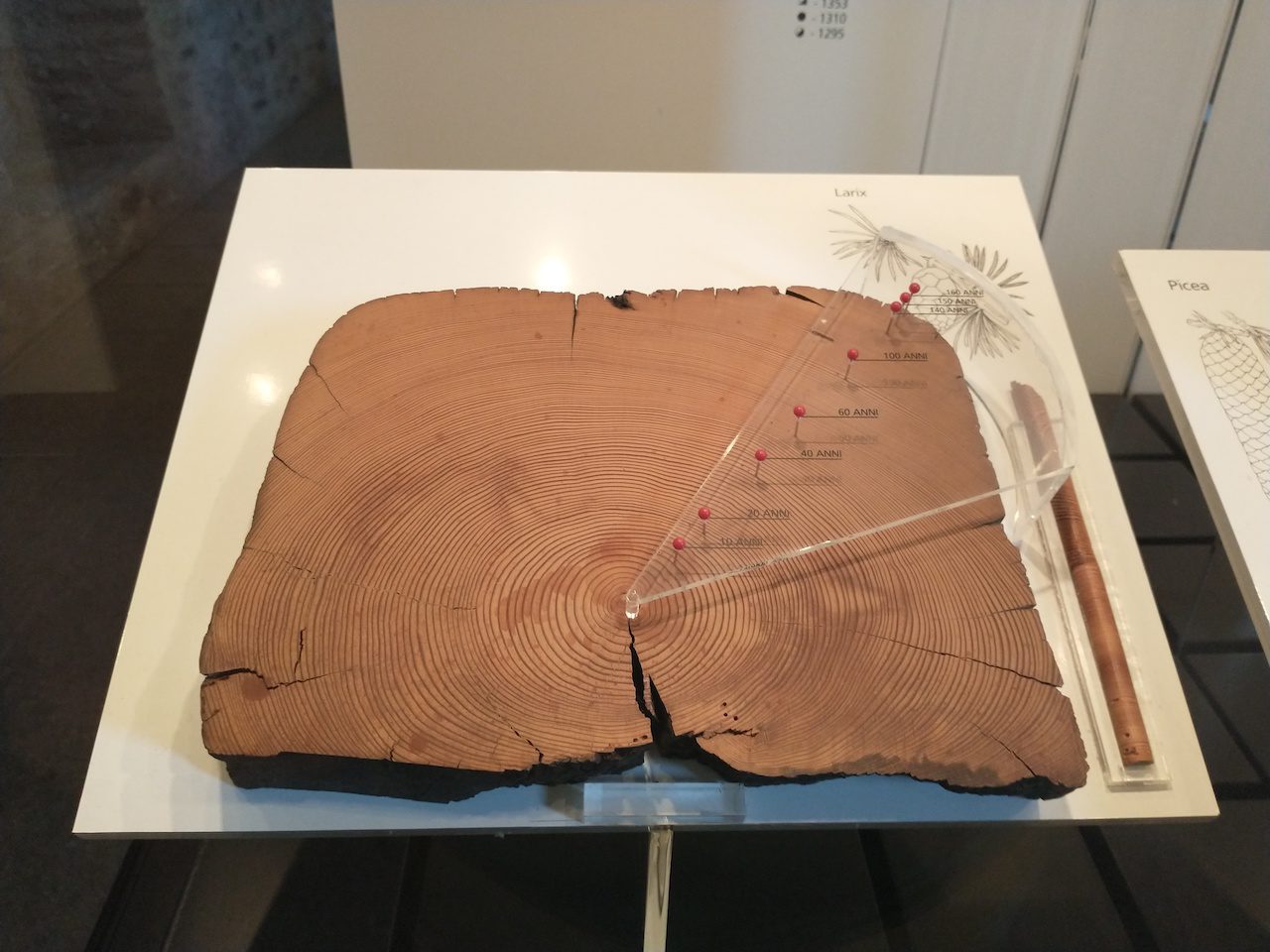
This post is by Lizzie. I took the photo on Tuesday at a Sforza fortress in Bellinzona. The museum currently also has an installation by Zimoun, who also did `36 ventilators, 4.7m3 packing chips.’
I recently read Tree Story: The History of the World Written in Rings by Valerie Trouet and recommend it. It’s a quick and fun read about dendrochronology — the study of tree rings to reconstruct climate (good recap of dendro here from recent What’s Going On in This Graph?) — weaving in the author’s scientific life and lots of the best tree ring stories (I think my favorite story may still be related to the climate reconstruction of the period around Genghis Khan’s empire). It was recommended to me the Tree Spotters National Phenology Network group in Boston, who I was chatting with when back in Boston in May.
After years of fascination with tree rings (including the intrigue of their divergence problem) I was finally thinking of dipping my toe in the topic, starting somewhere I had a little bit of scientific overlap: shifting growing seasons (I work on that!) and tree growth measured via radial ring width (I don’t work on that).
We’ll see what happens with that, but for now I am still trying to understand this massive field, and I feel I am coming from another pitch. Dendrochronology is focused on extracting climate signals from tree rings; as an ecologist I work a lot more on how trees — from seeds to younger saplings (that we can manipulate in experiments) to older trees — grow and reproduce. The dendro folks definitely do not think much about reproduction and I can’t fully blame them as even I set that aside in some ways with trees (when I am really interested in growth-reproductive trade-offs I work on annual or biennial plants), but they also think about growth from a climate focus, whereas I think about growth somewhat differently.
Recently someone in my lab said ‘of course we know drought and temperature matter to tree growth, that is not interesting.’ I perhaps would not go that far, but it captured the contrast. As a community ecologist tree growth to me is limited by lots of things, but especially other trees. For species to coexist in a stable manner my field says within-species competition must limit growth more than between-species competition (with this balance occurring most in the most climatically favorable years, which should differ among species for coexistence) — this whole world of tree-to-tree competition is where the story is at. It’s how we get diverse forests, and certainly it relates a lot to how trees grow.
Competition is something dendrochronologists spend a good while trying to avoid (at least for the trees that they core). They want trees growing on the edge of a ledge of stone, alone in the world (and I guess we assume alone forever) and they ‘standardize’ out the mess of the early years when we think most of the important competition between trees might happen. They fit a growth curve and take the residuals. Then they take all the time-series they have for individual trees in a similar (but climatically caustic) area and put them together so they get a ‘chronology.’ I knew all this before, but it was better explained in Tree Story. And the process of figuring out which species to use to reconstruct which climate variables and where to find these trees battling the climatic elements also explained.
But what the book didn’t explain and I still don’t get is where the field goes from its current approaches. I think I understand why the standardizing approach would have been good when the field started a hundred years ago or so, or maybe even 20-30 years ago, but I am not sure I see how it can be the path forward (so much so that the database for tree ring data it is all available as already `standardized’). I’d be interested if someone could convince me this is the way to go statistically.
Andrew has a paper on this (Schofield et al. 2016), which I also really like, but it doesn’t seem to be taking dendrochronology world by storm, especially compared other papers using Bayesian methods and tree rings, which seem to often use pre-standardized time series (e.g., Tingley & Huybers 2010, but correct me if I am wrong). This is partly social science, it would be a lot of work to take away the standardization methods and I can see the cost:benefit analysis many might be doing. It probably feels worth more now to build up the spatio-temporal methods. But it also makes the field hard to approach for people like me who see their part of the science lost to all the detrending and averaging.
I don’t really know the dendrochronology literature at all but my sense is other ecologists are thinking about the competition piece, too:
Anderegg, L. D. L., and J. HilleRisLambers. 2019. Local range boundaries vs. large-scale trade-offs: climatic and competitive constraints on tree growth. Ecology Letters 22:787–796. [https://doi.org/10.1111/ele.13236]
Heilman, K. A., M. C. Dietze, A. A. Arizpe, J. Aragon, A. Gray, J. D. Shaw, A. O. Finley, S. Klesse, R. J. DeRose, and M. E. K. Evans. 2022. Ecological forecasting of tree growth: Regional fusion of tree-ring and forest inventory data to quantify drivers and characterize uncertainty. Global Change Biology 28:2442–2460. [https://doi.org/10.1111/gcb.16038]
But is it a two-way street? Is the dendro research also being influenced by what ecologists are finding?
Yes! There are definitely ecologists working on tree rings — I am visiting one of the labs that does that now, and your citations catch many of the other authors I know, but none seem to be be providing a new method to the standardization approach that is catching on (or that I want to follow). There are also dendro folks rethinking standardization, but no clear direction yet.
Lizzie:
We analyzed our data directly, and I kinda liked our model. The bad news is that we didn’t have enough data to estimate the model well. We were using some standard dataset, I think it was 5000 trees. There are billions of trees out there, so it seems kinda ridiculous to only be analyzing 5000 of them. The trouble is that if you add new trees from other places, you need to expand your model. The whole project was frustrating because we never reached a stage of stability in the estimation. It’s just a hard problem.
My sense is there is lots of data, but maybe not as much as I thought. And I am not sure more sites or species or such would help without a better model of how the model should shift over space or species…. I am semi-hopeful that some experiments or (related) physiological fundamentals could provide informative priors but the uncertainty is probably higher than folks want to discuss. Many of the ecological models I look at add lots and lots of parameters, trying to get more and more out of the data, which does not feel like a great path to me either.
There was a kewl article on this in Science recently. A Japanese researcher figured out some (radioactive something) accurately(!!) datable events, so tree-ring counting from those events is accurate +/- a year or two, and the technique is becoming more widely used. (The article was probably within the last 2 months or so. Sorry for the fuzziness on the details. It should come up in a search. Should…)
So there are some new tricks in this field.
I barely know anything about tree rings, but I had never seen or heard the word, “kewl.” According to https://slang.net/meaning/kewl,
“Kewl is part of a set of x-treme 1990s slang terms, which changed words’ spelling to make them seem … kewler. However, kewl was so widely used that even the not-very-kewl Oxford English Dictionary recognized it as a legitimate word. Thus, the kewl kids who formerly used kewl have largely moved on to other slang terms (some of which you can see in the Related Slang section below), and kewl is now most often used sarcastically.”
Consequently, according to the above, David in Tokyo is almost as much behind the times as I am. So that we all catch up, that website listed the following:
———————————————
Related Slang
kwl Cool
coo Cool
2C4U Too cool for you
Dope Cool
ill Cool
Baller Cool person
Straight fire Very cool
Gas Great
My usage of kewl predates the 1990s. By several decades…
Sorry, I have to ask. Does the spelling reflect a pronunciation difference (e.g., back unrounded vowel)?
The instances where one pronounces “cool” like “kewl” occur in times when we are being silly and cutesy, I think. The pronunciation I’m referring to is simply drawing out the one syllable “cool” to two: “coo-wl”. It is not “kewl” like “q-wl”.
I think you must mean this article: https://www.nature.com/articles/ncomms2783 ? It went with the cool Viking story https://www.nature.com/articles/s41586-021-03972-8 (though my issue isn’t with the cross dating so much).
The Science article I read was an overview article, not a technical article. It had a lot of background, discussions of the people involved. Also some applications to pre-CE dataing. But, yes, at a quick glance at those, that’s what Science was talking about.
This one I think:
https://www.science.org/content/article/marking-time-cosmic-ray-storms-can-pin-precise-dates-history-ancient-egypt-vikings#.ZD3e32MJR00.twitter
I’d never heard of the divergence problem. I’d guess it has something to do with whatever happened to the temperature record starting ~1950: https://data.giss.nasa.gov/gistemp/history/output/history_numStations_coverage.gif
Ie, all those new weather stations weren’t getting put out in the middle of the woods where the trees are. They were being put somewhere more accessible and the temperature in the woods was interpolated.