Regular readers of this blog will know that one of my favorite books ever is “How to talk so kids will listen and listen so kids will talk,” by Adele Faber and Elaine Mazlish. Here’s how I described it a few years ago:
I read this book long before I had kids—it’s incredibly helpful for interactions with adults as well. It’s a book that really changed my life. No statistical content at all—but, implicitly it’s all about statistics, about what works and what doesn’t. I imagine that there’s a whole scholarly literature in which ideas such as described by Faber and Mazlish have been evaluated statistically. Maybe they don’t even work, I dunno. But the book seems great to me, and I recommend that every statistician read it.
So, regarding that “whole scholarly literature” . . . I happened to be googling today and came across this article published in 2018 in BMC Pediatrics (no, I can’t figure out what “BMC” stands for here; maybe it’s a brand name like Exxon that doesn’t stand for anything?) by Mireille Joussemet, Geneviève Mageau, Marie-Pier Larose, Mélanie Briand, and Frank Vitaro, and with the absolutely grabby (to me) title,
How to talk so kids will listen & listen so kids will talk: a randomized controlled trial evaluating the efficacy of the how-to parenting program on children’s mental health compared to a wait-list control group
It’s a pre-registered study of 315 kids, testing the theories of this book that I love. How cool is that? I clicked through to the study webpage itself on ClinicalTrials.gov:
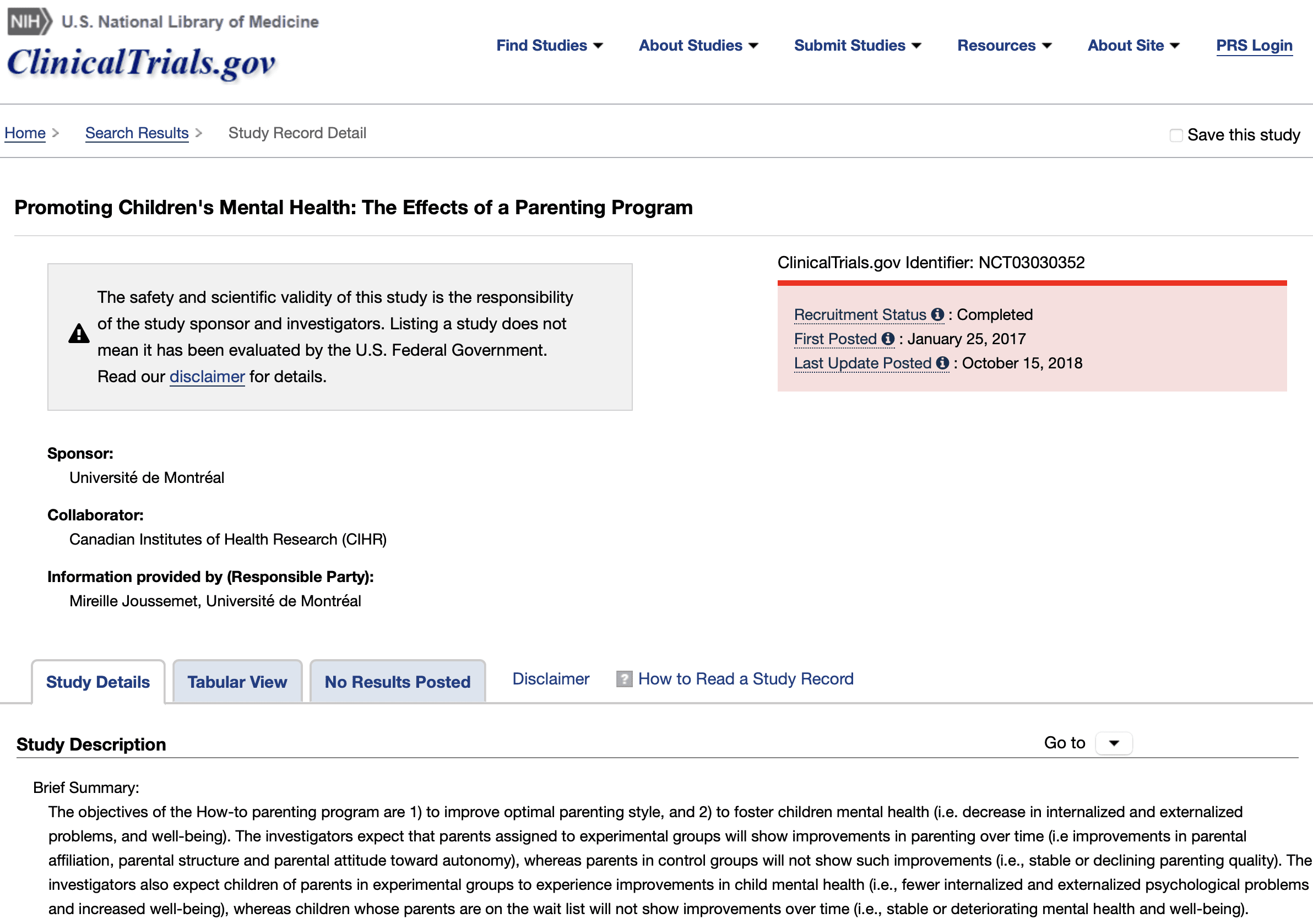

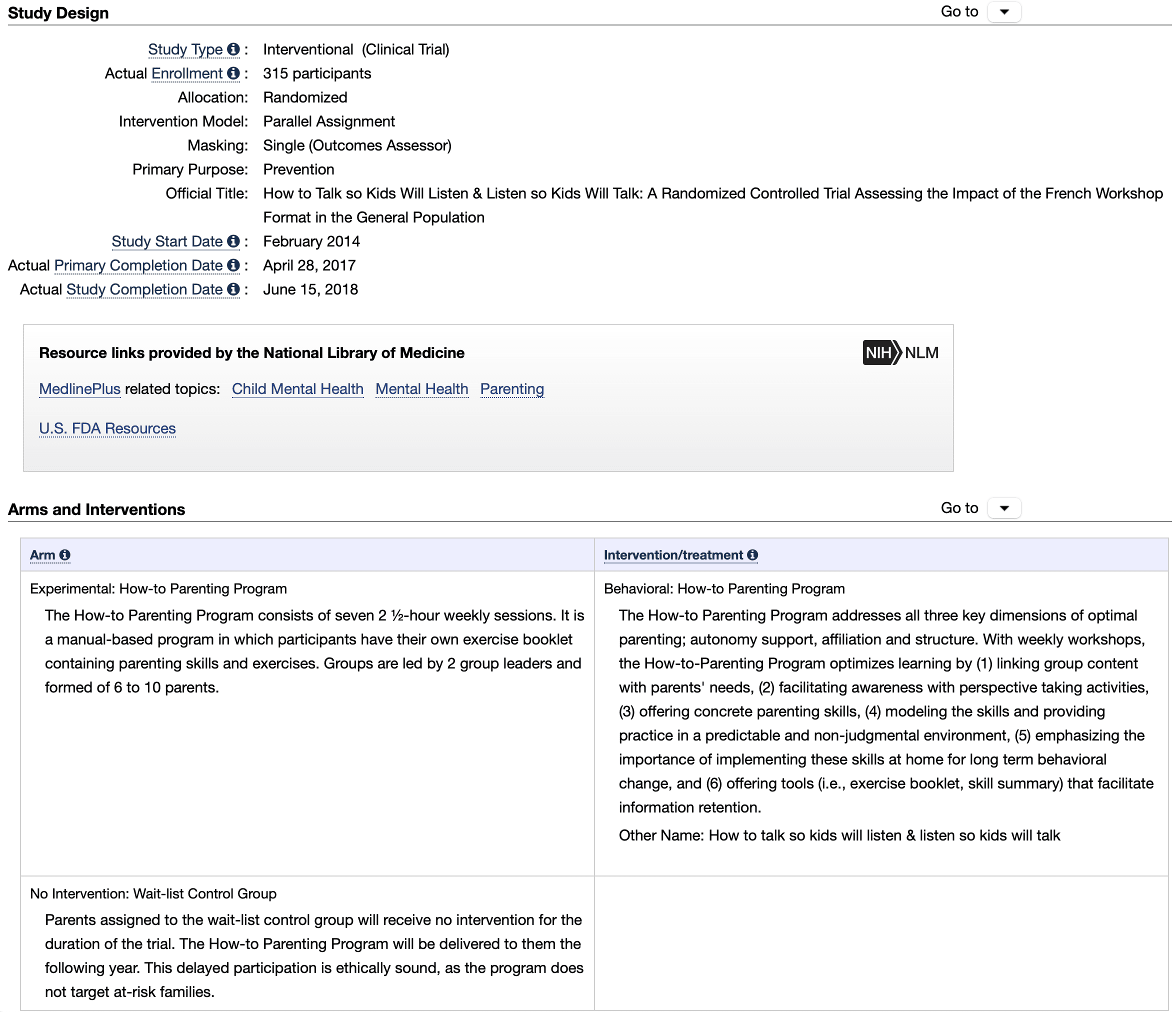
So . . . whassup? The study started in Feb 2014, last participant was examined in Apr 2017, the study was completed in June 2018, the preregistration paper was published in Aug 2018, so why are there no results reported on that ClinicalTrials.gov page?
I’m not sure, but after a Google Scholar search of the papers that cited the above-linked article, I did find the followup from Mar 2022, with some of the same authors and the following, blander title:
How-to parenting program: A randomized controlled trial evaluating its impact on parenting
Good news it that the “How to talk so kids will listen & listen so kids will talk” program seems to have worked! It says, “We recruited 293 parent-child dyads,” which isn’t quite the 315 reported at the preregistration site, so I’m not sure what happened with that. Oddly enough, I don’t see a link to the ClinicalTrials.gov page in this new paper, so it’s hard to follow this one up. Also no raw data which is really too bad in this modern age.
In any case, I’m glad to see that there’s been this evaluation of the book that I love so much. Anyone who’s interested can read the article, try to track down the underlying data, and use this to design new studies.
Bio Med Central
As a parent of a 5month old and 24 month old, I really appreciate this post and ordering the Faber/Mazlish book now. Thanks!
See https://link.springer.com/article/10.1007/s10826-022-02449-0 for a recent effort some specific ideas about parental praise that are in the book. The experimental manipulation is totally based on the book among others, although we are not informed about the other sources: “To enhance the validity of our experimental manipulation, we developed the verbatim for each praise condition based on examples provided by theoretical writings on descriptive and non-specific praise (e.g., Faber and Mazlish, 2000)”