First competition
It all started back in 2015 when we were told that Columbia would be graced by a very special seminar from the philosopher Bruno Latour, author of many bowls of world salad such as this:
The result of a twenty five years inquiry, it offers a positive version to the question raised, only negatively, with the publication, in 1991, of “We have never been modern”: if “we” have never been modern, then what have “we” been? From what sort of values should “we” inherit? In order to answer this question, a research protocol has been developed that is very different from the actor-network theory. The question is no longer only to define “associations” and to follow networks in order to redefine the notion of “society” and “social” (as in “Reassembling the Social”) but to follow the different types of connectors that provide those networks with their specific tonalities. Those modes of extension, or modes of existence, account for the many differences between law, science, politics, and so on. This systematic effort for building a new philosophical anthropology offers a completely different view of what the “Moderns” have been and thus a very different basis for opening a comparative anthropology with the other collectives – at the time when they all have to cope with ecological crisis. Thanks to a European research council grant (2011-2014) the printed book will be associated with a very original purpose built digital platform allowing for the inquiry summed up in the book to be pursued and modified by interested readers who will act as co-inquirers and co-authors of the final results. With this major book, readers will finally understand what has led to so many apparently disconnected topics and see how the symmetric anthropology begun forty years ago can come to fruition.
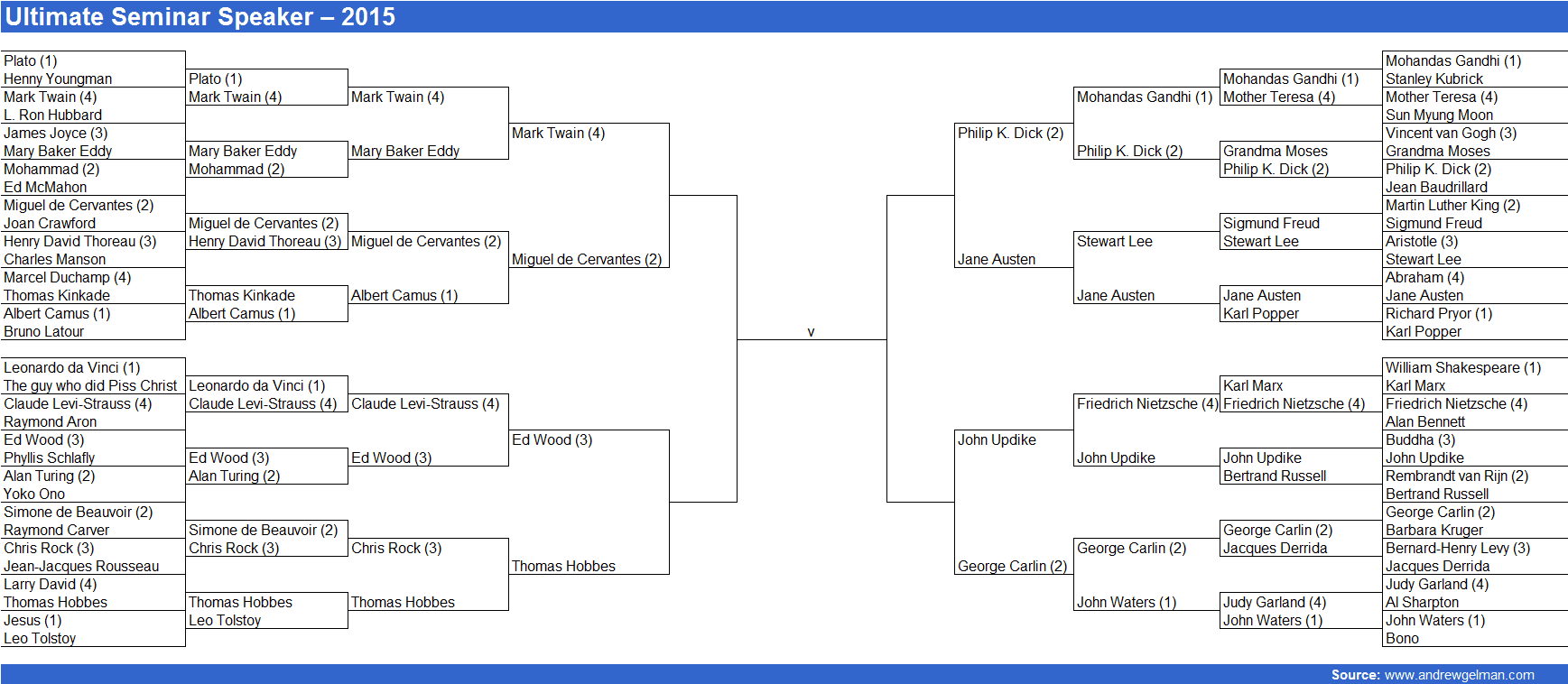
And I thought . . . Hey, we could do better than that. So we created our very first Greatest Seminar Speaker contest, featuring 64 contestants in 8 categories:
– Philosophers:
Plato (seeded 1 in group)
Alan Turing (seeded 2)
Aristotle (3)
Friedrich Nietzsche (4)
Thomas Hobbes
Jean-Jacques Rousseau
Bertrand Russell
Karl Popper
– Religious Leaders:
Mohandas Gandhi (1)
Martin Luther King (2)
Henry David Thoreau (3)
Mother Teresa (4)
Al Sharpton
Phyllis Schlafly
Yoko Ono
Bono
– Authors:
William Shakespeare (1)
Miguel de Cervantes (2)
James Joyce (3)
Mark Twain (4)
Jane Austen
John Updike
Raymond Carver
Leo Tolstoy
– Artists:
Leonardo da Vinci (1)
Rembrandt van Rijn (2)
Vincent van Gogh (3)
Marcel Duchamp (4)
Thomas Kinkade
Grandma Moses
Barbara Kruger
The guy who did Piss Christ
– Founders of Religions:
Jesus (1)
Mohammad (2)
Buddha (3)
Abraham (4)
L. Ron Hubbard
Mary Baker Eddy
Sigmund Freud
Karl Marx
– Cult Figures:
John Waters (1)
Philip K. Dick (2)
Ed Wood (3)
Judy Garland (4)
Sun Myung Moon
Charles Manson
Joan Crawford
Stanley Kubrick
– Comedians:
Richard Pryor (1)
George Carlin (2)
Chris Rock (3)
Larry David (4)
Alan Bennett
Stewart Lee
Ed McMahon
Henny Youngman
– Modern French Intellectuals:
Albert Camus (1)
Simone de Beauvoir (2)
Bernard-Henry Levy (3)
Claude Levi-Strauss (4)
Raymond Aron
Jacques Derrida
Jean Baudrillard
Bruno Latour
Paul Davidson randomized the names while following seeding constraints and created the bracket. We had a great time with this: one match per day for two months, beginning with Plato vs. Henny Youngman for the first Round 1 matchup and concluding with Thomas Hobbes vs. Philip K. Dick in the final.
Second competition
In 2019 we brought it back with a new set of candidates:

– Wits:
Oscar Wilde (seeded 1 in group)
Dorothy Parker (2)
David Sedaris (3)
Voltaire (4)
Veronica Geng
Albert Brooks
Mel Brooks
Monty Python
– Creative eaters:
M. F. K. Fisher (1)
Julia Child (2)
Anthony Bourdain (3)
Alice Waters (4)
A. J. Liebling
Nora Ephron
The Japanese dude who won the hot dog eating contest
John Belushi
– Magicians:
Harry Houdini (1)
George H. W. Bush (2)
Penn and Teller (3)
Steve Martin (4)
David Blaine
Eric Antoine
Martin Gardner
Ira Glass
– Mathematicians:
Carl Friedrich Gauss (1)
Pierre-Simon Laplace (2)
John von Neumann (3)
Alan Turing (4)
Leonhard Euler
Paul Erdos
Stanislaw Ulam
Benoit Mandelbrot
– TV personalities:
Oprah Winfrey (1)
Johnny Carson (2)
Ed Sullivan (3)
Carol Burnett (4)
Sid Caesar
David Letterman
Ellen DeGeneres
John Oliver
– People from New Jersey:
Bruce Springsteen (1)
Chris Christie (2)
Frank Sinatra (3)
Philip Roth (4)
William Carlos Williams
Virginia Apgar
Meryl Streep
Joe Pesci
– GOATs:
Jim Thorpe (1)
Babe Didrikson Zaharias (2)
LeBron James (3)
Bobby Fischer (4)
Serena Williams
Pele
Simone Biles
Lance Armstrong
– People whose names end in f:
Riad Sattouf (1)
Ian McKellen (2)
Boris Karloff (3)
Darrell Huff (4)
Yakov Smirnoff
DJ Jazzy Jeff
Adam Schiff
Anastasia Romanoff
Alan Turing was included in both competitions; that was an oversight. The matchups started with Jim Thorpe vs. John Oliver, which was won by Jim:
We got a couple arguments in Oliver’s favor—we’d get to hear him say “Whot?”, and he’s English—but for Thorpe we heard a lot more, including his uniqueness as greatest athlete of all time, and that we could save money on the helmet if that were required. We also got the following bad reason: “the chance to hear him say, ‘I’ve been asked to advise those of you who are following this talk on social media, whatever that means, to use “octothorpe talktothorpe.”‘” Even that bad reason ain’t so bad, also it’s got 3 levels of quotation nesting, which counts for something right there. What iced it for Thorpe was this comment from Tom: “Seeing as he could do everything better than everyone else, just by giving it a go, he would surely give an incredible seminar.”
And it concluded with the finals, pitting the Japanese dude who won the hot dog eating contest against Riad Sattouf. My favorite match, though, was Virginia Apgar vs. Frank Sinatra, a battle of two Jerseyites. I looked up Apgar on wikipedia and learned that she came from a musical family! Meanwhile, Frank Sinatra had friends who put a lot of people in the hospital. So lots of overlap here.
Third competition
Who would be the ultimate seminar speaker? We’re not asking for the most popular speaker, or the most relevant, or the best speaker, or the deepest, or even the coolest, but rather some combination of the above.
Our new bracket of 64 includes eight current or historical figures from each of the following eight categories:
– Duplicate names
– Alleged tax cheats
– People known by initials
– Cool people
– Namesakes
– Children’s book authors
– Creators of laws or rules
– Traitors
The rules
We’ll post one matchup each day at noon, starting in a few weeks.
Once each pairing is up, all of you are encouraged to comment. We’ll announce the results when posting the next day’s matchup.
We’ll decide each day’s winner not based on a popular vote but based on the strength and amusingness of the arguments given by advocates on both sides. So give it your best!
As with our previous contests, we’ll continue the regular flow of statistical modeling, causal inference, and social science posts. They’ll alternate with these matchup postings.
What does “duplicate names” mean?
Like someone named Tom Frank?
Joshua:
Famous people such as Albert Brooks who share a name with some other, more famous, person.
So what, then, is namesakes – people whose name is the same as something other than another person?
Oh, sorry, that was namesakes. Duplicate names are people with duplication in their names, for example John John.
According to wikipedia, there is only one famous person named “Albert Books”. Or are you referring to Brooks’s original surname of Einstein?
I wonder if Irving/Isiah Berlin would qualify.
Adede:
1. Yes, Albert Brooks is only the second-most-famous person named Albert Einstein.
2. Isaiah and Israel are different names, no?
I see. Didn’t know if both names had to be the same, or just one. Technically, “Albert Lawrence Einstein” and “Albert Einstein” (no middle name) are different names, but I guess we are just limiting to First+Last.
By the way Bruno Latour just died, let this be an hommage to him!
Dr. Isaac Azimov’s Three Laws of Robotics ought to qualify him as a law-maker, up there with Moses.
I’m curious about the “traitors” category. As “treason never prospers”, this must be a bunch of failures. How good are failure stories for a seminar? I guess we’ll see.
Finally, another chance for me to add value in this forum.
Long time reader first time commenter. I’ve nothing particularly constructive to say but I want to register disagreement with both LeBron and Fischer on the GOATs list. Jordan and at minimum three chess players would like a word…