John Williams points us to this post by Jason Collins. Collins criticizes embodied cognition and he’s not a member of the club, so I guess that makes him a methodological terrorist. But he also criticizes the nudgelords and is not a member of that club either, so I guess that makes him Stasi.
In all seriousness, Collins says things well. Regarding the hot hand fallacy fallacy, he writes:
The researchers expanded the original hot hand research from a story about people misperceiving randomness, to one of them continuing to do so even when presented with evidence that they were making an error.
But, as we can now see, their belief in the hot hand was not an error. The punters in the stands were right. Their accumulated experience had given them the answer. The researchers were wrong. Rather than the researchers asking whether they themselves were making an error when people refused to believe their research, they double downed and identified a second failure of human reasoning. The blunt dismissal of people’s beliefs led behavioural scientists to hold an untrue belief for over thirty years.
Collins summarizes:
This is a persistent characteristic of much applied behavioural science. . . . We spend too little time questioning our understanding of the decisions or observations other people make. If we believe they are in error, we should first question whether the error is ours.
I would just add that the nudgelords triple down on their error when they ignore or evade criticisms of their work by other scientists, sometimes doing this by the simple expedient of pretending the criticism never happened, sometimes pointing to alternative analyses that allow them not to think seriously about the flaws in their methods, sometimes memory-holing their mistakes (as in the disappearance without comment of any mention of the work of former culture-hero Brian Wansink), and sometimes all-out attacking their critics (see “terrorist” and “Stasi” above). These nudgelords put a lot of effort into maintaining their pristine state of ignorance.
The piranha principle!
Collins also makes a piranha-like point:
There is an interesting intersection between this priming research and the hot hand. Much behavioural science research (including priming) is built on the concept that subtle, often ignored features of our environment can have marked effects on our decisions and performance. Yet why didn’t the hot hand researchers consider that a basketball player would be influenced by their earlier shots, surely a highly salient part of the environment and influence on their mental state? But, alas, the desire to show one bias allowed us to overlook another.
Yup.
Our benevolent overlords
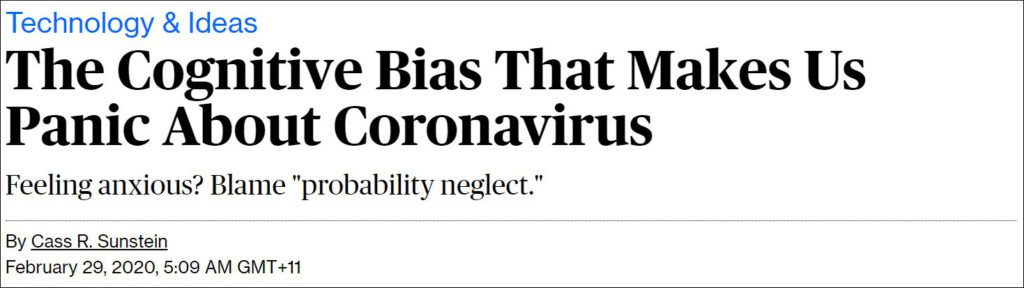
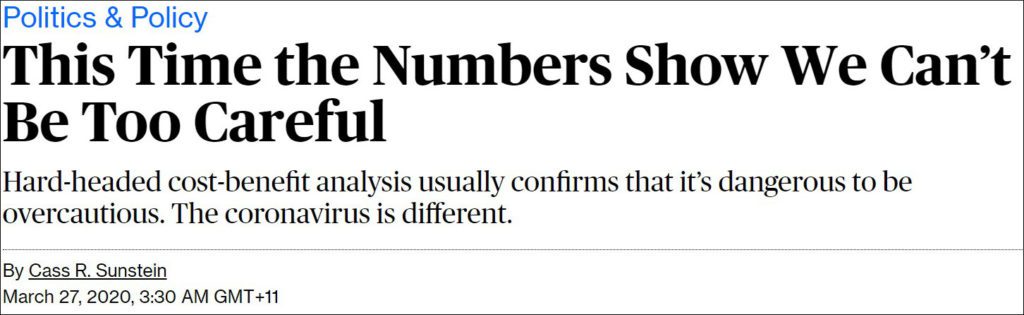
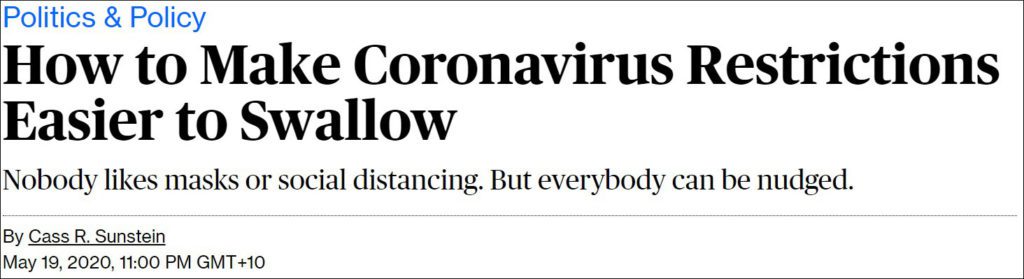
And Collins collects a series of headlines from Cass “Nudge” Sunstein which would be funny if they didn’t capture so well the idea that these people think they know what’s best for us—even if “what’s best” is changing every week month:
Collins summarizes:
As Sunstein wrote:
To address the coronavirus pandemic, it’s essential to influence human behavior; to promote social distancing, to get people to wear masks, to encourage people to stay home. Many nations have imposed mandates as well. But to enforce the mandates and to promote safer choices as the mandates wind down, people have to be nudged.
So now it’s all about trying to get people to stay home, because they, err, are underestimating the risk? . . .
As applied behavioural scientists, we need to inject some humility into our assessment of other people’s decisions. . . . We need to stop making glib assumptions about what other people want and how they can best achieve their objectives. And importantly, we need to stop being lazy storytellers who don’t subject ourselves to the same critique that we would apply to someone else.
I don’t think it’s fair to say that the advice is changing every week. The first two Sunstein articles are nearly a month apart, and the third is over 1.5 months after the second. Also, the second and third don’t really contradict each other. The first two, sure, but we also learned a lot between February and March 2020, so you can’t really blame her for changing her message based on new information (although, I think it would be fair to say that the first article shouldn’t have been so confident). But once the March headline says to be careful, the May article is just suggesting nudging as a method to encourage being careful.
Adede:
You’re right. I changed “week” to “month” above.
Speaking more generally, I think it’s fine for a pundit to change his opinion and to change the advice he offers to us. I agree with Collins that the problem is not so much that Sunstein is changing his advice but rather that, in making these changes, Sunstein isn’t acknowledging these shifts but instead is maintaining a consistent position that he knows best and that other people “have to be nudged.”
👍👍👍
Cass Sunstein is a man, not that it matters. Putting aside that nitpicky criticism that Andrew was exagerating for rhetoric effect when he said “every week”, the criticism is fair because Sunstein’s original point in February was that mere mortals don’t understand probability which is why we mortals were freaking out about an infectious disease. But, he was the one who didn’t understand that infectious diseases spread at a geometric rate not an arithmetic rate, and therefore taking extreme measures to stop the spread or “panic,” as he called it, was not some cognitive error but the correct course of action. He then writes an article that says in effect foolish mortals cost/benefit analysis usually instructs us not to be overcaustious, but not here without ever acknowledging that he is the one that got it wrong through “hard headed cost/benefit analysis.” Being honest might have lead the reader to raise the question that just maybe there is something wrong with cost/benefit analysis. Then, he is back to urging nudges to make it easier for us mortals to accept the wisdom of preventing the spread of the virus without ever considering that one of the reasons public is having trouble is because he and others told them the real danger was over reactiong to begin with. We don’t need nudges. We need truth.
Is it really fair to say that the fans in the stands were more right about hot hand than those who said it doesn’t exist? If I say the effect size is 1, you say it is 0, and the average size is actually 0.2, am I more right because I said it was non-zero, or you because you were closer to the average value? I say you.
Rick:
Sure, but nobody was saying that the hot hand effect was “1,” right? Even Red Auerbach knew that people do miss shots on occasion.
Andrew, you have a bit of habit of absolutely beating certain jokes/insults to death. I probably read 20-40% of the posts on here (I come and go in spurts), yet even as an infrequent reader I am very tired of the Stasi-Sunstein reference. And I don’t particularly like Sunstein or the Nudgelords. From what I recall he deleted the tweet and apologized, so I don’t think you need to keep beating him over the head with it unless Sunstein has repeatedly said similar things since then. To me it just comes off as petty and uncharitable; we all do and say things we regret, and one would hope these regrettable moments aren’t what others use to define us.
Matt:
1. This general issue has come up before. This blog has a diverse audience. Some people come for the examples with R code, other people are interested in political science, others read the posts on science reform. It’s kind of like the newspaper, which is full of articles on all sorts of topics. If you don’t like sports (if you’re one of those people, I think you’d use the term “sportsball”), avoid the sports section. If you don’t like posts on nudgelords, really my advice is to just not read them.
2. If you follow the link above, you’ll see that when Sunstein deleted the Stasi comment, he also said that it had “a grain of truth.” I still don’t know what that grain is. As I wrote in that post, I’m disturbed that an influential figure such as Sunstein thinks that the junk science produced Brian Wansink and other purveyors of unreplicable research are “masterpieces,” while he thinks it’s “funny” with “a grain of truth” to label careful, thoughtful analysts such as Brown, Dreber, Simonson as “Stasi.” Dude’s picking the wrong side on this one.
3. I’d hope that Sunstein regrets promoting the work of Wansink, but if so he could be constructive about it and look into how he and others screwed up on that. This is related to Collins’s point that the nudgelords just keep going full steam ahead without wrestling with where they screwed up in the past.
4. In any case, I appreciate the feedback. The only way for me to learn that my posts are annoying people is if the annoyed parties tell me.
I vote in favor of your jokes when it comes to Sunstein. He is very influential figure in American politics. We could end up wasting an enormous amount of money and time on various “nudges” he promotes in public policy. I am not against research in behaviour economics, but he is a leading voice and has shown himself to not be trustworthy. Making fun of people’s prior lapses in truthfulness is a “nudge” too. He shouldn’t object.
I thought the Stasi comment came from the Power Pose person originally, do I misremember?
Dogen:
The Stasi comment came from the nudgelord. The terrorist comment came from the advisor of the power pose person.
It seems like all I hear in the news about NYC is mandates, and now cases are an order of magnitude higher while new hospitalizations are at the highest levels seen since at least summer 2020 (data before that is murky). Yes, of course these stats are both highly flawed. They have been since the beginning.
So nothing they wanted to influence people to do worked, the method of measuring success is highly flawed anyway, and the “nudging” used to attempt achieving this influence does not work either.
It is really amazing to see the nonsense NHST has produced. They have created an entire bizarro reality for themselves.
Anoneuoid –
> So nothing they wanted to influence people to do worked,…
You look at a current high rate of cases and based on that assert those measures didn’t “work?”
Really? Did I get that right?
I also like this…
> It seems like all I hear in the news about NYC is mandates…
Reminds me of when I read someone saying..
“You just can’t talk about X anymore.”
As if they didn’t just talk about X.
I hear plenty in the news about NYC on topics other than mandates.
Why do up suppose I hear a variety of reports about NYC, and all you hear about is mandates? Do you have some kind of a” mandate-only” filter in operation?
To be fair, he said “it seems like” all he hears in the news about NYC is mandates. That phrase is commonly used to indicate that one is exaggerating.
Thanks, Phil.
Today my friend, who is not sick, wanted a ride to a testing site to get tested for work. Unfortunately, there are no tests available nearby, and the far away ones close at 4 pm.
So now healthy people are stopped from working due to no access to tests that the cdc has finally admited do not measure infection. The cdc now says a positive result only means you were infected sometime in the last 3 months.
And if you are positive, there is no specific treatment anyway. So it makes no difference.
This is the pinnacle achievement of the NHST/EBM bizzaro science.
> And if you are positive, there is no specific treatment anyway. So it makes no difference.
??
I hope you’re not telling your friend to do the exact same things regardless of testing status (or if you are, he/she knows better) ’cause that would be terrible advice.
Not to defend the improper utilization of PCR testing or the lack of availability (and use of) of the rapid antigen tests.
The terrible advice is sending people who feel sick all to the same place then also forcing healthy people to go there.
Then there is the matter of the masks concentrating the virus around the heads of people standing in line, who then step into each others clouds. Without masks, the aerosol is spewed at the ground where it belongs.
The cdc advice has essentially created an assembly line of viral infections and selection for variants.
It’s funny how the mechanics of aerosols can so easily be imagined in ways to confirm preferences.
Indoors, it seems to me that ventilation is what’s key. Outdoors, it seems to me that it much transmission takes place.
Seems likely to me that you don’t have evidence that (1) more transmissions take place becuase if testing than would happen without, especially when (2) people may be more likely to isolate if they find out they’re positive.
Counterfactuals are hard. That’s why facile assumptions about counterfactuals can lead to bad advice.
As usual, the CDC (and other EBM followers like you) assume things with no chance of happening as default. Eg, herd immunity.
Then assume things that have happened over and over will not happen again. Eg, forcing people to go where sick people gather will spread disease, seasonality, etc.
That is why its bizarro science instead of just pseudoscience.
First, apologies to Raghu.. .but hopefully his scroll wheel is in fine working order…
Anoneuoid –
> As usual, the CDC (and other EBM followers like you) assume things with no chance of happening as default. Eg, herd immunity.
What does that even mean? In what way am I a “follower” of EBM? And you have zero evidence of any “assumptions” that I’ve made about “herd immunity.” None.
> Then assume things that have happened over and over will not happen again. Eg, forcing people to go where sick people gather will spread disease, seasonality, etc.
Again, that’s mistaken. Of course I make zero assumption that if people gather there won’t be transmissions. I’ve indicated that directly above. My point, again, was that counterfactuals are hard. If a lot of people aren’t gathering to be tested, what are they doing instead and how many infections will result from other other activities?
That’s a complicated answer, and mixed in to that answer is that many who might have tested positive would not isolate if they don’t test positive.
Countefactuals are hard. I get that you think facile assumptions about counterfactuals can prove your theories correct. I’m skeptical.
Despite your assertions otherwise, no one is “ignoring” seasonality. And you have failed, imo, to provide compelling evidence that seasonality explains as much as you claim
Contrary-wise, I’ve seen other evidence I think is somewhat compelling that while seasonality is certainly a factor, it merely goes into the mix along with a lot of other factors.