My colleague and I wrote a paper, and someone suggested we submit it to the journal Nature Communications. Sounds fine, right? But then we noticed this:
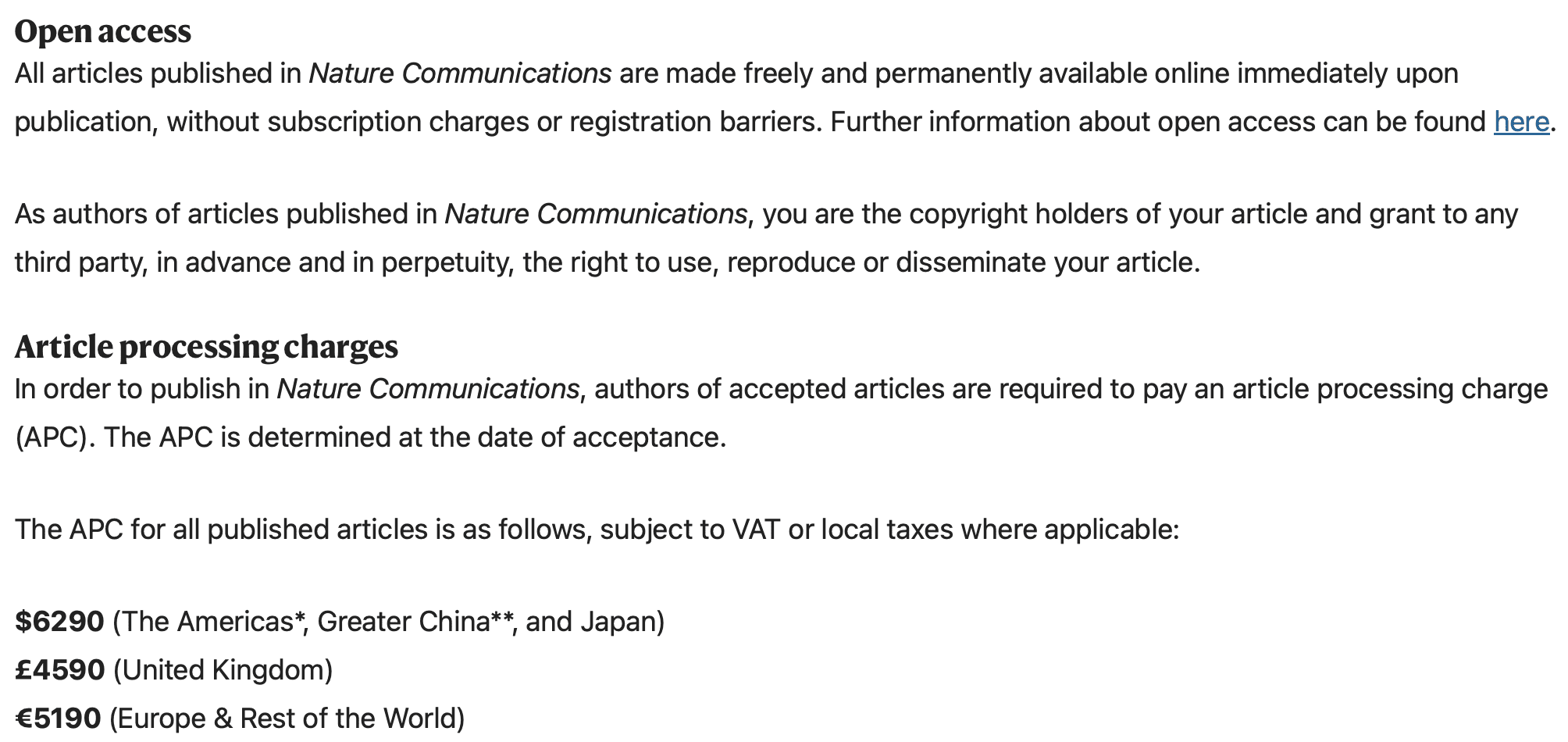
Hey! We wrote the damn article, right? They should be paying us to publish it, not the other way around. Ok, processing fees yeah yeah, but $6290??? How much labor could it possibly take to publish one article? This makes no damn sense at all. I guess part of that $6290 goes to paying for that stupid website where they try to con you into paying several thousand dollars to put an article on their website that you can put on Arxiv for free.
Ok, then the question arises: What else could we get for that $6290? A trawl through the blog archive gives some possibilities:
– 37% of an invitation to a conference featuring Grover Norquist, Gray Davis, and a rabbi
– 1/160th of the naming rights for a sleep center at the University of California
– 4735 Jamaican beef patties
I guess that, among all these options, the Nature Communications publication would do the least damage to my heart. Still, I couldn’t quite bring myself to commit to forking over $6290. So we’re sending the paper elsewhere.
At this point I’m still torn between the other three options. 4735 Jamaican beef patties sounds good, but 1/160th of a sleep center named just for me, that would be pretty cool. And 37% of a chance to meet Grover Norquist, Gray Davis, and a rabbi . . . that’s gotta be the most fun since Henry Kissinger’s 100th birthday party. (Unfortunately I was out of town for that one, but I made good use of my invite: I forwarded it to Kissinger superfan Cass Sunstein, and it seems he had a good time, so nothing was wasted.) So don’t worry, that $6290 will go to a good cause, one way or another.
Tickets to tonight’s World Series Game are $500 on StubHub. Four tickets, business class flights to Dallas, hotel, dinner would be my way of spending $6290.
Oncodoc,
Maybe you could get it down to $6280 and then you could throw in a couple of Jamaican beef patties.
Beef patties all the way.
4735 should be enough for breakfast, lunch, AND dinner. Maybe even some leftovers.
Joshua,
I hope enough $ left over to pay for the necessary coronary artery surgery too.
Reading about Andrew’s changing relationship with beef patties over the years always makes me wanna hop in my car, head to the Jamaican grocery, and grab like 10 patties, a jar of that Matouk’s West Indian Hot Sauce, and maybe one of those giant island avocados and then sadly eat them while I contemplate a future in which I cannot eat them.
Which is to say, it feels a little like dying.
On the other hand, I’d rather die than pay $6290 to have a paper published, so at least this post didn’t precipitate a career-based existential crisis. Just a pattie-based one.
Jrc:
I’ve been making a delicious Cincinnati-style chili using black lentils instead of ground beef. And chana masala whenever I want. Kale salad. Etc. Your culinary future is just fine.
Open access articles are always insanely expensive. I guess they’re charging under the assumption that more access -> more reads -> more citations/news/etc. And they suspect that institutions will pay the hefty price tag instead of the authors personally. Even so, the price tag is beyond exorbitant and is just another argument about why traditional publishers can’t go away quickly enough.
Yes, they’re insanely expensive, but it’s in general the same insane expense as subscription journals. For the latter, the cost is hidden (paid for by university libraries, and therefore by grant overheads / undergrad tuition / etc.), but with open access the ridiculous costs are more transparent.
You should think it over more carefully, Andrew. If you publish in their journal you could end up with more citations and as you know a citation is worth $100,000 each. This is easily a bargain!
Erm,well, … :
=============
The APC for all published articles is as follows, subject to VAT or local taxes where applicable:
$6490 (The Americas*, Greater China**, and Japan)
£4790 (United Kingdom)
€5390 (Europe & Rest of the World)
…
* The Americas = USA, Canada, Central America and South America
** Greater China = Mainland China, Hong Kong, Taiwan and Macau
==============
To quote a contemporary: ” Take that, economists!”
It’s even worse than just the amount of money. While some Pay_to_Publish (more accurate than Open Access) journals were started with the best of intentions, the incentive structure is intrinsically perverse (see https://uva.theopenscholar.com/manuel-lerdau/publications/challenge-open-access-incentives) with a link to a paper that explores the incentive issue).
Quote from above: “So don’t worry, that $6290 will go to a good cause, one way or another.”
I have wondered for years now what could happen when a few scientists with certain characteristics (e.g. tenured, well-respected) would stop sending in papers to journals and merely publish their papers on an online platform.
And no, publishing your paper on an online platform and also still sending in your paper to a typical journal might not really solve anything concerning the many problematic issues of scientific publishing.
And no, coming up with some new scheme to somehow incorporate “pre-publication” peer-review on an online platform before papers are subsequently published in a typical journal might not really solve anything either. On top of that, these new schemes could lead to a whole new set of problematic issues (e.g. I’ll give your paper a “thumbs up” if you give mine a “thumbs up”. Also, what are we like 12 and on facebook with all that “thumbs up” BS).
Maybe it would be useful to possibly think about spending the 6290 dollars on an online publishing platform that is meant as a final destination for the papers in your field in a way that leaves out the journal system and publishers that ask for 6290 dollars to publish a paper.
Quote from above: “Maybe it would be useful to possibly think about spending the 6290 dollars on an online publishing platform that is meant as a final destination for the papers in your field in a way that leaves out the journal system and publishers that ask for 6290 dollars to publish a paper.”
I think “Researchers.One” has something like this in mind with their approach. I don’t know about Arxiv, and whether papers published on Arxiv eventually get published in a typical journal.
Way back in 2001, the machine learning community decided that journal subscription fees should be a thing of the past. The editorial board of the top journal resigned on mass, and setup the Journal of Machine Learning Research, with no submission fees, no publication fees, and no profit going to anyone. It’s now one of the top ML journals.
https://www.jmlr.org/statement.html
Robin:
Yes, this came up in the comment thread here. In statistics, we have the similarly-open journal Bayesian Analysis. I don’t know why other fields don’t do this.
The Institute of Mathematical Statistics (IMS) journals are split. Bayesian Analysis will let you publish open access for free, but suggest donating a $625 publication fee. Other IMS journals like Statistical Science have a $1100 publication open-access fee. See https://imstat.org/shop/publication-charge-funding-form/
I declined the invitation to write a Statistical Science overview of Bayesian statistical computing because it’s not free open access.
Here’s what I do and suggest everyone else does: refuse to review for pay-to-publish journals. They can’t publish without reviewers. The only time I ever submit to these journals is when my co-authors insist. For example, the “top” journals in stats (as judged by tenure and promotion and hiring committees) are not free and open access. Here’s JASA’s upsell, “Articles published Open Select with Taylor & Francis typically receive 95% more citations* and over 7 times as many downloads** compared to those that are not published Open Select.” see: https://www.tandfonline.com/action/authorSubmission?show=instructions&journalCode=uasa20#oa
Bob:
Your insistence on that point has been helpful. Sometimes when talking with colleagues about where to submit a paper, I’ll say: No, we can’t submit to that journal because then Bob won’t be able to join us as a coauthor.
Relatedly, the reason why Aki and I made BDA3 freely available to all on our website is because our in-progress Bayesian Workflow book has an appendix on how to read BDA3, and you objected to having the workflow book have a dependency on something that was not freely available. So you have made a difference with your principled stance.
Wow. Cass Sunstein praising a Niall Ferguson book about Henry Kissinger on X. I don’t know how that magnificent confluence didn’t create some kind of black hole.
Grover Norquist, Gray Davis, and a rabbi receive an invitation to a conference — the rabbi declines, replying “Nu, alone?”
This is the sound of one hand golf clapping.
Nkh,
Yeah, the only thing that would top it would be Sunstein writing a book about a topic he knows nothing about and then declaring, “we think we’ve discovered a new continent.” Oh wait, that already happened!
Sunstein is a bigtime Democrat, so I’m guessing that he thinks that being buds with Ferguson and Kissinger gives him some bipartisan credibility.
Nature Communications is a bargain compared to Nature Ecology and Evolution. Despite perceptions, evolutionary biologists are not exactly flush with funds. https://www.nature.com/natecolevol/submission-guidelines/publishing-options
2 – Gold Open Access – same publishing process as above. The difference is that when an
article is accepted for publication, the author/s or funder/s pay an Article Processing Charge
(APC). The final version of the published article is then free to read for everyone. The APC to
publish Gold Open Access in Nature Ecology & Evolution is €9,750 / $11,690 / £8,490.
Coincidentally, our microbial ecology journal club was discussing a Nature Communications paper yesterday. The $6290 certainly doesn’t get you an editor who pays attention to figures. Try this one, https://www.nature.com/articles/s41467-021-26101-5/figures/2 , and see if you can match the features to the caption, “…Data for each donor strain are represented as boxplots where the middle line is the median, the lower and upper hinges correspond to the 25th and 75th percentiles, and the whiskers extend from the minimum to maximum values…” . Extra credit: What X does log(X) = 0 on the y-axis correspond to?
There are some good things in the paper, but it’s overall rather excruciating.
Raghu:
As an author of many hundreds of published papers, I think it’s fair to say that the role of the editor is to accept the paper, certainly not to check the figures.
You may be right that checking the figures isn’t an editor’s job. I was (unclearly) suggesting that perhaps some such checking would be a perk of the $6k price. They could at least give you a Nature Communications tote bag.
But is it the editor’s job? For Nature Communications, I’m not sure. For some society journals I know of the editors are unpaid. It’s a sizeable amount of work, and I certainly wouldn’t expect the editors to scrutinize figures. I don’t know if the Nature family journal editors are paid or not — they certainly have (paid) editors, but I don’t know if they are “hands on” with submissions or if they do some sort of higher-level things and leave the grunt work to others.
I’ve only been a guest editor / editor for specific manuscripts. I certainly wasn’t paid, but I did read the articles and tried to balance reviewer comments. Finding reviewers is challenging.
Checking the figures certainly is part of the review process; the task is divided between the reviewers and the editors. As a reviewer, scrutinizing the figures is part of the (unpaid) job. As an editor, I at least looked over the figures, and, for submissions that aligned closely with my expertise, gave them as careful a review as would a reviewer. As an author, I have had editors make comments on figures.
In my experience, which is largely with society journals, a submission gets two ad hoc reviews, plus an editorial review of varying intensity– something approaching up to about 2.5 reviews. The figures are certainly part of this.
Editors of Nature journals are paid, unlike most other journals. They also have a whole hierarchy of staffers. Their web site’s editorial process says, “After acceptance: Your accepted manuscript is prepared for publication by copy editors (also called subeditors), who refine it so that the text and figures are readable and clear to those outside the immediate field; choose keywords to maximize visibility in online searches as well as suitable for indexing services; and ensure that the manuscripts conform to house style. The copy editors are happy to give advice to authors whose native language is not English, and will edit those papers with special care.”
Bob:
Look at that quote carefully: “copy editors . . . who refine it so that the text and figures are readable and clear to those outside the immediate field . . .”
What that means is that they’ll do things like check that fonts are consistent and that color shading renders well and that your sentences don’t have comma splices or whatever. They’re not gonna check things like, “what X does log(X) = 0 on the y-axis correspond to.”
The whole ecosystem has become insane. More “prestigious” platforms get a higher rate of free reviewer / discounted assoc editor contributions, which means that you as an author are likely to get better and more timely review. The journal charges more, makes no contributions, and pockets the difference. Some of them have realized that it’s “other people’s money” for corporate scientists, who pay the outrageous fee. At the other end of the spectrum, Frontiers and similar are happy to provide meaningless nominal review, rejecting next to nothing with short timelines, for a much smaller fee. In the middle, journals trying to provide actual review struggle to get timely and effective review.
Ryan:
Oh, I didn’t know that Frontiers publishes nearly everything. I should publish something there, as a step toward my goal in publishing in 200 different journals. Hmm, let me go to the webpage . . . here’s Frontiers in Applied Mathematics and Statistics, that seems like the best fit for me . . . publication fees are $1,285 / $780 / $490 / Free. That last category (“Free”) is for Corrections and Editorials. It could be tough to publish an Editorial given that I’m not on the editorial board, but maybe I could publish a Correction? What I have to do is find a paper already published in that journal that has an error and then I can run a correction. OK, the journal has several sections, and one of them is the Statistics and Probability section. They have a webpage with recent articles . . . Most of these are pretty theoretical and I doubt I’ll find an error, but Hey! Here’s one, “The value of being the decisive voter: Exploratory evidence from a hedonic model.” Let’s click through and read . . . Yup, I found an error! They say the probability of a decisive vote 3/(2*sqrt(2*pi*(n-1))), where n is the number of voters. That’s ridiculous, way too high. But the paper as a whole is terrible. Actually, it’s so bad, nobody will read it, I can’t bring myself to go to the trouble of writing a correction for the journal.
OK, I get the point. The evidence seems consistent with your statement that this journal will publish just about anything. I had no idea!
Andrew: If it’s all the same to you, I’d rather take the money instead. Direct deposit is easiest but I’m fine with a credit card number or personal check. John
Interesting that this came up. I just submitted an article to another open access journal that charges about $2500 for publication. I guess that’s a deal, right?
Since I don’t have institutional support, I was thinking of a Go Fund Me campaign if the article is accepted. Maybe I could offer everyone who contributes a beef patty.
Unfortunately, it will take a journal like the one I submitted to for my article to get exposure. I couldn’t see any alternative, unless I opt for a paywall, and then I’ll price out some of the audience I’m trying to reach. There needs to be a better system.
Quote from above: “Unfortunately, it will take a journal like the one I submitted to for my article to get exposure. ”
When I wanted to publish my 1st paper in an official journal I didn’t care where it would be published, just that it would be published somewhere so it could be found by others. That’s a perspective and attitude that now fits well with me merely “publishing” manuscripts on SSRN.
Perhaps you’ll never know what’s the thing that might give your paper exposure, or when that’s gonna happen. Maybe there are lots of things that have to sort of align for that to happen, and maybe many of these things are out of your control.
Maybe you publishing your paper for 2500 dollar in an open access journal of your 1st choice might lead to having a certain reviewer making certain comments which you then listen to but in 10 years time might regret. Who knows. Or maybe you simply refusing to pay 2500 dollar and looking for an alternative might lead to being happy about that all in 10 years time because you stuck to what you thought might be important. Who knows.
Maybe you publishing your paper in some obscure journal or merely publishing it as a preprint might lead to a different kind of scientist or audience that finds and reads your paper. Maybe that might be a good thing in your case. Who knows.
“Unfortunately, it will take a journal like the one I submitted to for my article to get exposure.”
Imagine what it would be like to have a publishable idea with minimal academic credentials and a position in industry rather than academia. When we (I was second author but it was my idea) attempted to get published, every journal had at least one requirement that was impossible for us, like naming our peer reviewers when we knew nobody in the field. My theory – based upon first principles – was that failure rate decay during factory testing could be modeled as rate = ae(exp)-bt, where “a” is a dimensionless but stable constant, “e” is of course the natural log, “b” is a fluctuating number that basically tells you how good your testing system is, “t” is time, and test strength is normalized using established methods. It worked splendidly with both real and simulated data. Never saw the light of day. I’m long retired now but I am still frustrated!
Peter:
You write, “it will take a journal like the one I submitted to for my article to get exposure.” You could send it to me and I could post it on the blog and it would get exposure! Maybe not to the right people, though.
Thanks! But it’s not statistics-related — actually a super simple model of how you can translate the stock constraint of a remaining carbon budget into a flow constraint of annual carbon emissions without a horizon problem and with extensions for stuff like carbon removal. It’s an alternative to the net zero framing, so the goal is to get it out to climate policy people, maybe not the core readership of this blog. But if you want to branch out….
This whole for-profit peer review system is clearly a mess. As Ryan pointed out, we have the $2k range fees that will buy you open access and not mess too much with critical peer review and we have prestigious open access from “Nature” and “Science” in the $6k++ range.
Andrew — if I may try and put you on the spot, you, as a well known research, don’t really need to play the game anymore if you don’t want to. Are there radical alternatives that you’ve considered? Is there any universe where a cabal of Ivy’s or the UC system or some other big player try to create a truly non-profit journal consortium?
Chris,
A few years ago, statistics professor Harry Crane started up a new peer review and publication platform called Researchers One. It still seems to exist, so maybe this is close to what you’re looking for?
About twenty years before that, a colleague of mine started up a new system of journals with reviewing based on some economic/social principles where if you submit a paper to the journal and it gets reviewed, that you then have the obligation to review some papers yourself. The journals were completely open access. Unfortunately, these journals didn’t really catch on. Or maybe they did catch on, as they were bought by a for-profit publishing company and all became closed-access. After all that effort on his part . . . what a waste!
We discussed the above two stories in a post from a few years ago.
The most successful open-access journal I know of is the Journal of Machine Learning Research. It’s all free, and I think it’s one of the most respected journals in the field. The journal Bayesian Analysis is also free and open-access and respected, if a bit lower-profile than JMLR. So this can be done.
Thank you. Researchers One does look interesting, although at a glance it doesn’t seem to have done well to inspire a movement around it (which is obviously hard). I appreciate the mention here (and above) to JMLR. The path those editors walked to establishing a researcher-driven journal is impressive and a compelling model, in my opinion.
“we have prestigious open access from “Nature” and “Science” in the $6k++ range.”
You might want to check the Science number: Science _claims_ that they’re a non-profit while all the other major rags are parts of big companies. They also claim that profits on papers go to good things they do as opposed to corporate profits, so maybe it’s no cheaper. (I don’t have an axe to grind here other than that I like Science’s science reporting. YMMV as they say.)
See: https://www.science.org/doi/10.1126/science.adk9900
Academics, please just stop.
Just 2 of the beneficial owners of Springer Nature, personally, are able to fund publishing 476,948 + 4,769,475 papers at $6,290.
(a crude assessment yet numunaire correct). Apologies in advance for my rash but real comment.
“How much do the researchers get paid for that?
– Nothing.
“Do they get a discount on access to paywalls?
– Nope.
“Not even a happy meal voucher?
– It is always done for free by the researcher”
~ Director of Research at Cure Parkinson’s
EDITORIAL: Paywalls
Nov 27, 2020
(link at end. Worth your time academics)
The DEAL is “framed” by Science except for the BUT; “but it doesn’t allow authors to publish open access in Nature or its sister journals.”
“More than 700 German research institutions strike open-access deal with Springer Nature
“Agreement will make thousands of German-authored papers available free worldwide every year
…
“The agreement is the largest national open-access deal to date, but it doesn’t allow authors to publish open access in Nature or its sister journals.”
…
“… corresponding authors at a Project DEAL member institution can publish open-access papers in roughly 1900 Springer Nature journals for €2750 per paper.
…
” However, he notes the agreement’s €2750 fee is higher than those in an earlier deal Springer Nature struck in the Netherlands. “The big risk is that this price will become the norm. … So, we are still far away from a market situation where publishers offer a service for a competitive price.”
…
https://www.science.org/content/article/more-700-german-research-institutions-strike-open-access-deal-springer-nature
[See what California Uni did in “EDITORIAL: Paywalls” below )
Andrew, by using “or 4735 Jamaican beef patties” you show academics are the dogs bodies being wagged by private equity tails. Switch back to your heads and you may wag the tail again.
Who owns Springer Nature?
Holtzbrinck Publishing Group (53%) BC Partners (47%)
Stefan von Holtzbrinck is able to pay for 476,948 papers to be published for you. And he only has control if 53% of Springer Nature. Nature [insert journal name] is owned by? – you don’t really know do you.
BC Partners (47%) …”Svider’s investors are sitting on a $30 billion windfall.” (Forbes) That dead meat windfall may pay for the publication of 4,769,475 paper. Any guess as the the pet mear industry externalities we all bear?
“We generally look for a 30% ROI, which is about 3x in 4-5 year per iod” … “similar to other historically higher performing VC funds.”
300,000 papers published annually.
Blue sky – 300,000 papers x $6,290 =
$1,887,000,000.
What percentage of papers are paid to publish? Do you know? Where do I find such a figure?
Springer Nature
– Type – Privately held
– Headquarters [as tax minimization]
London (global)
Berlin (corporate)
New York City (sales)
– Revenue US$ 2.1 billion (2022)
– Owners
Holtzbrinck Publishing Group (53%) BC Partners (47%)
– Number of employees
10,000 (2019)
Wikipedia
The people you need to budget against are Stefan von Holtzbrinck.
Net Worth $3Bn (Forbes) / $6,290 = 476,948 papers published.
Or BC Partners – “Svider’s investors are sitting on a $30 billion windfall.”
“Holtzbrinck Publishing Group [53%]
“Holtzbrinck Publishing Group is a family-owned German holding company with interests in research publishing (Springer Nature), educational content (Macmillan Learning), consumer books (Macmillan Publishers) and technology (Digital Science, HV Holtzbrinck Ventures). Subsidiaries include ZEIT Group, Nature Publishing Group, Palgrave, Scientific American, St. Martin’s Press, Farrar Straus and Giroux, Henry Holt, S. Fischer Verlage, Rowohlt Verlag, Holtzbrinck Ventures and other fund activities (GSV, Founders Factory,
● Rethink Education ●).
It has ownership and stakes in start-ups under Digital Science (Dimensions, Overleaf, figshare, Altmetric, Gigantum, überResearch), Macmillan Learning (iClicker, intellus Learning, Achieve), Holtzbrinck Digital (Amboss, pflege.de, lecturio) and the ZEIT Group (Zeit Online, ze.tt).
https://www.weforum.org/organizations/holtzbrinck-publishing-group
53% of Springer Nature;
“Holtzbrinck Publishing Group
“In 2015, it merged most of its Macmillan Science and Education unit (including Nature Publishing Group) with Springer Science+Business Media, creating the company Springer Nature. Holtzbrinck owns 53% of the combined company.[2][3]”
“Stefan von Holtzbrinck
$3B
Real Time Net Worth
as of 10/28/23
#946 in the world today
“About Stefan von Holtzbrinck
Stefan von Holtzbrinck, his brother Dieter and sister Monika Schoeller inherited Holtzbrinck Publishing Group from their father, Georg. [Don’t ask about zee var!] Originally founded as a book club in 1948, Holtzbrinck’s businesses include
– Macmillan Publishers,
– S. Fischer Verlag and
Holtzbrinck Digital.
In 2006, Dieter sold his shares to his siblings, leaving each of them with 50% of the company. Monika died in 2019. Holtzbrinck Ventures (now HV Capital) was founded in 2000 as an investment arm of the publishing business and became independent in 2010. HV has invested in many internet and e-commerce startups including Zalando, Groupon, HelloFresh and Rocket Internet.
Forbes Lists
#852 Billionaires (2023)
“Stefan, who serves as CEO of Holtzbrinck Publishing Group, is a lawyer by trade.
Prior to joining his father’s company, he apprenticed at Bloomsbury Publishing in London.
https://www.forbes.com/profile/stefan-von-holtzbrinck/
47% of Springer Nature
BC Partners. Here is ONE partner;
Raymond Svider
“All told, Svider’s investors are sitting on a $30 billion windfall.”
https://www.forbes.com/sites/antoinegara/2021/09/27/the-30-billion-kitty-meet-the-investor-who-made-a-fortune-on-pet-food/
● Just one of the private equity investments academics trickke up content funds:
Rethink Capital Partners
[Partners is code for – it’s mine, not the taxmans’]
“Our Difference
“We believe that lasting change must be driven by market-based solutions.
…
“Who We Are
“We believe that driving change and generating alpha go hand-in-hand. We have built and continue to grow an extensive network of like-minded partners on this journey.”
“We generally look for a 30% ROI, which is about 3x in 4-5 year per iod, but realistically we know that our results will be spread over a range of results, and we have 10x returns as often as we have 1x returns. Overall we would like for the fund itself to end up with competitive benchmark returns similar to other historically higher performing VC funds.”
Rick Segal (Rethink Capital Partners)
https://unicorn-nest.com/media/interviews/interview-rick-segal-rethink-capital-partners-we-favor-technology-saas-companies-because-we-want-the-impact-that-we-make-to-be-scalable/
EDITORIAL: Paywalls
Director of Research at Cure Parkinson’s
Nov 27, 2020
…
“What happens if people don’t pay the paywall fee?
This has recently been happening.
“There are approximately 28,000 scientists working for the University of California across 10 different campuses. They generate 10 percent of all the academic research papers published in the United States (source).
“But on the 10th July, 2019 all of those researchers lost direct access to a large chunk of the world’s published research, because the University decided to drop its $11 million annual subscription to Elsevier – the world’s largest publisher of academic journals (Source). Elsevier owns approximately 3,000 academic journals, and accounting for ~18% of all the world’s research output (Source).
“They were charging the University of California $11 million per year to access the research that they were taking part in producing.
“Stop and think about the stupidity of that situation for a second. The university needs to find money every year to do research and then it needs to find more money to access the product of that research (?!?).
“Germany, Sweden, Hungary & Norway also cancelled their subscription contracts with Elsevier after prolonged negotiations failed to find common ground (Source).
“But how do researchers in these countries access the research if they can’t get inside the paywall?
“It’s a bit cumbersome, but they simply email the researcher who published the research and ask for a reprint (or PDF) – which has always been the tradition.
…
“How much do the researchers get paid for that?
Nothing.
“Do they get a discount on access to paywalls?
Nope.
“Not even a happy meal voucher?
“It is always done for free by the researcher”
…
https://scienceofparkinsons.com/2020/11/27/paywalls/
My apologies if this is a bit back if the envelope and gauche for pure researchers. Simeine needs to follow the money
Q: What are Columbia Uni’s deals with Springer Nature, Elsiver, Wiley etc?
A suggestion. The ActivityPub fediverse (Mastodon, WordPress plugins, Friendica, Pixelfed etc etc) have a clear system whereby an “action” can be published to people who care about that action. I’m not in detail familiar with how it works, but it’d be surprising to me if it weren’t the case that someone with some knowledge could create an activitypub federated website system where you could publish your work by simply posting a PDF to your own site… people who follow you would be immediately notified of the publication. Relays similar to Mastodon relays could broadcast it more widely to people who choose to follow that relay (ie. maybe there are relays on certain topics). Then you have your little raspberry pi in your office that runs continuously and just sucks down the stuff you’re subscribed to onto a 1TB SSD. Also some universities or nonprofits could fund archival versions, that suck down whatever’s published and just burn it to their redundant storage array for posterity.
My guess is that for $200k all of this could be written in a reasonable way and released as free software to be maintained by a collaborative group. That’s the cost of publishing 33 articles on Nature Communications.
Then every day you just log into your “science archive” and see what’s newly published in the last few days, or search by keyword for stuff your server has seen at any time in its history (that you’re willing to store). And if you need to search for something more widely you log into your university library or the internet archive and search by keyword/date/etc
I proposed this kind of thing already about a decade ago but the actual social infrastructure is in place now.
Unfortunately, its almost 1.8 million for me in Pakistani rupees. Also, being from Pakistan, always felt the bias from editors in acceptance of our papers.
You are buying something with these charges in addition to having your paper published – prestige essentially.
That’s apparent from a brief list of Nature journals with their “article processing” charges and impact factors:
…………………………………………. IF ……………… APC
Nature ………………………………. 64.8 ………….. $11690
Nature Communications ……… 16.6 ………….. $6490
Nature Communications Biol …. 5.9 ………….. $3690
Scientific Reports …………………. 4.6 ………….. $2490
Nature and Nature Communications largely publish research funded by research council/government/charities and these will cover publishing costs fully or in part. And it’s certainly “worth” getting a paper published in Nature for the kudos and career stimulus. In general your paper is likely to do well in terms of citations, and despite the lazy perceptions to the contrary, papers in Nature are generally high up in the scale of influence/representation of significant advance etc. That’s at least partly due to the fact that papers are more likely to be from well-funded groups that can afford to do the very costly research usually (not always) associated with making significant advances (I’m speaking from a biol/biol med/mol biol perspective). That’s not to say that “cheap” studies can’t find astounding outcomes that could be published in Nature, but you still have to find that $11690!
Not saying that’s an unalloyed good but that’s the business. After all shoppers buy branded stuff (baked beans) in preference to the own-brand, essentially identical equivalent, and in similar vein they’re buying something that is over and above the contents of the tin*. If you haven’t got (much) funding you’re more likely to publish in Scientific Reports (perfectly good journal), and in my experience if you publish a good paper there (or in other decent but cheaper journals) it’s likely to get the credit it deserves in terms of influence/citations etc.
* The analogy isn’t exact since no one is vetting your credentials/”quality” of your appearance (say) in allowing you to spend your money on their branded product!
Elsevier’s Journal of Memory and Language charges some 3000+ Euros for publishing an article open access.
I pay it every time because my students and postdocs will be evaluated based on where they published,
not what they actually did. So basically I’m paying for the branding privilege. As we have seen in Andrew’s blog,
peer review per se is often not what it’s cut out to be. One good thing with the JML model is that at least I can reuse
parts of the text in an article (with attribution) without having to pay Elsevier (works also for Wiley articles).
Fun fact though: American Psychological Association journal articles have no open access option. Result: I don’t actually have access to my own APA papers, they are behind paywalls and they own the copyright to my papers. I also get a warning message from them every time I publish there to not post the published article online (not that I have a copy). I only publish there because my co-authors need the branding that comes with APA articles, for getting jobs and promotions and funding.
Overall, I see it as buying branding for my students and postdocs to satisfy scientometric driven evaluators of science. We saw how well that metrics- (funding-) based evaluation process played out with the recent nobel prize winner Katalin Karikó.
$6290? For what? Peer review from unpaid peers? Brand?
Two things:
1. Thinking about it, with LLMs, the source of the message and hence also the brand may matter even more in the future.
2. The details and transparency reports from national library associations are still somewhat vague. How much exactly of tax payers’ money is going into these fees throughout the world?
Academics. Any good?
“Open-access reformers launch next bold publishing plan
“The group behind Plan S has already accelerated the open-access movement. Now it is proposing a more radical revolution for science publishing.
https://www.nature.com/articles/d41586-023-03342-6