Happy pride !
One way I celebrated was by reading Lax & Phillips 2009, Gay Rights in the States: Public Opinion and Policy Responsiveness. It’s on-theme, an example in the MrPlew paper (which I also still need to digest), and I wanted examples of using MRP in later analyses.

Lax & Phillips 2009 studied the relationship between state-level public opinion and state adoption of policies affecting gays and lesbians. Andrew blogged about this work in Nov 2008, Jan 2009, and June 2009 when he wrote:
Fancy statistical analysis can indeed lead to better understanding. Jeff Lax and Justin Phillips used the method of multilevel regression and poststratification (“Mister P”…
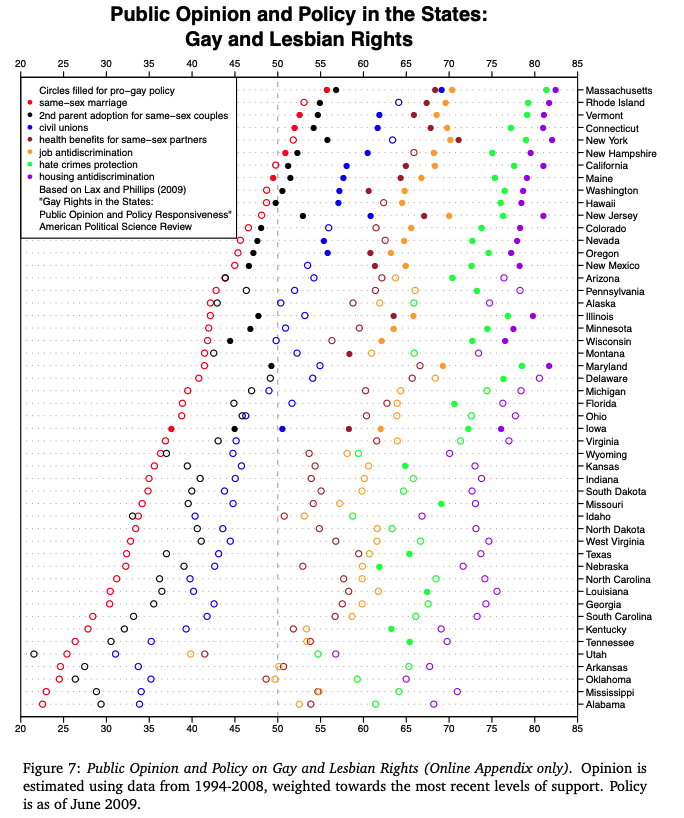
The paper’s appendix includes a NYT article and an almost-rainbow-colored plot:
Lax & Phillips 2009 used MRP to estimate state-level public opinion E(y | s). Let
- y_i = 1 if person i supports laws to protect against discrimination in job opportunities (for example), = 0 otherwise
- s[i] = state where person i lives, e.g. NY
- L_s = 1 if state s has laws to protect against discrimination in job opportunities, = 0 otherwise
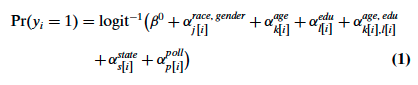
Their Multilevel Regression (“MR” of MRP) model had race, gender, age, education, state, and poll effects:
They modeled the state effect with state-level predictors (% religious conservatives, % Democratic voters in 2004):

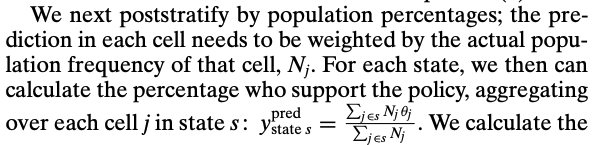
Then they Poststratified (“P” of MRP) to the population:
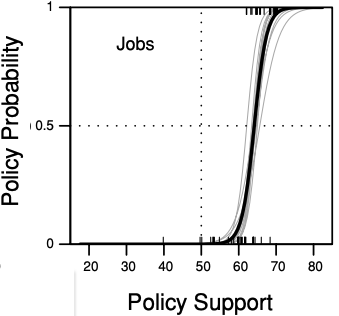
Then they used the MRP estimate of public opinion as a predictor of whether the state adopts the policy:
Pr(L_s = 1) = logit^-1(a + b * y_s^pred)
From their Figure 1:
Questions:
- (How) did Lax & Phillips 2009 incorporate uncertainty in the MRP estimate of public opinion y_s^pred in their later analysis of its effect on policy adoption L_s ?
Footnote 7 says they incorporated uncertainty for non-MRP estimates:if we use an opinion index based on disaggregation instead of MRP estimates, correcting for reliability using an error-in-variables approach (eivreg in Stata)…
- Are results sensitive to whether policy adoption L_s is a state-level predictor in the MRP model ?